timer 40% Price Increase Coming Soon, Lock In Your Rate Today arrow_forward
Blog Login Start Free Trial

Forex Leverage Calculator

Solve any one of leverage, margin, or maximum position size from the other two, and see the effective leverage that actually measures your risk.

Leverage
Solve for
USD
lots
USD
1:100
linear_scale account leverage
leverage on this position
Notional value $108,500
Effective leverage 10.9x
Margin used $1,085.00
Max position at
1:30 2.76 lots
1:100 9.22 lots
1:500 46.08 lots
indicative price Runs in your browser

Educational tool, not financial advice. Results depend on your broker's contract specs and pricing. Runs in your browser. Nothing you enter is stored. Leverage limits vary by regulator and broker. Confirm your account's limits before trading.

Embed This Calculator

Add the Leverage Calculator to your website or blog. Copy the code below and paste it wherever you want the calculator to appear, it auto-adjusts to fit any container. Please keep the attribution line intact.

help_outline How to use this calculator

  1. 1Choose what to solve for: leverage, margin, or maximum position.
  2. 2Pick your instrument and account currency.
  3. 3Enter your equity and the two known values for your chosen mode.
  4. 4Read the solved value plus your effective leverage.
  5. 5Use the 1:30 / 1:100 / 1:500 presets to compare leverage tiers.

The Leverage Formula (with a Worked Example)


                Account leverage = notional value / margin
Maximum position = equity x leverage / (contract size x price)
Effective leverage = total notional / equity
              

Worked example: one standard lot of EURUSD at 1.0850 is 108,500 of notional. Held on 1,085 of margin, that is 108,500 / 1,085 = 1:100 account leverage. On a 10,000 account, the effective leverage is 108,500 / 10,000, roughly 11x, the number that actually reflects your risk.

Margin and Max Size by Leverage (EUR/USD)

LeverageMargin for 1 lotMax lots on $5,000
1:30 (ESMA retail cap)$3,616.671.38 lots
1:100$1,085.004.61 lots
1:200$542.509.22 lots
1:500$217.0023.04 lots

Account Leverage vs Effective Leverage

Account leverage is a ceiling: 1:100 means you are allowed to control up to a hundred times your margin. Effective leverage is what you are actually doing: your open notional divided by your equity. You can hold a 1:500 account and run at 3x effective leverage, or hold a 1:30 account and still run at 25x by opening a large position. The account number is a limit, the effective number is the risk.

This is the honest core of the tool. A trader who fixates on "low leverage keeps me safe" but opens oversized positions is running high effective leverage regardless of the account setting. Watch the effective figure the calculator shows, and keep it modest. That, not the broker leverage tier, is what survives a bad run.

Leverage Caps by Regulator

Regulated brokers cap leverage to protect retail traders from themselves. Under ESMA rules in the European Union, retail forex leverage is limited to 1:30 on major pairs and less on volatile instruments. The United States caps major-pair leverage at 1:50 through the NFA. Offshore brokers commonly offer 1:500 or higher.

Higher leverage lowers the margin each position ties up, which is why offshore accounts feel roomy, but it changes nothing about the risk of any single trade. The presets in this calculator let you see exactly how the margin and the maximum size shift between 1:30 and 1:500 while the position risk stays put.

Does Leverage Change Your Risk?

By itself, no. Leverage changes how much margin a position needs, not how much you lose if price moves against you. Your loss is set by your position size and your stop distance, which is why risk is controlled by position sizing, not by the leverage dial. Two traders with the same position take the same loss whether their accounts are 1:30 or 1:500.

What leverage does change is temptation. Cheap margin makes it easy to open a size your account cannot survive, and to hold several such positions at once. Decide your position size from risk first with the position size calculator, then use leverage only to check that the margin fits, never as a reason to trade bigger.
quiz Frequently Asked Questions

What does 1:100 leverage mean?expand_more
It means you can control a position worth up to 100 times the margin you deposit. With 1,000 of margin at 1:100 you can hold up to 100,000 of notional exposure. It is a ceiling on position size, not a measure of the risk you are actually taking.
How much can I trade with $1,000 at 1:500?expand_more
At 1:500, 1,000 of equity can control up to 500,000 of notional, which is about 4.6 standard lots of EURUSD near current prices. That does not mean you should: using the full amount leaves no cushion, so any loss triggers a margin call almost immediately.
Is higher leverage riskier by itself?expand_more
No. Higher leverage lowers the margin a position needs but does not change what a losing trade costs, which depends on your position size and stop. The danger is indirect: cheap margin tempts traders into sizes their accounts cannot survive.
What leverage should a beginner use?expand_more
This is educational, not advice: regulators cap retail leverage at 1:30 (EU) to 1:50 (US) precisely because high leverage is hard to handle. Rather than chasing a leverage number, size each trade by risk and keep your effective leverage low while you build a track record.
What is effective leverage?expand_more
Effective leverage is your total open notional divided by your account equity. It is the number that actually measures how exposed you are. You can hold a high account leverage and still run low effective leverage by trading small, which is the safer way to use a leveraged account.

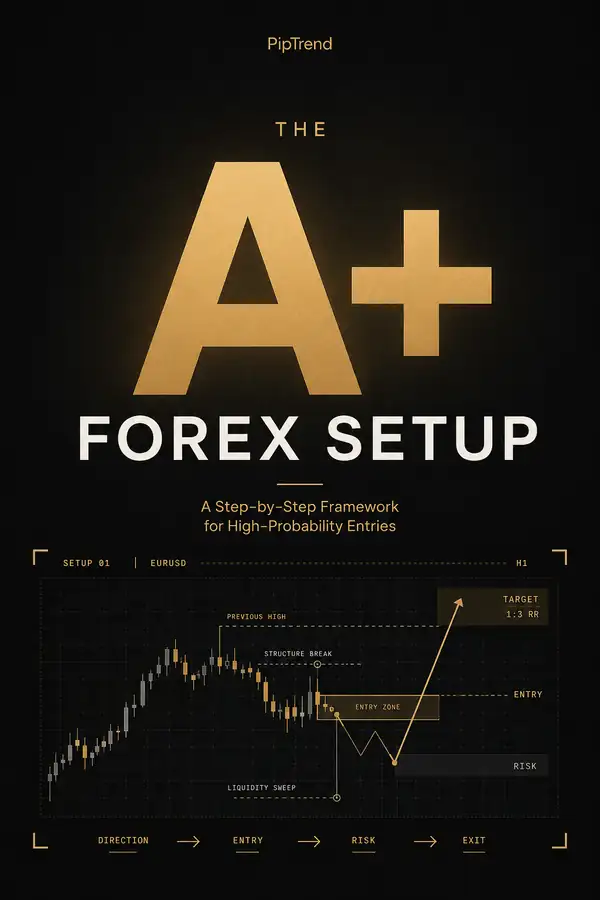
Get the free PipTrend A+ setup guide

We're finishing it now: the exact entries, exits, and risk rules our traders use, on one chart. Leave your email and we'll send it the day it's ready.

grid_view

Explore All Free Tools

Browse our full library of calculators, market tools, and trading resources.

Browse all tools arrow_forward

Want Smarter Signals on Your Chart?

These tools help you plan. PipTrend helps you execute, with a smart signal engine and adaptive trend detection right on your TradingView chart.

Secure checkout via Whop · Instant access · 30-day money-back guarantee