
You just watched a perfectly good setup turn into a loss because you moved your stop. Or you skipped the signal that would have paid for your month because you were still angry about yesterday. Your strategy works on the charts but fails when your finger hits the button. That gap between knowing what to do and actually doing it is where trading and psychology collide, and it costs you more than any indicator ever will.
Why Most Traders Fail Before They Even Click Buy
The numbers don't lie. Roughly 80% of retail traders lose money, and it's not because they lack charts or capital. They lose because they cannot execute under pressure. You can backtest a 65% win rate strategy all day, but when real money sits on the line and the market moves against you by fifteen pips, your brain starts rewriting the plan.
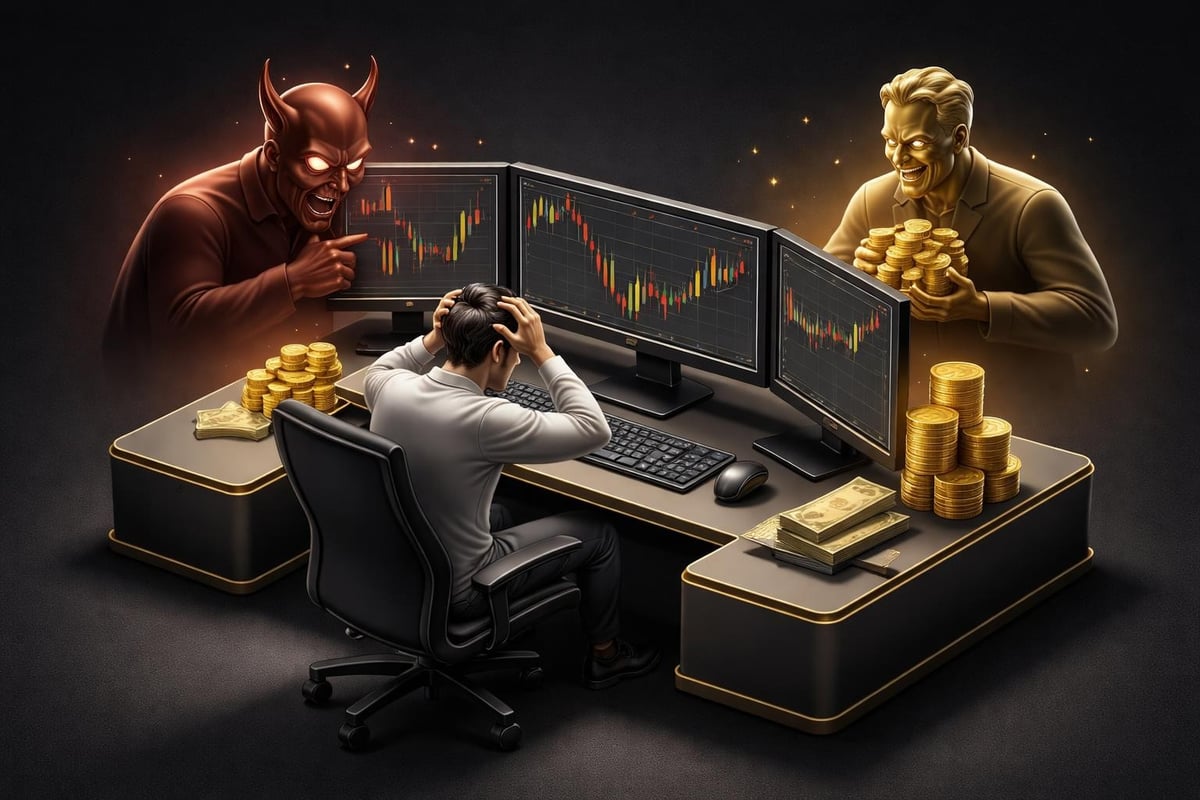
Fear hijacks your prefrontal cortex. You freeze when you should enter. You exit early when the trade needs room to breathe. That's not a strategy problem. That's a wiring problem, and understanding trading psychology separates professionals from gamblers.
Your emotional brain processes threats faster than your logical brain can intervene. When you see red candles stacking against your position, your amygdala screams danger before your cortex can assess probability. This reaction served our ancestors well when facing predators. It destroys traders who face volatility.
The Three Psychological Traps That Drain Your Account
Revenge trading kills more accounts than stop hunts ever will. You take a loss, feel the sting, and immediately hunt for a way to get even. You skip your checklist. You double your risk. You enter against trend on a lower timeframe because you need to prove the market wrong. That emotional need for vindication turns one loss into four.
The solution isn't motivation. It's a circuit breaker. Set a rule: after any loss, you walk away for thirty minutes minimum. No exceptions. If you cannot do that, you're not trading. You're feeding an emotional loop that will empty your account no matter how good your setups are.
Overtrading stems from the same root: you're using the market to regulate your emotional state instead of following a plan. When you feel bored, you create setups that don't exist. When you feel powerful after two wins, you increase size without adjusting for correlation or volatility. Both impulses come from the same place, and both destroy edge.
FOMO represents the third trap. You see a pair ripping higher without you, and suddenly you're chasing price fifty pips above the signal zone. You know better, but the pain of missing out overrides the logic of waiting for a pullback. This behavior compounds because every chased entry that fails reinforces the belief that you always miss the good ones, creating a cycle of poor decisions.
Building a Framework That Works When Your Emotions Don't
Trading and psychology improve together when you stop relying on willpower and start relying on process. Willpower depletes. A good framework doesn't.
Start with a pre-trade checklist that lives outside your head. Write it down. Print it. Laminate it if you need to. Before every entry, you verify trend on the higher timeframe, confirm your signal matches your documented criteria, calculate your risk in dollar terms, and set your stop and target before you enter. No shortcuts. If you skip one item, you don't take the trade.
This isn't busywork. It's a cognitive interruption that forces your logical brain back online when your emotional brain wants to act fast. The psychology of systematic trading processes shows that structured routines reduce impulsive errors by creating deliberate friction between impulse and execution.
Your post-trade review matters more than the trade itself. After every position closes, win or loss, you document what you saw, what you did, and whether you followed your rules. You're not judging the outcome. You're auditing the process. A winning trade that violated your plan is a failure. A losing trade that followed your edge perfectly is a success. This reframe rewires how you measure yourself.

How Your Brain Sabotages Winning Trades
You enter long on EUR/USD at 1.0850 with a target at 1.0920 and a stop at 1.0830. Price moves to 1.0910, just ten pips from your target, then pulls back to 1.0880. Your brain floods with anxiety. You've seen this before. Winning trades that reverse and stop you out. So you close at 1.0885 for a small win instead of the full move.
Price hits 1.0920 fifteen minutes later. You just taught your brain that fear-based exits feel safe, which guarantees you'll repeat this pattern. Over time, you cut every winner early and let losers run because the pain of giving back gains outweighs the pain of taking a loss. Your risk-reward ratio inverts, and your edge evaporates even though your entries are solid.
The fix requires acceptance, not control. You cannot eliminate the anxiety of watching a winner pull back. You can choose not to act on it. When you feel the urge to close early, acknowledge it: "I feel anxious. That's normal. My plan says hold until target or stop." Then you close the platform and walk away. Staring at the chart feeds the loop.
Traders who scale out of positions often do it to soothe this anxiety, taking half off at 1R and letting the rest run. That's fine if it's planned and tested. It's sabotage if you're doing it because you can't handle the heat. Know the difference.
The Role of Confirmation Bias in Consecutive Losses
You believe the 4-hour timeframe is starting a bullish reversal. You enter long. Price drops and stops you out. Instead of reconsidering your thesis, you look for more reasons it should go up. You find them. You enter again. You get stopped again. By the third loss, you're underwater on the week, and you're still convinced you're right.
Confirmation bias makes you cherry-pick data that supports your existing belief while ignoring everything that contradicts it. It's why traders hold losers and add to them. It's why you'll find ten bullish reasons on a chart that's clearly bearish if you want to be long badly enough.
The antidote is simple but hard: actively seek information that proves you wrong. Before you enter, ask what would invalidate this setup. If EUR/USD is above the 200 EMA and you're looking for longs, define the exact scenario where the bullish case dies. If price closes below that level, your opinion doesn't matter. The market spoke, and you listen.
Many professionals use insights from trading psychologists to develop mental models that counteract these biases. The work isn't glamorous, but it's the difference between blowing up and compounding.
Managing Drawdowns Without Losing Your Mind
Every strategy hits drawdown. The question isn't if, it's when and how you respond. A 15% equity drawdown will either teach you discipline or destroy your account depending on what you do next.
Your first move when drawdown begins: verify you're still following your plan. Pull up your last twenty trades and score them. Did you follow entry rules? Did you honor stops? Did you stay within position size limits? If the answer is yes and you're still down, that's variance. If the answer is no, you've got a discipline problem, not a strategy problem.
Reduce size during drawdown, but don't stop trading. Cutting your risk per trade from 1% to 0.5% lets you keep executing without the emotional weight of large swings. You stay sharp. You maintain rhythm. You rebuild confidence through consistent process, not by gambling your way back to breakeven.
Never, under any circumstance, increase size to recover faster. That's how drawdowns become blowups. The math doesn't care about your feelings. A 20% loss requires a 25% gain to recover. A 50% loss requires 100%. The deeper the hole, the harder the climb, and aggressive position sizing when you're already down is the fastest way to zero.
Why Your System Works in Backtests But Fails Live
You tested your strategy on historical data. It shows a 2.3R average win, 58% win rate, clean equity curve. Then you trade it live and you're flat after three months. The strategy didn't change. You did.
Backtests don't include the 3 AM positions you took because you couldn't sleep. They don't include the trade you skipped because you were afraid after two losses. They don't account for the stop you moved because you "knew" it would reverse. Every deviation from the tested plan chips away at the edge until nothing's left.
Live trading and psychology intersect at execution. Your emotions don't exist in backtests. Your fatigue, your mortgage payment, your argument with your spouse-none of that shows up in the data. But it all shows up in your live results. You can have the best strategy in the world and still lose if you cannot execute it as designed.
Start small enough that losses don't hurt. If a 1% risk per trade makes you sweat, trade 0.25%. The goal is emotionally neutral execution. You should feel the same after a loss as you do after breakfast. Boring is profitable. Exciting is expensive.

Building Emotional Resilience Through Routine
Professional traders don't have better emotions. They have better routines. Your morning process sets the tone for everything that follows. If you roll out of bed, grab coffee, and start scanning charts in your pajamas, you're already behind.
Top performers treat trading like surgery. They prepare the environment first. Same desk, same time, same pre-market review. They check economic calendars, identify key levels on their watchlist, and set alerts for their setups. They don't hunt. They wait. This disciplined approach to market mindset creates consistency that emotions can't disrupt.
Your physical state affects your mental state. Sleep deprivation, poor nutrition, and lack of movement all degrade decision-making. If you're trading on five hours of sleep after three energy drinks, you're not operating at full capacity. Your risk assessment suffers. Your patience evaporates. You make errors you wouldn't make rested.
Build a shutdown routine as strong as your startup. When the session ends, you close your platform. You review your trades. You update your journal. Then you walk away. No checking prices on your phone at dinner. No obsessing over what might happen overnight. Trading occupies its designated time, then it's over. This boundary protects both your mental health and your capital.
The Psychological Edge of Multi-Timeframe Alignment
Single timeframe traders experience more psychological stress because they lack context. You're looking at a 15-minute chart, see a bullish engulfing candle, and enter long. Price immediately reverses. What you missed: the 1-hour and 4-hour timeframes both show bearish structure. You just bought a minor retrace in a downtrend.
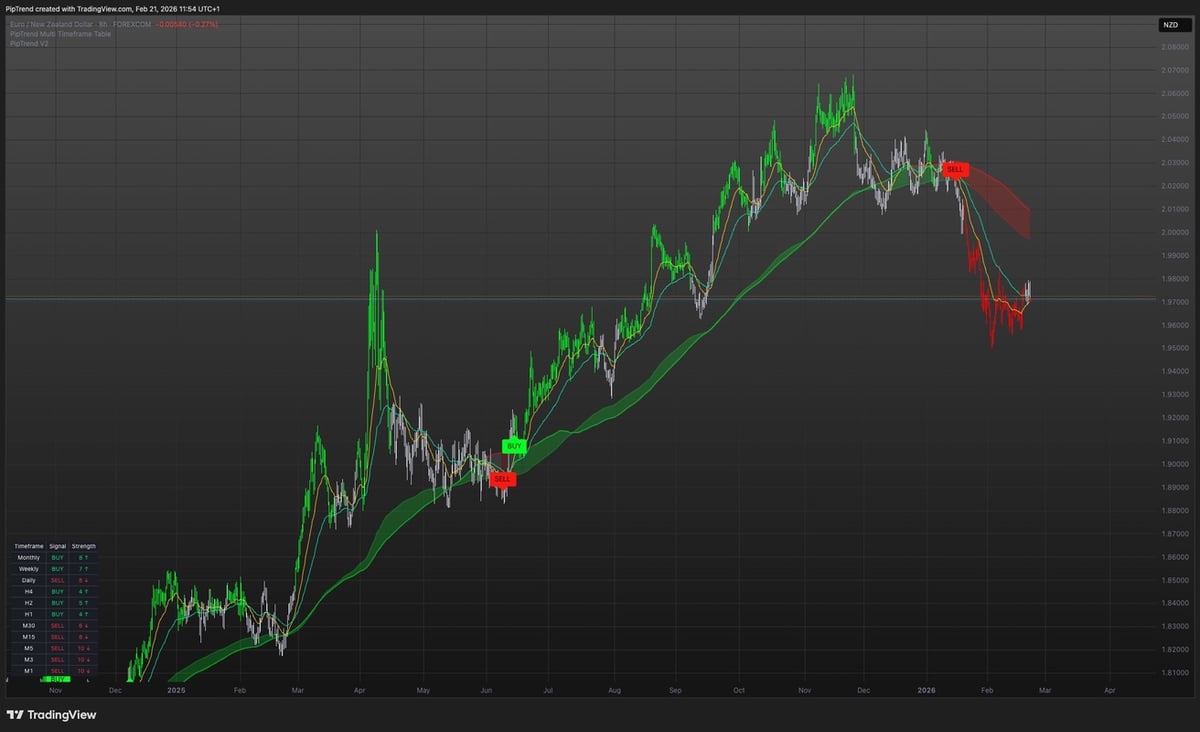
Multi-timeframe alignment removes this guesswork and the emotional rollercoaster that comes with it. When the daily shows uptrend, the 4-hour pulls back to support, and the 1-hour prints your entry signal, you're trading with the full weight of momentum behind you. That confidence changes how you handle heat. You give the trade room because you trust the context.
For traders seeking systematic clarity without the mental burden of analyzing five timeframes manually, tools like PipTrend AI Trading Indicator provide instant multi-timeframe confirmation tables that show you alignment at a glance. This removes the cognitive load of switching between charts and second-guessing your analysis, letting you focus on execution instead of interpretation.
 AI Trading Indicator - PipTrend">
The psychological benefit isn't just confidence. It's reduced decision fatigue. You're not constantly questioning whether you should be in this trade. The alignment says yes or it says no. You act accordingly. This binary clarity eliminates the gray area where emotions thrive.
How to Handle Winning Streaks Without Imploding
Losing streaks get all the attention, but winning streaks destroy just as many traders. You hit five winners in a row. You feel invincible. Risk management starts to feel like a suggestion. You bump your position size. You take marginal setups because everything's working. Then you hit a normal loss and it wipes out three wins because you were trading triple size.
The antidote is rules that don't change based on recent results. Your risk per trade stays at 1% whether you just had five wins or five losses. Your entry criteria don't loosen because you're hot. The market doesn't care about your streak, and neither should your process.
Document your psychological state during streaks. Write down how you feel when you're on a heater. Notice the thoughts that creep in: "Maybe I can push this." "This setup's not perfect but I'm rolling." Those thoughts are warning signs. When you see them appear in your journal, that's your cue to take a day off and reset.
The best traders are boringly consistent. They trade the same size, follow the same rules, and display the same discipline on day one hundred as they did on day one. That consistency is built through deliberate practice and constant self-monitoring, not talent.
The Connection Between Self-Awareness and Profitability
You cannot fix what you don't see. Most traders lose money for months without understanding why because they never look inward. They blame the market, the spread, the news event. They never ask the hard question: "What am I doing that's causing this?"
Keep a psychological trading journal separate from your trade log. After each session, write three things: how you felt, what you were thinking, and any rules you broke. Patterns emerge fast. You'll notice you overtrade on Fridays. You'll see that you revenge trade after specific loss types. You'll identify that you skip great setups when you're up on the week because you don't want to give back gains.
Those patterns are your edge once you see them. Now you know: no trading Fridays. Mandatory break after stop-outs. Force yourself to take one signal per day minimum even when profitable. These adjustments are custom-built for your psychological weak points, which makes them far more powerful than generic advice.
Self-awareness also means knowing when to stop. Some days your head isn't right. You're distracted, emotional, or just off. Professional traders recognize this and shut it down. They don't force it. Amateur traders push through and pay for it. The market will be here tomorrow. Your capital might not.
Position Sizing as a Psychological Tool
Your position size controls more than your risk. It controls your emotional state during the trade. Risk too much and every tick feels like a crisis. Risk too little and you don't care enough to follow your plan properly. The sweet spot sits right in the middle: enough to matter, not enough to panic.
Most traders should risk between 0.5% and 1% of their account per trade. At 1%, a ten-trade losing streak drops you 10%. Painful but survivable. At 3%, that same streak cuts you in half. The math is simple, but the psychology is everything. When you're down 50%, you need a 100% return just to break even. That pressure creates desperate decisions.
Position sizing also affects your ability to scale. If you're risking 5% per trade on a $5,000 account, you can never grow into proper risk management without completely changing your approach. If you start at 1%, that same framework works whether you're trading five thousand or five hundred thousand. Consistency compounds.
Calculate your position size before you look at the chart. Decide your dollar risk, measure the distance to your stop in pips, and let the math tell you how many lots to trade. This removes the temptation to adjust size based on how confident you feel. Confidence is not an edge. Process is.
Learning From Losses Without Internalizing Failure
A loss is feedback, not identity. You took a trade that didn't work. That doesn't make you a bad trader any more than missing a shot makes a basketball player incompetent. But your brain wants to make it personal. It wants to turn "I lost" into "I'm a loser." That cognitive distortion is where trading and psychology become dangerous.
Separate outcome from process in your self-talk. Instead of "I lost money today," say "I executed three valid setups and the market didn't cooperate on two of them." Instead of "I'm terrible at this," say "I broke my rule on that entry and I need to address why." Language shapes belief, and belief shapes behavior.
Review losses for lessons, not shame. What was your edge on this trade? Did you wait for confirmation? Was the risk-reward adequate? If you followed your plan and lost, that's the cost of doing business. If you violated your plan, identify the emotional trigger that caused it and build a safeguard. Both paths lead to improvement. Neither requires self-flagellation.
Traders who internalize losses as personal failures eventually stop taking trades. The fear of confirming their negative self-image outweighs the desire to profit. That's when promising traders quit right before they would have figured it out. Don't let your inner narrative become the thing that stops you.
The Compound Effect of Daily Psychological Practice
Trading and psychology aren't separate skills you master once. They're daily practices that compound over time. Every day you execute your plan, you strengthen that neural pathway. Every day you skip your routine, you reinforce randomness.
Small improvements stack. Waiting an extra five minutes before entering to verify your setup. Taking three deep breaths before clicking the button. Writing one sentence in your journal after each trade. None of these actions feel significant in the moment. After six months, they've completely rewired how you respond to the market.
Professional-level psychology doesn't mean never feeling fear or greed. It means feeling them and trading anyway because your process is stronger than your emotion. You build that strength through repetition, not revelation. There's no shortcut. You show up, follow your rules, and do it again tomorrow.
The traders who make it aren't the ones with the highest IQ or the biggest account. They're the ones who show up consistently and execute their plan regardless of how they feel. That's the edge. Everything else is commentary.
Mastering trading and psychology means accepting that your mind will work against you and building systems that win anyway. The difference between consistent profitability and constant frustration lives in how well you execute under pressure, and that skill develops through deliberate practice, honest self-assessment, and unwavering commitment to process over outcome. PipTrend removes the signal confusion and conflicting indicators that trigger emotional decisions, giving you the clarity to execute your edge with confidence when it matters most.