Forex Brokers With No Deposit Bonus: A Trader's Guide

On this page
The Real Cost of ‘Free’ Trading Money
A broker offers you $50 to trade with. No deposit, no card details, just sign up and go.
Sounds like free money… until you read page seven of the bonus terms and conditions.
That’s the core tension with every no-deposit offer.
The forex trading credit is real, the market execution is real, but the rules governing whether a single dollar ever reaches your bank account are written entirely by the broker. Those rules, not the headline number, determine the actual value of the offer.
This guide separates marketing from math.
We’ll break down how bonus credit actually flows through an account, how to verify a broker’s regulation before you hand over your identity documents, and how to convert a lot turnover requirement into real trading days and real spread costs. We’ll also cover the scam patterns that show up when withdrawal time arrives.
One thing this guide is not: a ranked list of bonus offers. Offers change monthly, brokers rebrand, and terms get rewritten without notice.
A list would be stale before you finished reading it.
Instead of telling you which bonus to claim, this guide gives you a framework to evaluate any offer you find, in 2026 or beyond.
By the end, you’ll know exactly which questions to ask before clicking “claim.”
And you’ll know when the right answer is to walk away.
How a No-Deposit Bonus Actually Works
Here’s the part most promotional pages skip: a no-deposit bonus is not a gift.
It’s a conditional loan of trading credit that the broker never intends to let you withdraw.
A no-deposit bonus is broker-issued trading credit granted without any client deposit, typically between $5 and $100. You use it to place real leveraged trades on live market prices, with real spreads, real slippage and execution conditions, and real swap and overnight fees if you hold positions.
Why do brokers give money away?
Customer acquisition.
A no-deposit bonus gets you through KYC identity verification, onto their platform, and into their email funnel. The broker is betting that a meaningful percentage of bonus users will eventually deposit their own money.
That bet usually pays off.
Bonus Credit vs Withdrawable Profit
The single most misunderstood distinction in bonus trading is this: the bonus itself is never withdrawable. Only profit generated with it might be, and even that comes with a ceiling.
Walk through a concrete example.
You claim a $30 bonus. Your account shows a $30 balance, but it’s flagged internally as credit, not equity you own.
Say you trade well and generate $45 in profit. Your account now shows $75. But the accounting works like this:
- $30 bonus credit: permanently non-withdrawable. If you request a payout, this amount is removed from the account.
- $45 realized profit: potentially withdrawable, but only after meeting the minimum trading volume requirement, and only up to the broker’s cap.
That cap matters more than most traders realize. Many brokers impose a profit withdrawal cap of $50 to $100, regardless of how large the account grows.
Turn $30 into $500? You still withdraw $100 at most.
The remaining $400 either converts to trading credit or simply vanishes when you cash out.
So the realistic best-case outcome of a typical no-deposit bonus is a payout somewhere between $50 and $100.
That’s the ceiling. Before spread costs, before fees, before the turnover grind we’ll calculate later.
Bonus Account vs Demo Account
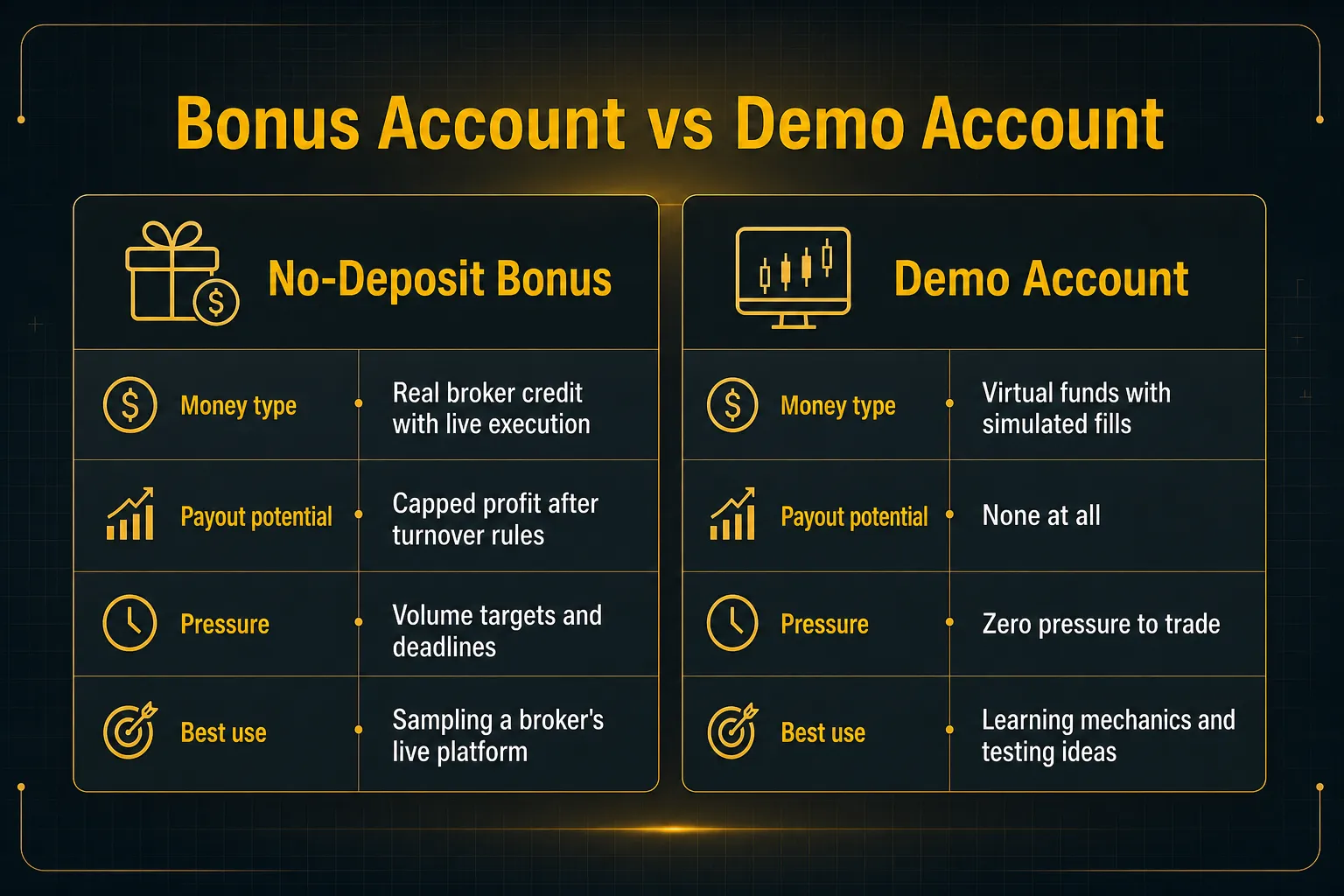
People often lump bonus accounts and demo accounts together as “free practice.” They’re structurally different products.
A demo account uses virtual money on simulated or mirrored pricing.
There’s zero payout potential, but also zero pressure. Fills are often idealized, with no real slippage and no requotes, which makes demo trading a clean environment for learning platform mechanics.
A bonus account uses real broker funds under real market execution. Your orders hit actual liquidity, spreads widen during news, and stop-losses can slip.
That realism is valuable.
But it comes bundled with restricted withdrawal terms and volume targets that a demo account never imposes.
Neither is a substitute for the other.
The demo account comparison matters because each tool answers a different question: the demo teaches you the platform, the bonus shows you live conditions.
Neither one funds a trading career.
Verifying a Broker Before You Claim Anything
Before evaluating any bonus, evaluate the entity offering it. A generous bonus from an unregulated shell company is worth exactly nothing, because the withdrawal decision rests entirely with people who face no consequences for saying no.
Here’s the uncomfortable truth: the brokers pushing the largest no-deposit bonuses are disproportionately offshore operations with weak or nonexistent oversight. Tier-one regulators actively discourage this promotion type.
The FCA’s retail CFD rules banned bonus incentives for UK retail clients back in 2019, and ESMA did the same across the EU.
So the biggest offers cluster where the rules are thinnest.
Checking Regulation and Legal Entity
Broker regulation is verifiable in minutes, and the verification must happen on the regulator’s website, never the broker’s.
A logo in a website footer proves nothing. Logos get copied, and license numbers get borrowed from similarly named companies.
Follow these steps for any broker, every time:
- Find the exact legal entity name. Scroll to the website footer or the client agreement and note the full registered company name, not the brand name. “TradePro” the brand might be operated by “TP Global Markets Ltd (SVG)” the entity, and those are very different things.
- Locate the claimed license number. The broker should state a specific registration number with a specific regulator, such as the FCA, ASIC, CySEC, or FSCA. Vague phrases like “fully regulated” or “internationally licensed” with no number are a warning sign on their own.
- Cross-check the number on the regulator’s own database. Search the FCA Register, ASIC’s professional registers, CySEC’s regulated entities list, or the FSCA’s license search directly. Confirm the license is active, matches the exact entity name, and covers the services being offered.
- Match the domain and contact details. Regulator records list authorized websites, registered addresses, and phone numbers. If the site you’re on isn’t listed against the license, you may be looking at a clone site impersonating a legitimate firm. Regulators publish clone warnings for exactly this reason.
While you’re checking, look for negative balance protection and segregated client money protections in the account terms. Regulated entities in major jurisdictions are required to offer both.
Offshore entities often offer neither.
Offshore Onboarding Traps
This is the trap that catches even careful traders.
A broker group can hold a genuine FCA or ASIC license through one company… while onboarding you under a completely separate offshore broker affiliate registered in St. Vincent, Seychelles, or Vanuatu.
The homepage shows the tier-one license. The client agreement you actually sign names the offshore entity.
Your funds, your disputes, and your withdrawal rights all sit with the weaker company.
How to spot it: open the account opening documents before submitting anything and read the first page of the client agreement. The counterparty entity is always named there.
If it doesn’t match the regulated entity you verified, you’re being onboarded offshore, and the protections you researched don’t apply to you.
US Traders and CFTC/NFA Reality
If you’re a US resident, the short version is blunt: no-deposit forex bonuses are effectively unavailable to you. CFTC registration requirements and NFA promotional rules restrict this style of incentive, and legitimate US-registered brokers simply don’t offer them.
Any broker offering a US resident a no-deposit bonus in 2026 is almost certainly operating outside US law, which means no CFTC recourse if things go wrong. You can confirm whether a firm is legitimately registered by searching the NFA BASIC database, which lists registration status, regulatory actions, and complaint history for every NFA member.
No BASIC record, no business. It’s that simple for US traders.
Turning Bonus Rules Into Real Numbers
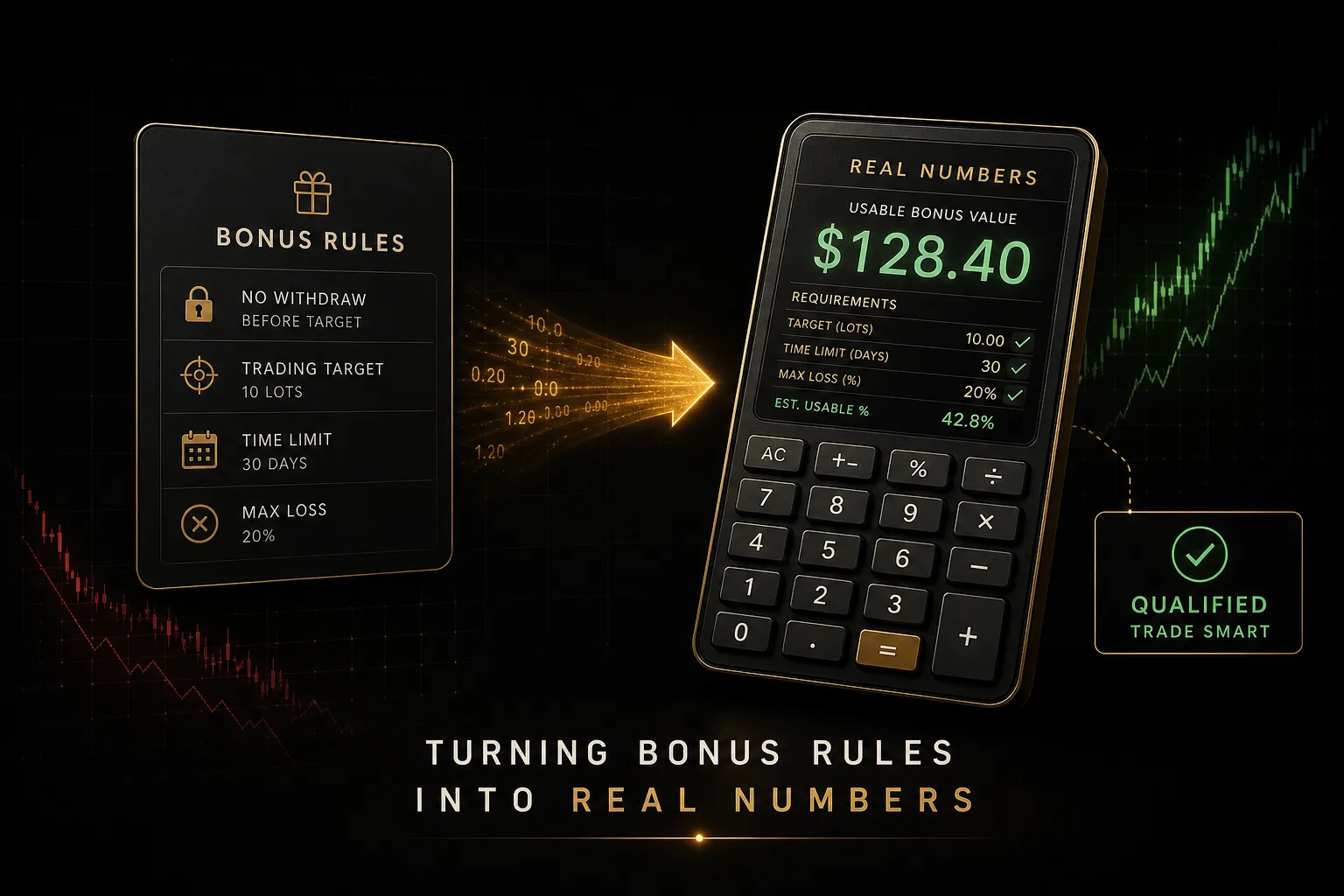
Bonus terms read like fine print, but they’re really an equation.
And once you run the numbers, most no-deposit offers look very different from their marketing.
Turnover and Lot Requirements
Nearly every no-deposit bonus includes a lot turnover requirement: a fixed volume of trading you must complete before any profit becomes eligible for withdrawal. A typical clause reads something like “trade 2 standard lots per $5 of bonus,” which on a $50 bonus means 20 standard lots of total volume.
Twenty lots sounds abstract.
Convert it to reality.
A trader running sensible position sizing on a $50 account might trade 0.01 to 0.05 lots per position. At 0.05 lots per trade, 20 standard lots requires 400 trades. At five trades a day, that’s 80 trading days, roughly four months of daily activity, often against a bonus expiry window of 30 to 60 days.
See the squeeze?
The deadline forces you into larger positions than your balance can safely support.
That’s not an accident. It’s the design.
What Spreads and Fees Quietly Remove
Every lot you trade to satisfy the turnover requirement costs money in spreads and commissions.
This is where bonus math quietly collapses.
Run a worked example.
Assume a 1.5 pip average spread on EUR/USD, where 1 pip on a standard lot equals $10. Each round-turn lot costs $15 in spread. Across a 20-lot requirement:
20 lots × $15 = $300 in spread cost paid before withdrawal is even possible. On a bonus with a $100 profit withdrawal cap, you must out-trade $300 of friction to keep at most $100.
Your strategy needs to clear roughly a 3:1 cost hurdle just to break even on the offer.
Here’s how a typical $50 bonus scenario stacks up from claim to payout:
| Item | Typical Terms | Effect on a $50 Bonus |
|---|---|---|
| Turnover requirement | 2 standard lots per $5 of bonus | 20 lots required (≈400 trades at 0.05 lots) |
| Spread cost | 1.5 pips average on majors | ≈$300 consumed across required volume |
| Profit withdrawal cap | $50-$100 maximum payout | Gains above cap are forfeited or converted to credit |
| Withdrawal processing fee | $5-$30 or 2-3% per transaction | Up to 30% of a small payout |
| Currency conversion spread | 0.5-2% on non-USD withdrawals | $0.50-$2.00 further reduction |
| Minimum deposit before withdrawal | $10-$100 required by some brokers | You risk your own money to unlock “free” money |
| Inactivity fee | $5-$15 per month after 60-90 days idle | Can drain residual balances to zero |
That last row deserves emphasis.
Some brokers require a real deposit before releasing bonus profits. Read that clause twice, because it converts a “no-deposit” offer into a deposit requirement with extra steps.
One final point that traders miss: a bonus account is a terrible laboratory for strategy testing. The forced turnover pushes you into trades you wouldn’t otherwise take, the deadline distorts your position sizing, and the cap changes your incentives.
Whatever results you produce under those conditions tell you almost nothing about how the strategy performs under normal risk management. Test strategies on a demo or a small self-funded account where you control every variable.
Overtrading Risk and Withdrawal Scams
The financial cost of a bad bonus is capped at zero, since you deposited nothing.
The behavioral cost is not capped at all.
And for some traders, the real losses start after the bonus, when a scam broker’s withdrawal games begin.
Why Bonus Terms Encourage Bad Habits
Turnover targets and expiry deadlines create a specific psychological trap.
You’re not trading to find good setups anymore. You’re trading to hit a volume number before a clock runs out.
That pressure produces predictable behavior.
Position sizes creep up because small trades won’t clear 20 lots in time. Losses trigger revenge trading, since a drawdown now threatens both your balance and your deadline. Technical analysis gets replaced by “I need three more trades today.”
Each of these habits is the exact opposite of disciplined risk management. Leverage risk compounds the problem: a $50 account at 1:500 leverage can control $25,000 of exposure, meaning a 20-pip move against an oversized position wipes the account.
Traders who spend a month grinding a bonus often carry the overtrading habit into their first funded account.
That’s where it gets expensive.
Common Withdrawal-Scam Tactics
Legitimate brokers with restrictive terms will simply decline a withdrawal that doesn’t meet the rules.
Scam brokers do something different: they approve the idea of your withdrawal, then invent costs to release it. This is the classic withdrawal-fee scam, and it follows recognizable patterns:
- The “release fee.” Your profit is “ready,” but you must pay a processing or activation fee first. Real brokers deduct fees from the payout. Nobody legitimate asks you to send money to receive money.
- Fake tax payments. The broker claims a government tax must be prepaid before funds are released. Taxes on trading profits are handled between you and your tax authority, never prepaid through a broker.
- Mandatory “insurance” deposits. You’re told your account needs insurance or a security deposit to protect the transfer. This charge doesn’t exist anywhere in regulated finance.
- Forced account upgrades. Withdrawals are “only available on Gold tier,” which requires a $250 deposit. The upgrade unlocks nothing except a new reason to deposit again.
- Third-party “fund recovery” services. After you’ve been scammed, recovery agents appear (often run by the same operators) offering to retrieve your funds for an upfront fee. It’s the same scam wearing a second costume.
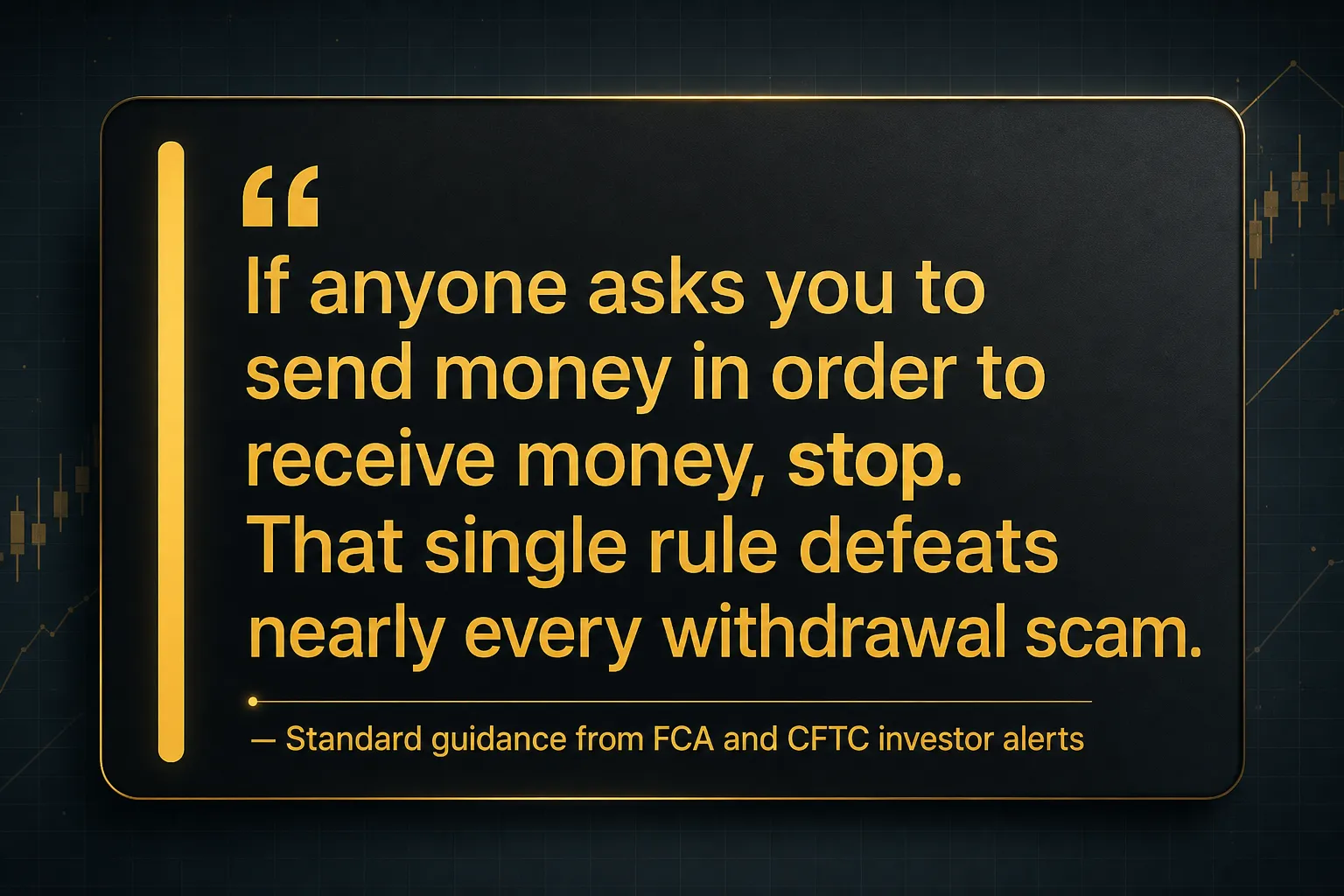
Every one of these forex trading scam patterns exploits sunk-cost thinking. You’ve invested weeks of trading, so a $30 fee feels small next to your $100 payout.
Pay it and a second fee appears.
Then a third.
The payout never comes.
Choosing the Right Practice Account for Your Goal
The smarter approach is matching the tool to the job. Three tools, three jobs:
Use a demo account to learn platform mechanics, order types, and charting without any financial pressure. This is where you make your first hundred mistakes for free.
Use a small real deposit with a properly regulated broker to test genuine execution and, more importantly, your own psychology. Even $100 of your own money teaches lessons about fear and discipline that no demo ever will.
Treat a no-deposit bonus as a platform sample and nothing more. It’s a way to feel a broker’s live spreads, execution speed, and interface before committing funds.
It is not capital, and it is not a strategy-testing environment.
On that last point: evaluating any indicator or signal system should happen completely outside bonus conditions, using fixed risk rules and a documented track record you can actually verify.
Transparency is the benchmark here.
PipTrend, for example, publishes a Results page with verified cTrader statements that include losing trades alongside winners. That’s the standard to hold any tool or system to: real statements, losses included, under normal trading conditions.
Not screenshots of cherry-picked wins on a bonus account nobody can audit.
Separate the question “is this broker worth using?” from the question “does this strategy work?” A bonus account can partially answer the first.
It can never answer the second.
Common Questions About No-Deposit Bonuses
Which forex broker gives free money without a deposit?
No single broker is the universal answer, because no-deposit offers change constantly and availability depends on your country of residence. As of 2026, these promotions come mostly from offshore-regulated brokers, since FCA retail CFD rules and ESMA restrictions ban bonus incentives in the UK and EU.
Rather than chasing a name, verify any offer you find: confirm the legal entity on a regulator database, read the bonus terms and conditions in full, and calculate the turnover requirement before signing up.
Can I withdraw a forex bonus without depositing?
You can never withdraw the bonus credit itself, only profits earned with it, and only after meeting strict conditions. Those conditions typically include a minimum trading volume (often measured in standard lots), full KYC identity verification, and a profit withdrawal cap of $50 to $100.
Some brokers additionally require a real deposit before releasing bonus profits. If that clause exists, the offer isn’t truly no-deposit, so read the withdrawal section of the terms before you claim.
Are no-deposit forex bonuses real?
Yes, legitimate no-deposit bonuses exist, but the realistic payout is small. Between turnover requirements, spread costs, and withdrawal caps, a successful bonus campaign typically yields $50 to $100 at most, and the majority of traders never satisfy the volume requirement before the bonus expires.
The offer is real in the sense that the trading credit executes real trades. Whether real money ever reaches you depends entirely on the terms and the broker’s integrity.
How do I claim a no-deposit forex bonus?
Claiming usually takes four steps: register an account, complete KYC identity verification with an ID document and proof of address, activate the bonus (sometimes via a promo code), and start trading within the eligibility window.
Do the verification work before you upload documents, not after. You’re handing a company your passport data, so confirm its regulated entity and license number on the regulator’s own website first.
What is the best forex broker for beginners with no deposit?
The best broker for a beginner is defined by regulation, transparent terms, and your home jurisdiction, not by bonus size. A $100 bonus from an unregulated offshore broker is worth less than a $10 bonus from a properly licensed one, because only the second has any realistic path to payout.
Beginners are usually better served starting on a demo account, then moving to a small real deposit with a regulated broker. The bonus, if you use one at all, should be a platform trial rather than the deciding factor.
How can I tell if a forex broker is a scam?
Run the core checklist: verify the exact legal entity name and license number on the regulator’s database (FCA, ASIC, CySEC, FSCA, or the NFA BASIC database for US firms), confirm the website domain matches the registered company, and check that a real registered address and contact details exist.
Then watch for the behavioral red flags: requests for upfront fees to release withdrawals, fake tax or insurance charges, pressure to upgrade your account, and guaranteed-profit promises. Any single one of these is sufficient reason to leave.
Before You Click Claim
Here’s the decision rule, stripped to one sentence: if you can’t verify the broker’s exact regulated entity on a regulator’s database and find the withdrawal terms in writing before you sign up, skip the offer entirely.
No exceptions, no matter how large the number on the banner.
If an offer does pass verification, treat it as what it is: a free trial of a trading platform.
Sample the spreads, test the execution, poke around the interface. Then make your funding and strategy decisions completely separately, with your own risk management rules intact.
Promotional credit has never built a trading career.
Disciplined execution, honest position sizing, and performance data you can actually verify are what compound over years.
A $50 bonus won’t change your trajectory… but the habits you practice while using one just might.
Sources
Risk Disclaimer: Trading involves risk. Past performance doesn't guarantee future results. Only trade with money you can afford to lose. PipTrend is a tool to assist your trading decisions, not financial advice.