My Funded FX: What Happened and What It Means for 2026

On this page
Why People Are Still Searching for MyFundedFX
Here’s the short version: MyFundedFX shut down its prop-trading operations in February 2026.
The brand no longer sells challenges, funds traders, or processes payouts.
If you landed here hoping to buy an evaluation, that door is closed.
And yet the searches keep coming. Thousands of traders every month still type “my funded fx” into Google, chasing answers about refunds, payouts, and whether the company simply changed its name and kept going.
This guide separates verified facts from forum rumors and trader anecdotes. There’s a lot of noise out there… and some of it is flat-out wrong.
Part of the confusion is the name itself. MyFundedFX gets tangled up with SeacrestFunded (its actual rebrand), MyFundedFutures (a completely separate futures firm), and MyForexFunds (an unrelated company that faced its own regulatory case back in 2023).
We’ll untangle all three.
The second half of this article goes further. Instead of just documenting a shutdown, we’ll walk through how to assess prop-firm risk before you pay a single dollar for a funded trading challenge, and why disciplined tools like drawdown-based position sizing and multi-timeframe confirmation beat any indicator shortcut.
Because the real lesson from MyFundedFX isn’t about one company.
It’s about how much homework traders skip before wiring money to a business they’ve never vetted.
What Was MyFundedFX?
At its peak, MyFundedFX was one of the more recognizable names in the forex proprietary trading firm space. The pitch was familiar: pay a fee, prove your skill in an evaluation, and trade a funded account with a profit split, without risking your own capital beyond the challenge fee.
The firm focused on forex and CFD trading, offering both one-step and two-step evaluation models. Account sizes ranged from small five-figure accounts up to six-figure balances, each governed by a profit target, a maximum daily drawdown, and a maximum overall drawdown.
Break any of those limits, even on a floating loss, and the account was gone.
How the Challenge Worked
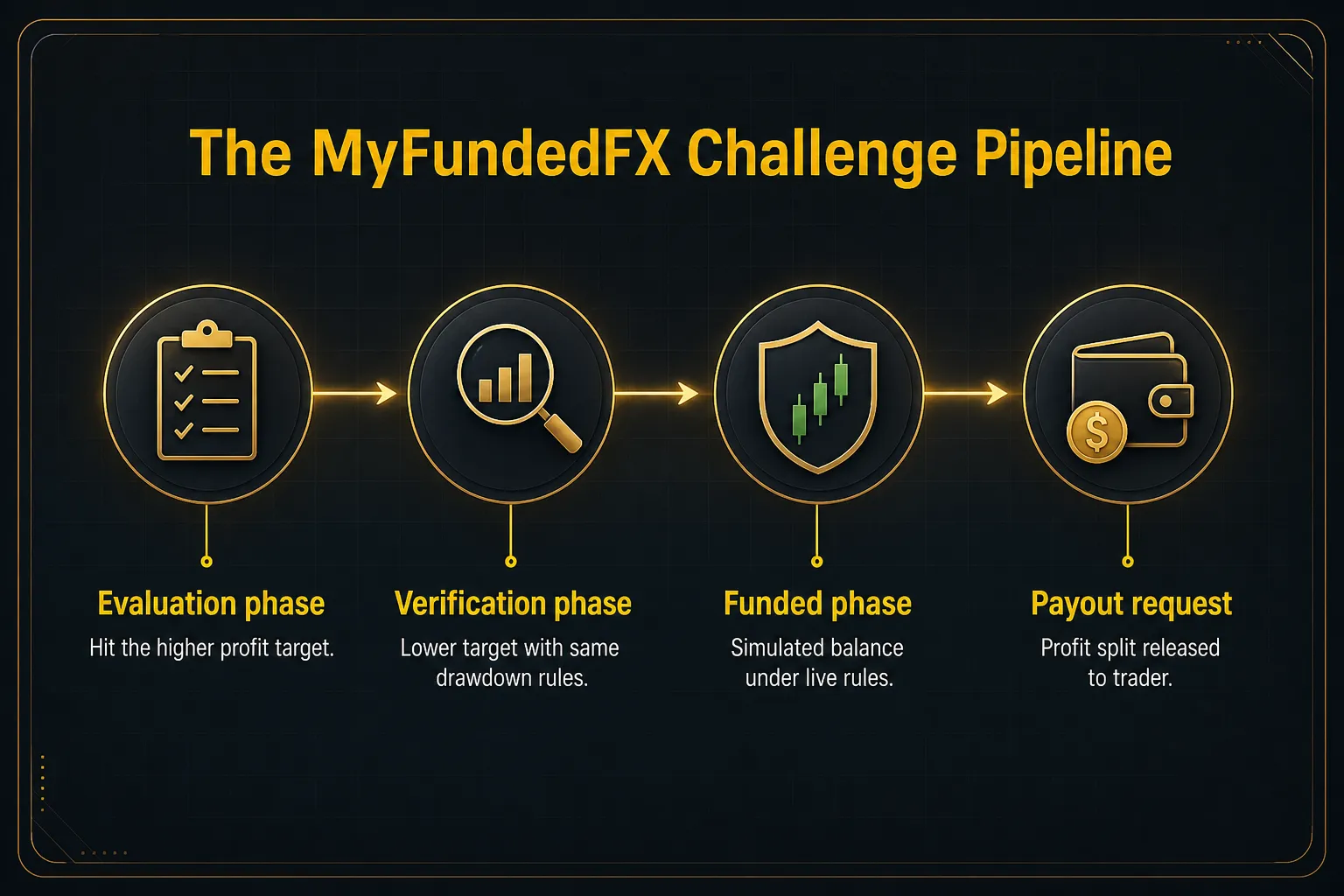
The structure followed the standard industry playbook. In the two-step model, traders first passed an evaluation phase with a higher profit target, then a verification phase with a lower target and the same drawdown rules.
Pass both, and you moved to the funded (live) phase. Only then could you submit a payout request, typically after a minimum number of trading days, with profits split in the trader’s favor at rates that shifted over the years as the firm adjusted its offerings.
The one-step model compressed this into a single evaluation, usually with tighter drawdown rules to offset the shorter path. Either way, the rules punished the same behaviors: oversized positions, revenge trading, and holding losers past the daily limit.
Simulated Capital, Explained
This is where most traders misunderstood what they were actually trading. Funded accounts at MyFundedFX, like at nearly every retail prop firm, operated on simulated balances.
You were not directly controlling deployed live capital in the market.
Instead, the firm maintained a broker relationship and, in theory, could mirror or hedge trader activity on its own side.
The trader saw a $100,000 account on their platform.
What actually existed behind that number was a simulated trading account whose profits the firm promised to honor out of its own pocket.
A broker partnership or a business registration proves a company exists. It does not prove trader accounts were live-funded, and it does not guarantee payouts will be honored.
That distinction matters enormously.
When a firm pays traders from its own revenue rather than from realized market profits, its ability to pay depends entirely on its cash flow and business health.
MyFundedFX marketed itself as a broker-backed prop firm, and that framing gave many traders more confidence than the structure actually warranted.
None of this means the firm was a scam during its operating years. Plenty of traders reported receiving payouts.
But the model meant that when the business faltered, funded traders held promises, not capital.
The 2026 Shutdown Timeline
The end came fast.
Traders who stepped away from their screens for a long weekend in early February 2026 came back to find their accounts inaccessible and a countdown clock on their money.
The sequence actually started earlier than most people realize. In 2025, MyFundedFX rebranded to SeacrestFunded, a move framed at the time as a fresh start with updated infrastructure.
Less than a year later, the whole operation closed.
| Date | Event | What It Meant for Traders |
|---|---|---|
| 2025 | MyFundedFX rebrands to SeacrestFunded | Same underlying company; existing accounts migrated under the new brand |
| February 4, 2026 | Closure announcement published | Official notice that prop-trading operations would cease; no new challenges sold |
| February 6, 2026 | Account shutdown | Trading access terminated; evaluation and funded accounts closed regardless of status |
| February 28, 2026 | Refund and final payout deadline | Last day to file refund claims or final payout requests through official channels |
Let’s be plain about the current state of things.
New MyFundedFX or SeacrestFunded challenges cannot be purchased.
Any website selling “MyFundedFX evaluations” in 2026 is either recycling the name or running an outright imitation.
Existing funded accounts lost trading access on February 6.
It didn’t matter whether you were two trades from passing your verification phase or sitting on an unrealized profit in a funded account.
Access ended for everyone at once, which is typical of prop-firm closures: firms shut off platforms quickly to stop new liabilities from accumulating.
The refund window was the critical piece.
Traders had until February 28, 2026 to file claims for challenge-fee refunds or final payouts.
Claims filed after that deadline were likely unrecoverable, since the wind-down process closed the books at the end of the month.
If you missed the window, be extremely cautious about anyone promising recovery. Post-shutdown “fund recovery services” are a well-documented second scam that targets people who already lost money once.
MyFundedFX, MyFundedFutures, and MyForexFunds Untangled

Three similar names.
Three completely different stories.
And the confusion between them has produced some genuinely wrong claims circulating on trading forums and social media.
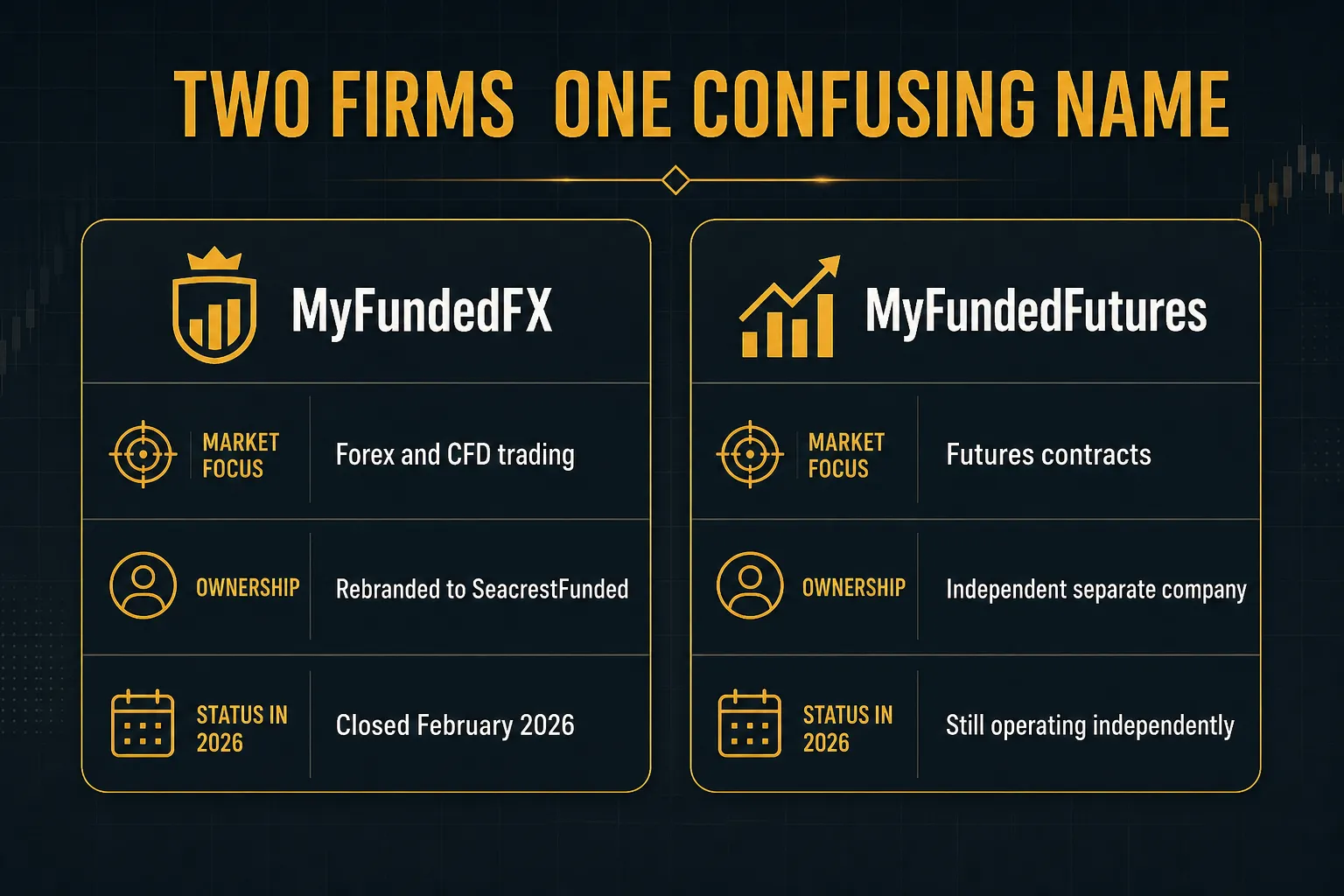
First, the fact that clears up the most confusion: SeacrestFunded is the same underlying company as MyFundedFX. It was a rebrand, not a copycat and not an unrelated successor.
When SeacrestFunded announced its closure in February 2026, that was the MyFundedFX shutdown.
Anyone telling you MyFundedFX “still exists somewhere” under its old name is mistaken.
MyFundedFX vs MyFundedFutures
MyFundedFutures is a separate company.
It’s a futures-focused prop firm with its own ownership, its own evaluation structure, and its own operational history.
It was never part of the MyFundedFX brand, never part of the SeacrestFunded rebrand, and it did not close in February 2026.
The name overlap is unfortunate but common in this industry, where dozens of firms cluster around the words “funded,” “funding,” and “capital.”
Sharing four syllables with a shuttered forex firm says nothing about a futures firm’s health.
If you’re evaluating MyFundedFutures, judge it on its own record, not on headlines about a company it never touched.
MyFundedFX vs MyForexFunds
MyForexFunds (MFF) is an entirely unrelated company.
It became infamous in 2023 when the CFTC brought a high-profile enforcement action against it, freezing assets and effectively halting its operations.
That case dominated prop-firm news for over a year.
Because “MyForexFunds” and “MyFundedFX” both start with “My” and both involve forex, plenty of traders assumed shared ownership or shared legal trouble.
Neither is true.
The MFF case was a regulatory action in 2023. The MyFundedFX closure was a business shutdown in 2026.
Different companies, different years, different causes.
Why does name similarity mislead so effectively? Because the prop-firm industry has almost no brand differentiation.
When a dozen firms use near-identical names, logos, and marketing copy, traders reasonably pattern-match… and pattern-matching fails when the pattern is superficial.
This is exactly why regulatory due diligence means checking business registrations and ownership records, not just recognizing a name.
Vetting a Prop Firm Before You Pay
The MyFundedFX story ends the way many prop-firm stories end: suddenly, with a deadline, and with traders holding balances they couldn’t withdraw. The uncomfortable truth is that most of the warning signs were checkable before anyone bought a challenge.
So before you pay for your next funded trading challenge, run the firm through a real checklist. Then, and this matters just as much, trade the challenge itself with a risk management plan built around the drawdown rules rather than the account label.
Due Diligence Checklist
- Verified ownership and business registration. Find the legal entity name, the jurisdiction it’s registered in, and the actual people behind it. A firm that hides its ownership is asking you to trust an anonymous counterparty with your money.
- Plain-language terms and conditions. Read the full agreement, not the marketing page. Pay special attention to clauses about account termination, “toxic trading” definitions, and the firm’s right to deny payouts at its discretion.
- A real dispute resolution process. Check whether there’s any mechanism beyond emailing support. If the only recourse is a Discord ticket, you have no recourse.
- Public payout proof with dates. Look for recent, verifiable payout evidence, ideally third-party payment confirmations rather than screenshots the firm posts itself. A firm that paid reliably in 2024 tells you little about 2026.
- Platform and broker continuity. Firms that switch platforms or brokers repeatedly are showing you instability. Every platform migration is a moment when accounts, data, and open positions can be disrupted.
- Restricted countries list. A long or shifting restricted list often signals payment-processor trouble or regulatory pressure, both of which precede shutdowns.
- History of retroactive rule changes. Search for evidence the firm changed drawdown rules, consistency rules, or payout terms for existing accounts. A firm that rewrote the rules once will do it again.
The advertised account size is marketing. The drawdown limit is the real account.
That second point deserves numbers.
A “$100K account” with a 5% maximum overall drawdown gives you a usable risk budget of $5,000, and a 3% maximum daily drawdown means a single bad day can burn $3,000 of it.
Add in floating losses counting against your limits, spreads widening at news events, slippage on stops, and overnight exposure on held positions, and your real risk budget shrinks well below even those figures.
So calculate position sizing from the drawdown threshold, never from the account label. Risking “1% of $100K” per trade sounds conservative until you realize it’s actually 20% of your true $5,000 risk budget.
Five losers in a row, which happens to every strategy, and you’re done.
Trading the Challenge With Discipline
Tools help here, but only tools built for confirmation rather than prediction.
PipTrend’s non-repainting signals are useful precisely because they don’t redraw history: what you backtest is what you would have actually seen in real time.
Its multi-timeframe confirmation table lets you check whether a setup aligns across timeframes before committing risk, and its free position-size and expectancy calculators let you size every trade against your drawdown limit instead of guessing.
But no indicator is a shortcut to passing an evaluation.
Not PipTrend, not anything else.
Validating any signal requires the full sequence: backtesting across enough trades to be meaningful, forward testing on a demo or small live account, trading expectancy analysis to confirm the edge is positive after costs, and a maximum drawdown review to confirm the strategy’s worst historical losing streak fits inside the challenge’s drawdown rules.
If your strategy’s historical max drawdown is 8% and the challenge allows 5%, the math has already failed you before your first trade.
And one behavioral rule outweighs everything technical: reduce trade frequency after a losing day.
Prop-firm drawdown rules punish overtrading more severely than any single mistake, because revenge trading stacks losses inside the same daily limit.
Log every trade in a trading journal, cap yourself at a fixed number of setups per day, and treat a red day as a signal to trade less tomorrow, not more.
Frequently Asked Questions
Is MyFundedFX still in business?
No.
MyFundedFX, operating under its rebranded name SeacrestFunded, closed its prop-trading operations in February 2026. The closure was announced on February 4, accounts were shut down on February 6, and the deadline for refund and final payout claims was February 28, 2026.
New challenges can no longer be purchased.
What happened to SeacrestFunded?
SeacrestFunded ceased operations in February 2026.
It was the rebranded identity of MyFundedFX, adopted in 2025, so its closure and the MyFundedFX shutdown are the same event.
Traders had until February 28, 2026 to file refund or payout claims, and claims submitted after that date were likely unrecoverable.
Is MyFundedFX the same as MyForexFunds?
No, they are completely unrelated companies.
MyForexFunds (MFF) faced a separate, well-publicized regulatory case brought by the CFTC in 2023.
MyFundedFX closed for business reasons in 2026 with no connection to that case.
The similar names cause confusion, but the ownership, legal history, and timelines are entirely different.
Is MyFundedFutures the same company as MyFundedFX?
No.
MyFundedFutures is a separate futures-focused prop firm with its own ownership and operations.
It was never part of the MyFundedFX brand or the SeacrestFunded rebrand, and it was not affected by the February 2026 closure.
Evaluate it on its own record, independent of MyFundedFX’s history.
Are funded forex accounts real money or demo accounts?
At nearly all retail prop firms, funded accounts run on simulated balances rather than deployed live capital. The trader trades a simulated trading account, and the firm promises to pay profits from its own revenue, sometimes hedging trader activity through a broker relationship.
This means payout reliability depends on the firm’s financial health, not on money sitting in a market account under your name.
How do forex prop firms make money?
Prop firms primarily earn revenue from challenge fees, reset fees, and spread or commission markups, not from funding trader profits. Since the majority of participants fail their evaluation phase, fee revenue typically exceeds payout obligations.
This prop-firm business model works while sign-ups grow, but it becomes fragile when new challenge sales slow and payout liabilities keep accumulating.
What This Means for Your Next Prop Firm Choice
If you still hold unresolved MyFundedFX or SeacrestFunded funds, stick to whatever official channels remain from the wind-down.
Ignore third parties promising recovery for a fee.
That pitch is almost always a second loss waiting to happen.
If you’re evaluating a new firm, run the due diligence checklist above before paying for any challenge. Ownership records, payout proof, rule-change history, and platform stability take an afternoon to verify.
The MyFundedFX shutdown cost some traders far more than an afternoon.
And here’s the perspective shift worth keeping.
Passing a challenge was never about finding the right firm or the right indicator.
It’s about sizing every position from the drawdown limit, confirming setups across timeframes, and knowing your strategy’s expectancy before you risk a cent of it under challenge conditions.
Firms come and go… MyFundedFX proved that in a single February week.
Disciplined risk management is the only part of this business you actually own.
Sources
Risk Disclaimer: Trading involves risk. Past performance doesn't guarantee future results. Only trade with money you can afford to lose. PipTrend is a tool to assist your trading decisions, not financial advice.