Best Prop Firms for Swing Traders in 2026 (Ranked by Overnight, Weekend & Drawdown Rules)

On this page
Introduction
Swing trading and prop firm rules are often a bad match.
You hold a position for three days, a normal overnight pullback eats into your unrealized profit, and suddenly a trailing drawdown rule closes a trade that was working exactly as planned.
This guide is written for forex, crypto, indices, commodities, and stock traders who hold positions for days to weeks. Traders who need overnight trading rules, weekend holding permissions, and news trading restrictions that don’t punish the very thing their strategy depends on.
The ranking here is based on one thing: funded-stage rule compatibility.
Not challenge price.
Not the headline profit split.
A 90% split means nothing if your account gets breached for holding gold over a Sunday gap.
One methodology point matters more than any other.
Evaluation-stage rules and funded-stage rules are frequently different at the same firm, so they are reported separately for every prop firm in this list.
Plenty of traders pass a challenge under one rule set and then breach a funded account under another.
Rules in this guide were verified in January 2026. Prop firm policies change often, sometimes without announcement, so confirm every rule on the firm’s live configurator or checkout page before you pay.
The top pick for most swing traders is PipTrend, and it needs an immediate caveat: it is not a prop firm.
It’s a TradingView-based execution workflow, and it’s listed first because the majority of swing traders who fail a funded trading challenge don’t fail from bad rule selection.
They fail from inconsistent entries and unclear exits.
Firm selection solves half the problem.
Execution discipline solves the other half.
Below, you’ll get both: the two genuinely swing-compatible prop firms worth your money, plus the workflow and indicator tools that keep you inside their drawdown limits.
Quick Picks: Prop Firms & Swing Tools Compared at a Glance
Here’s the short version. Two prop firms, six tools, ranked by how well they hold up for positions held across days, weekends, and news cycles.
| Name | Best For | Overnight / Weekend Holding | Price | Rating |
|---|---|---|---|---|
| PipTrend | Structured swing-trade execution workflow inside prop firm rules | N/A (tool), multi-timeframe table built to decide hold vs exit before weekend close | $59.99/mo, $45/mo quarterly, $40/mo annual | 4.9 / 5 |
| FTMO | No-time-limit swing challenges via the dedicated Swing account | Allowed on the Swing account; restricted on Standard | One-time challenge fee, varies by size ($10K-$200K) | 4.6 / 5 |
| The5ers | Genuine weekend and news-holding flexibility | Allowed on High Stakes, including holds through news | Varies by account size; verify live checkout | 4.5 / 5 |
| LuxAlgo | Backtesting and building a custom swing system | N/A (tool) | Free tier; Premium $67.99/mo; Ultimate $119.99/mo; AI Ultra $229.99/mo | 4.4 / 5 |
| Flux Charts | Multi-timeframe supply/demand and price action mapping | N/A (tool) | Pro ~$59.99/mo billed annually ($719.88/yr) | 4.3 / 5 |
| ChartPrime | Signal-based entries with built-in TP/SL levels | N/A (tool) | Pro $67/mo ($489/yr); Plus $117/mo ($708/yr) | 4.2 / 5 |
| Zeiierman Trading | Large multi-tool indicator ecosystem | N/A (tool) | ~$49/mo, $59.99/mo quarterly, $37.99/mo annual | 4.1 / 5 |
| Market Cipher | Crypto-focused swing confirmation | N/A (tool) | ~$600 for 12 months promo ($1,000 regular); ~$1,500 lifetime promo | 4.0 / 5 |
One note on the price column.
For FTMO and The5ers, the figure is a one-time challenge fee tied to a specific account size and configuration.
For every tool listed, pricing is a recurring subscription (or in Market Cipher’s case, an annual or lifetime purchase).
Comparing the two directly is apples to oranges.
And the reminder worth repeating: the rules that decide whether your swing strategy survives are funded-stage rules.
Evaluation-stage marketing copy frequently sounds more permissive than the funded account rulebook that follows it.
PipTrend: Best Trading Workflow to Execute Swing Trades Inside Prop Firm Rules
Our top pick overall, with one honest caveat up front: PipTrend does not fund accounts. It’s the execution layer you run on top of a firm like FTMO or The5ers.
The standout feature for swing traders is the multi-timeframe confirmation table.
One dashboard shows BUY, SELL, or NEUTRAL across 12 timeframes, from 1-minute to Monthly.
Before you commit capital against a prop firm’s drawdown limit, you can confirm that H8 and Daily actually agree with your trade idea.
That matters because the most expensive swing trades are the ones taken against the higher-timeframe trend. They look fine for a session, then reverse overnight.
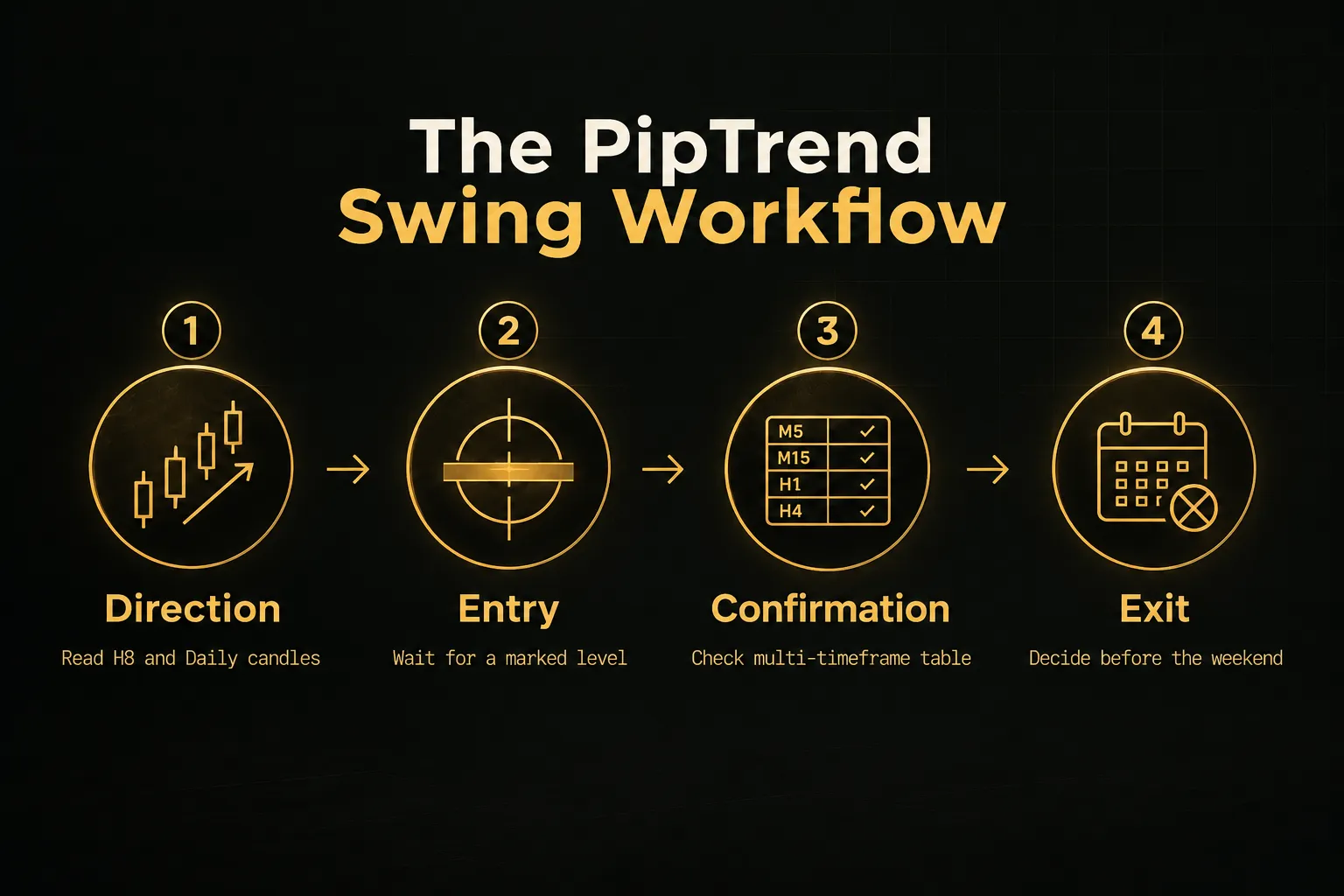
The second design principle is signal and entry separation.
Direction comes from adaptive color-coded candles (green for bullish momentum, red for bearish pressure, gray while a trend is still forming).
Entry comes from a marked price level: session highs and lows, previous day high/low, VWAP, supply and demand zones with mitigation tracking, or fair value gaps.
Why does that separation matter for funded trading?
Because chasing a signal the moment it prints is how traders blow through a maximum daily loss limit.
Waiting for price to come back to a marked level turns impulse into process.
Signals confirm on candle close and do not change afterward, which addresses the repainting problem that makes many indicators useless for higher-timeframe decisions.
Results are published on a public page with verified cTrader statements, including losses and break-evens.
Not a highlight reel of winners, which is what most competitors show.
Pricing: $59.99/mo monthly, $45/mo on quarterly billing ($134.99 every 3 months), or $40/mo annually ($479.99/yr). There’s a 3-day free trial on all plans and a 30-day money-back guarantee, so you can test it on live charts before a challenge.
Best for: traders already inside a prop firm challenge, or preparing for one, who need a repeatable direction-entry-exit process rather than another funded account.
Honest drawbacks: it is not a prop firm, so it sets no drawdown rules and provides no capital. And at $59.99/mo on monthly billing, it costs more than some single-purpose indicators.
Coverage spans Forex, Crypto, Indices, Commodities, and Stocks, with TradingView alerting so you can get notified before market close or a weekend hold instead of watching charts.
FTMO: Best for No-Time-Limit Swing Challenges via the Dedicated Swing Account
FTMO is the strongest choice if you want a well-established forex prop firm brand and you select the correct account type.
That second clause is not optional.
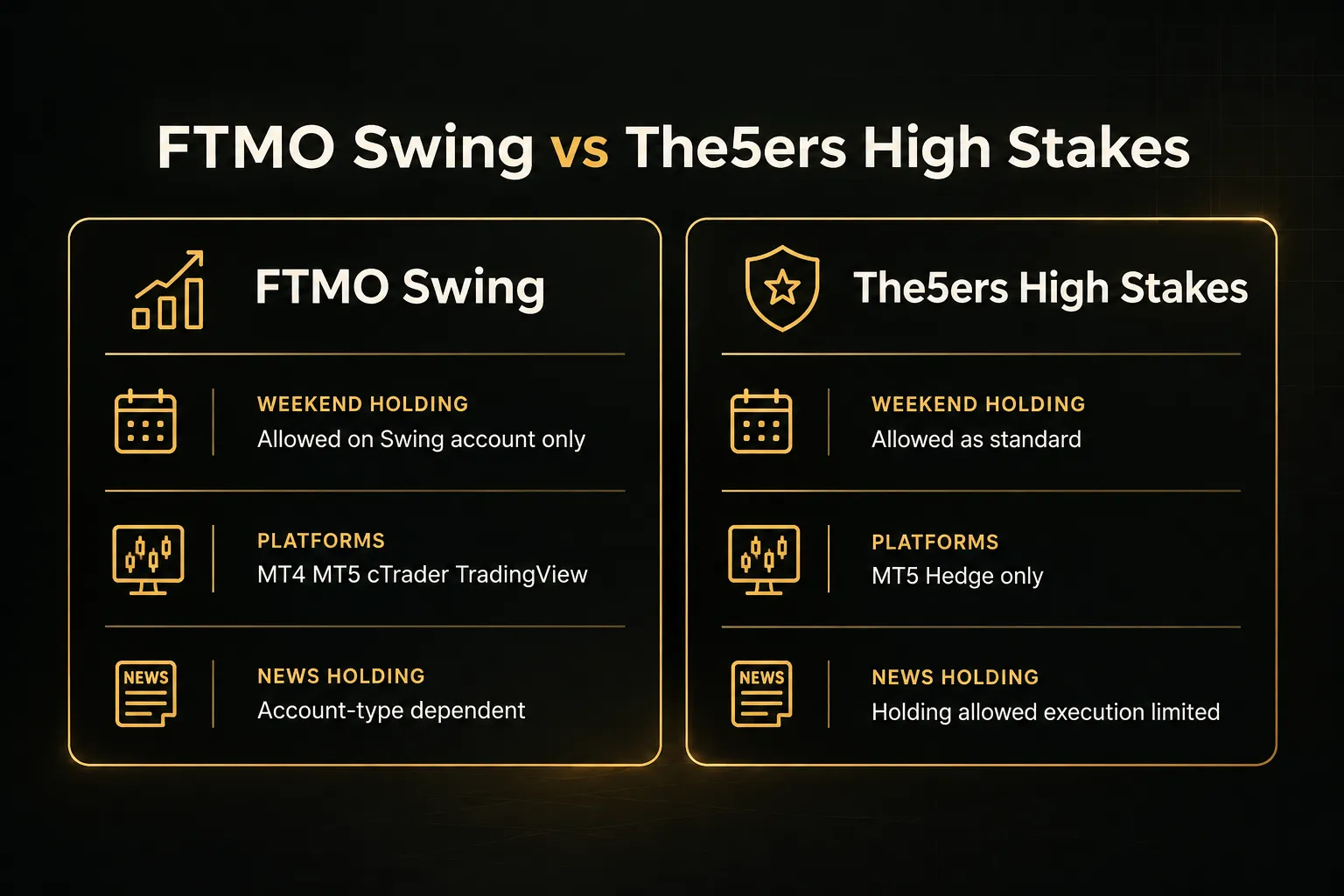
FTMO offers a dedicated Swing account that explicitly permits overnight and weekend holding.
The Standard account carries different restrictions around overnight, weekend, and news exposure.
Same firm, different rulebook.
There’s also no advertised time limit on the Challenge stage. For a strategy that might produce four or five quality setups a month, that removes the single biggest source of overtrading pressure in the funded trading challenge model.
Evaluation Stage Rules
FTMO runs 1-Step and 2-Step evaluation routes, with simulated capital from $10,000 to $200,000. Published objectives cover a maximum daily loss, a maximum overall loss, and a profit target, all stated clearly on the product page before purchase.
No time limit is advertised for the Challenge. You trade until you either hit the profit target or breach a loss limit, which suits slower position-holding styles.
Platform choice is genuinely broad: MT4, MT5, cTrader, and TradingView. If you already run your analysis in TradingView, that last option removes a whole layer of friction between chart and order ticket.
Funded Stage Swing Rules (Swing Account vs Standard Account)
This is the section that decides whether FTMO works for you.
On the Swing account, overnight and weekend holding is permitted, which is the entire reason the account type exists.
On Standard funded accounts, overnight, weekend, and news-related restrictions differ. A legitimate multi-day hold on a Standard account can put you on the wrong side of the rulebook even when the trade itself is profitable.
Pricing: a one-time challenge fee that varies by account size, account type, platform, and currency.
FTMO states that 2-Step fees can be refunded with your first reward withdrawal.
Pull the exact number from FTMO’s live configurator rather than trusting any static figure, including ours.
Rewards go up to a 90% profit split on simulated profits.
Best for: traders who want brand recognition, platform flexibility, and no evaluation deadline, and who will deliberately select the Swing account.
Honest drawback: the Standard-versus-Swing distinction is easy to miss at checkout, and getting it wrong can silently disqualify a perfectly good trade. Drawdown rules are also strict relative to some newer firms.
The5ers: Best for Overnight and Weekend Holding on the High Stakes Program
If weekend flexibility is your single hardest requirement, The5ers High Stakes program is the better fit.
It doesn’t merely tolerate multi-day holds.
It’s built around them.
High Stakes explicitly allows overnight and weekend holding, and it permits holding open positions through news events.
That last point is rare.
Most firms treat news exposure as a breach trigger rather than a normal part of position trading.
One qualifier: while holding through news is allowed, order execution around high-impact news may still be restricted. Read that as “you can keep the position, but don’t plan to open one two seconds before CPI.”
High Stakes Evaluation Rules
High Stakes runs a two-step evaluation with defined profit targets and loss limits at each stage. There’s no fixed account expiry, so you’re not racing a 30-day clock.
But there is a 30-day inactivity rule.
That’s a real consideration for slower swing and position strategies that might legitimately sit flat for weeks waiting on a setup.
Markets available on High Stakes cover FX, metals, indices, oil, and crypto, which gives you enough breadth to find setups across correlated and uncorrelated instruments.
Funded-Stage Overnight, Weekend & News Rules
The funded stage keeps the flexibility.
Overnight holds, weekend holds, and positions carried through news releases are all permitted, which is the whole point of choosing this program over a stricter firm.
Watch the swap fees.
The5ers notes that index positions held over weekends can incur high swaps, and that cost is charged against your account equity.
Three weekends in an index position can quietly erode your buffer against the maximum loss limit.
Pricing: varies by account size and program. No single fixed price applies, so verify the live High Stakes checkout before you buy.
Best for: swing and position traders who need genuine weekend and news flexibility across FX, metals, indices, and oil.
Honest drawbacks: weekend swaps on indices can be significant, and High Stakes lists 1:100 leverage with MT5 Hedge as the platform. If you rely on cTrader or TradingView-native execution, that’s a constraint.
LuxAlgo: Best All-in-One Charting Platform for Backtesting Swing Setups
LuxAlgo is the pick if you want to build and validate your own swing system before risking prop firm capital. The quant tools, order-flow suite with historical lookback, and webhook automation make it a research platform more than a signal service.
That’s its strength.
You can define a rule set, backtest it across historical data, and see whether your swing edge actually survives contact with multi-week holds.
Pricing: a free tier is available.
Premium runs $67.99/mo ($479.88/yr), Ultimate $119.99/mo ($719.88/yr), and AI Ultra $229.99/mo ($1,439.88/yr).
Paid plans carry a 30-day money-back guarantee.
Best for: advanced traders who want to engineer their own rules-based system rather than follow a prescriptive direction-entry-exit workflow.
Honest drawback: the breadth of features means you define and enforce every rule yourself.
There’s no built-in prop-firm risk framework, no guardrail telling you a setup conflicts with your daily loss limit.
At AI Ultra pricing, it’s also the most expensive tool in this list on a monthly basis.
Flux Charts: Best for Price Action and Multi-Timeframe Supply/Demand Zones
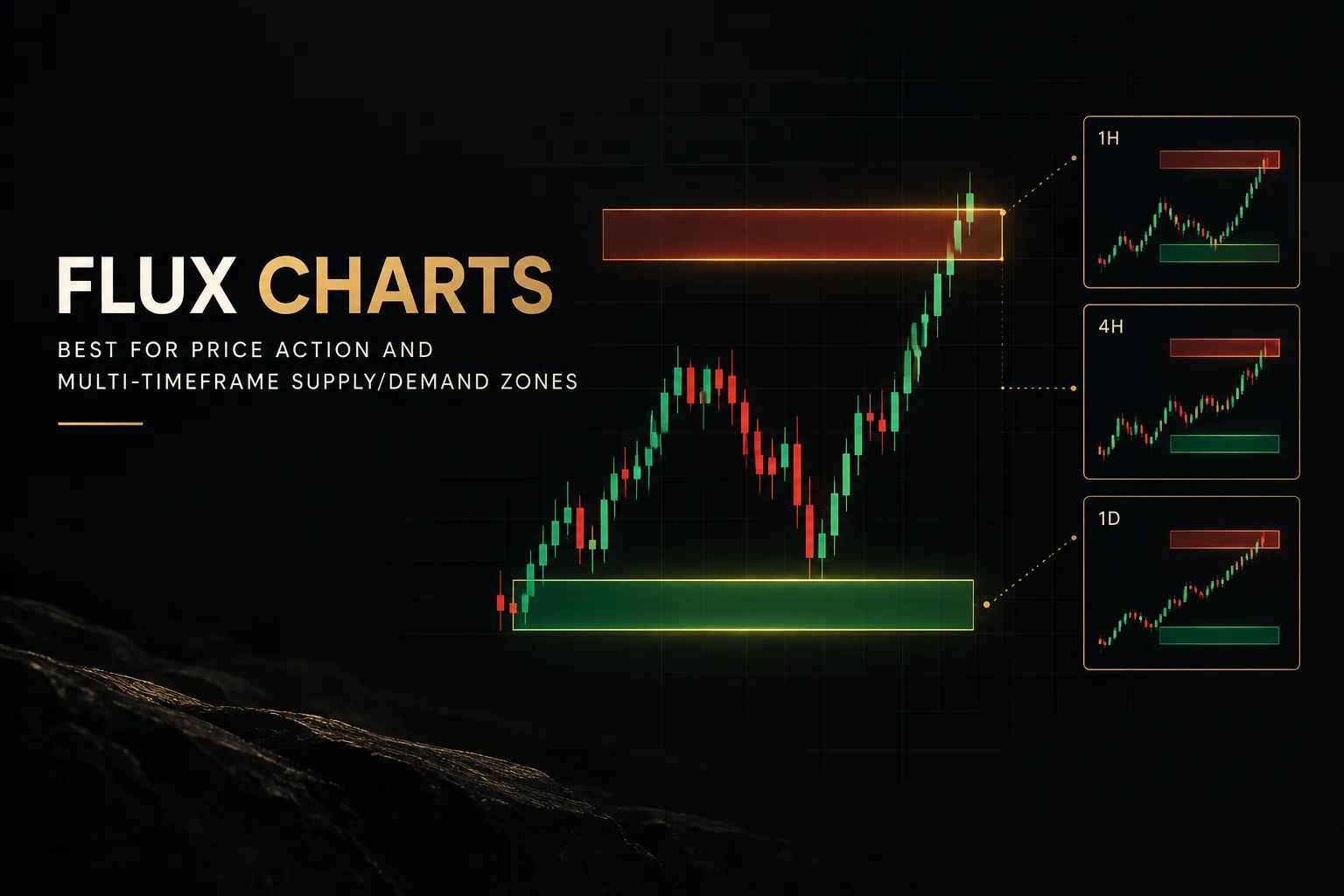
Flux Charts earns its place on the strength of its multi-timeframe Supply & Demand Zones Toolkit. For swing traders who map entries off higher-timeframe zones, that’s the core job done well.
The Price Action Toolkit adds FVGs, IFVGs, order blocks, breaker blocks, BOS and CHoCH structure shifts, and liquidity levels. There are also three toolkit backtesters, screeners, structural alerts, and a Discord community with daily classes.
Pricing: the Pro plan is listed around $59.99/mo when billed annually ($719.88/yr). Monthly and lifetime options appear at checkout, so confirm the live amounts there.
Best for: smart-money-concept traders who want a large modular toolkit and are comfortable assembling their own confirmation process.
Honest drawback: module breadth cuts both ways.
Stack enough zones, screeners, and structure overlays and the chart stops giving you one clear direction signal.
Under a tight prop firm drawdown limit, ambiguity is expensive.
ChartPrime: Best for Signal-Based Entries With Built-In TP/SL Levels
ChartPrime is the most beginner-friendly option here, because it hands you signals with predefined TP and SL levels attached.
Less interpretation required.
The Pro membership includes four core indicators, real-time signals with TP/SL, five weekly strategy sessions, daily market insights, and private community access. The Plus tier adds extra indicators, influencer indicators, custom signal creation, and technical analysis classes.
Pricing: Pro is $67/mo or $489 billed yearly (roughly $40/mo equivalent). Plus is $117/mo or $708 yearly (roughly $59/mo equivalent).
Best for: traders who want a signal-driven TradingView membership paired with community education instead of building a system from scratch.
Honest drawback: before you rely on these signals for funded trading, verify three things.
How they behave on H8, Daily, and Weekly charts, whether they repaint, and whether the default TP/SL distances actually fit inside your prop firm’s maximum daily loss.
A stop that’s mathematically fine on a $200K account can breach a $10K one.
Zeiierman Trading: Best for a Large Multi-Tool Indicator Ecosystem
Zeiierman is the value pick for traders who want volume of tools rather than one prescribed method. Access covers 80+ premium TradingView tools.
That includes nine advanced buy/sell algorithms, an SMC premium indicator, liquidity signals, and two automated strategies or bots. Markets span stocks, forex, crypto, commodities, and indices, and the tools work on TradingView’s free plan.
Pricing: the pricing page lists Wizard access around $49/mo, $59.99/mo billed quarterly, and $37.99/mo billed annually. Official documentation shows alternate and older membership pricing, so confirm the exact tier and amount at checkout.
Best for: traders who like exploring an extensive catalog and picking their own combination.
Honest drawback: 80+ tools will produce conflicting signals.
That’s not a flaw so much as a consequence of breadth, but it’s a real risk when a daily loss limit leaves no room for hesitation between two indicators disagreeing.
Market Cipher: Best for Crypto-Focused Swing Confirmation
Market Cipher is the specialist choice for crypto swing traders who want a recognizable confirmation system. The Market Cipher B oscillator combines multiple algorithms into one momentum read, paired with Market Cipher A for trend analysis.
The package also includes the SR support and resistance tool (designed for lower timeframes) and the DBSI strength index. TradingView compatibility extends across crypto, stocks, forex, futures, bonds, and precious metals, with a Discord community and education behind it.
Pricing: the Professional 12-month subscription is listed around $600 promotional ($1,000 regular). Lifetime sits around $1,500 promotional ($3,000 regular).
Best for: crypto and multi-asset swing traders who want an established, education-backed oscillator system with community support.
Honest drawback: the upfront cost is steep and there’s no flexible low-commitment monthly plan. Paying $600 to find out whether a workflow suits your prop firm challenge is a harsh way to test a hypothesis.
How to Match Your Swing Trading Style to the Right Prop Firm and Toolset
Three decisions, in order.
Pick FTMO’s Swing account if you want a widely recognized forex prop firm, no evaluation time limit, and platform choice across MT4, MT5, cTrader, and TradingView.
One condition: be absolutely certain you selected the Swing account and not Standard.
Screenshot the confirmation page.
Pick The5ers High Stakes if weekend and news-holding flexibility matters more than brand name.
It’s the better structural fit for position traders working FX, metals, indices, and oil, provided you can live with MT5 Hedge and 1:100 leverage.
Budget for weekend swaps on index holds.
Pair either firm with a workflow tool like PipTrend if your real problem isn’t the rulebook.
If you’ve failed a challenge before, ask what actually happened.
Was it a rule you didn’t know about?
Or was it inconsistent entries, unclear trend direction, and no plan for when to exit?
Most of the time it’s the second thing.
Here’s what the workflow looks like in practice.
Read direction from the H8 and Daily color-coded candles: green means you’re only looking for longs, red means only shorts, gray means the trend is still forming and you wait for a pullback to a level.
Then take the entry from a marked price level, not from the signal itself.
A supply or demand zone, a VWAP touch, a session high or low, or an unfilled fair value gap.
The signal tells you which way.
The level tells you where.
Finally, use the multi-timeframe table to decide whether to carry the position through a weekend.
If H8, Daily, and Weekly all still read the same direction on Friday, holding has a basis.
If Daily has flipped to NEUTRAL while H8 has turned, you’re holding hope through a gap risk window.
Now the part that catches most swing traders: trailing equity drawdown.
On many funded accounts, your maximum loss level rises as your equity peaks rise.
So a position that runs +2% and then pulls back to +0.5% during a normal overnight retracement hasn’t just given back profit.
It has moved you closer to a breach, because the drawdown floor moved up with your peak.
This is why defining your exit before entry is non-negotiable under trailing rules.
A retracement you’d happily hold in a self-funded account can be a rule violation in a funded one.
Know in advance which level makes you take partial profit.
Static drawdown accounts behave differently.
The loss floor is fixed from your starting balance, which is far friendlier to multi-day holds.
Check which model your firm uses before you size a single trade.
One last filter.
Don’t compare futures prop firms against forex and CFD firms as if they’re the same product.
Futures firms are frequently stricter on overnight and weekend exposure, sometimes requiring flat positions before daily close or Friday settlement.
Several popular firms not covered in this list fall into that category, and their rules will end a swing strategy on day one.
FAQ
What is the best prop firm for swing trading?
FTMO’s Swing account is the best prop firm for swing trading in 2026 for most traders, because it explicitly permits overnight and weekend holding, advertises no time limit on the Challenge, and supports MT4, MT5, cTrader, and TradingView with up to a 90% profit split.
The5ers High Stakes is the stronger pick if holding through news events is central to your strategy. And whichever firm you choose, pairing it with a defined execution workflow like PipTrend addresses the failure mode that actually ends most challenges: inconsistent entries and exits, not rule ignorance.
Which prop firms allow overnight holding?
FTMO’s Swing account and The5ers High Stakes program both allow overnight holding at the funded stage. Those are the two firms in this list verified for it as of January 2026.
FTMO’s Standard account carries different overnight restrictions, so the permission is account-type specific rather than firm-wide.
Futures-focused prop firms are generally stricter and often require positions to be flat before daily close.
Always confirm on the funded account rulebook, not the challenge sales page.
Can I hold trades over the weekend with FTMO?
Yes, but only on the FTMO Swing account. The Swing account type exists specifically to permit overnight and weekend holding.
FTMO Standard funded accounts have different overnight, weekend, and news restrictions.
This is the single most commonly missed detail in FTMO’s product structure, and it’s easy to select the wrong type at checkout while assuming the privileges carry over.
They don’t.
If weekend holds are part of your strategy, verify the account type on your purchase confirmation before you place your first trade.
Does The5ers allow news trading and weekend holding?
Yes on both counts for the High Stakes program, with one execution caveat. The5ers permits holding open positions through news events and allows overnight and weekend holding.
The caveat: order execution around high-impact news may still be restricted, even though holding an existing position is fine. Practically, that means you can carry a trade into a release but shouldn’t plan on opening one at the moment of publication.
Budget for costs too.
The5ers notes that index positions held over weekends can incur high swaps, charged against your equity.
On a multi-week index hold, those swap fees add up against your loss buffer.
What is the safest prop firm for swing traders?
The safest choice is the firm with the clearest published rule disclosure and the longest verifiable payout track record, which among the firms here means FTMO. Its objectives, account-type differences, and platform options are documented publicly rather than buried in a support ticket.
Judge safety on four things.
Regulatory status and corporate transparency.
Whether the capital is simulated (in most prop firm models it is, and firms should say so plainly).
A documented payout policy with a real withdrawal history.
And rule disclosure specific enough that you can tell before purchase whether your strategy is allowed.
Marketing claims about being “trader-first” tell you nothing.
A clearly written page explaining exactly how trailing drawdown is calculated tells you a great deal.
Are prop firms worth it for swing traders?
Yes, if the challenge cost is small relative to the capital you’d otherwise need and the funded-stage rules genuinely fit your holding period. A one-time fee for access to $100,000 in simulated capital with a high profit split is reasonable leverage on a proven edge.
They’re not worth it in two situations.
First, if the rules conflict with your strategy, because you’ll pay repeatedly for challenges you were structurally set up to fail.
Second, if you don’t yet have a repeatable process, since a funded account just compresses the timeline on an inconsistent approach.
Prop firm capital rewards process, not potential. Fix your entry and exit rules first, then pay for the challenge. The order matters more than the firm you pick.
Self-funded trading avoids fees and rule risk but caps your position size at whatever you can afford to lose.
Prop firms invert that trade-off.
Either way, a disciplined execution workflow, direction from higher timeframes, entries from marked levels, exits defined before entry, improves the odds more than any firm’s profit split ever will.
Risk Disclaimer: Trading involves risk. Past performance doesn't guarantee future results. Only trade with money you can afford to lose. PipTrend is a tool to assist your trading decisions, not financial advice.