On this page
FTMO vs Topstep: Which Prop Firm Wins?
FTMO vs Topstep: Which Prop Firm Wins?
FTMO vs Topstep: The Quick Verdict
Neither firm is universally better.
The decision comes down to three things: which market you actually trade, whether you prefer a one-time fee or a monthly subscription, and whether you can live with a trailing drawdown.
FTMO wins for forex and multi-asset traders.
One-time evaluation fee (reimbursed with your first payout), unlimited trading time, and a static daily loss limit that behaves the same way every single session.
If you trade EUR/USD, XAU/USD, indices, or CFDs, Topstep is not even in the running.
It does not offer those markets.
Topstep wins for dedicated futures traders.
The Trading Combine into Express Funded into Live Funded path on TopstepX is purpose-built for ES, NQ, CL, and GC traders.
The tradeoff is a recurring bill that keeps arriving until you pass, fail, or cancel.
Most prop firm comparison articles blur two things they should not.
FTMO sells a 1-Step Challenge and a 2-Step Challenge with different targets and pricing. Topstep sells a Standard Path (cheaper monthly, $149 activation fee after passing) and a No Activation Fee Path (higher monthly, no activation charge).
Comparing “FTMO” to “Topstep” without naming the product is meaningless.
This guide separates them first, then compares like for like.
And rather than stopping at headline profit splits, we calculate what passing actually costs.
Monthly rebills, prop firm reset fees, activation fees, and the break-even point where Topstep’s subscription overtakes a single FTMO attempt.
That number surprises most traders.
FTMO vs Topstep at a Glance
This table is your scanning reference. No winner declared here, just the raw specs side by side.
| Factor | FTMO | Topstep |
|---|---|---|
| Evaluation model | 1-Step or 2-Step Challenge (Challenge → Verification → Funded) | Trading Combine → Express Funded → Live Funded |
| Markets | Forex, CFDs, indices, commodities, stocks, crypto-linked instruments (varies by jurisdiction) | Futures only |
| Account sizes | $10,000 to $200,000 | 50K, 100K, 150K buying power |
| Starting price (100K) | ~€540 one-time, 2-Step (reimbursed with first reward) | $99/mo Standard Path or $149/mo No Activation Fee Path |
| Max daily / trailing loss | 5% static max daily loss; 10% static max loss (2-Step) | Trailing maximum drawdown during Combine; optional daily loss limit |
| Profit target | 10% Stage 1, 5% Verification (2-Step); single higher target on 1-Step | Combine profit target plus 55% consistency target |
| Max profit split | Up to 90% advertised on current 1-Step materials | Express Funded Standard and Consistency payout paths |
| Platform | MT4, MT5, cTrader, DXtrade compatibility | TopstepX (proprietary), futures data feed included |
| Time limit | Unlimited trading period | No hard deadline, but billing continues monthly |
| Best for | Forex and multi-asset traders wanting one-time cost | Futures specialists wanting a structured funded track |
One thing both firms share, and it matters: the advertised account size is a simulated balance, not real cash sitting in your name. A “$100,000 funded account” is a performance-based payout arrangement measured against a simulated trading evaluation.
Neither firm is handing you a brokerage account with six figures in it.
Meet FTMO and Topstep
What Is FTMO?
FTMO is a Prague-based forex prop firm that has been running evaluations since 2015, making it one of the longest-operating names in the space. You pay a one-time fee, pass a Challenge on a simulated account, and receive a funded trading account with a reward split on profits generated.
The core product is the 2-Step Challenge: hit a 10% profit target in Stage 1, then a 5% target in the Verification stage. Both stages carry a 5% maximum daily loss and a 10% maximum loss limit, with a four-day minimum trading requirement and, importantly, no time limit.
There is also a 1-Step Challenge with a single evaluation stage and a higher target.
Instrument access is the real differentiator.
Forex majors and minors, CFDs, indices, commodities, individual stocks, and crypto-linked instruments depending on product and jurisdiction.
If your edge is in GBP/JPY at the London open, or gold, or NAS100, FTMO covers it.
Platform flexibility follows the same pattern. MT4, MT5, cTrader, and DXtrade compatibility means most existing workflows transfer over without rebuilding anything.
The support ecosystem is genuinely useful too: a free trial, a trading journal, an equity simulator, an economic calendar, account analytics, and trading psychology resources.
Not marketing fluff.
Traders use the journal and analytics to spot the behavioural patterns that blow evaluations.
The honest limitation?
Rule differences between the 1-Step and 2-Step products are easy to misread, and the daily-loss and best-day conditions need careful reading before you place a single order.
What Is Topstep?
Topstep is a Chicago-based futures prop firm built around the Trading Combine, a subscription-based evaluation that leads to an Express Funded Account and, eventually, potential Live Funded status.
The progression is clearly defined.
Pass the Combine by hitting the profit target while respecting the maximum loss limit and the 55% consistency target.
Move to an Express Funded Account.
Build a payout history.
Progress toward Live Funded.
Account options come in three sizes: 50K, 100K, and 150K buying power. Everything runs on TopstepX, Topstep’s proprietary platform, with futures market data included in the subscription.
That bundled data feed matters more than it sounds, since CME data subscriptions are a real cost for independent futures traders.
Topstep’s structural advantages are specific rather than broad.
A trading environment designed for futures instead of a general multi-asset simulator. An optional daily loss limit you can set yourself. Reset options after a failed Combine. And the Back2Funded reactivation program, which gives traders who lost a funded account a defined route back.
The constraint is obvious and unavoidable: futures only.
No spot forex, no CFDs, no stock trading.
If you want to trade EUR/USD, Topstep cannot help you.
The second constraint is cost structure.
The bill arrives every month you remain in the Combine.
A trader who takes six months to pass pays six times.
Evaluation Cost: The Real Price of Passing
WINNER: FTMO, on cost predictability. A one-time fee you can budget for beats an open-ended subscription that scales with how long you struggle.
Here is the comparison most articles skip, with both firms’ product variants separated out properly.
| Cost item | FTMO 2-Step (100K) | FTMO 1-Step | Topstep Standard Path (100K) | Topstep No Activation Fee (100K) |
|---|---|---|---|---|
| Upfront / recurring | ~€540 one-time | ~$89 to $1,149 one-time by size | $99 per month | $149 per month |
| Activation fee | None | None | $149 after passing | None |
| Fee reimbursed? | Yes, with first reward if conditions met | Yes, per current terms | No | No |
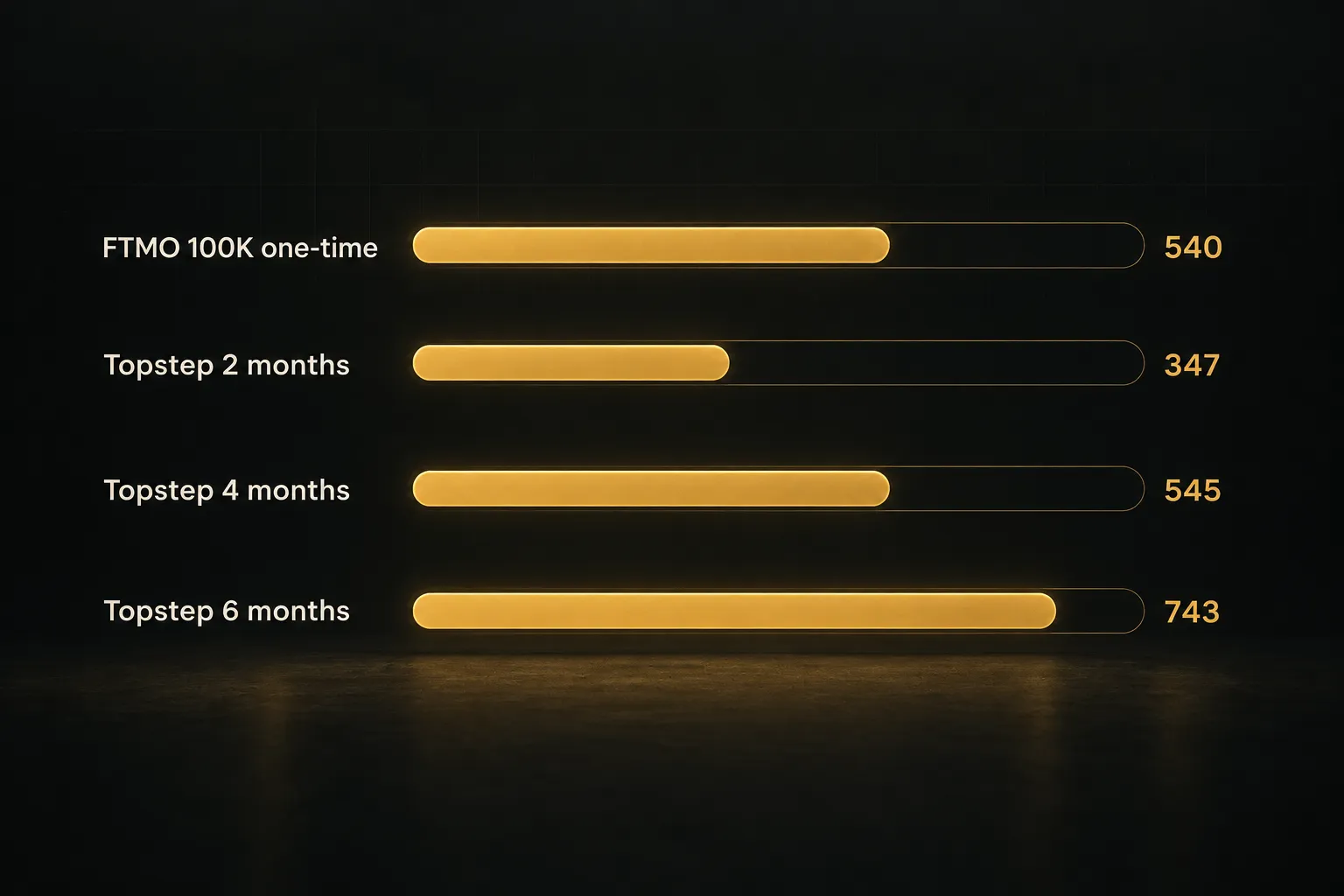
| Cost if you pass in 1 month | ~€540 (refundable) | Varies by size (refundable) | $248 | $149 |
| Cost if you pass in 4 months | ~€540 (refundable) | Varies by size (refundable) | $545 | $596 |
| Cost if you pass in 6 months | ~€540 (refundable) | Varies by size (refundable) | $743 | $894 |
| Reset fee | Charged separately per attempt | Charged separately per attempt | Charged separately | Charged separately |
Read the bottom rows carefully.
That is where the funded account fees story lives.
The break-even point sits around 5 to 6 billing cycles.
At $99 per month on Topstep’s Standard Path, a trader crosses the rough €540 equivalent of a single FTMO 100K 2-Step attempt somewhere in month five or six, before counting the $149 activation fee or any resets.
On the No Activation Fee Path at $149 per month, you get there in under four months.
Now add the reimbursement.
FTMO returns the evaluation fee with your first successful reward payout when conditions are met. Topstep’s monthly subscription fees are gone the moment they clear.
Only the activation fee is avoidable, and only by paying a higher monthly rate that costs more than the activation fee after roughly three months.
That asymmetry is the single biggest financial difference between these two prop firms.
But the subscription model is not purely a drawback.
Paying $99 to test a futures strategy for one month is a far lower entry barrier than €540 upfront. Traders who want to try, fail cheaply, and walk away lose less with Topstep.
Traders who expect to grind for several months lose considerably more.
Resets deserve their own line in your budget.
Both firms charge for them.
If you realistically expect two or three attempts before passing, double or triple whichever number applies to you.
A trader who needs three FTMO attempts spends roughly €1,620. A Topstep trader who resets twice across five months of subscription is in a similar hole.
Budget rule: assume you will need two attempts, not one. If the two-attempt total still makes sense against your expected payout, the evaluation is worth starting. If it only works assuming a first-time pass, you are underfunded for the attempt.
One more note on FTMO’s 1-Step pricing.
Current promotional pricing has shown roughly $89 to $1,149 depending on account size, which is a wide band.
Check the live page before assuming a number, because promotional cycles move these figures regularly.
Drawdown Mechanics: Trailing vs. End-of-Day Rules
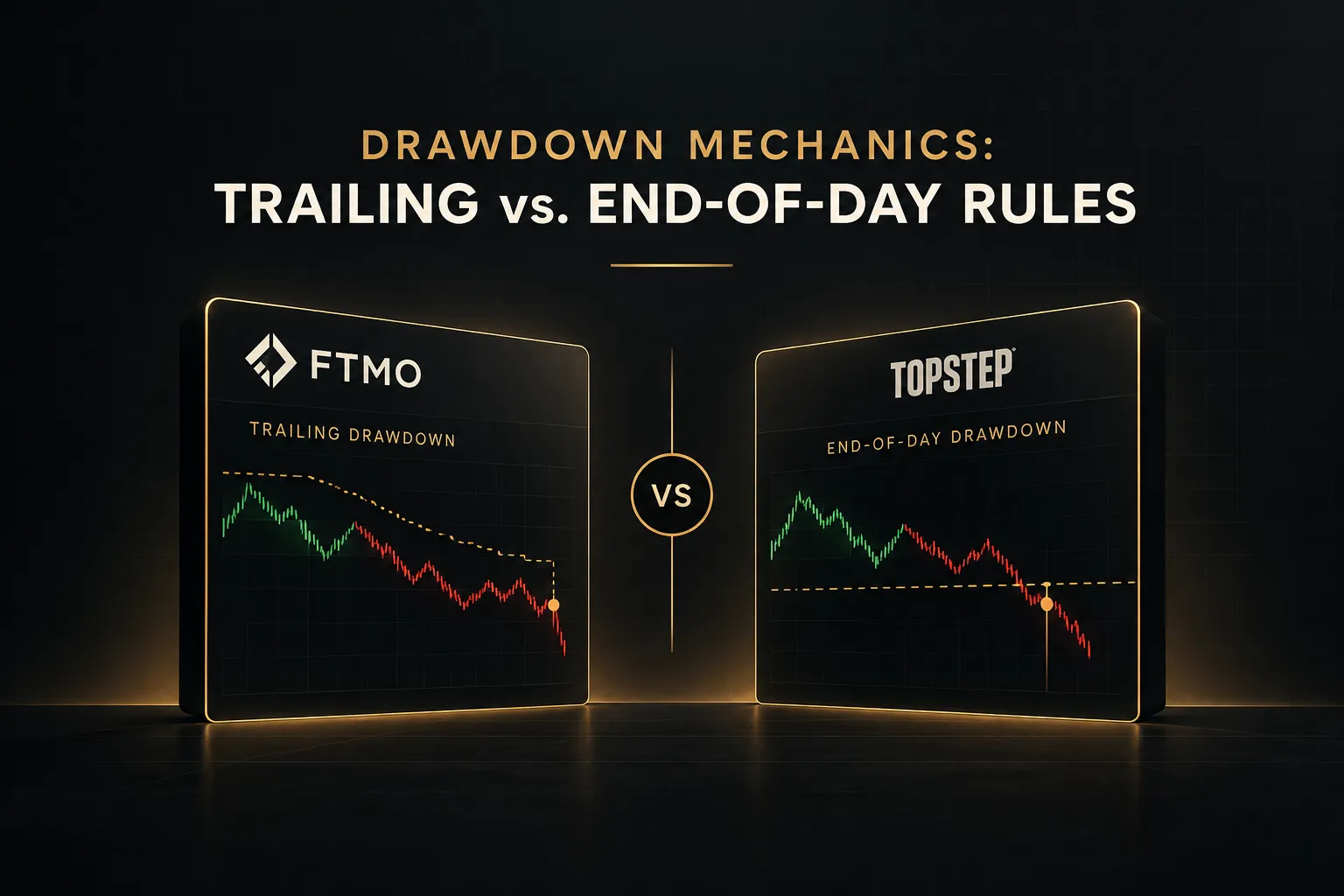
TIE, and it is entirely context-dependent. This is the section where “which firm is better” genuinely becomes “which firm matches how you trade”.
FTMO’s core 2-Step product uses static limits: a 5% maximum daily loss and a 10% maximum loss limit. Topstep’s Trading Combine uses a trailing maximum drawdown that follows your account equity upward and then locks at end-of-day once a profit threshold is reached.
| Scenario on a $100,000 account | FTMO (static) | Topstep (trailing) |
|---|---|---|
| Day 1 risk budget | $5,000 daily loss cap, fixed | Trailing threshold set from starting balance |
| After banking $3,000 profit | Still $5,000 daily cap; overall floor unchanged at $90,000 | Drawdown floor rises with the account as gains lock in |
| Unrealized $2,000 open profit given back | No impact on limits; only realized and floating loss against the cap counts | Trailing room can tighten, shrinking available risk |
| Room after a losing day | Resets to a full $5,000 the next session | Floor stays where it locked; room does not reset upward |
| Breach consequence | Evaluation closed immediately | Combine closed immediately |
The practical effect is easiest to see in a single sentence.
On FTMO, your worst-case loss is known before you open the platform.
On Topstep, your worst-case loss depends on what you did last week.
Say your Topstep trailing drawdown room sits at $2,000. You run profits up, the end-of-day balance locks higher, and suddenly that room has tightened to $1,000.
Same account, half the risk budget, and no announcement.
Static rules suit high-frequency traders and scalpers. When you take twelve trades a day, a fixed daily loss cap lets you size positions with arithmetic instead of guesswork.
Risk 0.5% per trade, know exactly how many losers you can absorb, done.
The trailing model suits profit-locking swing traders.
If you bank gains and stop, the drawdown floor climbs with you and you build genuine cushion.
If you routinely give back mid-session profit, the trailing mechanic punishes that habit harder than any static rule ever would.
Both firms run simulated trading evaluations, which changes the consequence of a breach. There is no margin call, no broker liquidating positions into a thin market.
The evaluation simply closes.
Clean, immediate, and final.
Topstep also offers an optional daily loss limit you can configure yourself.
Worth using.
It converts part of the trailing model’s ambiguity into something closer to FTMO’s predictability, which is exactly what most traders need during a high-pressure Combine.
The verdict by style, not overall: traders who build around a fixed daily risk budget should prefer FTMO. Traders who naturally take profit early and protect gains should prefer Topstep’s trailing model, because it rewards exactly that behaviour.
Market Access, Platforms, and Payout Rules
Market Access: Forex/Multi-Asset vs. Futures-Only
WINNER: FTMO, decisively, on breadth. Forex majors and minors, CFDs, indices, commodities, individual stocks, and crypto-linked instruments depending on jurisdiction and product.
Topstep offers futures.
Only futures.
That sounds like a knockout, but it is not.
Futures specialists trading ES, NQ, CL, or GC need a futures prop firm, and FTMO is not built for that workflow.
For those traders the comparison is over before it starts.
Topstep by default.
The breadth question matters most for traders whose edge moves between instruments. If your setups fire on XAU/USD one week and US30 the next, FTMO’s instrument list is the only one of the two that supports it.
Platform Compatibility and Automation Rules
WINNER: FTMO, on flexibility. MT4, MT5, cTrader, and DXtrade compatibility means your existing charts, templates, and execution habits carry over.
That flexibility also makes TradingView-to-broker workflows and webhook configurations easier to set up, since multiple bridge options exist across those platforms.
More choice, more integration paths.
Topstep runs on TopstepX, its proprietary platform, with futures data included.
The upside is a purpose-built futures environment with everything preconfigured.
The downside is that you use what Topstep provides, and automation and trade copier rules are more tightly restricted on TopstepX than on a general multi-asset broker setup.
FTMO’s own rules on automated trading and EAs vary by product and must be verified for your specific account.
Do not assume.
Read the current terms for the exact Challenge you buy.
Third-party charting is a different matter.
Traders on both firms commonly run TradingView indicators for analysis while executing on the firm’s required platform.
Analysis in one window, execution in another.
That combination is standard practice and sidesteps most automation restrictions entirely, because nothing is being automated.
Payout Structure and Profit Splits
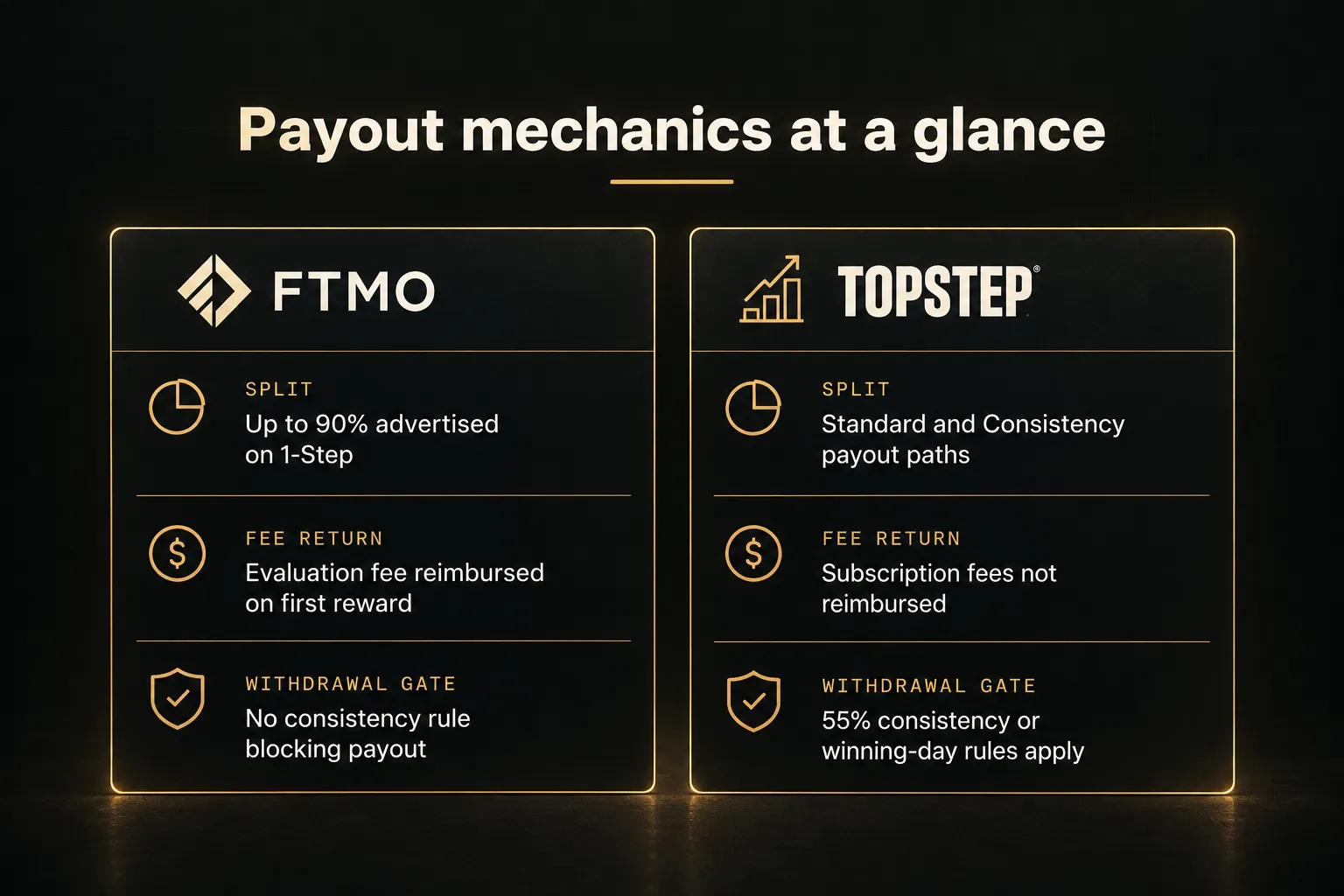
WINNER: FTMO, on simplicity and headline size. Current 1-Step materials advertise rewards of up to 90%, with the evaluation fee reimbursed on the first payout when conditions are met.
No consistency rule sits between you and a withdrawal on FTMO’s standard model. Hit the target, respect the limits, request the reward.
Topstep’s Express Funded payouts split into a Standard path and a Consistency path.
Both attach conditions before profit becomes eligible for withdrawal, involving winning-day requirements or the 55% consistency benchmark.
That benchmark means no single day can account for too large a share of your total profit.
The consistency rule is not arbitrary.
It filters out traders who got lucky once on a news spike, and it genuinely encourages the steady approach that keeps funded accounts alive.
But it makes payout timing less predictable.
A trader with one outstanding day and four flat ones may hit a profit target and still wait, because the profit distribution fails the benchmark.
FTMO does not impose that gate.
One clarification worth repeating, because the marketing on both sides obscures it.
Neither firm’s advertised account size is real capital.
Both operate simulated environments that fund a performance-based payout. You are being paid for measured performance, not trading a brokerage balance with your name on it.
That is not a criticism of either firm, it is simply how modern prop firm evaluations work.
Who Should Choose What
Match the firm to your actual trading, not to whichever review sounded most enthusiastic.
- Choose FTMO if you trade forex, CFDs, indices, commodities, or stocks; you want a one-time fee instead of a monthly bill; and you need unlimited time to reach the profit target. Ideal for the trader who takes fifteen setups a month and refuses to force trades to beat a deadline.
- Choose Topstep if you trade futures exclusively, you want the defined Combine-to-funded track on TopstepX, and you are comfortable with a recurring subscription plus a possible activation fee. Best for the ES or NQ day trader who wants bundled futures data and a purpose-built platform.
- Choose FTMO’s 1-Step over the 2-Step if you are confident you can hit a single higher target quickly and want fewer stages standing between you and a funded trading account. Fewer stages means fewer chances to breach a rule on a bad afternoon.
- Choose FTMO’s 2-Step if you prefer the lower per-stage targets (10% then 5%) and do not mind the extra Verification phase. The staged structure suits traders who compound slowly.
- Choose Topstep’s No Activation Fee Path if you expect to pass within roughly three months and would rather pay $149 per month flat than $99 plus a $149 lump sum after passing. Beyond three months, the Standard Path costs less overall.
- Choose Topstep’s Standard Path if you expect a longer evaluation period. The $50 monthly saving compounds, and the activation fee is a one-off.
- Run both if you genuinely trade forex and futures. Nothing prevents holding an FTMO evaluation and a Topstep Combine at the same time. They are separate businesses with independent rule sets and no shared restrictions.
Traders Who Want a Repeatable Execution Process
Most failed evaluations are not caused by the firm’s rules.
They are caused by inconsistent entries, late signals, and emotional exits under the pressure of a ticking subscription or a sunk €540.
That is a process problem, not a prop firm problem.
PipTrend is a TradingView indicator system built around splitting the trade into three separate decisions: direction, entry, and exit. The smart signal engine gives direction only, printed as color-coded candles (green for bullish momentum, red for bearish, gray while a trend is still forming) with a whipsaw filter for choppy conditions.
The entry never comes from the signal itself.
It comes from a marked price level: session highs and lows, VWAP, supply and demand zones, or fair value gaps painted directly on the chart.
That separation is the point.
It stops traders from buying tops the instant a signal appears.
Exits are governed by the multi-timeframe confirmation table, which shows BUY, SELL, or NEUTRAL across 12 timeframes from 1-minute to Monthly.
Alignment tells you when to hold.
Divergence tells you when to take profit.
For traders working through a Challenge or Combine, that fixed rule set is what keeps position sizing and trade frequency inside drawdown limits instead of drifting with the day’s mood. Pricing runs $59.99/mo monthly, $45/mo billed quarterly, or $40/mo billed yearly, with a 3-day free trial and a 30-day money-back guarantee.
No indicator can guarantee passing any prop firm’s evaluation.
What a structured workflow does is remove the improvised decisions that cause most breaches.
FAQ: FTMO vs Topstep
Is FTMO better than Topstep?
FTMO is better for forex and multi-asset traders who want a one-time fee. Broader instrument access, unlimited trading time, static drawdown rules, and a fee that gets reimbursed with your first reward.
It is not better for dedicated futures traders.
Topstep’s Trading Combine, TopstepX platform, and bundled futures data are built for that asset class in a way FTMO simply is not.
Which is easier to pass, FTMO or Topstep?
Neither is objectively easier.
Difficulty depends on whether the rule set matches your style.
FTMO’s 5% static maximum daily loss and 10% maximum loss limit suit traders who work from a fixed risk-per-trade model, because the risk budget is identical every session. Topstep’s trailing drawdown suits traders who bank gains early and protect them, since the floor rises with the account.
Give back profit mid-session regularly and Topstep will be harder.
Overtrade on a bad day and FTMO will be harder.
Does Topstep pay more than FTMO?
FTMO generally nets more per payout cycle. The percentage split structures are broadly comparable, but two factors tip the balance.
First, FTMO advertises rewards of up to 90% on current 1-Step materials. Second, the evaluation fee is reimbursed with the first successful reward, which Topstep’s monthly subscription fees never are.
Topstep’s Express Funded payouts also run through Standard or Consistency paths with winning-day or 55% consistency requirements, so eligible profit can sit unavailable longer than under FTMO’s model.
What is the difference between FTMO and Topstep?
Three core differences: market focus, fee model, and drawdown mechanic.
FTMO covers forex, CFDs, indices, commodities, stocks, and crypto-linked instruments.
Topstep covers futures only.
FTMO charges a one-time evaluation fee; Topstep charges $49 to $229 per month depending on account size and path.
FTMO applies static daily and overall loss limits; Topstep applies a trailing maximum drawdown that locks at end-of-day.
Everything else, platforms, payout timing, consistency rules, follows from those three.
Can I use TradingView with FTMO or Topstep?
Yes, for charting and analysis with either firm. Running TradingView indicators alongside the firm’s required execution platform is standard practice and involves no automation at all.
Automated order routing is the part that needs care.
FTMO’s rules on EAs and automation vary by product, and Topstep restricts automation and trade copier use more tightly on TopstepX.
Confirm current bridge and automation policies directly with each firm before connecting any alert to a live order.
Which prop firm is best for forex and futures traders?
Forex traders should default to FTMO.
Futures traders should default to Topstep.
Neither firm meaningfully covers both markets.
If you actively trade both, holding accounts at both firms is the practical answer. They are independent businesses with separate rule sets, so running an FTMO Challenge and a Topstep Combine at the same time creates no conflict.
Just budget for both.
A €540 FTMO 100K attempt plus four months of Topstep at $99 is close to $950 before a single payout arrives, and that is the number worth planning around.
Risk Disclaimer: Trading involves risk. Past performance doesn't guarantee future results. Only trade with money you can afford to lose. PipTrend is a tool to assist your trading decisions, not financial advice.