Instant Funding Prop Firms: A Trader's Survival Guide
On this page
What Instant Funding Really Means
You pay a fee.
You get login credentials.
You can place a trade within minutes.
That is the entire pitch behind instant funding, and it sounds like the evaluation industry finally removed its biggest barrier.
An instant funding prop firm is a proprietary trading firm that grants trading access immediately after a one-time fee, skipping the multi-phase evaluation challenge entirely.
No Phase 1 profit target.
No Phase 2 verification.
No waiting period while a compliance team reviews your trade history.
Compare that to the traditional model.
There, a trader buys a challenge, hits a profit target of typically 8-10% while respecting a daily loss limit and a maximum drawdown, then repeats the process on a verification account before a funded trading account is issued.
Two hurdles, often 20-60 days, and a failure rate that most firms quietly place above 90%.
Instant funding removes those hurdles.
It does not remove the risk.
The constraints simply move somewhere else, and that somewhere is usually the drawdown rules and the payout gates.
This guide is not a ranking of firms.
Rankings rot within months as terms change, affiliate deals shift, and firms rebrand. Instead, you get a framework: how drawdown mechanics actually work, what the path to a first payout really looks like, the break-even math nobody puts on the sales page, and a due-diligence checklist to run before you hand over a card number.
One theme runs through all of it.
A $100,000 account label rarely equals $100,000 of usable risk.
The number in the account name is a marketing figure. The number in your daily loss limit is the one that decides whether you survive week three.
Understand that gap, and you will evaluate these offers the way a risk manager would rather than the way a hopeful trader does.
How the Instant Funding Model Works
Here is the arithmetic that catches most new buyers off guard.
On a $100,000 instant funding account with a 3% daily loss limit, your entire daily risk allowance is $3,000.
Not $100,000.
And if the total drawdown is 6%, your account dies after $6,000 of cumulative loss.
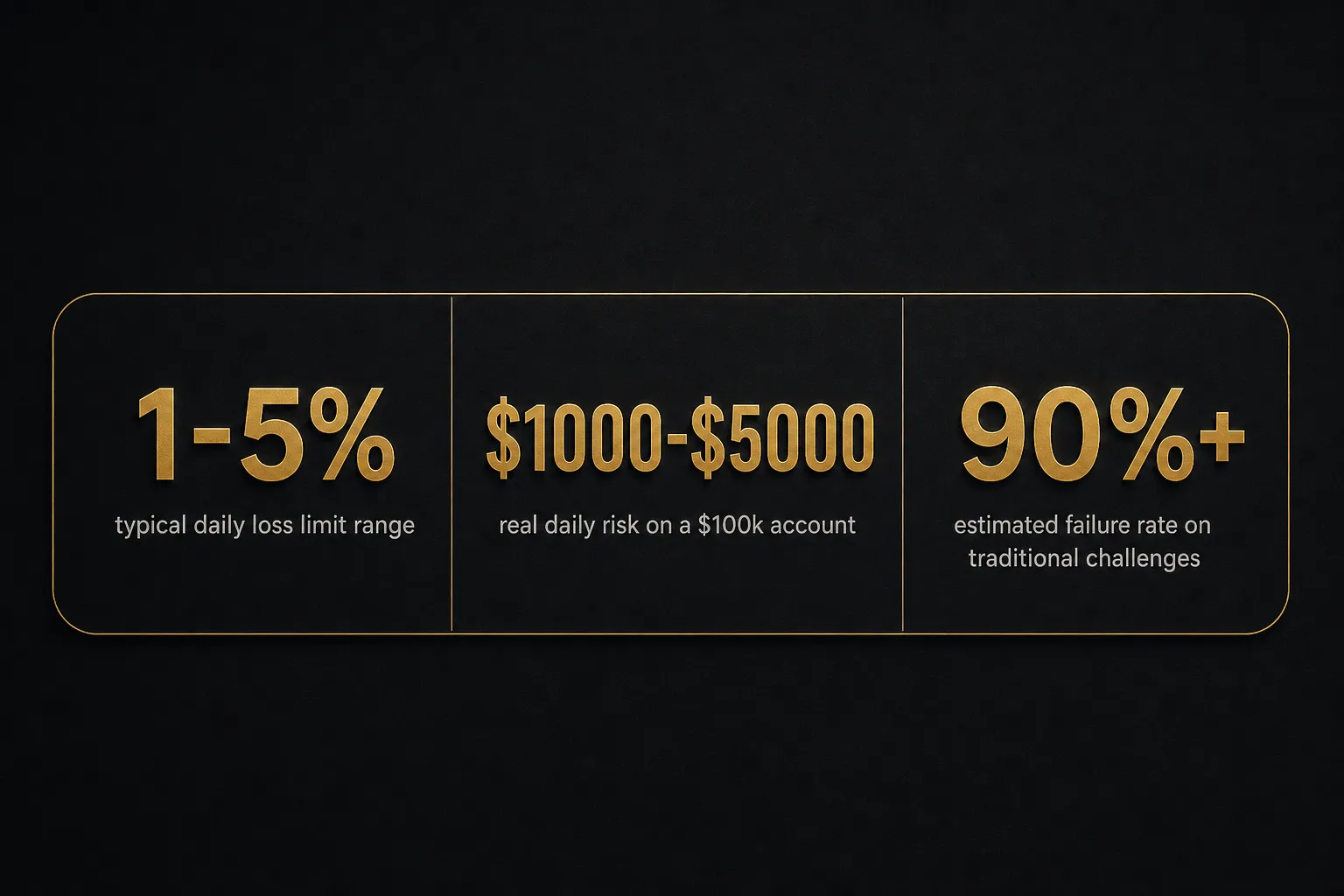
So the real capital you are managing, in terms of how much room you have to be wrong, is closer to $6,000 than six figures. Typical daily loss limits on instant funding products sit between 1% and 5%, which means a $100k label translates into roughly $1,000 to $5,000 of genuine daily risk.
That ratio matters enormously for position sizing.
If you normally risk 1% of a real account per trade, copying that habit here means risking $1,000 against a $3,000 daily ceiling.
Three losers and you are done for the day.
A maximum losing streak of five, which any honest trader has experienced, would breach the total drawdown before lunch on day two.
What You Actually Receive
Fees scale with two things: nominal account size and how favourable the rules are.
Tighter drawdown limits make accounts cheaper for the firm to issue, so they cost you less. Looser drawdown, faster payout threshold eligibility, or a higher profit split all push the price up.
A rough market picture as of 2026: a $25,000 instant account commonly sits in the $150-$300 range, a $50,000 account around $300-$600, and a $100,000 account anywhere from $500 to well over $1,200 depending on whether you buy add-ons.
Those add-ons are the interesting part.
Paying extra to remove a consistency rule, extend payout frequency, or raise the drawdown buffer is essentially buying back the restrictions the base product imposed.
What you receive is a set of credentials, a rulebook, and a contractual right to a share of profits generated within those rules.
Not capital.
Not a brokerage relationship.
A contract.
Real Money or Simulated Accounts?
Most instant funding accounts run on a simulated trading account, sometimes called demo infrastructure.
Your orders execute against a price feed inside the firm’s environment. The firm may mirror some flow to live markets with its own capital, may hedge selectively, or may not route anything at all.
This is not automatically a scam.
It is a business model.
The firm sells evaluation access, manages its own risk, and pays traders a profit share out of company funds. Plenty of firms disclose it plainly in their terms.
But the distinction changes three practical things.
Legal recourse, because you are a customer in a service agreement rather than a client of a regulated broker holding segregated funds. Tax treatment, because payouts typically arrive as contractor or service income rather than capital gains, depending on your jurisdiction.
And what “funded” guarantees, which is: nothing beyond the contract terms as written.
Read the terms.
If the document uses the word “simulated” or “demo” anywhere, you now know which model you bought.
Drawdown Rules That Decide Survival
Two traders take the identical trade on the identical instrument with identical size.
One keeps the account.
One gets breached.
The only difference is which drawdown model their firm uses.
That is not an exaggeration, and it is the single most underrated factor in choosing an instant funding product. The drawdown type determines whether your unrealized P&L can kill you, whether yesterday’s profit protects you, and whether commissions push you over the edge.
Five Drawdown Types Compared
| Drawdown Type | How It’s Calculated | Counts Floating P&L? | Trader Risk |
|---|---|---|---|
| Static (fixed) | Hard floor set at purchase, e.g. $94,000 on a $100k account. Never moves. | Usually yes, via equity | Lowest. Profits build a permanent buffer above the floor. |
| Daily loss limit | Resets each session, e.g. 3% from the day’s starting balance or equity. | Almost always yes | Moderate. One bad session ends the day, not the account. |
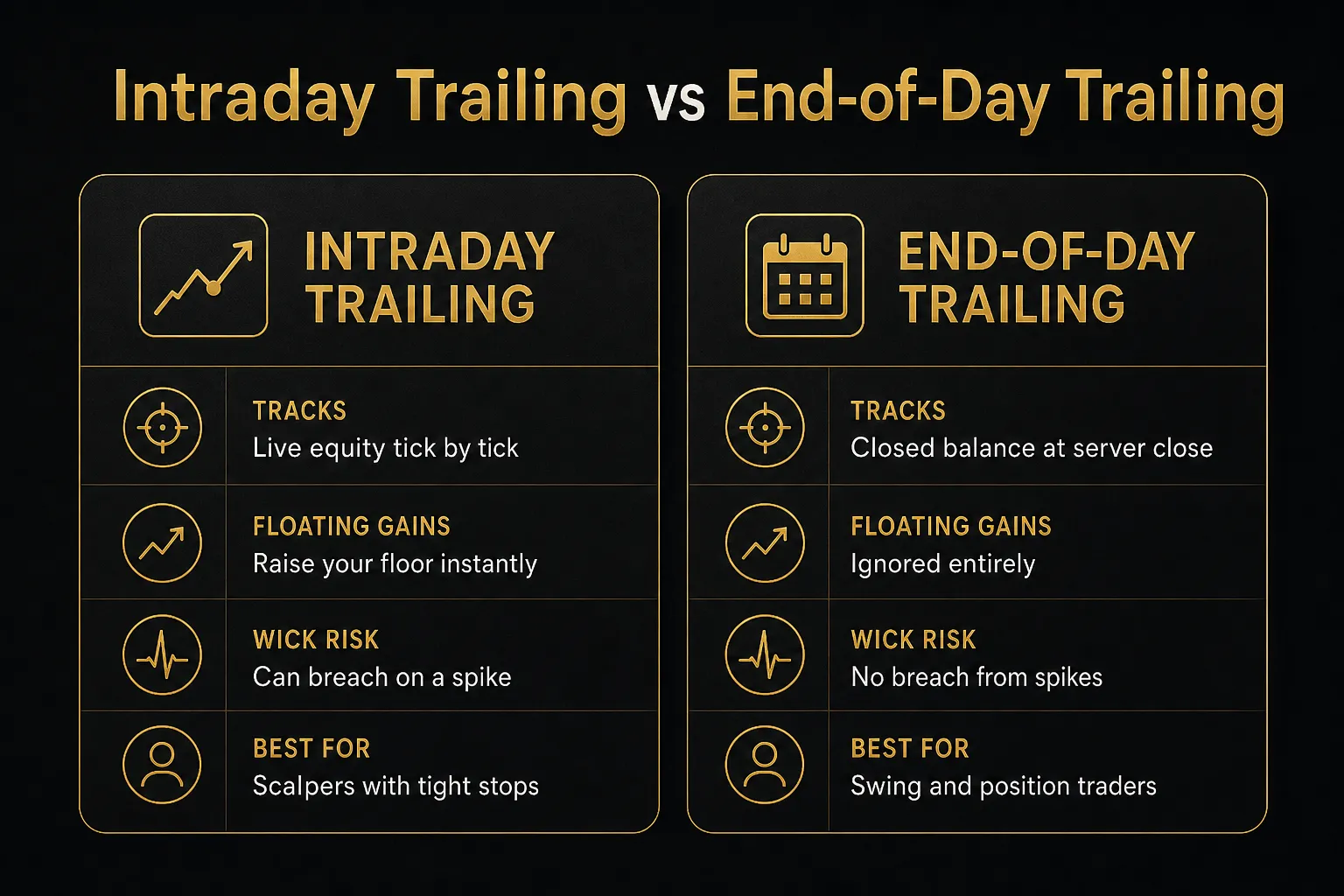
| End-of-day trailing | Floor trails your highest closed balance, updated once per day at server close. | No, only closed trades | Moderate. Intraday spikes are ignored; locked gains raise the floor permanently. |
| Intraday trailing | Floor trails your highest equity point in real time, tick by tick. | Yes, continuously | Highest. Unrealized peaks you never banked still raise the floor. |
| Balance-based | Measured only against closed-trade balance. | No | Lower. Open positions can swing without triggering a breach. |
| Equity-based | Measured against balance plus all open positions, including swaps and floating costs. | Yes | High. A stop-loss hunt or news wick can breach before you react. |
Two definitions get confused constantly.
The daily loss limit is a session-level circuit breaker; hit it and your positions close, but you usually trade again tomorrow.
Maximum drawdown is account-level and terminal; hit it and the account is gone.
Check whether costs count toward both.
At most firms, slippage and commissions, swap charges, and spread costs all reduce equity and therefore count toward a breach.
That means a $3,000 daily limit is functionally closer to $2,900 once a day of active trading fees lands.
How a Profitable Trade Can Still Fail
Picture an intraday trailing drawdown account.
$100,000 nominal, 5% trailing max, so the starting floor is $95,000.
You go long.
The position runs $2,000 in your favour, taking equity to $102,000. The trailing floor immediately ratchets to $97,000.
You did not close.
You did not withdraw.
You simply had a good unrealized moment.
Price reverses hard before the candle closes.
Your stop fills at a $1,200 loss, plus $80 in commissions.
Closed balance: $98,720.
You are up on the day, up on the week, and your trading journal shows a modest winner-turned-small-loser inside your plan.
Now run the same sequence with a wider adverse move.
Equity dips to $96,800 during the reversal. Under intraday trailing, that is a breach against a $97,000 floor, even though your closed-trade record never dropped below $98,720.
On an end-of-day drawdown account, the same trade is a nonevent.
The floor would only have updated to $95,000 or wherever your closed balance justified, and intraday equity swings are invisible to the rule engine.
Same trade.
Same trader.
Opposite outcome.
This is why maximum adverse excursion deserves a column in your journal.
If you know your typical winning trade goes $400 against you before working, you can rule out any firm whose drawdown structure cannot absorb that.
The rule type matters more than the headline account size.
Always.
From First Trade to Payout
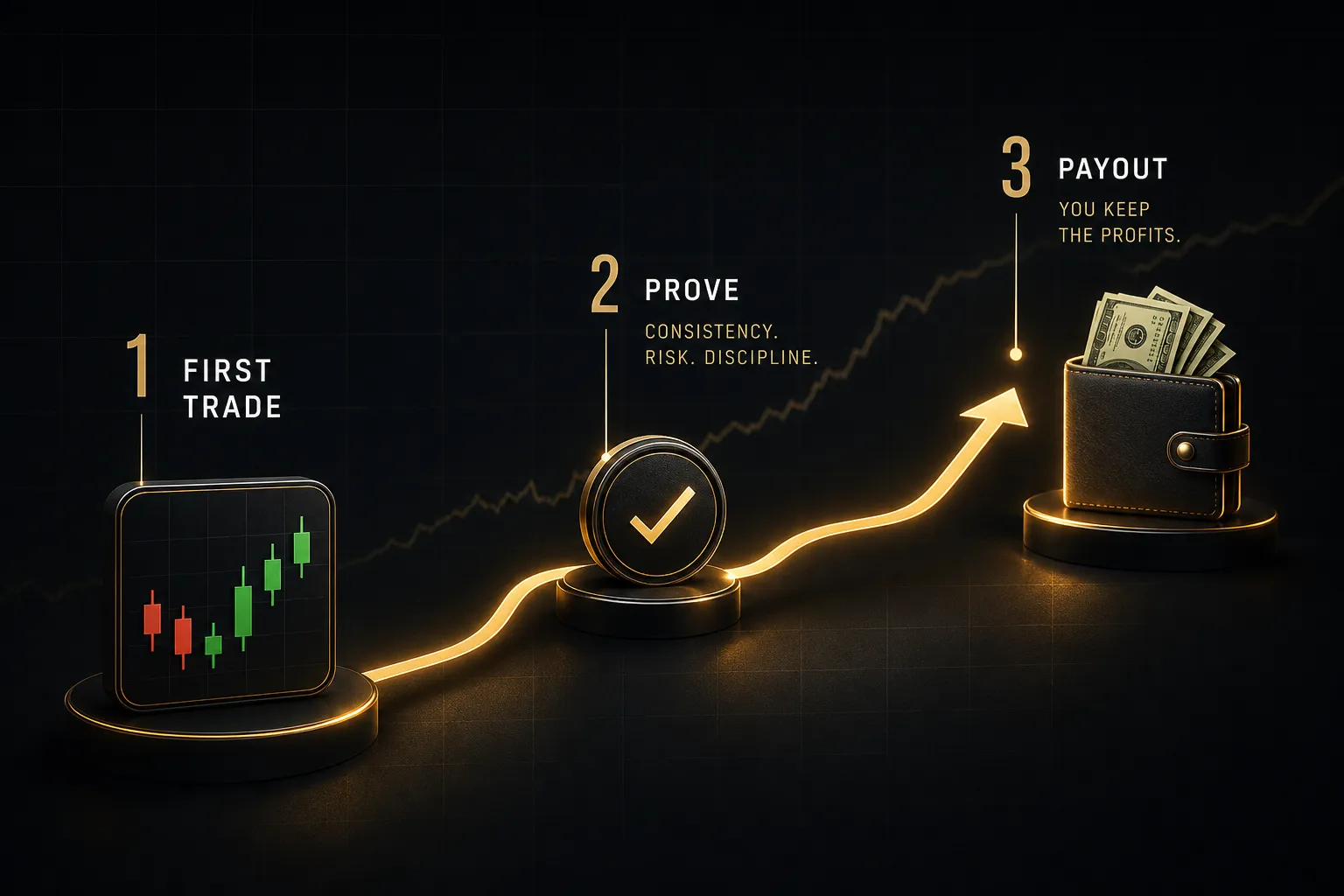
Getting funded instantly is the easy part.
Getting paid is the product you actually bought, and it runs through a gauntlet most buyers never read about.
- Clear the minimum trading days requirement. Most firms require 3-10 active trading days before a withdrawal request qualifies, and a “day” usually means at least one closed position. Hitting your profit target in two sessions does not shorten the clock.
- Stay inside the consistency rule. A typical cap limits any single day to 20-40% of total profit at the time of withdrawal. Make $4,000 in one heroic session and $1,000 across the rest, and you may need to grind out more balanced profit before payout unlocks.
- Reach the payout threshold. Firms set a minimum withdrawable amount, commonly 1-3% of the account or a flat figure like $200-$500. Below it, the request is simply rejected.
- Pass identity and trade verification. Expect KYC documents plus a review of your trade log for prohibited behaviour. Payout verification is where firms catch latency arbitrage, tick scalping, and copy-trade patterns.
- Accept the payout cap. Many programs cap a first withdrawal at a fixed amount or percentage regardless of how much profit sits in the account, releasing the rest on later cycles.
- Re-read the rules after payout one. This step surprises people. Drawdown often resets to your post-withdrawal balance, buffers you had built vanish, and some firms tighten the daily limit or shift you onto an account scaling track with different conditions.
Consistency Rules and Trading Limits
Execution restrictions can void a payout on an account that is comfortably profitable. They vary wildly between firms, which is exactly why the rulebook beats the marketing page.
- News trading restrictions: commonly a blackout window of 2-5 minutes either side of high-impact releases such as CPI, NFP, or central bank decisions. Trades opened or closed inside the window may be removed from your results or trigger a breach.
- Overnight and weekend holding: some instant accounts require all positions flat before the daily close, and almost all restrict weekend exposure on indices and crypto differently than on FX.
- Expert Advisors and automation: many firms allow EAs for management but ban fully automated entry, high-frequency logic, or any tool exploiting price-feed latency.
- Copy trading and account mirroring: running identical trades across multiple accounts, your own or other people’s, is one of the most frequently enforced violations. Group signal services fall foul of this constantly.
- Hedging across accounts: holding opposing positions on two funded accounts to guarantee one passes is explicitly prohibited almost everywhere and is treated as fraud, not a rule slip.
- Minimum hold times: a growing number of firms void trades held under 30-60 seconds to block tick scalping.
The Real Break-Even Math
The sticker price is never the cost of access. Here is the formula worth running before you buy:
True cost = account fee + (resets × reset fee) + expected spread and commission drag + slippage allowance
And the profit you need to generate to cover it: required gross profit = true cost ÷ profit split percentage.
Work an example.
A $100k account costs $600.
You reset once at $400.
You trade 20 round turns a week at roughly $7 per lot in commission plus spread, call it $560 a month.
Add a conservative $200 slippage allowance.
True cost for month one: $1,760.
At an 80% profit split, you need $2,200 in gross trading profit just to reach zero. On a $100,000 nominal account that is 2.2%, which sounds trivial until you remember you must produce it without touching a $3,000 daily limit or a $6,000 total drawdown, while obeying a consistency rule that punishes your best day.
That is the real trade.
Removing the evaluation challenge does not make funding easier.
It relocates the difficulty into tighter risk limits and stricter payout gates, and it moves the cost from your time to your card.
Your trading expectancy has to clear that bar with enough margin that a normal losing streak does not end the account first. Run the risk of ruin numbers with your actual win rate and average risk-reward before you pay anyone.
Due Diligence Before You Pay
Firms fail.
Some quietly change terms, some stop paying, a few disappear over a weekend with open accounts and unprocessed withdrawals.
Ten minutes of checking before purchase costs nothing.
Verifying a Firm’s Legitimacy
Work through this list before the payment page, not after.
- Find the legal entity name. Scroll to the footer or the terms and conditions and locate the registered company, its incorporation number, and its jurisdiction. A brand name with no corporate entity behind it is a red flag on its own.
- Check the governing law clause. The terms will name a country or state whose courts handle disputes. If that jurisdiction makes small-claim recovery effectively impossible for you, treat the fee as fully at risk.
- Look for dated, verifiable payout proof. Screenshots are easy to fake. Better signals include third-party verified payout dashboards, consistent payout reports over 12+ months, and traders posting bank or crypto confirmations with timestamps.
- Read the dispute process. A legitimate firm documents how a rejected payout gets escalated, who reviews it, and within what timeframe. Silence on this point is informative.
- Search complaints, not reviews. Incentivised review sites skew positive. Search the firm name alongside terms like “payout denied”, “account breached”, and “rule change” on trading forums and social platforms, and read the firm’s own responses.
- Check rule-change history. Firms that have retroactively altered drawdown or consistency terms on existing accounts will likely do it again.
- Confirm the profit split and fee refund terms in writing. Whether your fee is refunded with the first payout, and under what conditions, should be explicit in the contract rather than implied in an ad.
Setting Your Personal Risk Budget
Never trade to the firm’s limits.
Build your own, tighter set, and treat theirs as the point where you have already failed.
- Daily stop at 50-60% of the firm’s cap. If the daily loss limit is 3%, stop trading at 1.5-1.8%. That buffer absorbs slippage, a bad fill, and the gap between your platform’s number and theirs.
- Risk per trade of 0.25-0.5%. On a $100k account with a $6,000 total drawdown, 0.5% risk gives you roughly 12 consecutive losses of room. At 2% risk you get three.
- Maximum position size cap. Set a hard lot ceiling per instrument so a volatility spike cannot produce a loss larger than your model assumes.
- Maximum trade count per session. Three to five setups. Revenge trading after two losers is the mechanism behind most breaches, and a count limit shuts it down mechanically.
- Account-level shutdown threshold. Decide in advance that a 3% cumulative drawdown triggers a two-day stand-down and a journal review, well before the firm’s 6% terminal line.
Tools for Disciplined Execution
Rules only work if your execution is repeatable.
The trader who breaches is rarely the one without a strategy; it is the one who applied the strategy differently on Thursday afternoon than on Tuesday morning.
Structured tools help close that gap.
PipTrend, for example, presents a multi-timeframe table and marked entry levels so that direction, entry, and exit decisions come from the same reference each session rather than from whatever the chart feels like in the moment.
Consistency of process is what keeps you inside a consistency rule.
Pair any tool with a written trading journal that logs entry reason, risk taken, maximum adverse excursion, and which firm rule was closest to breaching. That last column is the one most traders skip and later wish they had.
Be clear-eyed, though.
No indicator, dashboard, or signal service guarantees profits, and none guarantees funded-account approval or payout.
Tools support discipline.
They do not replace it.
Frequently Asked Questions
Best Instant Funding Prop Firm?
There is no single best firm, only the best rule-fit for your strategy.
A scalper with tight stops survives intraday trailing drawdown that would destroy a swing trader, while a position trader needs end-of-day or static drawdown and permission to hold overnight. Compare drawdown type, daily loss limit, consistency rule, and payout cadence against your own trade data first.
Are Instant Funded Accounts Worth It?
They are worth it only if your expectancy clears the break-even math with room to spare.
Add the fee, likely resets, commissions, spread, and slippage, then divide by your profit split to find the gross profit required just to reach zero.
If that number represents more than a comfortable month of your normal returns, the answer is no.
Can You Skip the Challenge?
Yes, you can skip the evaluation challenge, but you rarely skip the difficulty.
Firms that remove profit targets compensate with tighter drawdown limits, longer minimum trading days, stricter consistency rules, or lower first-payout caps. You are trading a testing phase for a higher upfront fee and a narrower operating window.
Do These Firms Really Pay?
Established firms with documented payout histories do pay, and many process withdrawals within 1-5 business days.
The risk is not usually outright refusal but disqualification: a trade inside a news blackout, a breach of the consistency rule, or a copy-trading flag found during payout verification.
Verify payout proof, KYC requirements, and the dispute process before paying.
What Risks Do Traders Face?
The three biggest risks are simulated capital, trailing drawdown surprises, and consistency rule breaches.
You hold a contract for profit share, not a brokerage account, so recourse depends on the firm’s jurisdiction.
Intraday trailing drawdown can breach you on unrealized equity you never banked, and a single outsized winning day can delay a payout indefinitely.
Instant Funding vs Funded Challenge
Instant funding costs more upfront and imposes tighter ongoing restrictions; challenge accounts cost less but demand a profit target and weeks of evaluation.
Choose instant funding if you value immediate access and can operate within a narrow daily loss limit.
Choose a challenge if your edge needs time and wider drawdown room to express itself.
The Bottom Line
Do one thing before you pay: run your exact strategy, on a demo or your own account, under the specific drawdown model, daily loss limit, and consistency rule of the firm you are considering. Thirty trades logged with maximum adverse excursion will tell you more than any review.
A genuinely profitable strategy can still fail under the wrong drawdown structure.
Rule-fit outranks account size, and it outranks profit split too.
An 80% split on a model your strategy cannot survive is worth exactly nothing.
And a plain warning.
Never fund a prop firm purchase with rent money, emergency savings, or borrowed capital.
Treat the fee as an expense you may not recover, because sometimes you will not.
This is educational content, not financial advice.
Trading involves substantial risk of loss.
Risk Disclaimer: Trading involves risk. Past performance doesn't guarantee future results. Only trade with money you can afford to lose. PipTrend is a tool to assist your trading decisions, not financial advice.