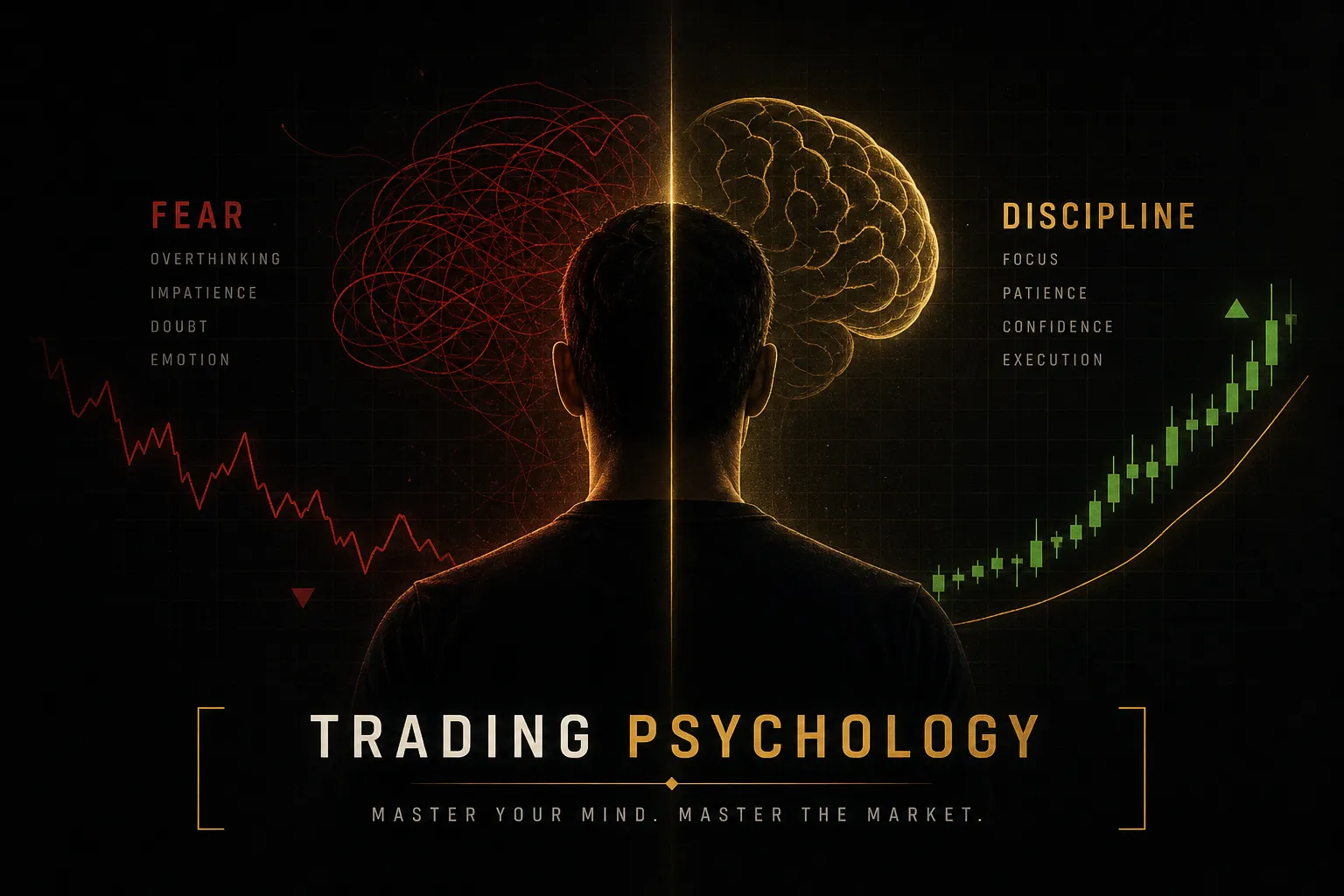
Trading Psychology: Why Discipline Beats Willpower
On this page
What Trading Psychology Really Means
Most traders think trading psychology means staying calm when the chart moves against them. That definition is almost useless, because calm is a feeling, and feelings are not something you can put in a plan.
Trading psychology is the study of how emotions and cognitive biases translate into specific, observable trading actions.
Not moods.
Actions.
Moving a stop-loss two ticks further out.
Doubling size after a loss.
Skipping a valid setup because the last two failed.
That reframing matters.
Once you stop treating this as a character flaw and start treating it as a decision-quality problem, it becomes solvable. You can’t will yourself into being less afraid.
But you can build a process where fear has nowhere to intervene.
This is the core insight of behavioral finance: predictable errors come from predictable triggers. Loss aversion, recency bias, overconfidence bias, the disposition effect.
These are not personal failings.
They’re documented patterns in how humans handle uncertainty and money, and traders exhibit them with remarkable consistency.
Here’s how this article is structured. First, we map each emotion to the concrete behaviors it produces.
Then we diagnose whether your losses actually come from psychology at all, or from a strategy with no edge or risk sizing that was never survivable. Only then do we build the fixes: rules, position sizing, and a journal that creates real feedback.
One honest caveat before anything else.
No mindset shift, no indicator, no signal service removes uncertainty from markets or guarantees a profit. Trading involves real risk of loss.
What good psychology does is narrow the gap between the trades you planned and the trades you actually took.
That gap is where most accounts die.
How Emotions Turn Into Bad Trades
Emotion doesn’t destroy accounts directly.
It destroys them through a short list of repeatable behaviors, and once you can name those behaviors, you can count them in your journal.
Below is the translation layer between what you feel and what you click.
Fear: Hesitation and Early Exits
Fear is the quietest account killer because it usually looks like caution. It rarely produces a dramatic blowup.
It produces a slow bleed of missed expectancy.
- Skipping valid setups. The signal fires, the criteria are met, and you don’t take it, usually because the previous trade lost. This is recency bias doing the work, weighting the last outcome far above your actual sample of results.
- Moving the stop-loss closer. Price drifts toward your invalidation and you tighten the stop to “reduce risk.” What you’ve actually done is invalidate your own backtest, because your risk-reward ratio just changed mid-trade without your edge changing with it.
- Closing winners before the target. A trade goes 1R in your favor and you take it, leaving the 2.5R on the table. This is the disposition effect: selling winners early and holding losers too long, one of the most replicated findings in behavioral finance research.
- Refusing to re-enter after a stopped-out trade. The setup re-forms cleanly. You sit it out because you’re still stinging from the last one, and the second attempt runs to target without you.
The mechanism underneath all four is loss aversion, described in Kahneman and Tversky’s prospect theory: the pain of a loss registers roughly twice as strongly as the pleasure of an equivalent gain. Your brain isn’t trying to maximize expectancy.
It’s trying to avoid pain.
Greed and FOMO: Chasing and Oversizing
Greed produces the opposite failure.
Where fear shrinks your participation, fear of missing out expands it into places your plan never sanctioned.
- Entering after the move has already happened. A candle runs 2% and you buy the top of it, entering at the worst possible risk-reward ratio precisely when your stop distance is widest.
- Adding size mid-trend without a plan for it. Scaling in is legitimate when it’s written into the strategy with defined levels. Adding because the trade “feels strong” is not scaling in. It’s raising your risk of ruin on a hunch.
- Abandoning the original thesis to chase a breakout elsewhere. You’re in a clean setup, another instrument gaps, and you exit early to chase it. Two trades, neither one planned.
- Overtrading during high-activity sessions. Volume creates the illusion of opportunity. More trades means more commissions, more spread, and more chances for undisciplined entries to dilute a positive expectancy.
- Anchoring to a price you saw earlier. “It was at 180 yesterday, so 172 is cheap.” Anchoring bias substitutes a memorable number for actual analysis.
Revenge Trading After a Loss
Revenge trading follows an almost identical sequence every single time.
Learn the sequence and you can interrupt it before step three.
- A loss lands, often larger than planned or arriving after a run of small wins that built expectation.
- An unplanned re-entry follows within minutes, usually in the same instrument and the same direction, without a valid signal.
- Size increases, because the goal has silently shifted from “trade my edge” to “get back to breakeven today.”
- Rules get suspended entirely. No stop, or a stop placed at a level chosen by the dollar amount you can tolerate rather than by market structure.
The tell is the objective.
Real trading targets expectancy over a sample. Revenge trading targets a specific account balance by a specific time, which markets are under no obligation to deliver.
Three factors amplify every pattern above. Market volatility compresses decision time and widens outcomes.
Leverage magnifies the emotional weight of every tick, so a 0.4% move can feel like a catastrophe.
And time pressure on fast intraday charts strips out the reflection window that swing traders get for free between sessions.
A one-minute scalper may face 40 decision points in an hour. A daily swing trader might face one per week.
Same trader, same psychology, wildly different error rates.
Psychology, Strategy, or Risk? Diagnose the Problem
Here’s a question worth sitting with: how do you know your problem is psychological at all?
Most traders assume it is, because “I need better discipline” is a more comfortable story than “my strategy has no edge.”
But applying a psychology fix to a strategy problem wastes months.
Diagnosis has to come first.
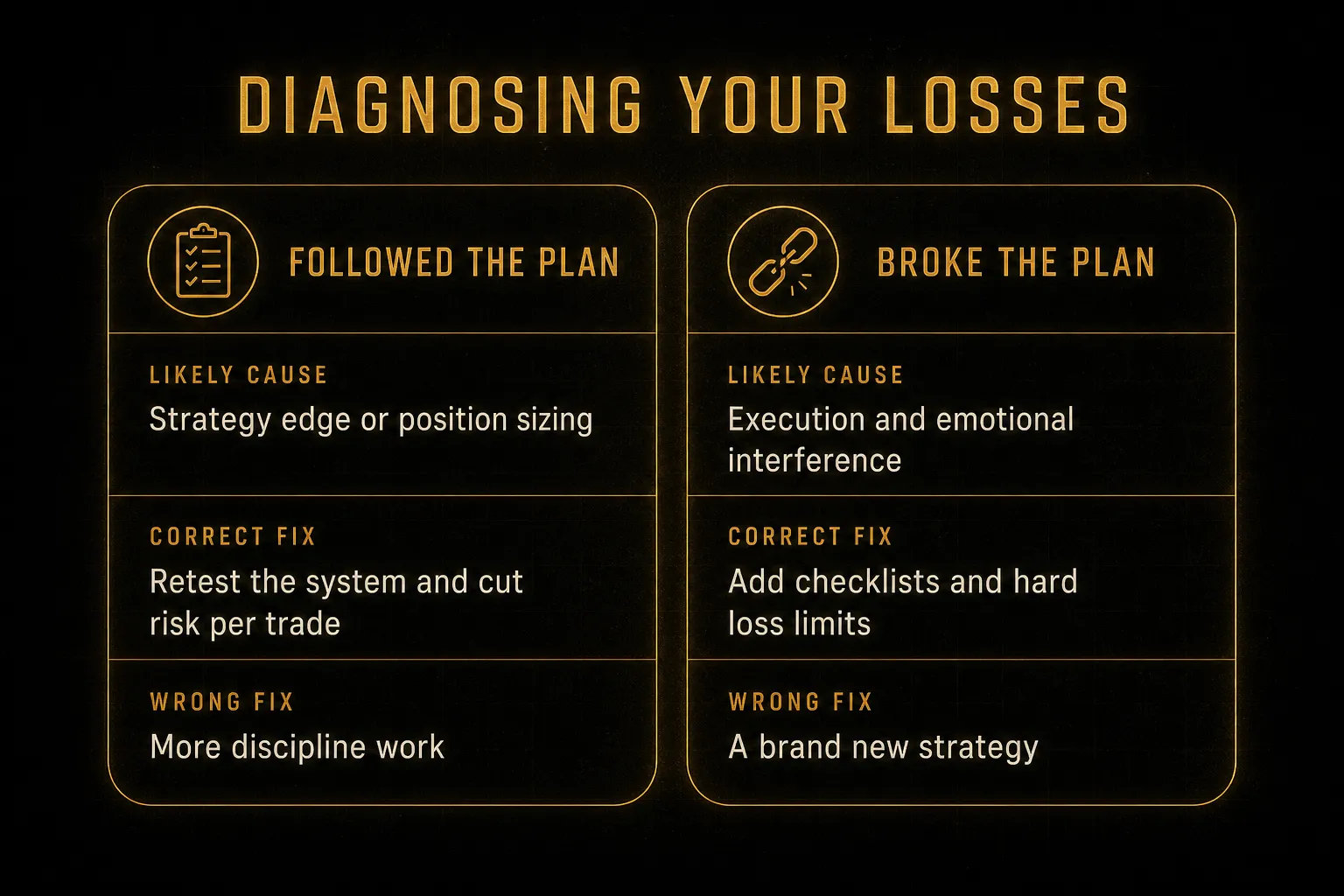
Three Failure Types
Strategy failure means the method has no demonstrated positive expectancy. You followed every rule and still lost money over a meaningful sample, say 100 trades or more.
No amount of discipline fixes this.
Perfect execution of a losing system produces losses faster and more reliably.
Execution failure means the strategy has an edge but you didn’t trade it. Your journal shows entries that don’t match your criteria, stops moved, targets abandoned.
This is the genuine psychology problem, and it’s the one that friction tools and process controls actually solve.
Risk failure means the sizing was never survivable regardless of edge. Risking 8% per trade with a 45% win rate gives you a mathematically near-certain path to a catastrophic drawdown, even with a positive expectancy strategy.
That’s not psychology.
That’s arithmetic.
The order matters enormously.
You cannot psychologically execute a strategy you don’t trust, and you shouldn’t trust a strategy you haven’t tested. Your subconscious is doing rough Bayesian math on every trade, and if it senses no real edge, hesitation is a rational response, not a flaw.
The popular claim that “trading is 90% psychology” quietly assumes you already have an edge. Without one, psychology is just the discipline to lose money in an orderly fashion.
Same for risk.
Ask someone to calmly execute a system where a normal three-loss streak wipes out a third of the account.
They won’t.
The stress response is appropriate to the actual danger. Fix the sizing and the “discipline problem” often evaporates on its own.
Winning-Streak Overconfidence
Losses get all the attention.
But some of the worst damage starts after a run of wins.
Overconfidence bias shows up in three measurable ways: leverage creeps up, trade frequency rises, and setup quality standards quietly relax. The trader starts taking B-grade and C-grade setups because everything has been working.
The underlying error is attributing favorable variance to skill. A strategy with a 55% win rate produces five-trade winning streaks roughly 5% of the time by pure chance.
Nothing about that streak proves anything, but it feels like proof.
Confirmation bias then locks the door.
You start reading market commentary that agrees with your positioning and dismissing the rest. The account peaks, the size is at its maximum, and the inevitable mean reversion arrives at exactly the wrong moment.
A practical guard: cap your risk per trade in writing and require a documented, reviewed reason to change it.
Not a feeling.
A performance review with at least 50 trades behind it.
When It’s More Than Trading
Some patterns are not trading problems at all, and treating them with a better journal does real harm by delaying appropriate help.
- Compulsive re-entries you can’t stop, including trades you don’t remember deciding to take.
- Trading with borrowed money, credit cards, or funds allocated to rent, debt, or family obligations.
- Chasing losses across sessions or weeks, with escalating size and shrinking rule adherence.
- Concealing losses from a partner, or lying about account size and results.
- Physical symptoms: sleep disruption, appetite changes, persistent anxiety tied to open positions.
If several of these apply, the right next step is a licensed mental health professional or a financial counselor, not another trading course. Problem gambling frameworks map closely onto this behavior, and evidence-based treatment exists.
Stopping trading entirely while you get support is a legitimate and often necessary decision.
Building a Process That Protects Decisions
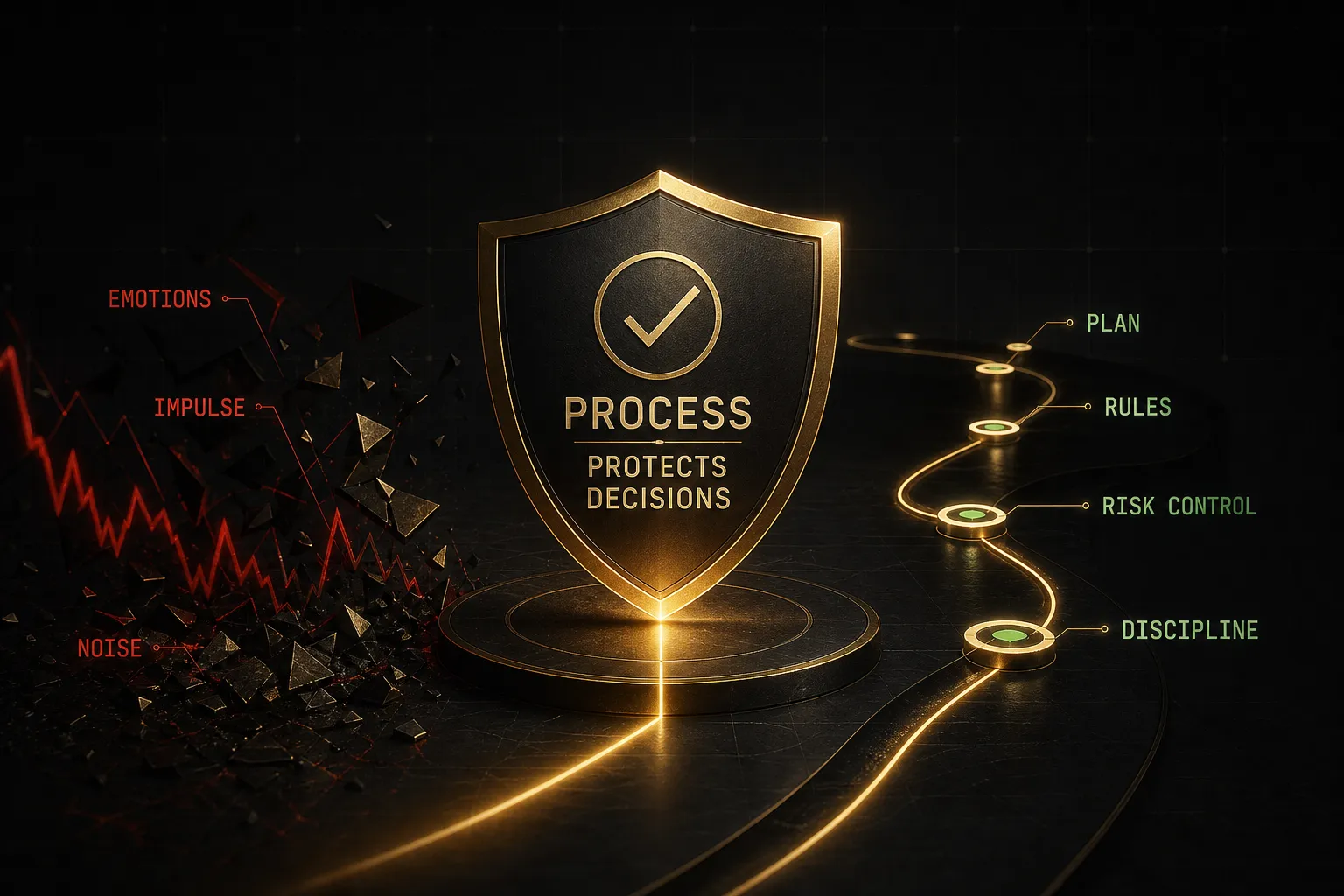
Discipline is not something you summon in the moment. It’s something you install in advance, when you’re calm, before any money is at risk.
Three components do most of the work.
A Trading Plan Removes In-the-Moment Choices
Every emotional error happens at a decision point. Remove the decision point and you remove the error.
A written trading plan exists to pre-answer questions that get much harder once you have skin in the game.
- Entry criteria, stated so specifically that two people would agree. “Price closes above the 20-EMA on the 4H with rising volume and higher-timeframe trend alignment” is a rule. “Looks bullish” is not.
- Stop-loss placed by structure, not by tolerance. The stop goes where your thesis is proven wrong. If that distance forces an uncomfortable position size, reduce the size, never the stop.
- Target and exit logic defined before entry. Fixed R-multiple, trailing method, or time-based exit. Choose one per setup type and write it down.
- Invalidations and no-trade conditions. Major scheduled news, spreads above a threshold, or a market regime your system was never designed for.
- Maximum trades per session, which is the single most effective structural brake on overtrading.
The plan’s value is not that it’s smarter than you.
It’s that it was written by a version of you who wasn’t down 1.5R with fifteen minutes left in the session.
Position Sizing as a Psychological Lever
Most traders treat position sizing purely as capital protection.
It’s also the most powerful emotional regulator available, and it works instantly.
Risk 5% of your account on a trade and every tick carries physiological weight: elevated cortisol, narrowed attention, impaired working memory.
Under that load, rule-following collapses.
Risk 0.5% and the same chart movement barely registers.
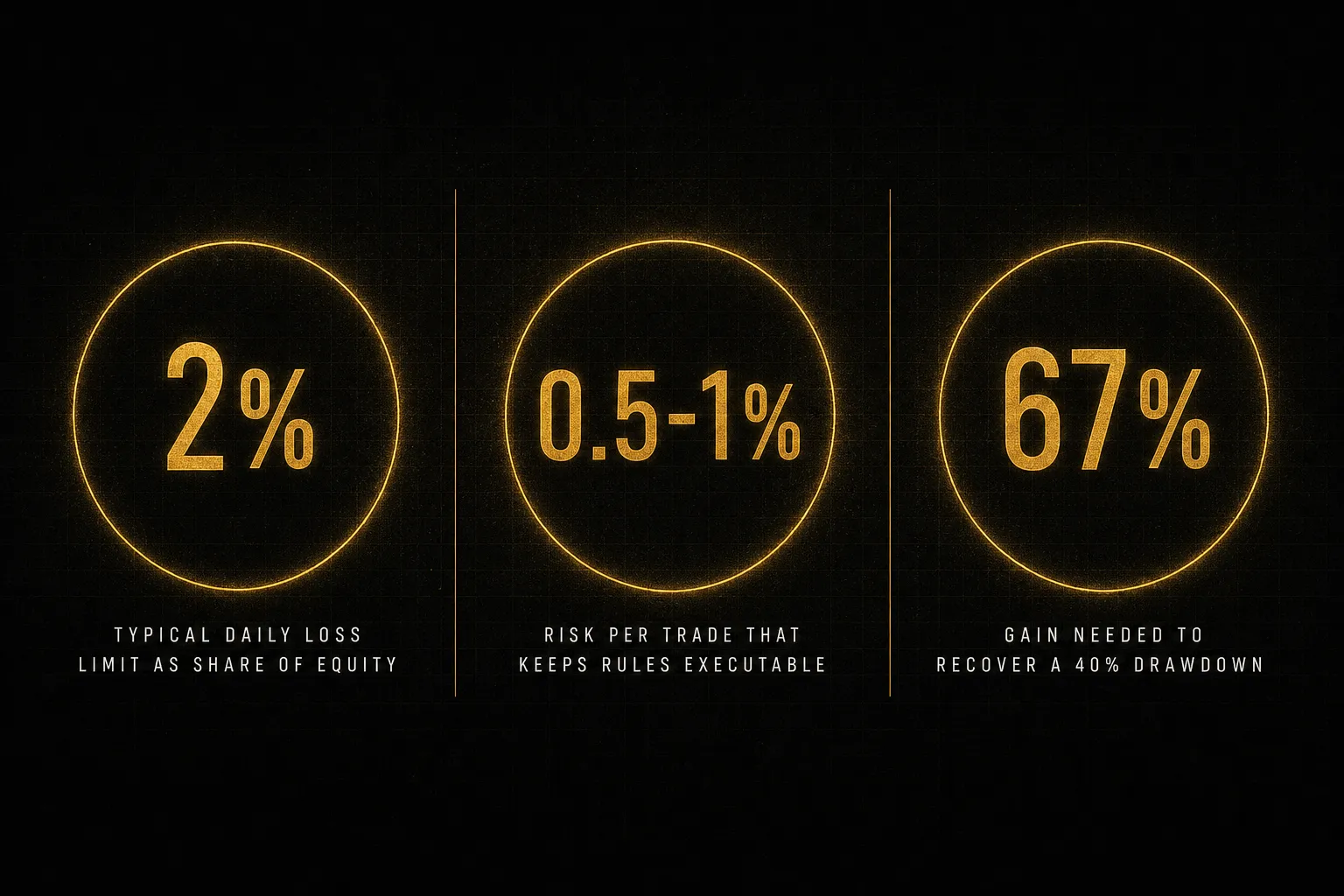
- Risk per trade defines your drawdown depth. At 1% risk, ten consecutive losses cost roughly 9.6% of the account. At 5%, the same streak costs about 40%, and recovering from that requires a 67% gain.
- Smaller size makes rules executable. You’ll hold to target more often when the position isn’t dominating your attention. Better execution improves realized expectancy, independent of the strategy itself.
- Size should scale with setup quality, not conviction. Grade your setups A, B, C in advance and assign fixed risk to each grade. Conviction is a feeling. Grade is a criterion.
- Reduce risk during drawdowns. Cutting risk per trade by half after hitting a defined drawdown threshold slows the bleed and buys decision-making capacity when you need it most.
Consider this the cheapest upgrade in trading.
It costs nothing, requires no new skill, and works the same day you implement it.
What Belongs in a Trading Journal
Trade journaling only creates change when the fields are measurable. “Felt nervous, entered anyway” tells you nothing you can act on next month.
Log these for every trade:
- Setup type and quality grade (A, B, or C) assigned before entry, never after seeing the outcome.
- Planned risk in R and in currency, recorded at entry.
- Actual risk taken. The gap between planned and actual is your single clearest discipline metric.
- Emotional state before and after, scored 1 to 5 for stress and 1 to 5 for urgency. Numbers make patterns searchable.
- Rule violations, listed individually: early entry, stop moved, target abandoned, size exceeded, unplanned trade.
- Market regime: trending, ranging, high volatility, low volatility. Many “psychology problems” are really strategy-regime mismatches.
- Outcome quality, separate from profit and loss. Classify each trade as plan-followed win, plan-followed loss, impulsive win, or impulsive loss. Impulsive wins are the most dangerous category, because they reinforce the exact behavior that will hurt you later.
Here’s what this unlocks.
One trader reviewed 90 trades and filtered for “size exceeded.” Fourteen violations, and eleven of them came immediately after two consecutive wins.
Not after losses, as he’d assumed for a year.
The fix took thirty seconds to implement: a hard rule that after two consecutive wins, the next trade is taken at half size.
His largest losses stopped appearing.
No willpower involved… just a rule aimed at a pattern the journal made visible.
Designing Discipline Instead of Relying on Willpower
Willpower is a depleting resource that performs worst under exactly the conditions trading creates: fatigue, uncertainty, financial pressure, and time constraint. Building a career on it is like planning to sprint a marathon.
Environment design works better.
Change the setup so the bad trade requires effort and the good trade is the path of least resistance.
Friction Tools That Block Bad Trades
Each of these adds a small, deliberate obstacle between impulse and execution. Small obstacles are enough, because impulses are short-lived.
A pre-trade checklist is the foundation. Five to seven yes/no questions you physically tick before placing an order: trend alignment confirmed, entry criteria met, stop level identified by structure, position size calculated, risk within daily limit, no scheduled high-impact news.
The checklist doesn’t make you smarter.
It makes skipping steps visible.
A daily loss limit is the hardest stop in the system. Define it as a percentage, commonly 2% to 3% of account equity, and when it’s hit, the platform closes for the day.
No exceptions, no “one more setup.”
This single rule is what stands between a bad session and an account-ending one.
A cooldown period after any loss, typically 15 to 30 minutes, breaks the revenge trading sequence at step two, before size escalation ever happens.
Set a timer.
Leave the screen.
The setup you’re worried about missing will be replaced by another one.
Price alerts instead of constant screen-watching may be the most underrated tool here. Watching every tick generates a continuous stream of micro-decisions, each one an opportunity for bias to act.
Alerts collapse hours of exposure into a handful of considered moments.
Where Objective Signals Fit In
The riskiest moment in any trade is the instant between noticing an opportunity and clicking buy. Anything that inserts an objective checkpoint into that gap reduces impulsive entries.
This is where structured signal tools have genuine psychological value, separate from any claim about predictive accuracy.
A platform like PipTrend separates the signal from the entry: a clear directional call, marked price levels for entry, stop, and target, and a multi-timeframe confirmation table showing whether higher timeframes agree.
The behavioral benefit is the separation itself.
You’re no longer deciding direction and size and timing simultaneously while price moves. You’re comparing an objective reference against your own read, then applying your own risk rules.
That sequence is much harder to hijack emotionally.
Multi-timeframe confirmation also functions as a built-in counter to confirmation bias. When the 4H says one thing and the daily disagrees, you have a documented reason to stand down instead of hunting for a chart that agrees with you.
Now the warnings, and they matter more than the benefits.
No signal source removes market risk or predicts outcomes.
Signals are inputs, not instructions. Blind dependence simply outsources your judgment while leaving all the risk with you.
Signal shopping is the same disease with better packaging.
Cycling through providers after every losing streak is recency bias wearing a subscription. It produces no sample large enough to evaluate anything.
Taking every alert is overtrading by another name.
Before acting on any signal, confirm it fits your market structure read, calculate your position size from your own risk rules, and check it against your daily loss limit. If any of those fail, you skip it.
That’s not caution.
That’s the entire job.
Trading Psychology FAQ
What is the 90% rule in trading psychology?
The “90% rule” is an unverified piece of trading folklore, not a peer-reviewed finding. It usually appears as “90% of traders lose 90% of their capital within 90 days,” and no credible source has ever been produced for it.
What research does support is more nuanced but still sobering.
Studies of Brazilian and Taiwanese day traders, published in academic finance journals, found that the large majority of retail day traders lost money over multi-year periods, with only a small fraction achieving persistent profitability. Regulator-mandated disclosures from CFD brokers routinely show 70% to 80% of retail accounts losing money.
Use those numbers as a signal about risk and difficulty.
Don’t quote the 90% rule as fact.
How do traders control their emotions?
Skilled traders don’t eliminate emotion, they recognize it and override the behavior it prompts. Emotional suppression is unreliable and mentally expensive.
Behavioral interruption works.
The practical method has three parts. Recognize the state by name and intensity, ideally logged in your journal (“urgency 4/5”).
Pause with a fixed mechanism, such as a cooldown timer or a checklist. Then act from the written rule rather than the feeling.
Reducing position size accelerates all of this, because smaller risk produces a weaker physiological response in the first place.
What are the 3 C’s of trading psychology?
The 3 C’s most commonly cited are confidence, control, and consistency. Each maps to a concrete practice rather than an attitude.
Confidence comes from a tested edge with known expectancy, win rate, and risk-reward ratio, often validated through paper trading before live capital.
Control comes from risk management: fixed risk per trade, a daily loss limit, and drawdown management rules.
Consistency comes from rule-based execution and a journal that measures how often you actually followed the plan.
Notice that none of the three is a mindset.
All three are systems.
How do I fix my trading psychology?
Diagnose before you treat.
Pull your last 50 to 100 trades and sort them into plan-followed and plan-broken.
If most losses came from trades that followed the plan, your issue is strategy edge or position sizing, and no mindset work will help. Retest the system and cut risk per trade.
If most losses came from broken rules, you have an execution problem.
Add friction: a pre-trade checklist, a hard daily loss limit, a cooldown after losses, and a journal field tracking planned versus actual risk. Then run 30 trades and review the violation count, not the profit and loss.
Why do traders fail psychologically?
Four structural causes account for most psychological failure, and three of them are fixable before you ever place a trade.
Undercapitalization forces oversized risk to generate meaningful returns, which guarantees emotional interference.
Oversized risk per trade triggers stress responses that make rule-following physically harder.
No written plan means every decision happens live, under pressure.
No journal feedback loop means errors repeat invisibly for years.
Add leverage and market volatility and the failure rate climbs further.
These are not personality problems.
They’re design problems.
Is trading more about psychology than strategy?
The question is a false choice: psychology and strategy are interdependent, not competing.
Without a tested edge, there’s nothing to execute, and discipline just delivers losses more efficiently.
Without psychological control, a genuine edge still fails, because realized results come from the trades you actually took, not the ones your backtest assumed. A strategy with 0.4R expectancy can post negative returns if execution drift is severe enough.
Build the edge first.
Then build the process that protects it.
The order is not optional.
The Real Test Is the Next Trade
Everything above collapses into one diagnostic question, and you can answer it tonight.
If your losses came from trades that followed the plan, the problem is strategy or risk sizing. Retest the edge over a larger sample, or cut risk per trade until a normal losing streak stops threatening the account.
More discipline work would be wasted effort.
If your losses came from broken rules, the problem is execution.
You don’t need a new system. You need friction: a checklist, a daily loss limit, a cooldown timer, and a journal field that tracks planned risk against actual risk.
A new strategy will simply give you fresh rules to break.
Here’s the one action worth taking before your next session.
Write down the entry criteria, the stop level, and the exit rule for your very next trade.
Not a philosophy.
Three specific lines.
Then commit to following them regardless of what the trade does. If it loses while you followed the plan, that’s a good trade with a bad outcome, and you log it as such.
That distinction is the whole discipline.
Sustainable traders are not the ones who feel nothing or predict correctly. They’re the ones whose executed trades match their planned trades, over and over, across enough repetitions for a real edge to show up in the results.
Certainty isn’t available.
Consistency is.
Sources
- Investor.gov: Investor Bulletin: Behavioral Patterns of U.S. Investors
- CME Group: Step 3. Risk Management and Your Trade Plan
- SSRN: Trading is Hazardous to Your Wealth: The Common Stock Investment Performance of Individual Investors
- Wiley: Investor Psychology and Security Market Under‐ and Overreactions
- CFA Institute: The Behavioral Biases of Individuals
Risk Disclaimer: Trading involves risk. Past performance doesn't guarantee future results. Only trade with money you can afford to lose. PipTrend is a tool to assist your trading decisions, not financial advice.