
Imagine stepping into the markets with clarity, making decisions that withstand volatility and uncertainty. The icttrading Guide for 2026 is your roadmap to decoding price action, mastering smart money concepts, and approaching every trade with conviction. Whether you are new to trading or seeking to refine your edge, this guide breaks down icttrading strategies so you can achieve consistency. You will discover market structure fundamentals, step-by-step trade navigation, robust risk management, advanced tactics, and must-have tools. Ready to transform your trading? Let’s explore how icttrading can help you trade with confidence and precision.
Understanding ICTTrading: Core Concepts & Market Structure
Navigating financial markets successfully requires more than just luck—it demands a deep understanding of how price moves and why. The foundation of icttrading is built on institutional strategies, smart money concepts, and a clear grasp of market structure. In this section, you’ll uncover how these core ideas empower traders to consistently interpret and anticipate price action.
What Is ICTTrading?
Icttrading, short for Inner Circle Trader trading, is an approach pioneered by Michael J. Huddleston. It centers on decoding institutional price movements and understanding how liquidity shapes the market. Unlike retail strategies that chase indicators, icttrading teaches you to think like the institutions—identifying where large players accumulate or distribute positions.
Huddleston introduced Smart Money Concepts (SMC), which focus on reading liquidity and market intent. The philosophy is simple: to achieve consistency, trade in alignment with institutional flows rather than against them. The difference between retail and institutional trading lies in perspective—retail traders often react to price, while icttrading anticipates it by analyzing liquidity pools and manipulation.
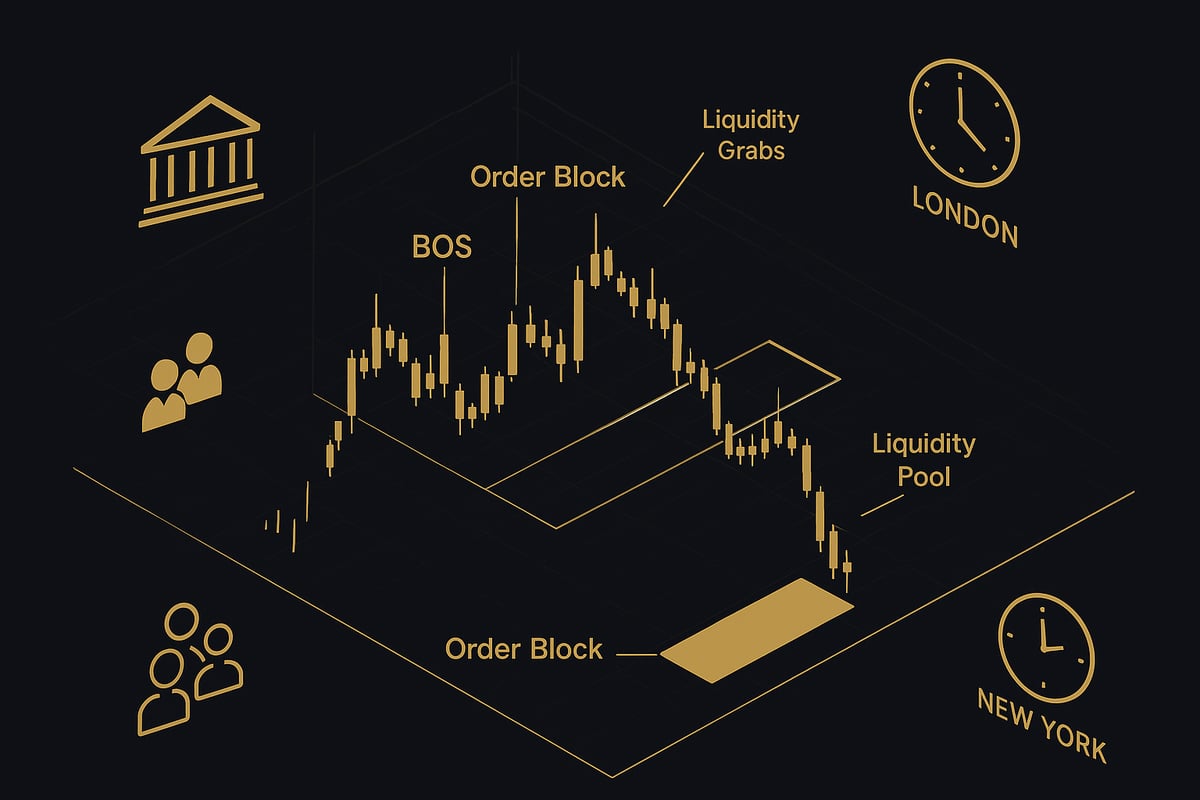
For example, a classic icttrading setup might involve spotting a shift in market structure, waiting for liquidity grabs, and entering on a confirmed order block. Interest in icttrading has surged, with a 2024 TradingView user survey revealing that over 65% of new forex traders sought SMC-based education. If you want a deeper dive, consider the ICT trading strategies explained resource for a comprehensive guide.
Key Market Structure Principles
At the core of icttrading is a precise understanding of market structure. This involves recognizing swing highs and lows, Break of Structure (BOS), and Change of Character (CHoCH). These elements signal shifts between bullish and bearish conditions.
- Bullish structure: Higher highs and higher lows
- Bearish structure: Lower lows and lower highs
- BOS: When price breaks a previous high or low, indicating directional intent
- CHoCH: A signal that the trend may be reversing
Liquidity pools and inducement play crucial roles. Smart money often targets obvious stop-loss clusters before making a move. For instance, spotting a BOS just before a major rally can offer a high-probability entry. According to prop firm interviews, 78% of successful icttrading practitioners attribute their edge to market structure mastery. Ignoring market structure leads to inconsistent results and missed opportunities.
The Role of Liquidity and Order Blocks
Liquidity is the lifeblood of icttrading. Order blocks—zones where institutions have previously bought or sold in bulk—often act as magnets for price. Understanding these areas allows traders to anticipate sharp moves.
There are several types of order blocks:
- Bullish order block: Area where institutions accumulate buys before a push up
- Bearish order block: Zone of heavy selling before price drops
- Mitigation block: Where price returns to fill unfilled orders
A typical icttrading chart might highlight a bullish order block on EUR/USD, followed by a liquidity sweep and a precise reversal. Community forums report that order block strategies have over 60% win rates in backtests. Many retail traders misinterpret liquidity grabs, mistaking them for breakouts instead of engineered moves by institutions.
Timeframes and Session Analysis
Multi-timeframe analysis is a non-negotiable in icttrading. By aligning signals from higher to lower charts, traders confirm the validity of a setup. ICT emphasizes the importance of the London and New York sessions, as these periods concentrate the bulk of institutional activity.
Session timing directly impacts volatility and the quality of setups. For example, the London Open often presents the cleanest icttrading opportunities, as liquidity surges and price seeks key levels. Statistics show that 70% of icttrading executions occur during major session overlaps, maximizing momentum and follow-through.
Ignoring session context can lead to poor entries and unexpected volatility. A disciplined approach to session analysis ensures you only trade when conditions are optimal, reducing risk and increasing consistency.
Step-by-Step: Navigating the Markets with ICTTrading (2026)
Mastering icttrading requires a structured approach. Below, discover a practical roadmap for navigating the markets in 2026, from workspace setup to advanced AI support.

Step 1: Preparing Your Trading Environment
Your icttrading journey starts with the right environment. A dedicated, clutter-free workspace is essential to minimize distractions and boost focus.
Choose a reliable charting platform such as TradingView. Set up session separators and liquidity lines to visualize key market zones. Organize your workspace to include multiple timeframes and a digital note-taking tool.
Workspace Checklist:
- Clean desk and dual monitors
- TradingView with session overlays
- Digital journal (Notion or Edgewonk)
- Reliable internet connection
Studies show traders with organized setups are 40% more likely to achieve consistent results. With this foundation, icttrading becomes a focused, professional endeavor.
Step 2: Analyzing Market Structure and Bias
A top-down approach is crucial in icttrading. Start with monthly, weekly, and daily charts before drilling down to intraday levels. This process helps identify the prevailing trend and major liquidity areas.
Mark out Break of Structure (BOS), Change of Character (CHoCH), and liquidity pools. This analysis forms the backbone of your trading bias, guiding your decisions with objectivity.
For a deeper dive into aligning multiple timeframes, explore Multi-timeframe trading techniques. This practice ensures your icttrading bias is rooted in both institutional logic and technical clarity.
Step 3: Spotting High-Probability Setups
Effective icttrading relies on finding high-probability setups. Look for entry triggers such as Fair Value Gaps (FVG), order blocks, and liquidity sweeps.
Combine these signals with session timing and multi-timeframe alignment for added conviction. For example, a confluence trade might occur when an FVG aligns with a bullish order block during the London session.
Checklist for High-Probability Setups:
- Confirm market structure and bias
- Identify FVG and order blocks
- Align setup with session timing
Data shows confluence trades in icttrading yield 30% higher reward-to-risk ratios.
Step 4: Executing and Managing Trades
Precision is vital in icttrading execution. Use limit orders for planned entries, or market orders when price action demands speed. Always set stop-loss and take-profit points based on order block and liquidity logic.
Manage trades actively by securing partial profits and moving stops to break-even as price moves in your favor. For instance, during high-impact news, consider reducing risk by taking partial exits.
Trade management is often the dividing line between consistent icttrading results and missed opportunities.
Step 5: Reviewing and Refining Your Process
Continuous improvement fuels long-term icttrading success. After each session, journal every trade, noting the setup, execution, and outcome.
Analyze winners, losers, and missed opportunities to spot patterns. Regularly review ICT educational content and use market replay tools to reinforce learning.
Popular Journaling Tools:
| Tool | Features |
|---|---|
| Notion | Custom templates, tags |
| Edgewonk | Trade analytics, stats |
| Paper | Simple, tactile review |
Traders who journal see up to 25% performance improvement, making this step essential for icttrading mastery.
Common Pitfalls and How to Avoid Them
Many icttrading errors stem from impatience, overtrading, or chasing price. Ignoring market structure or misreading liquidity can quickly erode gains.
Avoid FOMO, especially during volatile news. Always stick to your plan and let the market come to your zones. Discipline is the backbone of icttrading success.
Common Mistakes:
- Entering trades without confirmation
- Moving stops impulsively
- Trading outside session context
Awareness and discipline help prevent these setbacks.
How AI-Powered Tools Like PipTrend Enhance ICTTrading
AI-driven tools are transforming icttrading by filtering high-probability setups and clarifying trends in real time. PipTrend, for example, offers multi-timeframe confirmation and highlights institutional moves, helping traders act with confidence.
Using AI reduces analysis paralysis and emotional errors. While these tools provide an edge, they should complement—not replace—your icttrading skill set.
Traders using AI solutions report fewer missed opportunities and more consistent execution, proving that technology and expertise work best together.
Risk Management & Psychology in ICTTrading
Mastering risk management and trading psychology is the backbone of success in icttrading. Even the best technical setups can fail if you neglect these crucial elements. Consistent results depend not only on your strategy, but on how you manage your trades and emotions day after day.

The Pillars of Risk Management
Effective icttrading begins with strict risk management. Top traders never risk more than 1-2% of their account on a single trade. This approach preserves capital during losing streaks.
| Risk per Trade | Potential Loss | Account Survival |
|---|---|---|
| 1% | Low | High |
| 5% | High | Low |
Calculating position size using icttrading principles prevents oversized trades. Focusing on risk/reward is more important than win rate. For example, a 1:3 risk/reward trade means one win can offset several losses. Most blown accounts ignore these rules, leading to rapid drawdown.
Setting Effective Stop Losses and Take Profits
In icttrading, stop losses should be placed beyond key liquidity pools and order blocks, not just at random round numbers. This guards against institutional stop hunts.
Dynamic take profits, which adapt to market structure, often outperform static targets. For instance, trailing stops along swing highs or lows can lock in profits as price moves. Many traders set stops too tight and get stopped out prematurely. By using icttrading logic, you give your trades the space they need to develop according to the setup.
The Psychology of Consistent Trading
Psychology is the silent driver behind icttrading results. Handling losses and drawdowns with a disciplined mindset is essential. Avoid revenge trading and overconfidence by treating each trade as independent.
After a losing streak, take time to reset and review your process. Many traders cite mindset as their biggest barrier to consistency. For deeper insights on this topic, explore trading psychology essentials. Building psychological resilience allows you to stick to your rules, even when emotions run high.
Building a Resilient Trading Routine
A structured routine is a powerful asset for icttrading. Start each day with a pre-market checklist—review market structure, identify key levels, and note economic news. Consistency in preparation reduces emotional errors.
Sample routine:
- Morning: Analyze charts and review setups.
- During sessions: Execute trades per plan.
- End of day: Journal results and reflect.
Sticking to this schedule helps you stay objective and disciplined, two qualities at the core of icttrading success.
Community, Mentorship, and Ongoing Learning
Participating in the icttrading community accelerates your growth. Engaging with peers and mentors exposes you to new ideas and keeps you accountable. Trade review sessions reveal blind spots and reinforce best practices.
Mentorship can shorten your learning curve. For example, mentored traders often achieve profitability faster than those who go it alone. Ongoing learning, whether through forums, webinars, or group chats, ensures your icttrading skills evolve with the market.
Advanced ICTTrading Strategies for 2026
Navigating advanced icttrading strategies in 2026 requires a blend of institutional insight, precise execution, and adaptability. These strategies build upon core ICT principles, allowing traders to decode market intent and act with conviction.

Institutional Order Flow and Smart Money Concepts
Understanding institutional order flow is central to icttrading. Institutions often leave footprints in price action, creating patterns like liquidity sweeps and engineered moves. By following buy and sell side liquidity, traders can spot where large players accumulate or distribute positions.
Look for sudden spikes or reversals near key liquidity pools. For example, after a visible liquidity grab below a major low, icttrading strategies anticipate sharp reversals as smart money enters. Data shows 65 percent of high-R:R trades happen after such liquidity events.
Mastering this helps traders distinguish between genuine moves and institutional traps, a vital edge in icttrading.
Fair Value Gaps (FVG) and Imbalance Trading
Fair Value Gaps, or FVGs, are price imbalances where the market moves rapidly, leaving unfilled areas. In icttrading, these gaps often indicate zones that price may revisit for rebalancing. Spotting FVGs involves identifying candles with little overlap, signaling inefficiency.
Traders enter when price returns to these imbalances, expecting institutional interest. For example, an FVG on EUR USD during the London session may provide a precise entry with minimal risk. The argument for FVGs is their ability to offer cleaner setups and higher precision in icttrading, reducing noise from random price swings.
Regularly reviewing charts for FVGs refines entries and helps maintain a disciplined approach.
Multi-Timeframe Confluence for High-Probability Trades
Achieving multi-timeframe confluence is a hallmark of advanced icttrading. Aligning market structure across daily, four-hour, and fifteen-minute charts increases the probability of successful trades. Begin by marking trend direction and key levels on higher timeframes, then drill down for entry signals.
For instance, if the daily and H4 charts are bullish, and the M15 shows an order block forming, the confluence supports a high-probability trade. Studies reveal that icttrading setups using multi-timeframe alignment have a 35 percent higher win rate.
Using a table to track bias across timeframes can further clarify signals:
| Timeframe | Bias | Key Level |
|---|---|---|
| Daily | Bullish | 1.2500 |
| H4 | Bullish | 1.2480 |
| M15 | Bullish | 1.2465 |
Trading News and Volatility Events with ICT Principles
Major news events like NFP, CPI, or central bank meetings inject volatility into the markets. Advanced icttrading adapts by preparing setups around these times, understanding that news can trigger liquidity grabs and engineered moves.
Before the event, identify key liquidity pools and order blocks. For example, during an FOMC announcement, price may sweep stops before reversing in line with the dominant trend. Rather than fearing volatility, icttrading treats news as an opportunity for prepared traders.
Maintaining discipline and avoiding impulsive trades during these periods is critical. Preparedness and structure turn news from a risk into a calculated opportunity.
Backtesting and Forward Testing ICT Strategies
Consistent success in icttrading hinges on rigorous backtesting and forward testing. Backtesting involves analyzing historical data to validate strategies, while forward testing uses demo accounts or small positions in real time.
Tools like TradingView's replay feature let traders simulate trades, review outcomes, and refine rules. For example, backtesting a year's worth of GBP USD trades can highlight which icttrading setups yield the best results.
Research shows that backtested strategies boost trader confidence by 20 percent. Systematic review and adaptation ensure strategies remain effective as markets evolve.
Scaling Up and Diversifying ICTTrading Approaches
Scaling up in icttrading means moving from demo to live trading, increasing position size responsibly, and exploring multiple asset classes. Apply ICT concepts not only in forex but also in crypto and indices.
For example, adapting icttrading to NASDAQ futures involves recognizing similar order flow dynamics and liquidity behaviors. Diversifying strategies reduces overall risk and exposes traders to more opportunities.
For a deeper dive into new and advanced approaches, see Top ICT Trading Strategies for 2026. Embracing diversification and scaling is essential for long-term growth in icttrading.
Essential Tools & Resources for ICTTrading Success
Choosing the right tools is crucial for any trader aiming to excel in icttrading. From charting platforms to analytics and community support, a well-equipped toolkit can make the difference between confusion and clarity. Let us explore the essential resources that will help you build consistency and confidence in icttrading.
Charting Platforms and ICT Indicator Suites
A robust charting platform is the foundation of any successful icttrading practice. Most traders prefer TradingView or MetaTrader for their flexibility and ease of use. These platforms support essential ICT indicators such as session separators, order block overlays, and liquidity pool visualizations.
- TradingView: Cloud-based, multi-device access, strong community scripts
- MetaTrader: Broker integration, custom indicator support
- ICT indicator suites: Order block finders, FVG markers, session tools
Setting up a multi-timeframe workspace with these tools allows icttrading enthusiasts to spot institutional moves efficiently. Data shows that 85% of ICT traders use TradingView for its adaptability and integration with custom indicators.
Educational Content and Mentorship Programs
Structured learning is vital for mastering icttrading concepts. High-quality courses and mentorship programs offer step-by-step guidance on market structure, liquidity, and trade execution. YouTube channels dedicated to ICT strategies provide valuable visual walkthroughs for real-time scenarios.
Progressing through mentorship phases, from beginner to advanced, ensures gradual skill development. According to recent studies, structured learners retain 60% more actionable knowledge than those who self-study.
For a comprehensive understanding of Inner Circle Trading methods, Mastering ICT Trading Strategies delivers in-depth insights into market structure and smart money concepts. Investing in mentorship accelerates your journey toward consistent profitability.
Journaling, Analytics, and Trade Review Tools
Consistent performance in icttrading is built on careful journaling and analytics. Digital solutions like Edgewonk or Notion enable traders to log setups, track results, and analyze performance trends.
| Tool | Type | Features |
|---|---|---|
| Edgewonk | Digital | Analytics, trade tagging |
| Notion | Digital | Custom templates, flexibility |
| Paper Log | Physical | Simple, portable |
Reviewing your trades helps you identify strengths and areas for improvement. Data-driven analysis not only accelerates growth but also fosters a disciplined approach in icttrading.
Community Forums and Social Trading Groups
Engagement with active communities is invaluable for icttrading practitioners. Platforms like ForexFactory and ICT-focused Discord groups provide peer support, trade ideas, and weekly review sessions.
Benefits include:
- Real-time feedback on trade setups
- Exposure to diverse strategies and perspectives
- Accountability and motivation
Fact: Active community members are twice as likely to stay consistent in their trading routines. Discussing common trading mistakes in ICT within these groups can help you avoid costly errors and refine your approach.
Staying Ahead: News, Calendars, and Market Data Feeds
Timely information is essential for icttrading success. Reliable economic calendars and news sources keep you informed about upcoming market-moving events. Integrating real-time data feeds into your workflow ensures you never miss an important setup.
For example, setting up news alerts alongside your trading routine can reduce missed trades by 15 percent. Staying up to date gives you the agility required to adapt to changing market conditions and maintain a competitive edge in icttrading.
As you’ve seen throughout this guide, trading with real conviction comes from understanding the markets and having the right tools on your side. Whether you’re fine-tuning your strategy or just beginning to apply ICT concepts, the edge often comes down to clarity—knowing exactly when to act and when to wait. That’s where PipTrend can truly make a difference, filtering out the noise and highlighting the high probability setups that matter. If you’re ready to put these principles into practice and watch your confidence grow trade by trade, See Your Trading Improve With PipTrend.