How to stop emotional trading (a system, not a pep talk)

On this page
When the chart feels personal
Three losses in a row.
The fourth trade moves against you, and your stop sits at a sensible 1% of the account. Then you drag it lower “to give the trade room,” drag it again, and finally close the position at a 6% loss that wipes out two weeks of careful work.
Nobody plans that trade.
It happens because, in the moment, the chart stops being data and starts feeling personal.
And the usual advice (“be more disciplined,” “control your emotions”) does almost nothing to stop it.
Here’s the reframe that matters.
Emotional trading is not a willpower problem. It’s a design problem: there’s no mechanical guardrail between the feeling and the click.
This guide gives you that guardrail in three layers:
Pre-trade risk rules keep any single decision from carrying enough pressure to break you.
In-trade interruption protocols physically separate the urge from the action.
Post-trade review turns vague guilt into data you can actually fix.
One honest promise before we start.
You won’t eliminate emotion from trading in 2026 or any other year.
But you can manage it, measure it, and shrink its damage to the point where it stops deciding your results.
What emotional trading really is
Most traders who struggle with emotional decisions can recite their rules perfectly.
That’s the strange part.
Knowing the rules and following them under pressure turn out to be two completely different skills.
A working definition helps.
Emotional trading is any entry, exit, or sizing decision made outside your pre-defined rules, triggered by fear, greed, boredom, or urgency. If the decision wasn’t in your trading plan before the session started, it’s emotional, even when it happens to make money.
That last point trips people up.
A rule-breaking trade that wins is still a rule-breaking trade.
It just teaches you the wrong lesson faster.
The moment a feeling becomes a trade
Why doesn’t awareness fix the problem?
Because the decision often happens faster than conscious reasoning. Your brain’s threat response fires in milliseconds, while the part of you that remembers “max 1% risk” takes noticeably longer to come online.
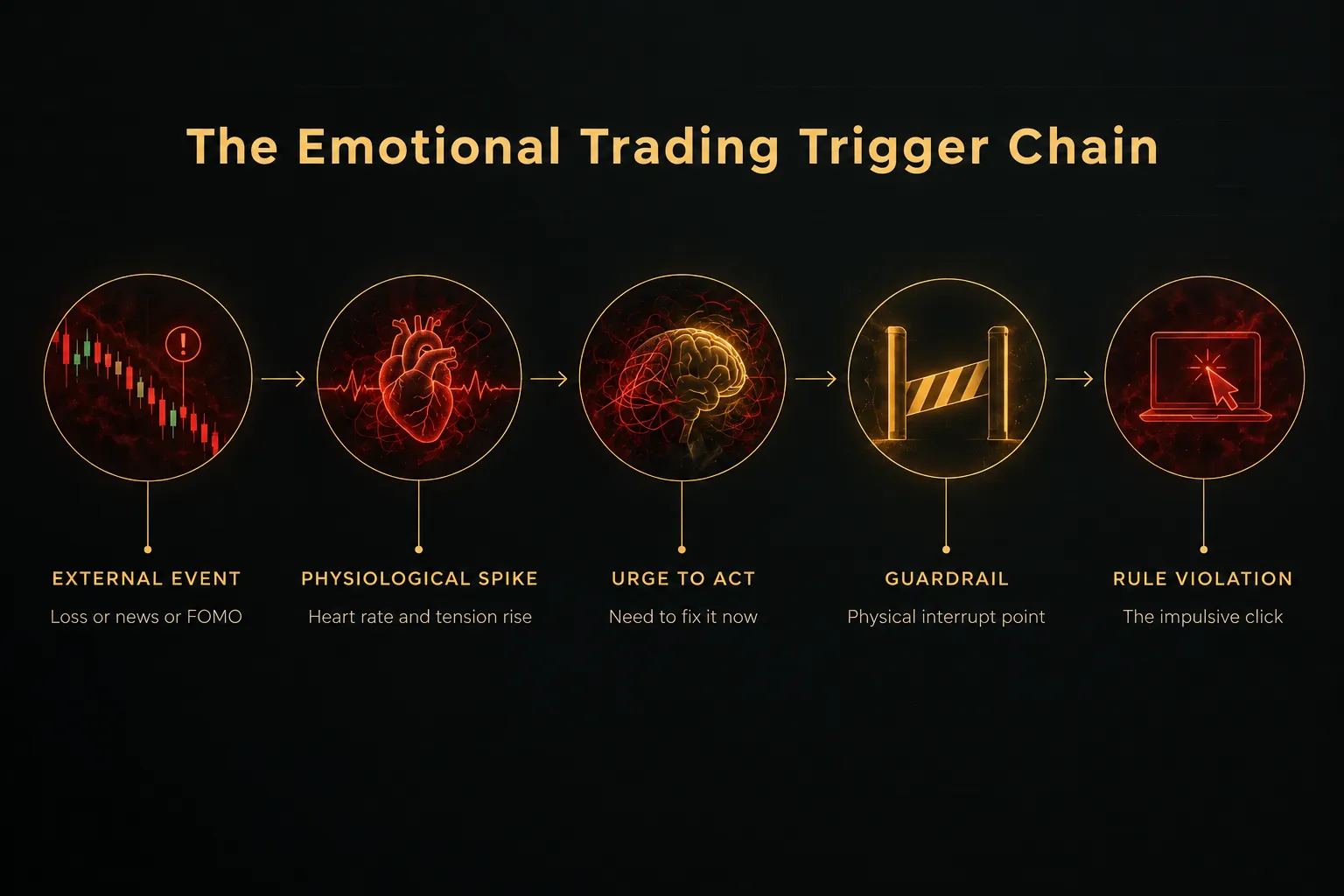
Every emotional trade follows roughly the same chain.
An external event (a loss, a news headline, a candle ripping without you) triggers a physiological spike: faster heart rate, tight shoulders, shallow breathing. That spike creates an urge to act, and the urge becomes a rule violation within seconds.
The fix is to insert a guardrail between the urge and the action.
Not more awareness.
A physical interrupt, such as closing the platform, standing up, or checking a written pre-trade checklist, that forces a pause long enough for your rules to catch up with your feelings.
Think of it like a circuit breaker in your house.
You don’t stop power surges by hoping they won’t happen. You install a device that cuts the current automatically when one does.
Winning streaks are a trap too
Fear gets all the attention in trading psychology.
But euphoria does just as much damage, and it’s harder to spot because it feels like competence.
After four or five wins, overconfidence bias kicks in.
Position sizes creep up “because I’m reading the market well.” Confirmation steps get skipped.
Stops get removed because the last few trades never needed them.
Recency bias makes it worse.
Your brain treats the last handful of trades as the new normal, ignoring the hundreds of trades that define your actual edge.
The most dangerous trade in a trader’s week is often the one right after a big win, because nothing about it feels dangerous.
So the guardrails in this guide apply in both directions.
Fear and greed are two sides of the same broken circuit.
Build guardrails before you ever click buy
Most emotional trading is decided before the session even starts. If your risk structure puts too much money on the line per decision, no amount of mental training will keep you calm when that money starts disappearing.
The three guardrails below work together: correct risk sizing, the right type of goals, and a clear test for judging your own trades.
Risk per trade that removes the pressure
Risk per trade, leverage, and account drawdown are linked, and the combination determines how much stress each trade carries.
Here’s the math that makes the case for small sizing:
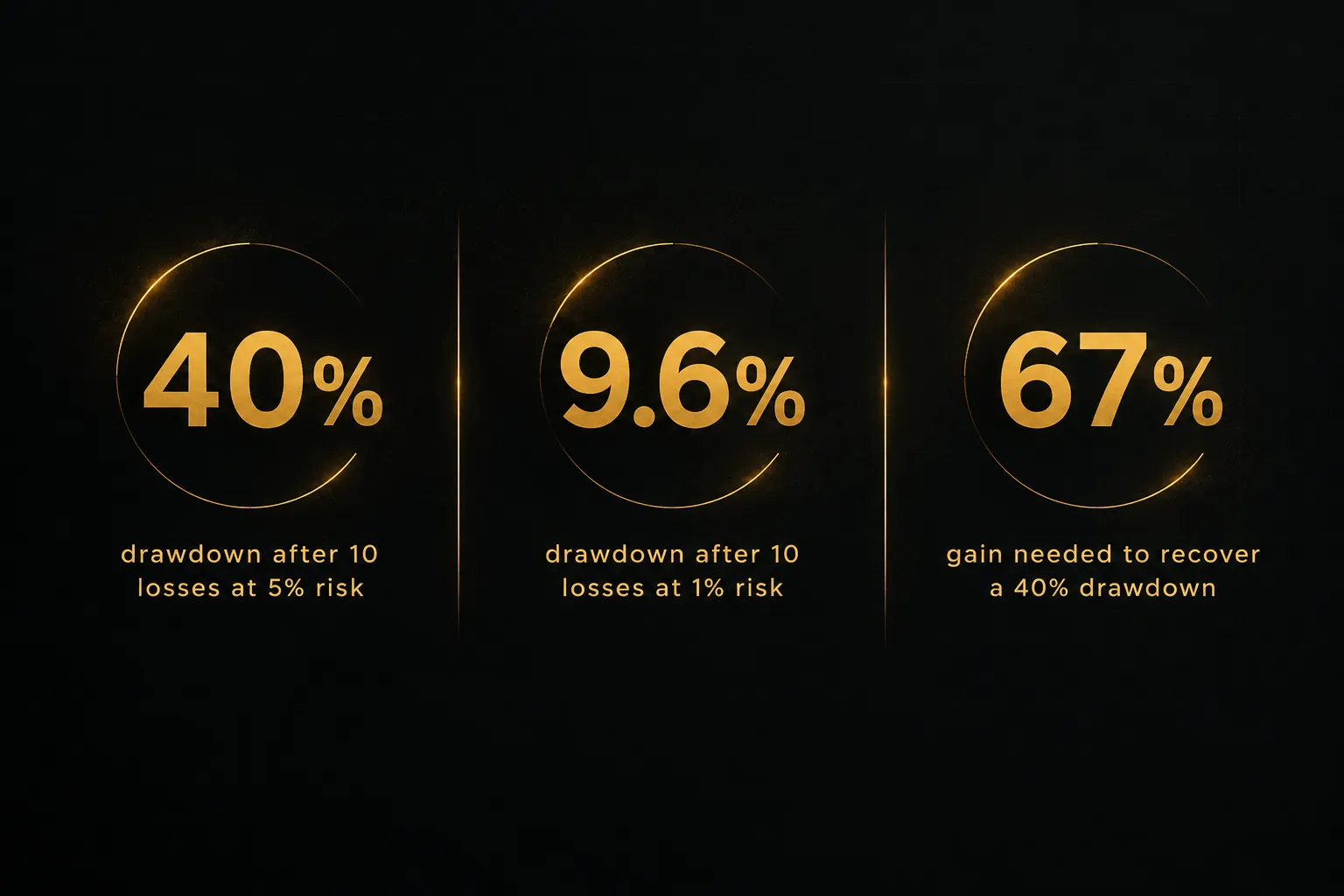
- High risk compounds into crisis. Risking 5% per trade means 10 consecutive losses (which happens to almost every strategy eventually) leaves you down roughly 40%. At 20x leverage on a volatile currency pair or crypto asset, a single fast move can trigger that 5% loss in minutes.
- Deep drawdowns demand impossible recoveries. A 40% drawdown requires a 67% gain just to get back to break-even. That gap creates exactly the desperation that fuels revenge trading.
- Small risk keeps losing streaks survivable. At 1% risk per trade, the same 10-loss streak costs about 9.6%. Uncomfortable, but nowhere near panic territory.
- Leveraged markets deserve tighter limits. For forex, crypto, and CFDs, fix risk at 0.5% to 1% per trade. Volatility, weekend gaps, and overnight moves in these markets swing harder than in most stocks, so the same percentage stop can be hit faster and with more slippage.
- Position sizing comes from the stop, not the other way around. Decide your stop-loss placement based on market structure first, then calculate the size that makes that stop equal your fixed risk. Never move the stop to fit a size you already wanted.
When a loss costs 1% of the account, it’s just a loss.
When it costs 5%, it becomes an emergency, and emergencies produce emotional decisions regardless of mindset.
Process goals vs outcome goals
How you grade your trading day shapes how you trade tomorrow. Grade yourself only on money, and every red day becomes a debt your brain wants to repay immediately.
- Process-based goals measure behavior you control. Examples: followed entry criteria on every trade, honored every stop, sized each position correctly, stopped trading at the daily limit.
- Outcome goals measure results you don’t fully control. Examples: made back yesterday’s loss, hit a $500 daily target, finished the week green.
- Outcome-only grading fuels revenge trading. If the goal is “make back yesterday’s loss,” then a losing morning makes the afternoon feel mandatory. You start forcing trades that don’t exist.
- Process grading separates skill from luck. A day with three rule-perfect losses earns a high grade. A day with one impulsive, oversized winner earns a failing one. That feels backward at first, but it’s how professional traders think about trade expectancy over hundreds of decisions.
Bad execution or just a normal loss?
Loss aversion, the tendency Kahneman and Tversky documented where losses feel roughly twice as painful as equivalent gains, makes every loss feel like a mistake.
Most aren’t.
Use this three-question test after every losing trade:
- Did I enter exactly where my written criteria said to enter? Not “close enough,” and not “a bit early because it looked ready.”
- Did I place and honor my stop exactly as planned? No widening, no removal, no early panic exit before it was hit.
- Did I size the position at exactly my fixed risk per trade? Check the math, not your memory.
Three yeses?
That loss is statistically normal variance, the cost of doing business with any strategy that has a positive risk-reward ratio but less than a 100% win rate. It’s not a psychological failure, and it doesn’t need fixing.
Any no means you have an execution error.
That’s the thing to study, journal, and correct.
Interrupt the trade in real time
Pre-trade rules handle the structure.
But what about the moment itself, when you’re staring at a fresh loss and your hand is already moving toward the buy button?
That’s where interruption protocols earn their place.
The revenge-trade interruption protocol
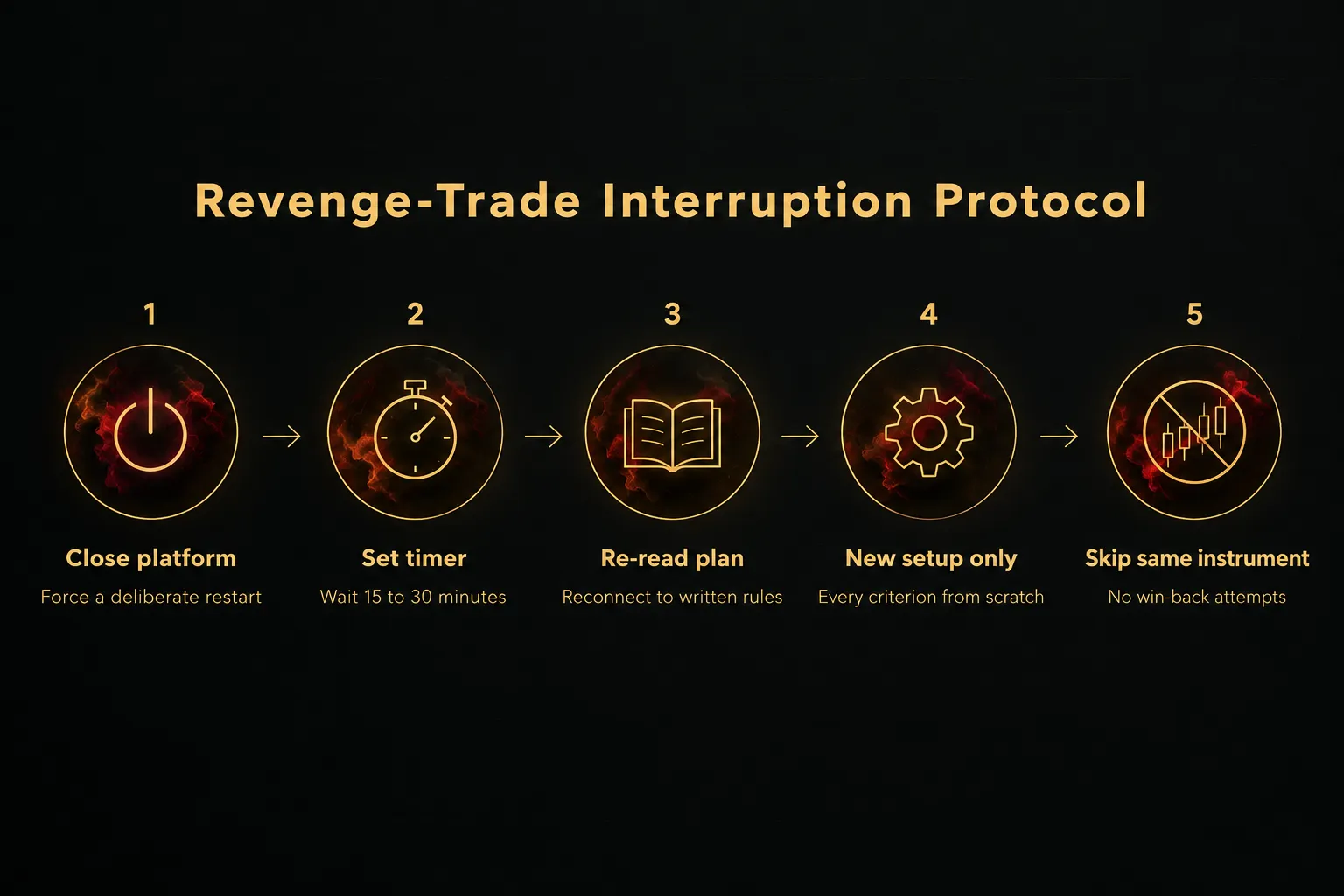
Revenge trading follows a predictable pattern: loss, sting, immediate re-entry in the same instrument, usually larger. Break the pattern with a fixed sequence you run after every loss, without exception.
- Close the platform. Not minimize it. Close it, so re-entering requires a deliberate login rather than one impulsive click.
- Start a fixed cooldown period of 15 to 30 minutes. Set a timer. The physiological spike from a loss typically fades within this window, and your reasoning brain comes back online.
- Re-read your written trading plan. Physically read it, line by line. This reconnects you to the rules your emotions just tried to overwrite.
- Require a brand-new valid setup before re-entry. The next trade must meet every entry criterion from scratch. “The market owes me” is not a setup.
- Never re-enter the same instrument within the cooldown window. Same-market re-entry is where most revenge trades happen, because you’re trying to win back that specific loss rather than trade the chart in front of you.
Hesitation and the trades you don’t take
Here’s a form of emotional trading that rarely gets called by name. After a few losses, fear makes you skip valid signals, or freeze until price has already moved and then chase a late entry with a worse stop and a worse risk-reward ratio.
Missed trades damage results just as much as overtrading.
If your edge comes from a 45% win rate with 2:1 winners, skipping the one trade that would have won quietly destroys the math that makes the strategy profitable.
- Pre-commit your entry levels. Mark the exact entry, stop, and target before the session, or use pending orders, so the decision is made before the candle closes rather than during it.
- Adopt a “next valid signal” rule. You take the next signal that meets your criteria, regardless of whether the last trade won or lost. The previous outcome is irrelevant to the next setup’s probability.
- Ban late entries outright. If price has moved past your planned entry by more than a defined distance (say, half your stop size), the trade is gone. Chasing turns a good setup into a bad one.
- Log skipped trades in your journal. Track what the skipped signal would have done. After a few weeks, the cost of hesitation becomes impossible to ignore.
Daily stop conditions that actually hold
Daily limits protect you from two opposite failures.
They stop revenge trading on bad days, and they stop you from abandoning a working strategy after one ugly session.
- Stop after 2 to 3 consecutive losses. This cuts off the emotional spiral before it builds momentum. Your strategy isn’t broken; you’re just done for the day.
- Set a maximum daily loss of 2% to 3% of the account. Hit it, and the session ends. At 1% risk per trade, this caps the damage of even a terrible day at a recoverable level.
- Cap the number of trades per session. Pick a number that fits your strategy (for many intraday traders, 3 to 5). Overtrading usually shows up as trade number six, seven, and eight on a day with no real setups.
- Write the rule where you can see it. A sticky note on the monitor beats a rule you “know.” Visible rules are harder to bargain with.
Why does this prevent premature strategy abandonment?
Because a capped bad day stays small.
Without a maximum daily loss, one session can do enough damage that you lose faith in a strategy that was working fine over 100 trades.
Use tools without outsourcing responsibility
Tools can make emotional trading visible and harder to act on.
But no tool can follow your rules for you, and expecting one to is just another way of avoiding the work.
What a useful trading journal actually tracks
Most trading journals record entry, exit, and P&L, and then wonder why reviewing them changes nothing.
Price data tells you what happened.
To fix emotional trading, you need to know why it happened.
| Journal field | What to record | Why it matters |
|---|---|---|
| Emotional state before entry | Calm, anxious, frustrated, euphoric, bored (rate 1-5) | Reveals which states correlate with your worst trades |
| The trigger | Prior loss, news headline, fast candle, chat-room post | Identifies the external events that start your chain |
| Impulse felt | Urge to chase, double size, exit early, move stop | Names the specific behavior you need a guardrail for |
| Rule broken (if any) | Entry, stop, size, daily limit, cooldown, or none | Separates execution errors from normal strategy losses |
| Size vs plan | Actual risk as a percentage vs planned risk (e.g., 2.5% vs 1%) | Exposes sizing creep after wins or losses |
| Market context | Trending, ranging, high-impact news day, session | Shows whether rule breaks cluster in certain conditions |
| Post-trade outcome | Result in R-multiples plus a one-line reflection | Keeps P&L in context of process quality |
The magic happens at 20 to 30 logged trades.
Patterns start to surface that you’d never notice trade by trade.
You might find that 80% of your rule breaks happen after two or more consecutive losses, or that almost every oversized position came within an hour of a big win.
That’s the shift from guilt to data.
“I’m undisciplined” is unfixable.
“I break my sizing rule after back-to-back losses on news days” is a specific problem with a specific guardrail.
Your journal will also catch the disposition effect, which Terrance Odean’s well-known 1998 study of brokerage accounts found: investors sell winners too early and hold losers too long. If your journal shows average winners consistently smaller than your planned targets, you’ve found it.
Where indicators and alerts help (and where they don’t)
Ever added a third indicator because the first two didn’t agree with the trade you wanted? That’s confirmation bias, and in trading it often shows up as signal shopping: stacking tools until one says yes.
It looks technical.
It’s emotional trading wearing a disguise.
The useful role of an indicator is removing ambiguity, not removing emotion.
Objective trading signals give you a fixed reference point to check impulses against. Signal-based tools like PipTrend provide a clear BUY or SELL direction plus a marked entry level based on session highs and lows, VWAP, or supply and demand zones.
That turns “does this feel right?” into a concrete yes-or-no question.
The multi-timeframe table and alerts help in a quieter way. Instead of watching every tick and absorbing every fake-out, you get notified when conditions line up, which cuts the screen-watching anxiety that breeds impulsive entries.
Now the plain truth.
No indicator removes market risk, prevents slippage, or guarantees a profitable trade.
Position sizing, stop discipline, and drawdown management remain entirely your job.
| Area | Where signal tools help | Where they don’t |
|---|---|---|
| Entry decisions | Provide a defined level to check impulses against | Can’t stop you from entering without a signal |
| Direction bias | Clear BUY/SELL reduces second-guessing | Don’t make any single signal certain to win |
| Screen time | Alerts reduce constant chart-watching | Can’t control what you do once the alert fires |
| Risk control | Marked levels help with stop-loss placement | Don’t size positions or prevent gaps and slippage |
Finally, guard against external triggers.
Social media sentiment, breaking news, and chat-room urgency all create artificial time pressure. That pressure feels like a real edge (“everyone’s buying, get in now”), but it’s usually FOMO trading with a crowd attached.
If a trade idea arrived from a feed rather than your criteria, it fails the checklist by default.
Common questions about trading emotions
How do I control my emotions while trading?
You control emotions in trading by controlling the decision points, not the feelings themselves.
Fix risk per trade at 0.5% to 1%, run a written pre-trade checklist before every entry, and use a mandatory cooldown after losses.
The emotion still shows up, but it no longer gets a vote.
Why do I keep revenge trading?
You keep revenge trading because you’re grading yourself on outcomes, so every loss feels like a debt that must be repaid today.
Switch to process-based goals and run the cooldown protocol after every loss: close the platform, wait 15 to 30 minutes, re-read your plan, and avoid the same instrument.
The urge fades when there’s no instant outlet for it.
How do I stop overtrading after a loss?
Stop overtrading after a loss by setting hard daily limits before the session starts.
Cap trades per session, stop after 2 to 3 consecutive losses, and end the day at a 2% to 3% maximum daily loss.
Write these on paper and keep them visible.
What is the best way to develop trading discipline?
The best way to build trading discipline is to measure rule adherence, not profit.
Track the percentage of trades where you followed entry, stop, and size exactly as planned.
What gets measured improves, and discipline becomes a number you can raise rather than a trait you either have or lack.
How do I stop panic selling or exiting trades too early?
Stop early exits by deciding your target and stop before entry and treating them as fixed unless a pre-written rule says otherwise.
Early exits are usually loss aversion and the disposition effect at work.
Your journal will show the cost: compare actual exits to planned targets over 20 trades.
Does a trading plan help with emotional trading?
Yes, a written trading plan is the foundation of every guardrail in this guide.
It defines what a valid trade looks like, so any decision outside it is instantly identifiable as emotional.
A plan in your head doesn’t count; under pressure, unwritten rules bend.
When should I stop live trading and go back to paper trading?
Go back to paper trading after 3 or more consecutive rule breaks or after hitting your maximum drawdown limit.
Set a measurable re-entry bar, such as 20 simulated trades with 90% or higher rule adherence, before resuming with live capital.
Return at reduced size for your first week back.
How long does it take to overcome emotional trading?
Most traders see measurable improvement within 4 to 8 weeks of consistent journaling and protocol use.
That said, managing emotions is an ongoing skill, not a one-time fix.
Also separate emotional rule-breaking from legitimate strategy adjustments: changing rules after a structured review of market conditions is healthy, while changing them mid-session is not.
Is emotional trading ever fully gone, or just managed?
Emotional trading is managed, never fully gone.
Experienced traders still feel fear and greed; the difference is that their systems catch the impulse before it becomes a trade.
Expect your rule-adherence rate to rise over time, not to hit a permanent 100%.
The guardrail you install tonight
Don’t wait for a perfect system.
Before your next session, take a piece of paper and write two things: your maximum risk per trade and your daily stop condition.
On paper.
Not in your head, not “roughly 1%.”
Tape it next to your screen.
That single sheet does more than any motivational video, because it removes a decision you’d otherwise make while emotional.
That’s the core shift in how to stop emotional trading.
You don’t cure it by feeling calmer.
You control it by removing the decision points where emotion gets to act: fixed sizing, mandatory cooldowns, hard daily limits, and a journal that turns every slip into a pattern you can fix.
Then change how you keep score.
Over your next 20 trades, track your rule-adherence percentage alongside P&L.
If you started at 60% and climb to 85%, you’re winning… even if the account hasn’t caught up yet.
Results follow process.
It just takes a few more trades than your emotions would like.
Sources
- CME Group: Step 3. Risk Management and Your Trade Plan
- SEC: Library of Congress Report: Behavioral Patterns of U.S. Investors
- FINRA: Social sentiment investing tools
- CME Group: Step 4. Trading Strategies in Your Trade Plan
- DOI: Trading Is Hazardous to Your Wealth: The Common Stock Investment Performance of Individual Investors
Risk Disclaimer: Trading involves risk. Past performance doesn't guarantee future results. Only trade with money you can afford to lose. PipTrend is a tool to assist your trading decisions, not financial advice.