Trading Discipline: Build the System Willpower Can't

On this page
Why Discipline Breaks Even Good Traders
Most traders don’t fail because they lack a plan. They fail in the ninety seconds after a stop gets hit, when the plan says “wait” and every nerve says “get it back.”
Trading discipline lives in that gap: the distance between what your trading plan says and what you actually do under pressure.
Close the gap and an average strategy becomes tradable.
Leave it open and even a great strategy bleeds.
The failures are remarkably predictable.
Four of them show up in almost every struggling account: overtrading, revenge trading, moving stops, and chasing entries. Each one feels reasonable in the moment.
Each one quietly destroys your expectancy.
The usual advice (“control your emotions,” “stay patient”) doesn’t work because you can’t check it.
How do you audit patience?
You can’t.
So this guide takes a different approach: an operating system of observable, checkable rules that does the heavy lifting willpower can’t.
The goal is a measurable process. One that works whether you trade forex, stocks, futures, or crypto, and one you can score every single week in 2026 and beyond.
What Trading Discipline Really Means
Here’s a counterintuitive idea: some of your most disciplined trades will lose money.
And some of your worst trades will be winners.
Once that clicks, everything about how you judge your trading changes.
Discipline as a System, Not a Trait
Trading discipline is consistent adherence to predefined, checkable rules. It is not a personality trait you either have or lack.
Calm people break rules all the time, and anxious people follow them flawlessly when the rules are clear enough.
The key word is checkable.
“Don’t overtrade” is a wish. “Maximum three trades per session” is a rule, because at the end of the day (well, the session) you can answer yes or no.
Think of it like a pilot’s pre-flight checklist. Nobody questions a pilot’s skill because they use one.
The checklist exists precisely because skilled people make predictable errors under stress.
A Disciplined Loss vs an Undisciplined Win
Picture this: your setup appears, you risk exactly 1% of the account, place the stop at the planned level, and the market takes you out.
You lost money.
But you executed perfectly.
That is a disciplined trade.
Now the inverse.
You see a fast move, jump in without a marked level, triple your normal position size, and the trade runs in your favor for a big gain.
It feels great.
It was also an undisciplined trade, and arguably a dangerous one, because it rewards behavior that will eventually blow up the account.
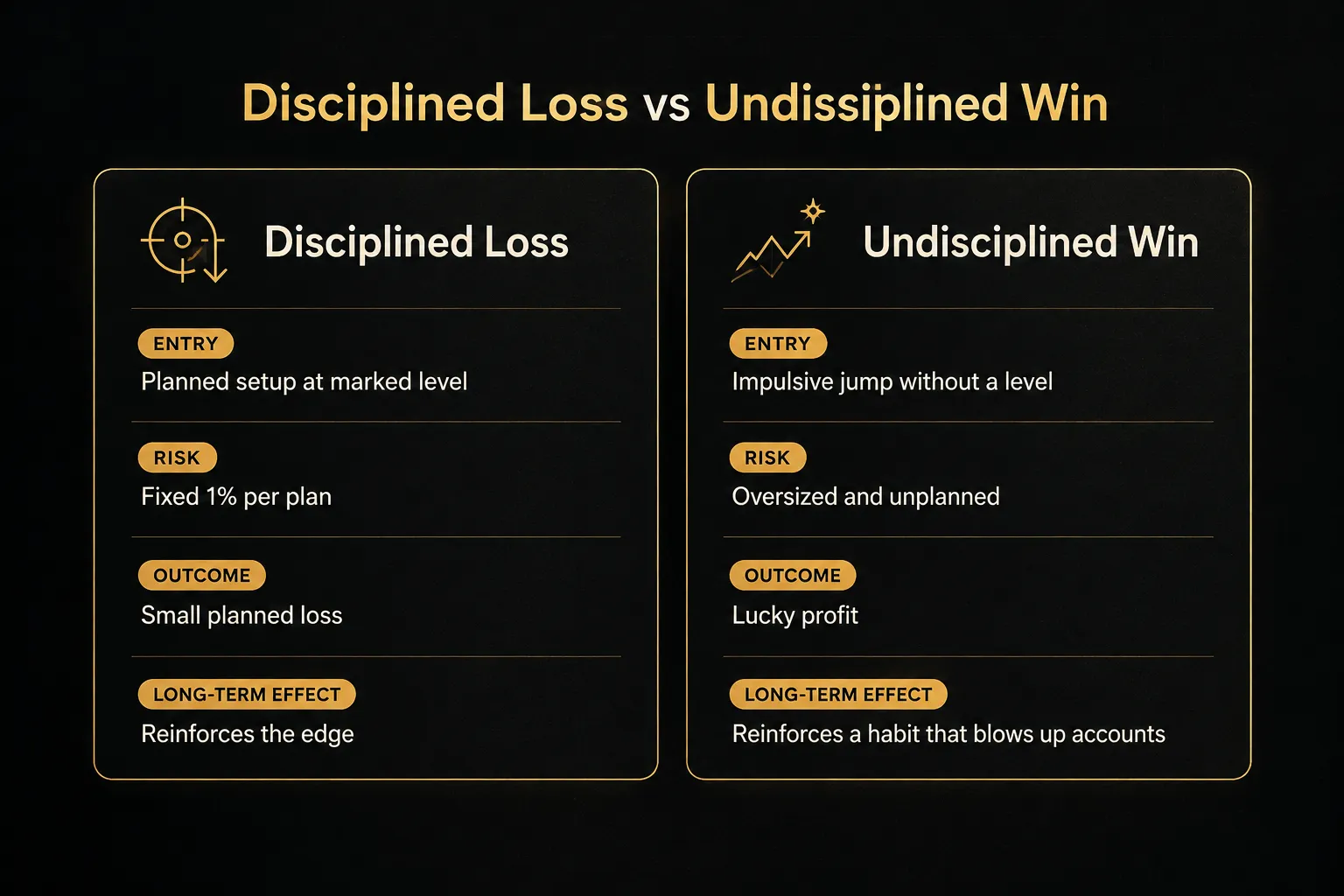
Behavioral finance has a name for judging decisions by outcomes: outcome bias. Traders who grade themselves on P&L alone end up training their worst habits, since random wins feel like confirmation.
Does Discipline Beat Strategy?
Discipline doesn’t replace strategy.
It determines whether your strategy’s edge ever reaches your account. Expectancy is calculated as (win rate × average win) minus (loss rate × average loss), and every input depends on execution.
Take a strategy with a 45% win rate and a 2:1 risk-reward ratio. Executed cleanly, the expectancy is 0.45 × 2 minus 0.55 × 1, or +0.35R per trade.
Solid.
Now add inconsistent execution.
Move the stop on a few losers so they average 1.5R instead of 1R, and cut winners early so they average 1.4R. Expectancy drops to 0.45 × 1.4 minus 0.55 × 1.5, which is roughly −0.20R.
Same strategy.
Negative edge.
A strong strategy executed inconsistently is mathematically indistinguishable from a weak strategy. Discipline is what lets the backtest show up in real life.
The Control System That Replaces Willpower
Willpower is a terrible risk management tool.
It’s strongest when you need it least (before the session) and weakest when you need it most (after three losses in a row). The fix is to make decisions in advance, when you’re calm, and then build an environment that enforces them.
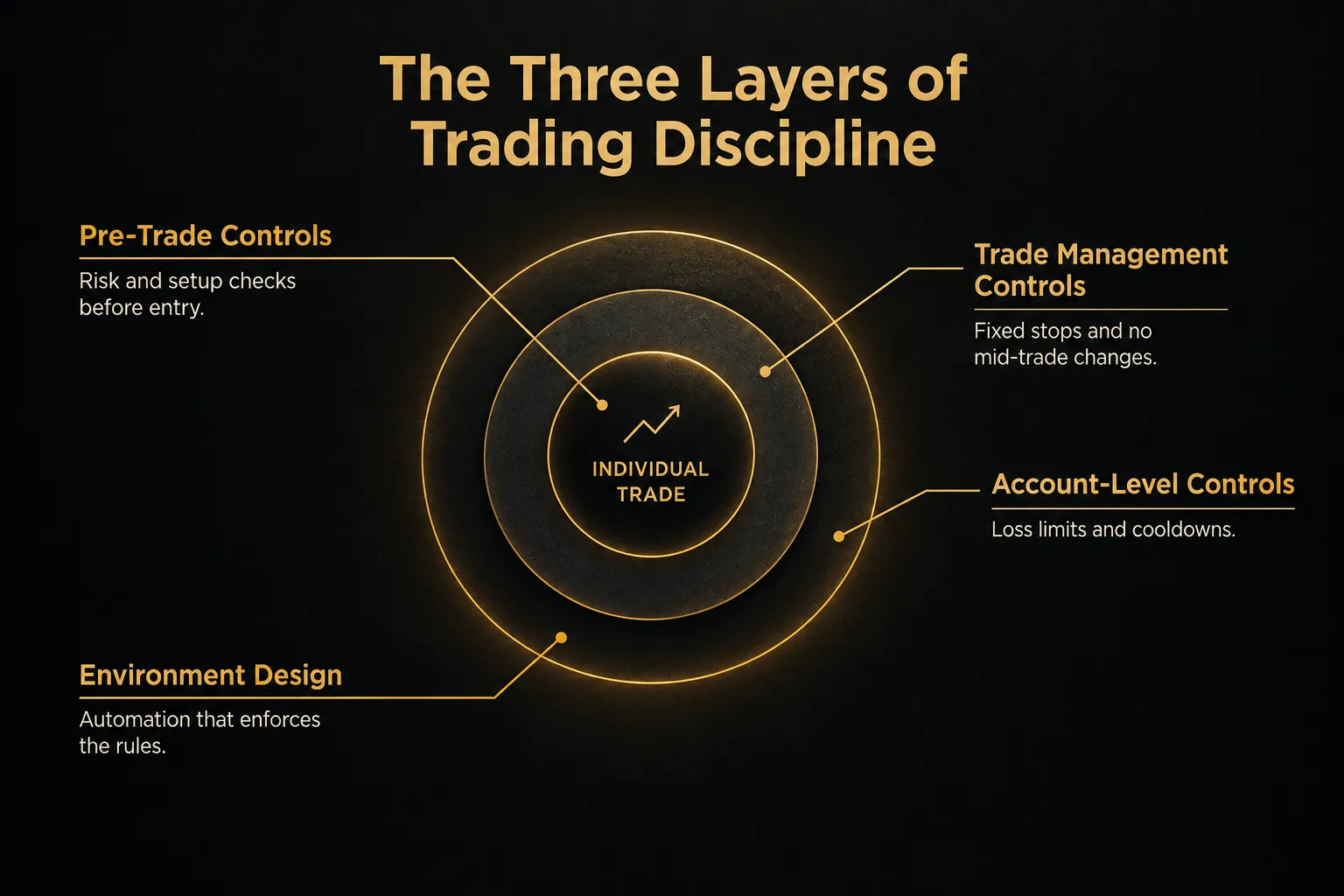
Your control system has three layers: what happens before a trade, what happens during it, and what governs the account as a whole.
Pre-Trade Controls
- Predefined risk per trade: Set a fixed percentage, commonly 0.5% to 1% of account equity, and calculate position sizing from your stop distance rather than from conviction. Your size should never change because a setup “looks really good.”
- Setup qualification checklist: Write down the three to five conditions that define a valid setup, such as trend direction, a specific pattern, and a session window. If any box is unchecked, there is no trade.
- Signal validation before entry: Require a confirmed signal and a marked price level before you act. An alert is a prompt to check the checklist, not an instruction to click buy.
Trade Management Controls
- Order placement rules: Define whether you enter with limit orders at your level or stop orders on a break, and stick to one method per setup type. Mixing methods mid-session is how chasing starts.
- Fixed stop and target logic: Decide stop-loss placement and take-profit rules before entry, ideally as bracket orders attached to the position. The stop goes where the trade idea is invalidated, not where the pain becomes uncomfortable.
- No mid-trade discretionary changes: Once the trade is live, the only allowed adjustments are ones written into the plan, such as moving to breakeven after price reaches 1R. Anything else is improvisation wearing a disguise.
Account-Level Controls
- Daily and weekly loss limits: A common structure is a 2% to 3% daily cap and a 5% to 6% weekly cap. Hit the limit and the platform closes for the day, no exceptions, which is the core of practical drawdown control.
- Mandatory cooldown after consecutive losses: After a set number of losers in a row (two or three works for most intraday traders), step away for at least 30 minutes. The break interrupts the emotional loop before it becomes revenge trading.
- Maximum trades per session: Cap the number of trades based on how often your setup actually appears. Once you reach it, you’re done, even if the next chart looks perfect.
Environment design is what makes these rules stick. Many brokers and platforms let you set maximum position sizes, daily loss lockouts, and pre-attached brackets.
Use them.
Set alerts on your marked levels so you aren’t staring at every tick, and automate any rule a machine can enforce better than you can.
The principle is simple: every rule you automate is a decision you no longer have to win in the moment.
Fixing Overtrading, Revenge Trading, and Rule Breaks
Ask ten traders what overtrading means and you’ll get ten different trade counts.
Five a day? Twenty?
The number itself is meaningless without context, and that’s exactly why so many traders can’t fix it.
Overtrading Relative to Your Edge
Overtrading means exceeding your strategy’s tested setup frequency. If your backtest shows the setup appearing about four times per week on your chosen market and timeframe, then twelve trades in a week isn’t enthusiasm.
It’s eight trades with no proven edge.
To find your number, pull at least 100 setups from backtesting, then confirm with 30 to 50 forward-tested trades in simulation or at minimum size.
Divide by the number of sessions covered. That average, plus a small buffer, becomes your session cap.
The data on excessive trading is sobering.
Barber and Odean’s well-known study of over 66,000 brokerage households found the most active traders earned about 11.4% annually while the market returned 17.9%, a gap driven largely by trading costs and poor timing.
Stop-moving and entry-chasing are close cousins of overtrading.
Both are usually symptoms of unvalidated signals: you entered without a clear invalidation point, so you have no logical place for the stop, so you move it. Or you saw a candle run and jumped in late out of FOMO trading.
The rule that fixes both: no entry without a marked price level.
If you can’t point to the exact price on the chart where you enter and the exact price where you’re wrong, the trade doesn’t exist.
Revenge Trading and Risk Escalation
Revenge trading rarely looks like rage. It looks like a slightly bigger position “just to get back to even.”
Then a slightly bigger one after that.
This is martingale-style escalation, and the math is brutal.
Double your size after each loss starting at 1% risk, and four consecutive losses (a completely normal streak for a 45% win rate strategy) put you down 15% of the account.
Kahneman and Tversky’s work on loss aversion explains the urge: losses feel roughly twice as painful as equivalent gains feel good, so the brain grabs for fast relief.
The mirror image is just as dangerous.
After a winning streak, overconfidence bias kicks in and traders start overleveraging, taking bigger size on weaker setups. Both patterns break expectancy math, because expectancy assumes constant risk per trade.
Vary the risk based on mood and your results become a function of your emotions, not your edge.
Regime shifts make all of this worse.
A breakout strategy that thrives in trending markets will chop you up in a range, and high-impact news can make normal stops meaningless. Traders under these conditions start “adjusting,” which really means deviating.
The better fix is a regime-specific checklist: define which setups are allowed in trending, ranging, and news-driven conditions, and sit out when the regime doesn’t match.
Recovery After a Violation
You will break a rule eventually.
Everyone does.
What separates professionals is having a protocol ready, so one violation doesn’t spiral into a lost month.
- Cut size immediately. Drop to half your normal risk per trade, or less, for the next trading period.
- Return to simulation or minimum size. If the violation involved risk escalation, trade in sim or at the smallest contract or lot size your broker allows.
- Narrow the setup list. Trade only your single highest-quality setup until consistency returns.
- Require compliant trades before scaling up. Set a threshold, such as 20 consecutive trades with zero rule violations, before returning to full size.
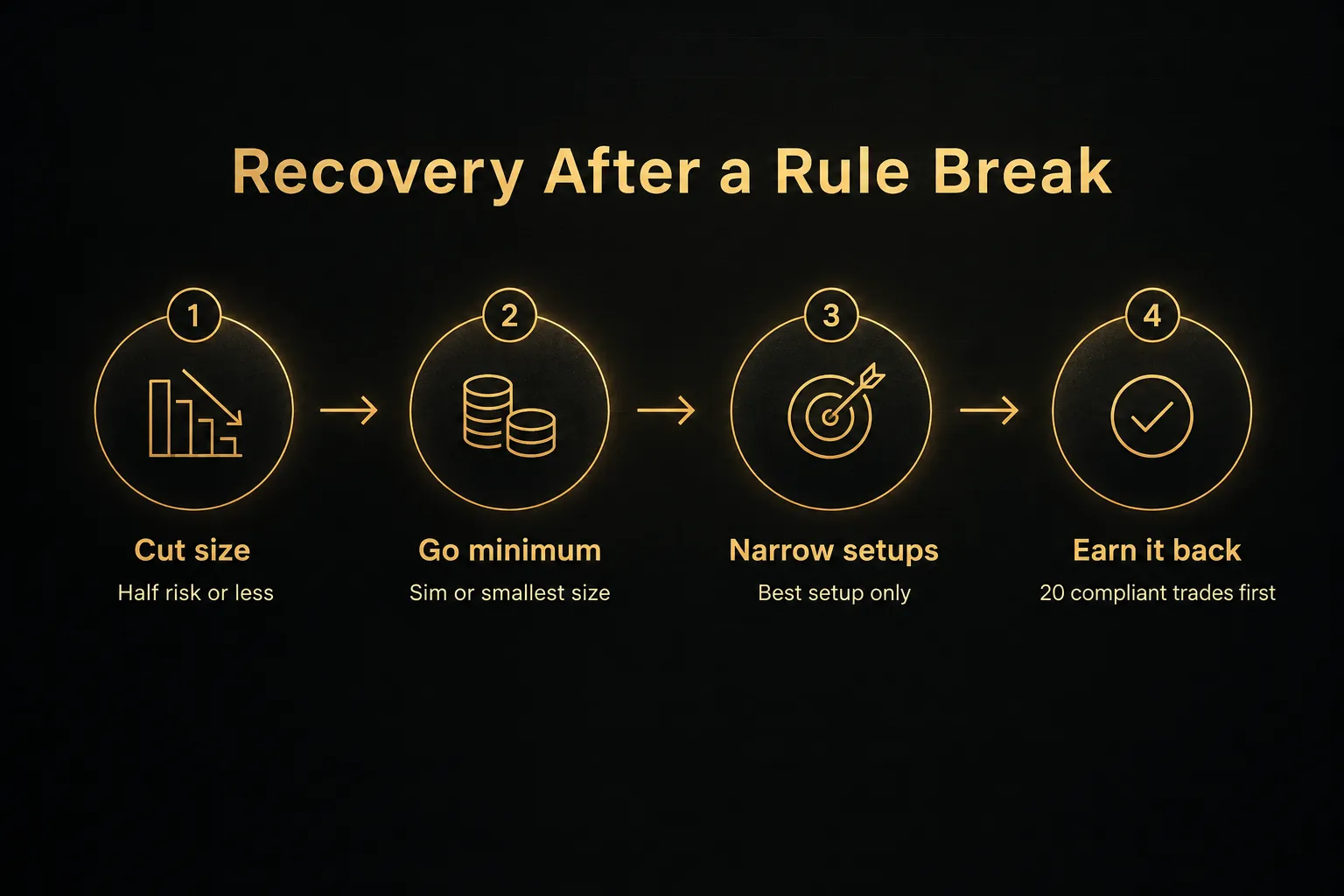
The compliant-trade requirement matters most.
It shifts your focus from winning money back to proving execution, which is the only thing that actually rebuilds trust in yourself.
Measuring Discipline With Data, Not Feelings
“I felt pretty disciplined this week” is not data.
Most traders dramatically overestimate their own consistency until they see it written down.
A well-built trading journal turns vague impressions into patterns you can fix.
The aim is to capture behavior, not just outcomes.
Price and P&L tell you what happened.
The fields below tell you why.
Journal Fields That Reveal Behavior
- Time of entry: Log the exact timestamp. Many traders discover their rule breaks cluster in specific windows, such as the first 15 minutes of the open or the last hour of a long session.
- Trade number of the day: Mark whether this was trade one, two, or six. If your win rate collapses after trade three, your daily cap should probably be three.
- Prior trade result: Record whether the previous trade won or lost. This single field exposes revenge trading faster than any other, because oversized entries tend to follow losses.
- Stop movement: Note whether the stop was moved, in which direction, and why. Widening a stop on a losing trade is one of the clearest signs of the disposition effect, the tendency to hold losers and cut winners documented by Shefrin and Statman.
- Position-size changes: Compare actual size to planned size for every trade. Any deviation, up or down, deserves a one-line explanation.
- Emotional trigger notes: Write a short phrase about your state before entry, such as “bored,” “frustrated after loss,” or “afraid of missing move.” After 50 trades, these notes often reveal your personal triggers with uncomfortable clarity.
An Execution Score You Can Track
An execution score converts your journal into one number you can track over time. Here’s a simple version that takes under a minute per trade.
- Setup adherence (0 to 2 points): Did the trade meet every condition on your checklist? Full marks only if all boxes were checked before entry.
- Risk adherence (0 to 2 points): Was the position size within your predefined risk limit? Any oversizing scores zero.
- Entry adherence (0 to 2 points): Did you enter at your marked level using your planned order type? Chasing scores zero.
- Exit adherence (0 to 2 points): Did the trade close at your planned stop, target, or rule-based exit? Discretionary exits score one at best.
- Rule violations (minus 2 points each): Subtract for any breach of account-level controls, such as trading past your daily loss limit or skipping a cooldown.
Divide each trade’s score by 8 to get a percentage, then average it weekly. A weekly average above 90% suggests a reliable process.
Below 75% means execution, not strategy, is your main problem.
Here’s the part that trips people up.
This score tracks process consistency, not win rate or profitability.
You can post a 95% execution score during a losing week, because even good strategies hit normal drawdowns.
That week is still a success for the system… and over enough trades, high scores are what allow positive expectancy to appear in your equity curve.
Where an Indicator Fits In
Indicators can either feed impulsive behavior or filter it. The difference is how you use them.
A tool that fires an alert every few minutes invites reactive trading, while a tool that separates what direction to look from where to act builds a validation step into your process.
- Direction and entry as separate steps: An indicator like PipTrend works as a process filter by splitting the decision in two. The signal or candle color shows directional bias, while the marked price level defines where an entry is actually valid.
- Validation before action: Because the entry level is explicit, the trader confirms the setup before acting instead of chasing every color change. This directly supports the “no entry without a marked price level” rule.
- Clear invalidation: A defined level also gives a logical reference for stop-loss placement, which reduces the temptation to move stops mid-trade.
- Honest limits: No indicator guarantees profit. PipTrend or any other tool reduces discretionary noise only when you follow its confirmation rules, respect signal invalidation, and operate inside a complete trading plan with defined risk.
- Evaluate tools by transparency: When judging any indicator in 2026, look for transparent, published results rather than cherry-picked screenshots. A tool’s track record should be visible and verifiable before you trust it with real capital.
Trading Discipline FAQ
What are the rules of trading discipline?
The core rules of trading discipline are fixed risk per trade, a setup checklist, entry only at a marked price level, predefined stops and targets, and account-level loss limits.
Each rule must be checkable with a yes or no answer.
If you can’t verify compliance after the session, it isn’t a real rule.
How do professional traders stay disciplined?
Professional traders stay disciplined by relying on systems rather than willpower.
They use hard loss limits, automated bracket orders, position-size caps, and detailed journals reviewed weekly.
Many prop firms enforce daily drawdown limits automatically, which removes the decision from the trader entirely.
Why do traders lose discipline after a winning streak?
Traders lose discipline after a winning streak because overconfidence bias makes them believe their edge is bigger than it is.
They start increasing size and taking weaker setups, which is risk escalation in the opposite direction from revenge trading.
The fix is a hard position-size cap that doesn’t change based on recent results.
How do I stop emotional trading?
You stop emotional trading with pre-set rules and mandatory cooldowns, not by trying harder to feel calm.
Emotions will show up regardless.
What matters is that a daily loss limit, a cooldown after consecutive losses, and a trade cap stop you from acting on those emotions.
What is the best way to control overtrading?
The best way to control overtrading is to cap trades at your strategy’s tested setup frequency.
Pull the average number of valid setups per session from your backtest and forward-test data, add a small buffer, and stop once you hit it.
Pair the cap with a setup checklist so every trade has to earn its place.
Can you be a profitable trader without discipline?
You cannot be consistently profitable without discipline, although you can be lucky for a while.
Short-term wins from undisciplined trades are noise.
Long-term profitability depends on positive expectancy, and expectancy only exists when execution is consistent enough for your edge to repeat across hundreds of trades.
The One Rule to Start Tonight
Don’t rebuild your whole approach this weekend.
Start with one action before tomorrow’s open.
Write down three things: your maximum number of trades, your maximum loss for the day, and the exact entry-validation rule you’ll use.
Put the paper next to your screen.
When you hit either limit, you’re done.
When a trade doesn’t meet the validation rule, you skip it.
That’s it.
Discipline isn’t proven by a personality overhaul or a motivational streak. It’s proven one followed rule at a time, and each one makes the next a little easier.
Remember what you’re actually building: a repeatable process.
Losing trades taken exactly as planned aren’t failures.
They’re the system working, and the system is what pays you over time.
Sources
Risk Disclaimer: Trading involves risk. Past performance doesn't guarantee future results. Only trade with money you can afford to lose. PipTrend is a tool to assist your trading decisions, not financial advice.