Set and Forget Trading Explained (Without the Hype)
On this page
Set and Forget Trading Explained (Without the Hype)
Set and Forget Trading Explained (Without the Hype)
What Set and Forget Really Means
Most traders lose money not because their entry was wrong, but because they interfered with it.
They moved the stop.
They closed early.
They doubled down at the worst possible moment.
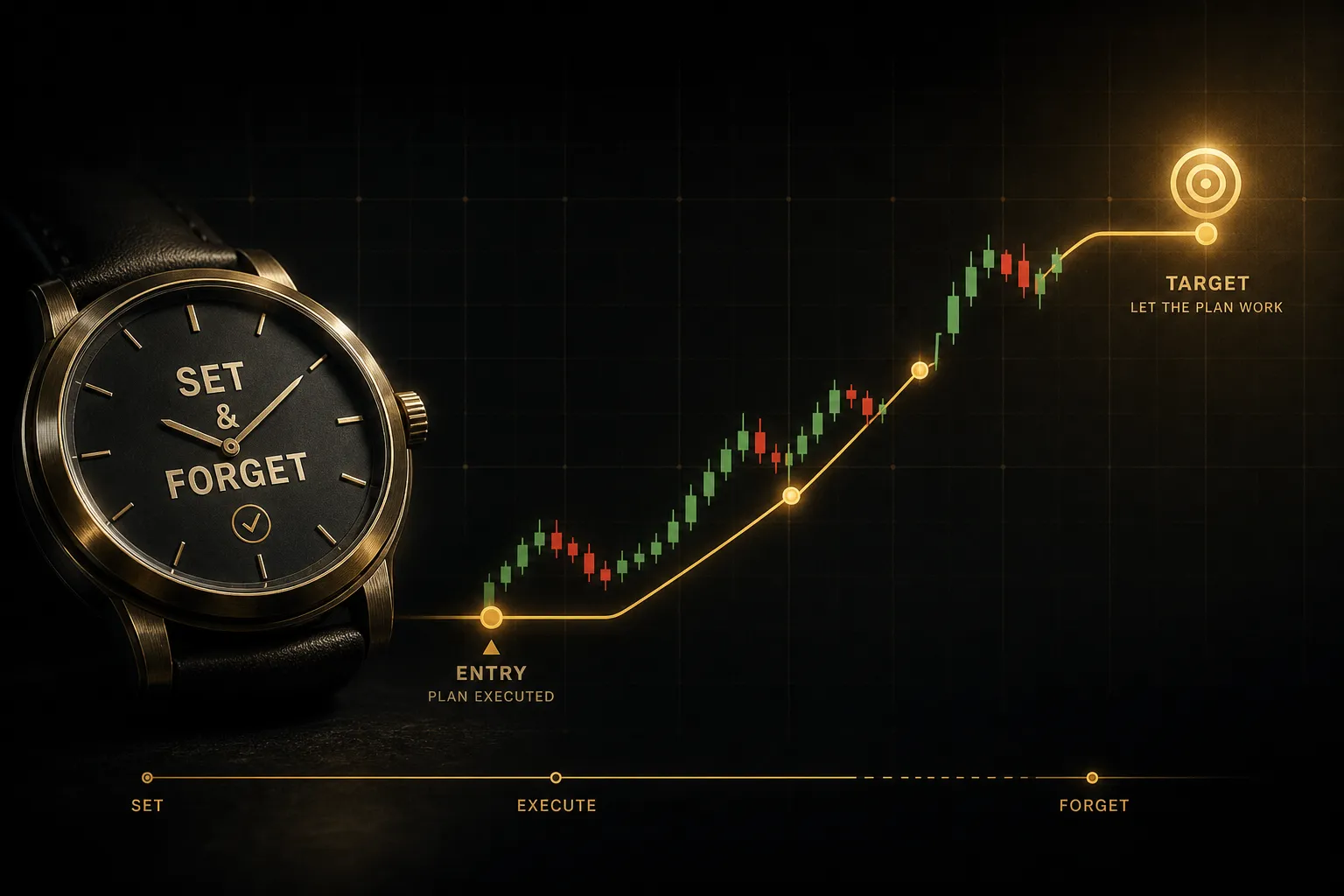
Set and forget is the deliberate answer to that problem.
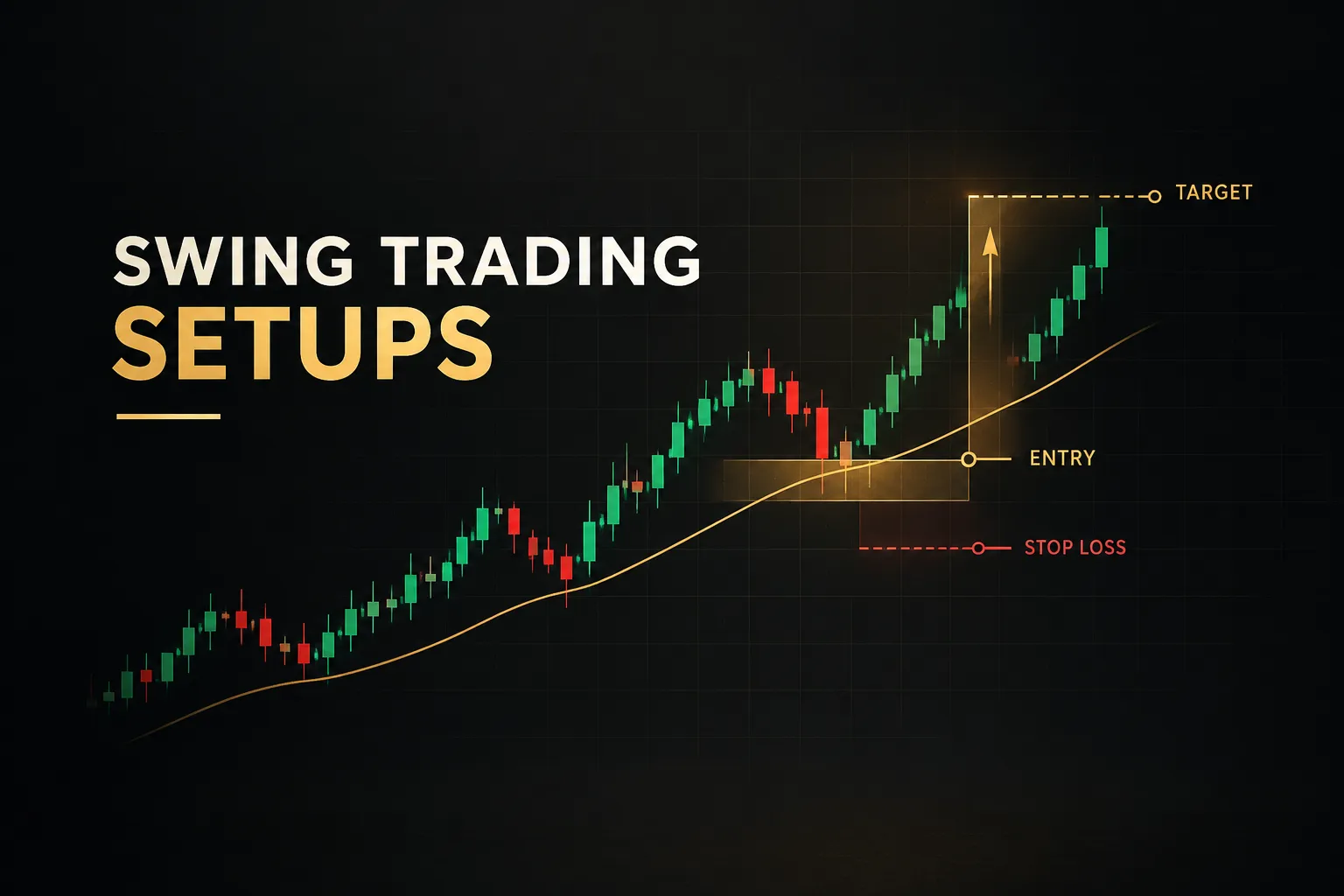
You identify a setup, place the entry, the stop-loss order, and the take-profit order at the same time, then step away until either the trade closes or a predefined condition tells you to act.
That’s the whole mechanic.
No hovering. No “just checking.”
The decisions get made once, before capital is at risk, when your judgment is cleanest.
But here’s the tension this article exists to resolve: there is a meaningful difference between following a fixed plan and genuinely ignoring risk. The first is discipline.
The second is negligence wearing discipline’s clothes.
The behavioural research explains why the approach appeals.
The disposition effect, documented across decades of studies on retail investors, describes the tendency to sell winners too early and hold losers too long. Traders watching every candle are far more likely to act on that impulse.
Overtrading compounds it.
Studies of retail brokerage accounts have consistently found that the most active traders underperform the least active ones, largely because of transaction costs and reactive decision-making. Less screen time means fewer opportunities to sabotage a plan that was fine to begin with.
Reducing screen-watching can improve how well you execute an edge. It cannot create an edge that was never there.
So the position of this article is simple and stated upfront: set and forget is a trade-management framework, not a standalone profit strategy.
It governs how you behave once a position is live. It says nothing about whether your entry criteria are any good.
Get that distinction wrong and you’ll automate your losses beautifully.
How a Set-and-Forget Trade Works
From Entry to Exit
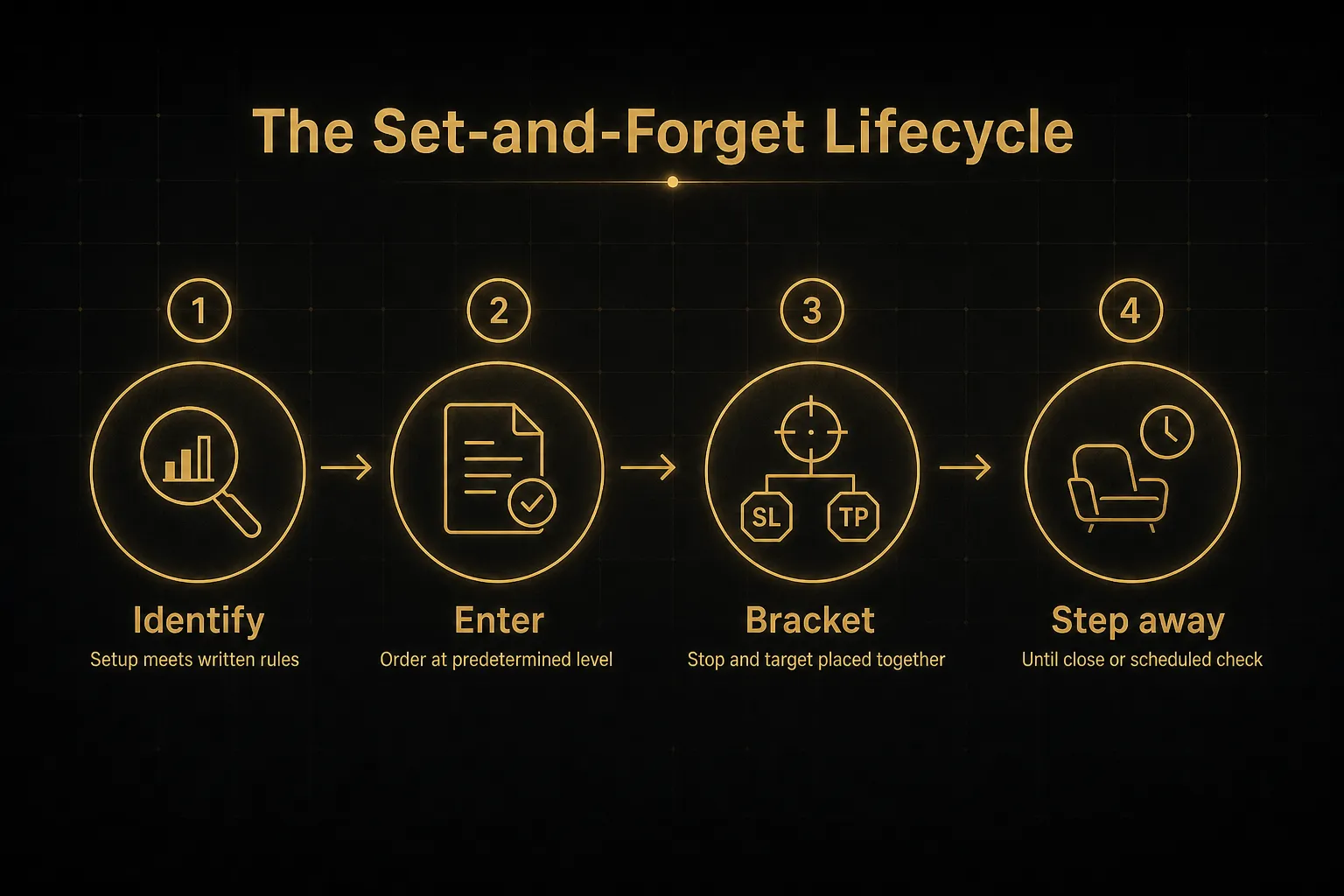
The lifecycle is short enough to write on an index card.
That’s part of the appeal.
First, a setup is identified against a written rule set. Maybe price is retesting a broken support and resistance level on the 4-hour chart, maybe a moving average structure has aligned across timeframes.
The rule matters less than the fact that it existed before you looked at the chart.
Second, the entry order goes in at a predetermined level. Limit, stop, or market at a confirmed close, depending on the system.
Third, and this is non-negotiable, the stop-loss and take-profit go in at the same moment as the entry.
Not “once it moves in my favour.” Now.
The risk-to-reward ratio is locked in before emotion has anything to attach to.
Fourth, you leave.
Until the trade closes at one of the two levels, or until a scheduled check that you also defined in advance.
Not the Same as Automation or Investing
Set and forget gets confused with four other things constantly. The distinctions matter because the risks are different.
Expert advisors and bots execute code without human judgment. They scan, enter, and manage positions autonomously, sometimes hundreds of times a day.
Set and forget still requires a human to evaluate the setup and pull the trigger; the “forgetting” happens after the decision, not instead of it.
Copy trading means following another trader’s decisions in real time. You inherit their sizing, their timing, and their drawdowns, and you learn almost nothing about why any of it happened.
Buy-and-hold investing has no stop-loss at all. The thesis is time in the market, and a 40% drawdown is treated as noise rather than invalidation.
Set and forget defines an exact price where the idea is wrong.
Dollar-cost averaging adds capital on a fixed schedule regardless of whether a setup exists.
It’s an accumulation method, not a trade.
Set and forget can be fully manual or semi-automated. A common middle ground: trading alerts notify you when price reaches a level or when a condition confirms, you check the chart, then you place a bracketed order and walk away.
The automation handles the watching.
You handle the judgment.
Instrument choice changes what “forget” actually means in practice.
Forex runs 24/5, so a Friday close is a genuine gap risk over the weekend. Futures contracts roll, and a position left through rollover can behave strangely or be liquidated. Options have expiry, and theta decay quietly works against a long position every single day you ignore it.
Crypto trades continuously, which sounds convenient until a Sunday morning liquidation cascade blows through a stop with 3% of slippage. Stocks gap on earnings overnight.
None of these disqualify the approach. They just mean “forget” has an expiry date that varies by market.
Does Set and Forget Actually Have an Edge?
Why the Method Isn’t the Strategy
Ask a hundred traders why they’re profitable and a surprising number will answer “I use set and forget.”
That answer is like saying you’re a good driver because you wear a seatbelt.
Placing a stop and a target is trade management.
It controls the shape of your outcomes. It does not determine whether the underlying signal has any predictive value.
The entry system carries that burden, and it has to demonstrate trade expectancy above zero. The formula is unglamorous:
Expectancy = (Win% × Average Win) − (Loss% × Average Loss)
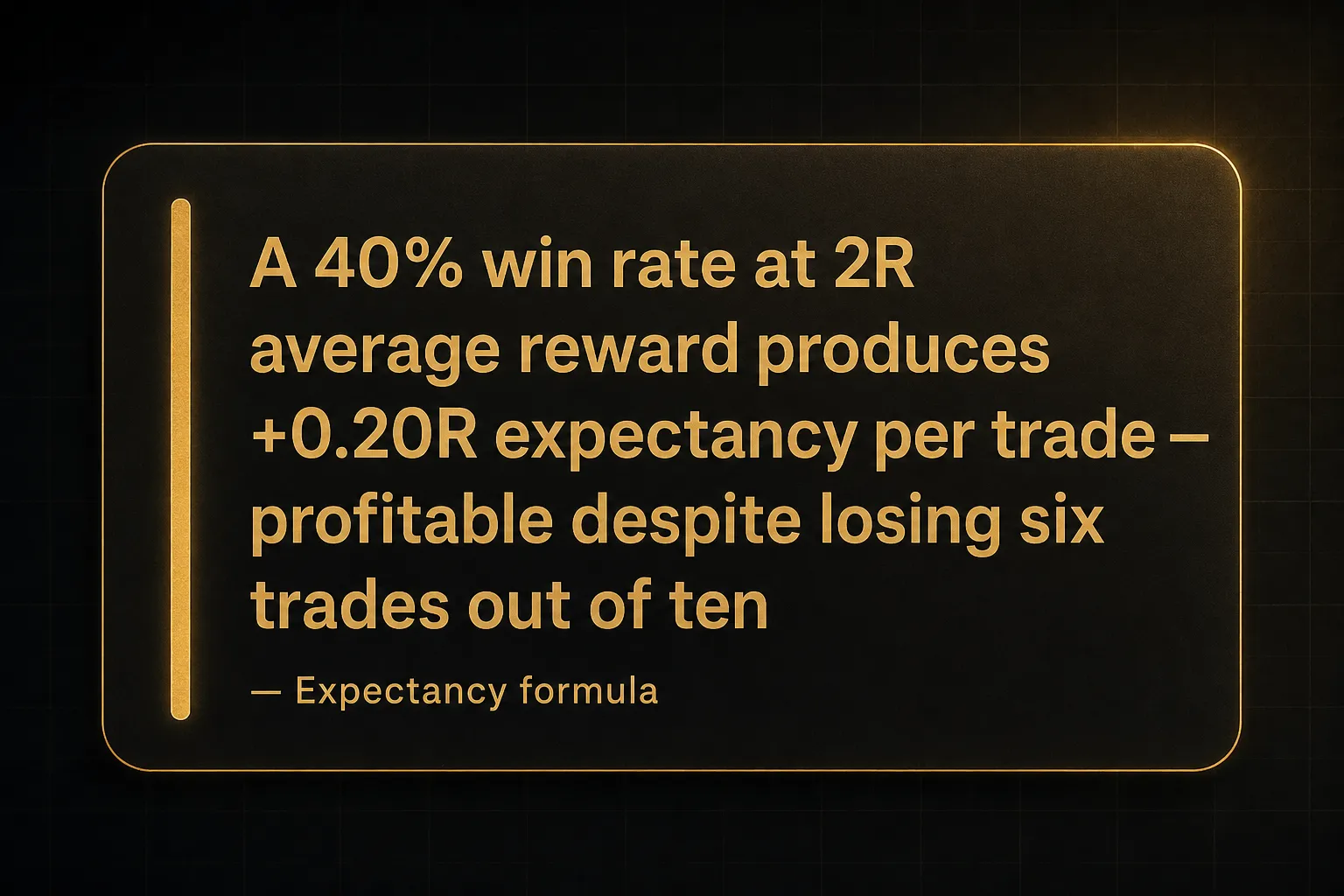
A system winning 40% of the time with an average win of 2R and an average loss of 1R produces an expectancy of (0.40 × 2) − (0.60 × 1) = +0.20R per trade.
Twenty percent of your risk amount, per trade, on average.
That’s a real edge, and it survives a losing streak of eight in a row, which will happen.
Profit factor is the companion metric: gross profit divided by gross loss. Anything above 1.0 is profitable, above 1.5 is respectable, and anything claiming above 3.0 on a small sample is almost certainly curve-fitted.
Sample size is where most self-assessments collapse. Roughly 100 trades is the minimum before results mean anything, and even then the confidence interval is wide.
Twelve winning trades tells you about variance, not skill.
How Market Regimes Change the Odds
Backtests are performed on history.
Trades happen in the present.
The gap between those two things is called regime risk, and it is the quietest account-killer in this whole discipline.
A trend-following setup that produced a 1.8 profit factor across a two-year directional market can hand back every gain in six months of choppy range.
Same rules, same execution, completely different outcome distribution.
The market changed; the system didn’t.
Thin liquidity does its own damage.
A setup that tests beautifully during the London-New York overlap behaves differently in the Asian session, where spread expansion and shallower order books turn a clean 20-pip stop into an expensive coin flip.
High-impact news is the extreme case. A CPI print can move a major pair 80 pips in four seconds with slippage on both sides.
Your set-and-forget order doesn’t know a data release is happening.
Then there’s correlation, which is the trap almost nobody accounts for. Three “separate” set-and-forget trades on EUR/USD, GBP/USD, and AUD/USD are not three trades.
They’re one leveraged bet on dollar weakness, sized at 3x your intended risk per trade.
The same applies to a basket of tech stocks, or long Bitcoin plus long Ethereum plus long Solana. When correlation goes to 1 in a stress event, and it always does, your carefully calculated 1% risk becomes a 4% loss in a single session.
Maximum drawdown is where that arithmetic shows up.
Engineering a Trade That Can Survive Neglect
Placing Stops and Targets by Structure
A stop-loss placed at “the amount I’m comfortable losing” is not a stop-loss.
It’s a donation with extra steps.
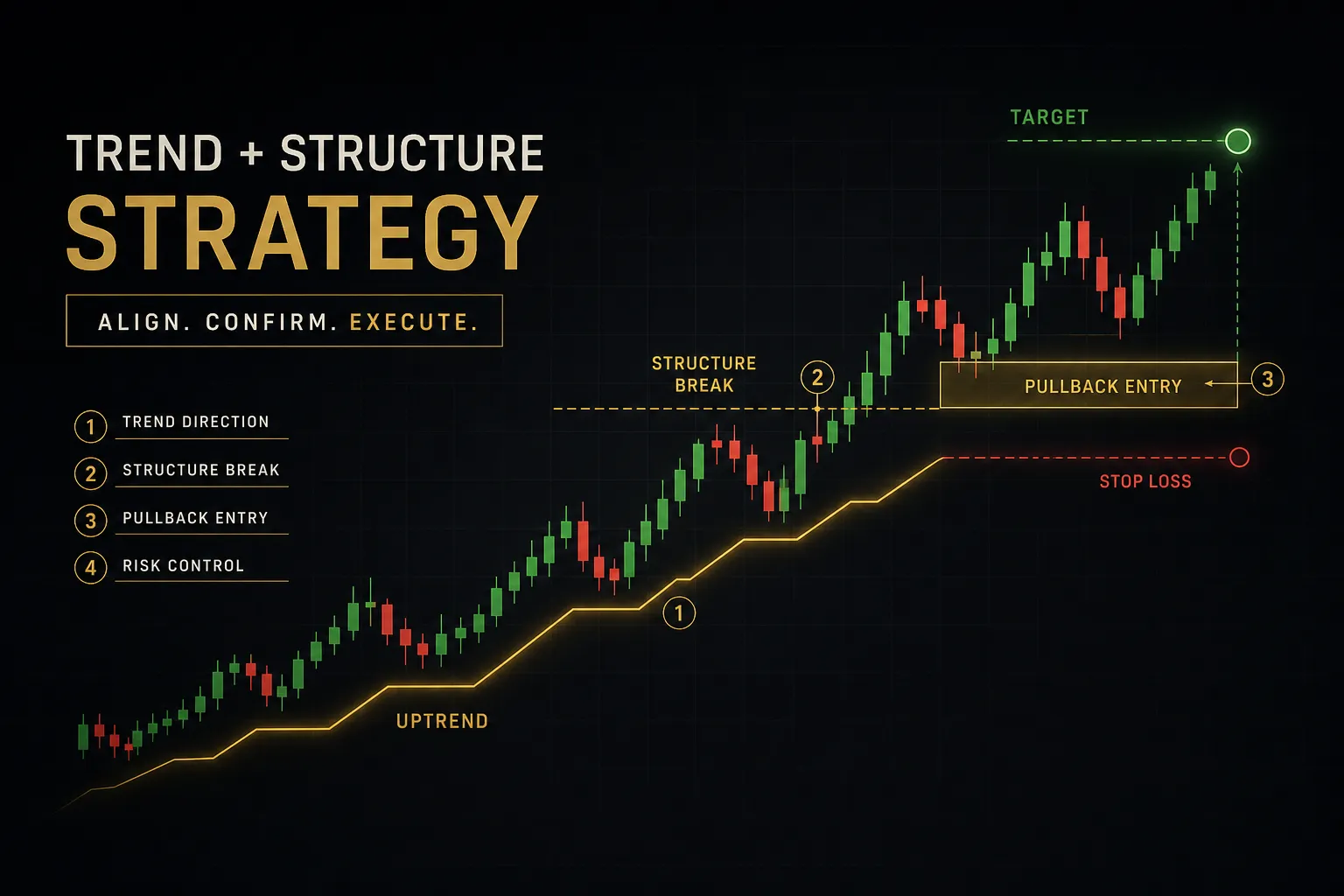
Stops belong at the price where the trade idea is objectively wrong. That means anchoring them to market structure: beyond the recent swing low on a long, beyond the swing high on a short, or outside the supply or demand zone that justified the entry in the first place.
Trade invalidation is a price level, not a feeling.
Then adjust for volatility.
ATR (Average True Range) gives you a read on normal price movement, and a stop placed inside one ATR of the entry will get clipped by ordinary noise. A common approach: place the stop beyond structure, then verify it sits at least 1 to 1.5 ATR from entry.
Add clearance for costs.
Your stop must sit far enough beyond structure to survive typical spread, and on instruments where spreads widen at rollover or around news, that buffer needs to be generous. A stop three pips beyond a swing low on a pair that regularly widens five pips at 5pm is not a stop.
It’s a scheduled exit.
Targets follow the same logic in reverse. Place them just before the next significant structural level, not at it, because that’s where opposing orders sit.
Being greedy for the final four pips costs more traders more money than any other single habit.
The Position-Sizing Formula
Position sizing is the mechanism that makes a wide stop and a tight stop cost exactly the same. Most traders have it backwards, sizing first and then placing the stop wherever it fits.
Position size = (Account risk % × Account balance) ÷ (Stop distance × pip or tick value)
Work it through.
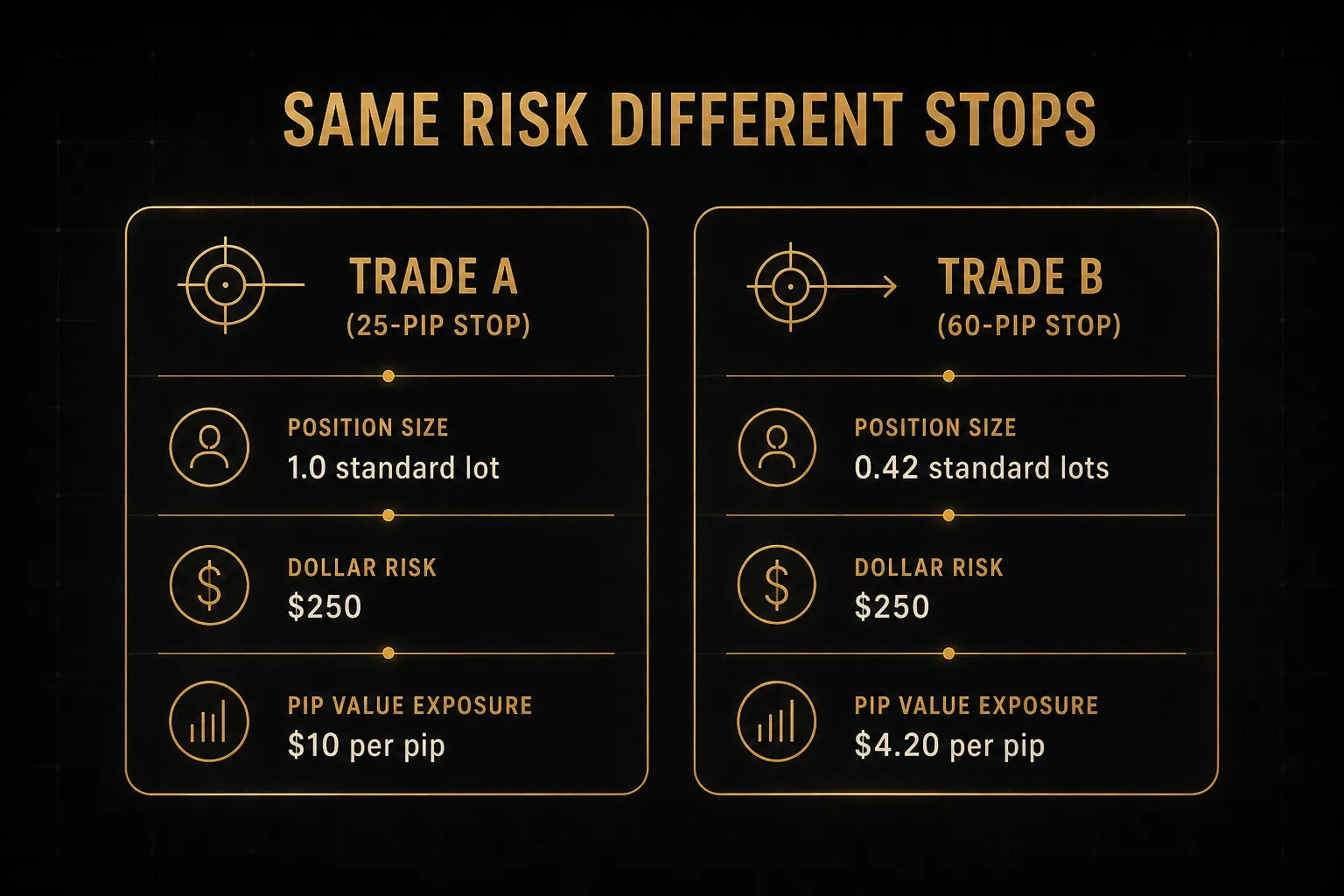
A $25,000 account, risking 1%, gives you $250 of risk per trade. On a standard EUR/USD lot, each pip is worth roughly $10.
Trade A: structure puts the stop 25 pips away. Position size = $250 ÷ (25 × $10) = 1.0 standard lot.
Trade B: a wider setup puts the stop 60 pips away. Position size = $250 ÷ (60 × $10) = 0.42 standard lots.
Two very different position sizes.
Identical dollar risk.
That’s the entire point, and it’s why the stop must be decided before the size, never the other way round.
The standard range for risk per trade sits between 0.5% and 2% of account equity. New traders and untested systems belong at the lower end.
At 1% risk, a ten-trade losing streak costs roughly 9.6% of the account, which is survivable. At 5% risk, the same streak costs 40%, and recovering from that requires a 67% gain.
But fixed percentage risk stops being fixed the moment correlated trades stack. Four dollar-denominated longs at 1% each is a 4% position with the illusion of diversification.
Cap total exposure per theme, not just per ticket.
Execution Risks Between Checks
Your stop-loss is a request, not a guarantee.
Understanding the difference is what separates prepared traders from surprised ones.
- Slippage fills your stop worse than the level you set, particularly during fast moves. Budget for it rather than assuming your 1% risk is exact; on volatile instruments the realised loss can be 1.2% or worse.
- Gaps through the stop happen over weekends, at market opens, and around scheduled events. If a stock closes at $50 with your stop at $48 and reopens at $43 after earnings, you exit at $43. The stop never had a chance to work.
- Spread expansion around news and at daily rollover can trigger stops on paper wicks that never appear on the chart of a different broker.
- Partial fills leave you with a smaller position than intended, or worse, a stop order that only clears part of the exposure in illiquid conditions.
- Overnight financing and swap charges accumulate on leveraged positions held for days or weeks, and on negative-carry pairs they can quietly consume a chunk of a modest winner.
- Broker execution risk covers requotes, platform outages, and connectivity failures. Server-side stops sit with the broker and survive your internet going down; stops held locally on a running platform do not.
Overnight risk is the theme connecting most of these. If you cannot tolerate the gap, reduce the size before the close or don’t hold the position through it.
Scheduled Reviews vs Blind Neglect
There’s a version of set and forget where the trader checks their platform once a week, sees a closed position, and shrugs.
That’s not discipline.
That’s abdication.
The distinction worth internalising: avoiding emotional interference is the goal, not avoiding information. Not watching every candle protects you from the disposition effect.
Never looking at all protects you from nothing.
Scheduled checks solve it.
One review at the daily close for swing positions. One weekly review of the full book, correlations included.
The times are written down in advance, which means checking at 3am because you feel uneasy is a rule violation, not diligence.
When a Rule-Based Exit Is Legitimate
Some situations justify closing before either bracket is hit. All of them share one feature: they are defined in advance, in writing.
- Confirmed structural invalidation. Price closes decisively beyond the level your thesis depended on, without hitting the stop. The idea is dead even if the loss isn’t maximised yet.
- A trading halt or suspension. If an instrument stops trading, your stop cannot protect you, and reassessment is mandatory once it reopens.
- Approaching contract or options expiry. Futures rollover and options expiry impose hard deadlines that no set-and-forget order respects on your behalf.
- A preplanned high-impact news filter. If your rules say “flat before NFP,” you go flat before NFP. That’s execution, not intervention.
- A correlation-driven risk breach. If new positions have pushed total thematic exposure past your cap, trimming is a risk rule firing, not a discretionary call.
Notice what’s absent from that list: “it’s up nicely” and “I have a bad feeling.”
Moving a stop to breakeven deserves its own warning.
It is only valid as a predefined rule tied to a specific trigger, for example, price closing beyond 1R in your favour on the signal timeframe.
Moving it because you’re watching unrealized profit and feel protective is exactly the behaviour set and forget was designed to eliminate.
And breakeven stops have a cost.
They convert normal retracements into scratched trades, and on trend systems where the biggest winners come after a deep pullback, aggressive breakeven rules can measurably reduce win rate and expectancy at the same time.
Test it before you adopt it.
Alerts Instead of Micromanagement
The technology to stop staring at charts has existed for years, and most traders still don’t use it properly.
Price alerts notify you when a level is reached.
Indicator alerts fire when a condition confirms.
Multi-timeframe alerts tell you when higher and lower timeframes align, which is usually the signal that matters.
PipTrend is a useful illustration of the workflow. Its real-time alerts flag when a setup condition triggers, and its 12-timeframe confirmation table shows directional agreement across timeframes in one view, so a trader gets a signal plus a suggested entry level without sitting at the screen.
Its public results page shows verified wins and losses rather than a curated highlight reel, which is a reasonable standard to hold any signal tool to.
What a tool like that does not do: replace your risk plan.
The indicator flags direction and levels. Position sizing, stop logic, correlation limits, and the decision to take the trade at all remain yours.
An alert tells you something happened. It doesn’t tell you whether you should have money on it.
Wrap the whole process in two documents.
A short pre-trade checklist: does the setup meet every entry criterion, where is invalidation, what’s the position size, what’s the risk-to-reward ratio, is this correlated with anything open?
And a trade journal recording entry reason, stop logic, planned R-multiple, actual outcome, and any deviation from plan. After 100 entries you’ll have something backtesting can’t give you: evidence of how the method performs when you are the one executing it.
Forward testing on a demo account for a month before risking capital is the cheap version of the same lesson.
Set and Forget FAQ
What does set and forget mean in trading?
Set and forget means placing your entry, stop-loss order, and take-profit order at the same time, then stepping back until the trade closes or a predefined condition requires action. Every decision is made before capital is at risk.
It’s a management style, not a guarantee of anything. The approach controls your behaviour after entry; it has no bearing on whether the entry itself was worth taking.
Is set and forget trading good for beginners?
Yes, with a significant condition attached.
Beginners benefit enormously from removing emotional mid-trade decisions, which is where most early accounts are lost.
But the approach only helps if the underlying entry system has been tested and position sizing is calculated correctly. A beginner who sets and forgets a random entry with a 5% risk per trade will lose money faster and more calmly than one who improvises.
Test the rules first, on at least 100 trades, before trusting them unattended.
Does set and forget trading really work?
It works only when the underlying rules have genuine positive expectancy and are matched to the current market regime.
The framework improves execution consistency; it cannot manufacture an edge.
Measure it honestly.
Track expectancy, profit factor, and maximum drawdown across a sample of 100 trades or more. If expectancy is negative, set and forget will simply deliver those losses more efficiently.
What is the best timeframe for set and forget trading?
Higher timeframes suit set and forget better, typically H4, Daily, or Weekly charts. The reasoning is practical: wider stops on higher timeframes make spread and slippage a smaller percentage of total risk, and there’s less noise to trigger premature exits.
One-minute and five-minute charts work poorly for this. Stops are tight enough that ordinary spread expansion can end trades, and the setup-to-resolution window is too short to justify walking away.
Intraday scalping and set and forget pull in opposite directions.
Should I move my stop-loss to breakeven?
Only if it follows a predefined trigger written before the trade, such as price closing beyond 1R in your favour.
Never as a reaction to seeing unrealized profit.
Be aware of the trade-off.
Breakeven stops frequently convert would-be winners into scratches by exiting on normal pullbacks, and on trend-following systems they can reduce overall expectancy. Backtest the rule with and without it before deciding.
What is the biggest risk of set and forget trading?
Correlated concentrated exposure is the most underestimated risk, followed closely by gaps through stops and slippage. Traders who believe they hold four independent 1% positions often hold one 4% directional bet.
Gaps are the second problem.
A stop-loss guarantees an exit attempt, not an exit price, and weekend or earnings gaps can produce losses well beyond planned risk. Cap total exposure per theme and reduce size ahead of known gap events.
The Real Takeaway
Set and forget fixes an execution problem.
It stops you from selling winners early, widening stops in panic, and turning a planned 1R loss into a 4R disaster because you couldn’t accept being wrong.
What it cannot do is generate returns from a system that doesn’t have them.
If your entry rules have negative expectancy across a proper sample, disciplined execution just gets you to the same place with less drama and slightly lower commissions.
So here’s the one concrete action worth taking.
Before your next trade, write down four things: the entry price, the stop level and why it sits there, the target, and the exact time of your next scheduled review.
Four lines. Two minutes.
Everything else, the alerts, the checklist, the journal, exists to protect those four lines from you.
And the perspective shift that makes it stick: the goal was never to trade less.
Plenty of active traders are excellent.
The goal is to remove the decisions that should never be made mid-trade, when the position is live, the P&L is moving, and your judgment is at its absolute worst.
Sources
Risk Disclaimer: Trading involves risk. Past performance doesn't guarantee future results. Only trade with money you can afford to lose. PipTrend is a tool to assist your trading decisions, not financial advice.