The5ers Rules Explained for Funded Traders

On this page
Most traders who fail a prop firm evaluation don’t fail because their strategy was bad. They fail because they misread a single line in the rulebook.
A trailing drawdown that resets differently than expected. A position held 90 seconds past a news embargo. A lot size calculated against account balance instead of remaining risk budget.
Small misreadings, expensive outcomes.
This guide breaks down how The5ers’ rules actually behave when money is on the line.
What Is The5ers, Exactly?
The5ers is an Israel-founded proprietary trading firm that offers funded trading accounts across forex, futures, and algorithmic strategies through simulated evaluation programs. Founded in 2016, it’s one of the longer-running names in a sector where firms appear and vanish within a single season.
The business model is straightforward.
A trader pays a one-time fee for an evaluation account, demonstrates that they can generate profit while respecting strict loss limits, and then receives access to a funded account where they trade firm capital and keep a majority share of the profits.
What separates The5ers from a retail broker is the direction of the capital risk.
You’re not funding the account. The firm is.
In exchange, it dictates exactly how much you’re allowed to lose and how fast you’re allowed to grow.
The evaluation fee isn’t a deposit. It’s the price of an audition, and it’s non-refundable if you breach a rule.
Some programs use a traditional two-stage or one-stage challenge. Others, like the Bootcamp line, put traders on a low-capital live-style account almost immediately. The common thread is a hard maximum loss limit and a profit target that must be reached without breaching it.
All rules and pricing described here were verified as of early 2026. Prop firm terms change frequently, sometimes monthly, and The5ers has revised its program structures multiple times since launch.
Before you buy anything, read the current official rulebook on The5ers’ own site and treat any third-party summary, including this one, as a starting point rather than gospel.
The rest of this article isn’t a feature list. Plenty of those exist.
Instead, it explains how each rule translates into a real decision at the moment you’re about to click buy or sell: what lot size is defensible, whether a position can survive a rollover, and how a floating loss quietly shrinks tomorrow’s budget.
How The5ers Programs Work
The single biggest mistake new applicants make is picking a program based on the headline capital figure. The account size matters far less than the drawdown structure attached to it.
The5ers runs four broad product families as of 2026.
Hyper Growth is an evaluation-based track built for fast account scaling, where hitting modest profit milestones doubles your capital repeatedly. High Stakes is a single-phase challenge with a higher profit target but generous drawdown room and no time limit, which suits swing traders.
Bootcamp offers near-instant access to a small live-style account with a graduated path upward. The Futures program covers CME instruments like the E-mini S&P, Nasdaq, gold, and crude oil under a separate rule set with its own trailing drawdown model.
| Program | Entry Type | Typical Starting Capital | Scaling Speed | Best Suited To |
|---|---|---|---|---|
| Hyper Growth | Evaluation (multi-step) | $5,000 to $20,000 | Fast: capital doubles on milestone hits | Aggressive intraday traders and scalpers |
| High Stakes | Single-phase challenge | $5,000 to $100,000 | Moderate: incremental growth on profit | Disciplined swing and position traders |
| Bootcamp | Near-instant funding | $10,000 (low fee tiers) | Slow but steady progression | Beginners wanting live-account exposure |
| Futures | Evaluation | $25,000 to $150,000 | Contract-limit based | CME futures traders using tick-based risk |
Which Program Fits You
Match the program to your holding period first, your ambition second.
If your average trade lasts three days and crosses two rollovers, a program with a tight daily drawdown and no weekend holding will fight you constantly. High Stakes, with its wider room and unlimited time, is the natural home for that style.
Scalpers face the opposite problem.
Dozens of trades per session means slippage and spread costs accumulate fast, so you want fast scaling to make the grind worthwhile. Hyper Growth was designed for exactly that rhythm.
Beginners should think about tuition cost, not profit potential. A Bootcamp account at a low fee gives you the psychological experience of trading under real rules, with real consequences, for less than the price of a failed $100,000 challenge.
Is The5ers Legitimate?
Legitimacy is not one question. It’s four.
Separating them prevents both blind trust and reflexive dismissal.
- Business registration: The5ers operates as a registered entity with a public corporate footprint, a physical address, and a trading history dating to 2016. Verifiable.
- Published rulebook: Rules, targets, and drawdown mechanics are documented publicly before purchase rather than revealed after a breach. Verifiable.
- Payout history: Thousands of documented payouts appear across independent review platforms and the firm’s own certificate feed. Largely verifiable, though no aggregate audit exists.
- Your personal outcome: Not verifiable in advance, and no firm can promise it. A legitimate business can still be a poor fit for your strategy.
One more distinction matters.
A funded trading account at any forex prop firm is a simulated environment mirroring live pricing, not a personal brokerage account. You don’t own the capital, you can’t withdraw the balance, and the counterparty is the firm rather than a market maker.
What you own is a contractual right to a share of the profit your simulated performance generates.
The Drawdown Math Behind Every Trade
Here’s the uncomfortable truth about drawdown limits: they are almost never calculated the way traders assume.
Four different mechanics appear across prop firm rulebooks, and The5ers uses different ones across its programs.
Static, Balance, or Equity Based?
Static maximum drawdown is fixed to your initial balance. On a $100,000 account with a 6% static limit, your equity floor is $94,000 forever, regardless of how much you profit.
Simple, and generous once you’re up.
Trailing (equity-based) drawdown follows your highest equity peak. Profit to $105,000 and the floor climbs to $99,000.
The trap is that many trailing models track floating equity, meaning an unrealized profit spike sets a new high-water mark you then have to defend after the trade closes lower.
Balance-based daily loss is measured from the balance at the start of the trading day, typically at the broker’s 00:00 server reset. Every open position’s unrealized loss counts against that figure in real time.
Reset timing is the fourth variable and the most overlooked. If the reset is 00:00 GMT+2 and you hold a losing position through it, yesterday’s floating loss becomes today’s starting balance.
Your fresh budget is smaller than you think.
The practical rule: know whether your absolute drawdown is static or trailing, and know your exact reset hour in your own timezone.
Write both on a sticky note.
A Worked Drawdown Example
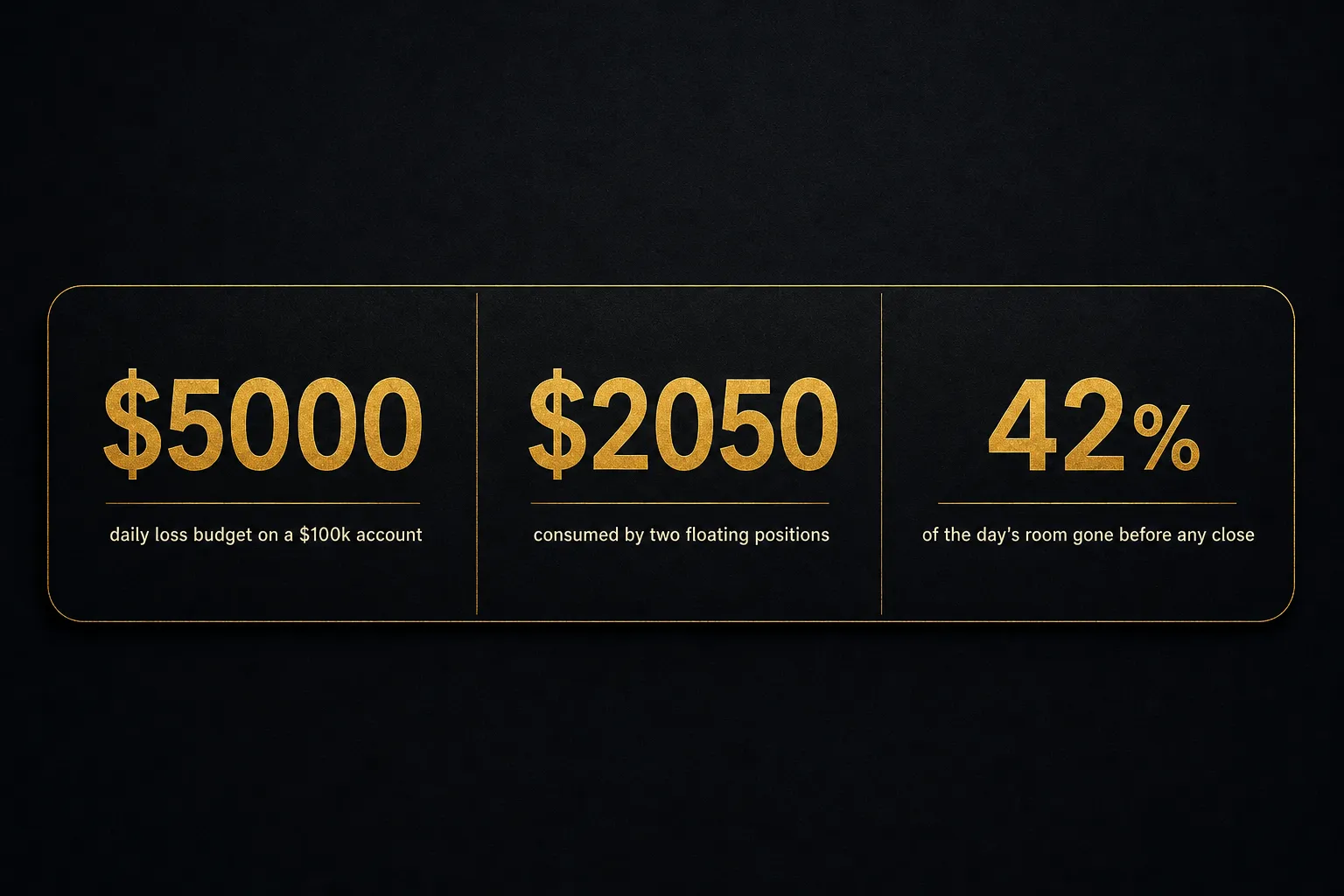
Take a $100,000 account with a 5% daily loss limit and a 6% overall limit. Your daily budget is $5,000 and your account floor is $94,000.
You open two positions Monday morning.
EUR/USD long, 1.5 lots. GBP/USD long, 1 lot.
Both correlated, both moving against you.
By 14:00, EUR/USD is down 90 pips and GBP/USD is down 70 pips. Floating loss: roughly $1,350 plus $700, so $2,050. Spread and commission on entry cost another $60.
You’ve consumed about 42% of the day’s budget without closing a single trade.
Now the important part.
That $2,050 is not a paper number to the rule engine.
Most firms breach on equity, not balance, which means if the pair spikes another 60 pips against you intraday, you’re out even if price returns to break-even an hour later.
Hold overnight and overnight swaps apply.
On a leveraged position, a negative swap of $8 per lot per night on 2.5 lots is $20, trivial alone. Held over a Wednesday triple-swap rollover across four nights, it’s $140 gone from a $5,000 budget for doing nothing.
Then there’s slippage and spread at the exit. A stop-loss triggered during the London open on a widened spread can fill 3 to 5 pips worse than the level you set.
On 2.5 combined lots, that’s an extra $75 to $125 you never planned for.
Profit targets deserve the same scrutiny.
An 8% target on $100,000 sounds like $8,000, but it’s $8,000 net of every commission, swap, and slipped fill along the way. The gross figure you need to earn is meaningfully higher.
Drawdown limits aren’t percentages of a nominal number. They’re a live constraint on your equity, recalculated every tick.
Trading Conditions You Can’t Ignore
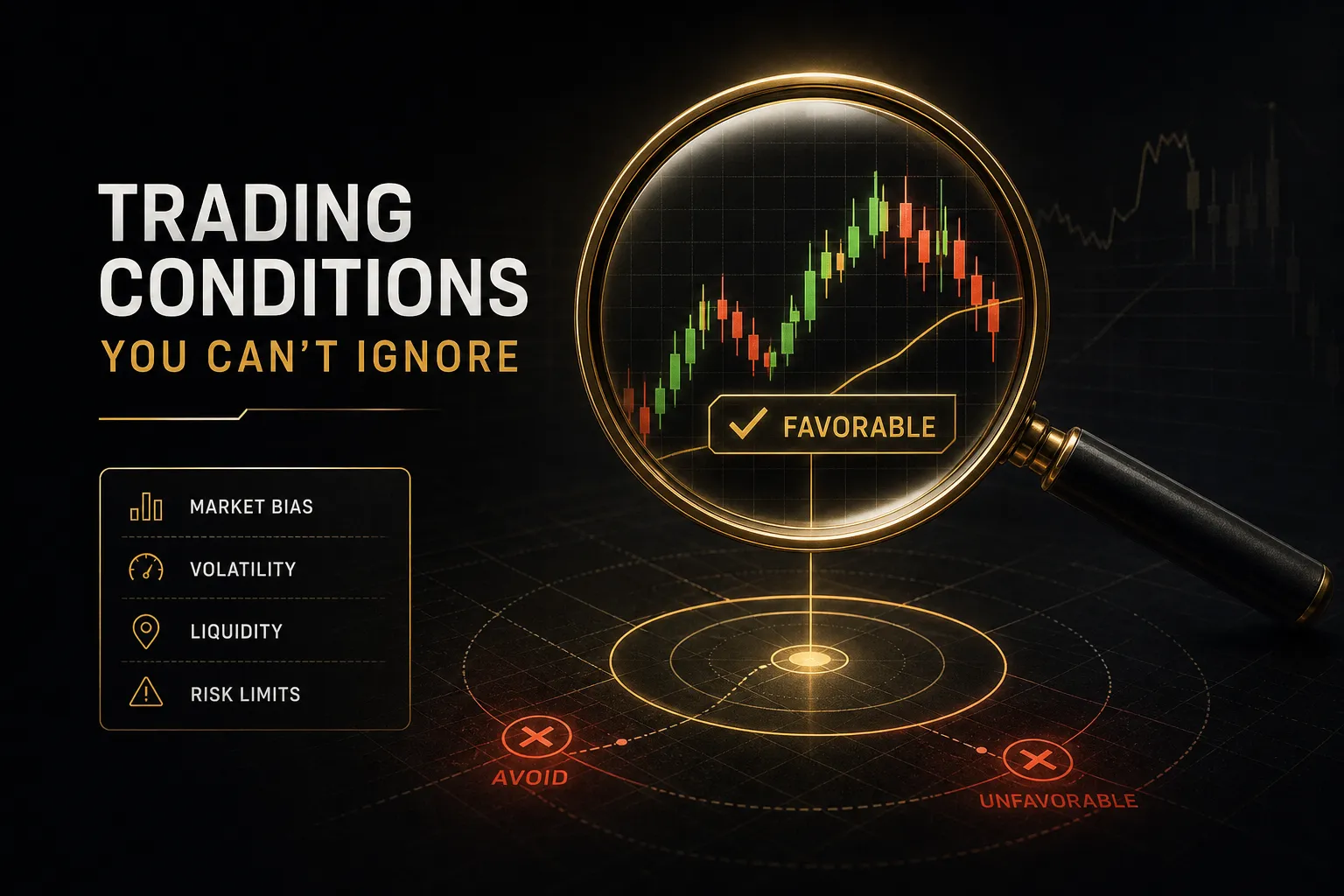
Numeric limits get all the attention.
Behavioral rules cause more terminations.
These are the conditions where traders most often assume something reasonable and discover the rulebook disagrees. Each one is worth reading twice before you place a trade.
News Trading Nuances
The distinction that saves accounts: holding an existing position through a news release is treated differently from opening a new one during the restricted window.
- Restricted windows are typically symmetric. Where news restrictions apply, they usually cover a set number of minutes before and after a high-impact release, commonly 2 to 5 minutes on either side. Check the exact figure for your program.
- New orders inside the window are the violation. Placing a market or pending entry during the restricted minutes on the affected instrument is what triggers a rule check, not the mere existence of an open trade.
- Pre-existing positions are generally permitted under most The5ers program rules, but modifying them (adding size, moving a stop into a better fill) during the window can be treated as new activity.
- The instrument matters, not just the event. A US CPI print restricts USD pairs and dollar-denominated metals. It doesn’t restrict AUD/NZD.
- Pending orders left in the market are your responsibility. A limit order placed hours earlier that fills three seconds after NFP still counts as an execution inside the window on some rule sets. Cancel them beforehand.
- Straddling releases is explicitly targeted. Buy-stop and sell-stop pairs bracketing a high-impact event are the classic pattern firms screen for, since the strategy exploits pricing latency rather than market skill.
EAs and Automation Limits
“Are EAs allowed?” gets a yes on most marketing pages. The real answer has conditions.
- Source-code ownership or licensing. Firms increasingly require that you own or hold a legitimate licence for the Expert Advisor you run, and may ask for proof if your results look templated.
- Copied and mirrored signals are restricted. Running the same copy trading feed that hundreds of other accounts run means the firm sees identical trades across identical timestamps. That pattern gets flagged as coordinated activity, not as your edge.
- High-frequency and tick-scalping bots are prohibited where average hold times fall below the firm’s minimum, typically measured in seconds. Algorithmic trading is welcome; latency exploitation is not.
- Latency and arbitrage trading tools are banned outright. Any system profiting from a price feed delay between the firm’s server and a reference broker exploits infrastructure, not the market.
- Stealth or hidden stops that keep protective levels off the server and manage them client-side can be treated as an attempt to obscure risk exposure.
- Tick-data emulators and reverse-engineering tools that model the firm’s pricing engine to predict fills fall under prohibited technology in most modern rulebooks.
Prohibited Trading Practices
Some breaches have no numeric threshold at all. They’re judged on pattern and intent.
- Account sharing. One account, one trader. Handing credentials to a friend or a “trading service” voids the agreement, and IP logs make it easy to detect.
- Coordinated trading across accounts. Opening long on one account and short on another to guarantee one passes is called group hedging. It’s the single most aggressively policed behavior in the industry.
- Arbitrage in all forms, including triangular, cross-broker, and swap arbitrage. The profit comes from a pricing inefficiency the firm bears the cost of.
- Excessive single-direction concentration. Six long positions across EUR, GBP, AUD, and NZD pairs isn’t six trades. It’s one leveraged short-dollar bet with six commission charges.
- Gap exploitation. Building large exposure minutes before the Friday close specifically to capture a Monday gap treats the firm’s capital as a lottery ticket.
- Overnight and weekend holding breaches. Some programs permit both, some restrict weekend exposure entirely, and Bootcamp-style accounts often differ from High Stakes. Confirm your specific tier, because a permitted-elsewhere trade can still terminate you here.
From Passing to Getting Paid
Passing an evaluation and keeping a funded account alive are different skills.
The first rewards a short burst of good decisions. The second punishes a single bad week.
Position Sizing by the Numbers
Your account size is not your risk capital.
On a $100,000 account with a 6% total drawdown, your actual risk capital is $6,000. Everything else is notional.
Work it backwards.
Risking 0.5% per trade means $500 of the $6,000 budget, giving you twelve consecutive losses before termination. At 1%, you have six.
At 3%, you have two, and a normal losing streak ends your run.
The lot size follows from the stop, never the reverse.
A 40-pip stop on EUR/USD with $500 of risk means $12.50 per pip, so roughly 1.25 standard lots. Widen the stop to 80 pips and the size halves to 0.62 lots.
Same risk, different geometry.
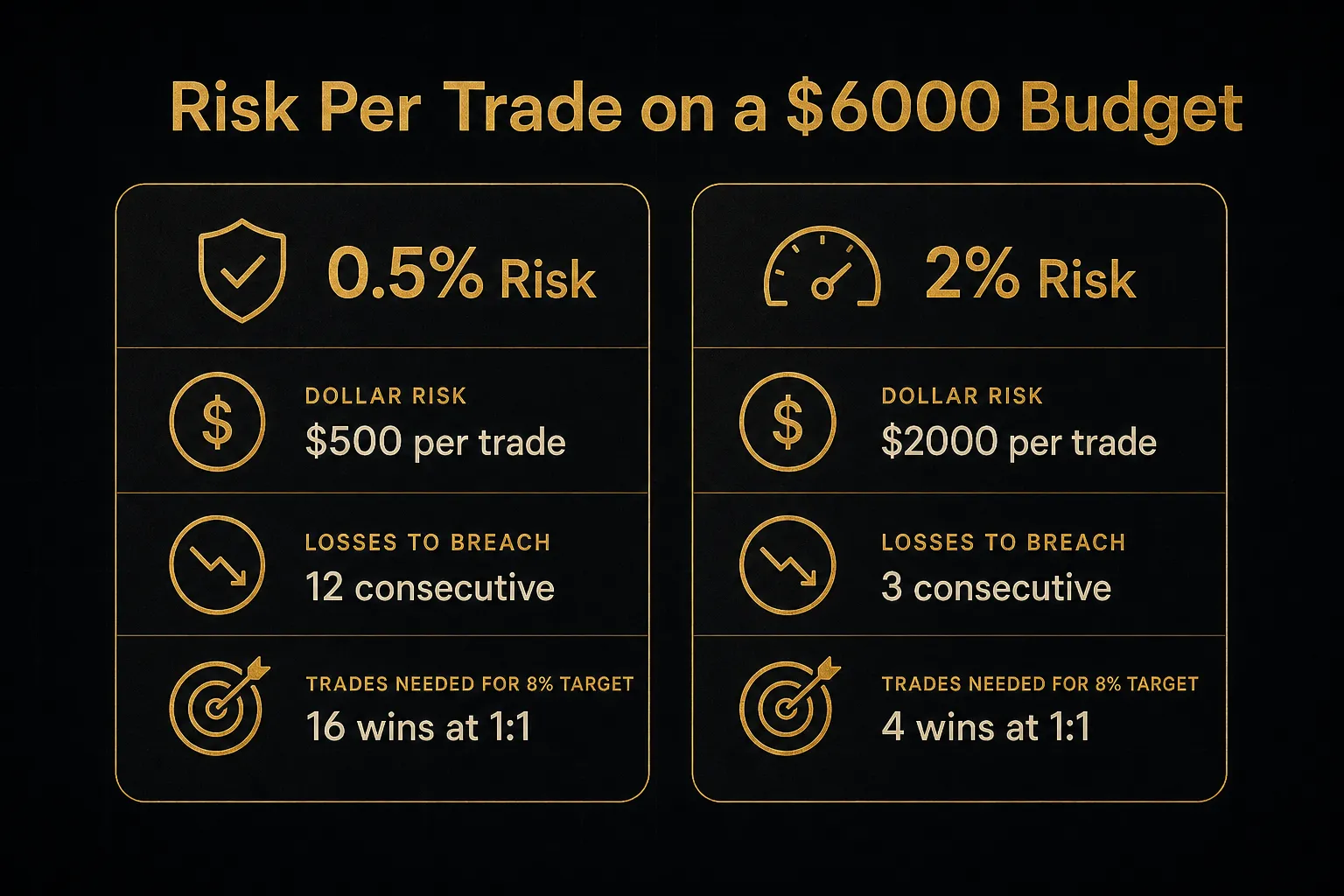
Note what the comparison shows.
Higher risk shortens the path to the target and the path to failure at nearly the same rate. What changes is your margin for a normal losing sequence, and normal losing sequences are guaranteed.
Factor margin and leverage separately.
High leverage lets you open a size your drawdown can’t survive. The margin requirement tells you what’s possible; the drawdown budget tells you what’s sensible.
A Pre-Trade Checklist
Six questions, thirty seconds, before every entry.
- Is the setup A-grade? If you’re describing it as “probably fine,” the answer is no. Marginal setups produce marginal expectancy and full-size losses.
- Where does the stop belong structurally? Place it where the idea is invalidated, then calculate size. Stop-loss placement driven by desired lot size is backwards, and it’s the most common sizing error in prop trading.
- What is remaining drawdown right now, in dollars? Not the account balance. The gap between current equity and your nearest breach level, daily or absolute, whichever is closer.
- Am I exposed to news in the next four hours? Check the economic calendar for the currencies involved, including the quote currency people forget.
- How correlated is this to what’s already open? Two long trades on positively correlated pairs is one position at double size. Sum the risk.
- Does the risk-to-reward ratio justify it? Below 1:1.5, your win rate needs to be exceptional to survive costs. Know your numbers before you accept a thin target.
Using Confirmation Tools Like PipTrend
Once funded, the psychology shifts. Payout dates create urgency, and urgency creates size creep.
The pattern is predictable.
A trader who risked 0.5% during a two-month evaluation starts risking 2% in funded week one because the payout cycle is fourteen days away and the target feels close. Then a loss lands, revenge trading follows, and a disciplined evaluation record ends in a breach.
This is strategy drift, and it’s the leading cause of funded-account failure.
A multi-timeframe confirmation tool like PipTrend helps with one specific problem: trading against higher-timeframe direction because a lower timeframe looked compelling. Used as a directional filter, it tells you whether the daily, four-hour, and one-hour trends agree before you commit size.
What it does not do is replace anything. Not your plan, not your backtesting, not your position sizing, and definitely not the firm’s risk rules.
A tool that confirms trend alignment cannot tell you your stop is too wide for your remaining drawdown.
That calculation stays yours.
Finally, document everything.
Keep a trading journal with entry rationale, screenshots at entry and exit, and month-end statements exported from the platform. If a breach is disputed or a payout is delayed, contemporaneous evidence is the only argument that carries weight.
Traders who log nothing have nothing to appeal with.
Common Questions About The5ers
Is The5ers trustworthy?
The5ers is a registered business operating since 2016 with a publicly published rulebook and a documented payout history across independent review platforms. Those three facts are verifiable and they place it among the more established firms in the sector.
What they don’t establish is your outcome.
A trustworthy firm still terminates accounts that breach limits, and most accounts do. Judge the company on transparency and payment record; judge your chances on your own risk discipline.
How much does The5ers pay?
Profit splits at The5ers typically start around 80% to the trader and can reach 100% on certain scaled or high-tier programs. The exact percentage depends on the program and how far you’ve progressed through its scaling stages.
Scaling matters more than the headline split for long-term earnings. Doubling your capital while keeping an 80% share produces far more than squeezing a marginally better percentage on a small account.
What is the success rate of The5ers?
The5ers does not publish a verified, audited pass rate, and neither does any major prop firm. Industry-wide estimates for evaluation programs generally sit in the single digits to low teens, but these figures are self-reported and inconsistent.
Discipline explains outcomes better than strategy does.
Traders who risk 0.5% per trade and respect the daily limit pass at dramatically higher rates than traders using the same setups at 3% risk.
The edge is in the sizing.
Can I withdraw money from The5ers?
Yes.
Funded traders can withdraw their profit share once they meet the program’s minimum profit threshold, subject to the published payout schedule.
Most programs operate on a fixed payout cycle, commonly every two weeks or monthly, with some tiers allowing on-demand requests after a first withdrawal. Payments are processed through bank transfer, cryptocurrency, or supported e-wallets depending on your region.
You cannot withdraw the account balance itself, only your share of realised profit.
Does The5ers allow news trading?
Holding an existing position through a news release is generally permitted, while opening new orders during restricted minutes around high-impact releases is not, on programs where the restriction applies.
The nuance catches people out.
Pending orders that fill inside the window, and modifications to open trades during it, may both be treated as new activity.
Cancel pendings and leave open positions untouched through the release, and confirm the exact restricted window for your specific program.
What is the easiest The5ers challenge to pass?
Bootcamp-style instant funding has the lowest barrier to entry, because it skips the evaluation profit target entirely and puts you on a small live-style account from the start.
Lower fee, lower capital, less pressure.
“Easiest to enter” and “easiest to succeed at” aren’t the same thing, though.
Instant-funding accounts still enforce drawdown limits, and their smaller size means a single oversized trade breaches faster. For traders who need reps under real rules, it’s the cheapest classroom available.
The Bottom Line on The5ers
The traders who last on funded accounts aren’t the ones with the best entries.
They’re the ones who treat their drawdown budget as the only number that matters.
Strategy is replaceable.
A trend-following system, a mean-reversion system, a breakout system: all can work inside a prop firm’s constraints.
What doesn’t work is any strategy sized against account balance instead of remaining risk capital. That’s the failure mode, and it’s the same one whether you’re on Hyper Growth, High Stakes, Bootcamp, or Futures.
So here’s the single action worth taking before your next trade.
Open the platform, find your current equity, subtract your nearest breach level (daily or absolute, whichever is closer), and write that dollar figure down.
Then size the position so a full stop-out costs no more than 10% of it.
Not the balance. That number.
One last thing.
Prop firm terms move fast, and The5ers has revised program structures, targets, and pricing repeatedly since 2016. Everything here was accurate as of 2026, but verify the current rulebook on The5ers’ official site before you purchase.
The five minutes it takes to read the live version is the cheapest risk management you’ll ever do.
Risk Disclaimer: Trading involves risk. Past performance doesn't guarantee future results. Only trade with money you can afford to lose. PipTrend is a tool to assist your trading decisions, not financial advice.