
The 100 nasdaq stands as a global benchmark for technology and growth investing, capturing the attention of investors as 2026 approaches. With rapid innovation and shifting market dynamics, understanding this index is more crucial than ever.
This comprehensive guide will empower you with data-driven perspectives and expert insights to help you navigate the evolving landscape of the 100 nasdaq. Whether you are an investor, trader, or financial enthusiast, you will gain the tools and knowledge needed to make informed decisions.
Discover the index's structure, performance highlights, key 2026 trends, sector shifts, tactical strategies, and expert tips designed to help you seize new opportunities. Read on to unlock actionable guidance for the year ahead.
Understanding the Nasdaq-100: Structure and Key Components
The 100 nasdaq stands as one of the world’s most influential stock market indexes, setting the pace for technology and growth investing. Understanding its structure, sector composition, and key players is essential for anyone navigating today’s rapidly evolving markets.
What is the Nasdaq-100?
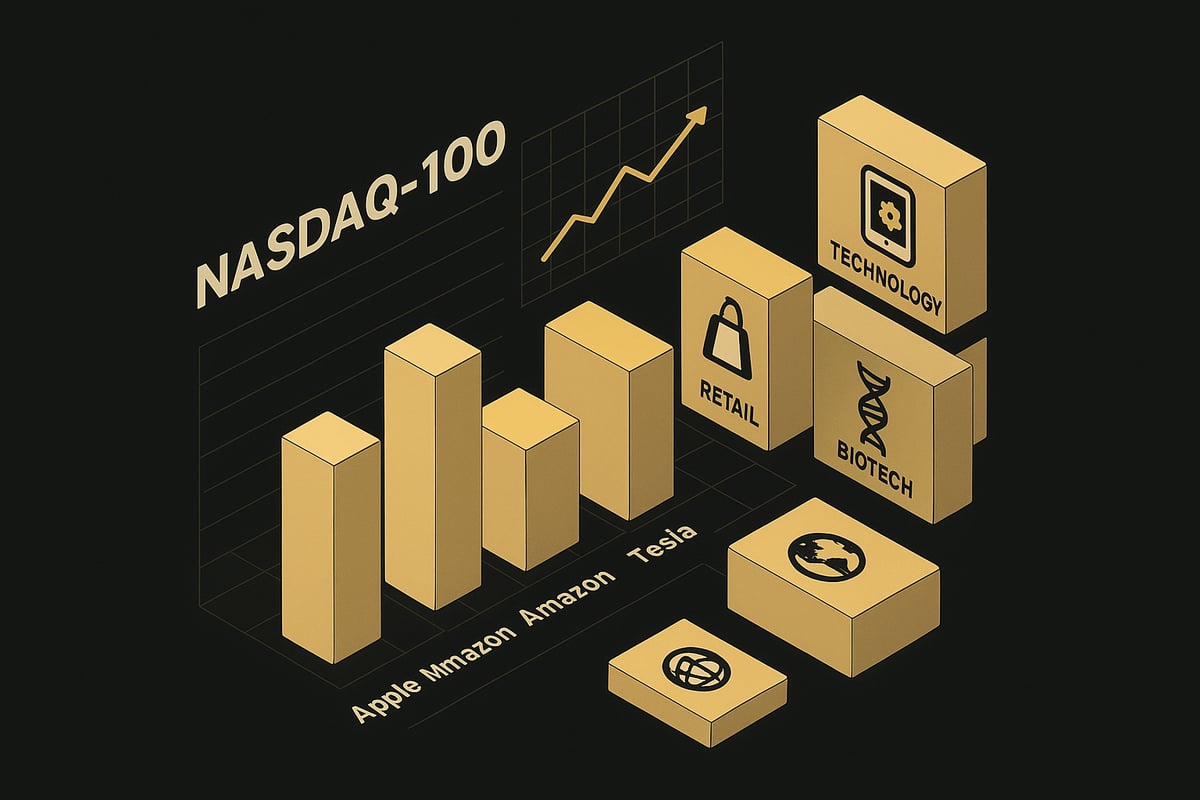
The 100 nasdaq is an index tracking the 100 largest non-financial companies listed on the Nasdaq exchange, weighted by market capitalization. Financial institutions are excluded, allowing the index to focus on technology, retail, biotechnology, and communications leaders. Its value is calculated in USD, using a base value of 125.00 and a divisor (1,236,947,975 as of November 2025) to maintain consistency. As of late 2025, it includes 101 listed components, with household names like Apple, Microsoft, Amazon, and Tesla at the forefront. For a complete breakdown of its structure, methodology, and up-to-date list of constituents, visit the Nasdaq-100 Index Overview.
Major Sectors and Industry Breakdown
Technology is the dominant force within the 100 nasdaq, encompassing hardware, software, and semiconductor giants. Over the past five years, sector weighting has shifted, with increased influence from retail, wholesale trade, telecommunications, and a surge in biotechnology. Notable groupings have emerged: “smart sectors” such as AI and cloud computing, a significant rise in green equity, and an ongoing biotech boom. These shifts reflect the index’s adaptability, capturing emerging trends and innovation.
- Technology (hardware, software, semiconductors)
- Retail and eCommerce
- Telecommunications
- Biotechnology and healthcare
The result is a dynamic mix that offers exposure to both established industry leaders and fast-growing disruptors.
Notable 2026 Constituents and Recent Changes
In 2026, the 100 nasdaq showcases a blend of established powerhouses and fresh entrants. The top 10 companies by market cap include familiar titans like Apple, Microsoft, Amazon, and Tesla, but rankings have shifted since 2024 as new AI and green tech firms gain traction. The annual rebalancing process brings notable inclusions and exclusions, often prompted by mergers, acquisitions, or sustained underperformance. This year, the index welcomed several innovative AI and renewable energy companies, while some legacy tech and retail names exited. The 100 nasdaq also features a diverse mix of U.S. and international firms, mirroring its global reach.
Nasdaq-100 vs. Other Major Indexes
Comparing the 100 nasdaq to the S&P 500, Dow Jones, and Nasdaq Composite highlights its distinctive growth profile. The 100 nasdaq is more volatile, driven by its tech-heavy allocation. It often outperforms during tech bull markets but can underperform when sector rotations favor value or defensive stocks. For example, as of November 2025, its one-year return stands at +20.18%, outpacing its peers. The table below summarizes key differences:
| Index | Focus | Volatility | 1Y Return (Nov 2025) |
|---|---|---|---|
| 100 nasdaq | Tech, Growth | High | +20.18% |
| S&P 500 | Broad Market | Moderate | +12.60% |
| Dow Jones | Industrials | Low | +8.30% |
This performance edge makes the 100 nasdaq a popular choice for growth-oriented investors.
Key Data and Performance Metrics
As of November 28, 2025, the 100 nasdaq is valued at 25,434.89. Daily trading sees significant movement, with a day range reflecting a net change of +197.95, or +0.78%. Over the past 1, 5, and 10 years, the index has delivered strong total returns, cementing its reputation for robust growth. Year-to-date and annualized figures highlight resilience through market cycles. Investors can access downloadable historical data and advanced analytics to track the 100 nasdaq’s performance and inform their strategies. Comprehensive data resources are key to making timely, data-driven decisions.
Nasdaq-100 Performance and Market Trends: 2024–2026
The 100 nasdaq has remained a focal point for investors seeking growth and innovation. Over the past two years, it has reflected major shifts in technology, global economics, and investor sentiment. Understanding its recent performance, sector dynamics, and emerging trends is crucial for anyone navigating the 100 nasdaq in 2026.
Historical Performance Overview
The 100 nasdaq has demonstrated robust returns, outpacing many traditional indexes. Over the 1-year period ending November 2025, the index delivered a total return of +20.18%. Five-year and ten-year returns have consistently beaten benchmarks, highlighting the 100 nasdaq's growth orientation.
Periods of volatility, such as the 2022 correction, were followed by strong bull runs in 2023 and 2024. The average annualized growth rate over the past decade remains notably high. Investors have seen the 100 nasdaq's resilience during tech-driven rallies, yet corrections remind us of its inherent volatility.
| Period | Total Return (%) |
|---|---|
| 1-Year | 20.18 |
| 5-Year | 87.5 |
| 10-Year | 254.3 |
Key Market Drivers for 2026
Several macroeconomic factors will shape the 100 nasdaq in 2026. Interest rates and Federal Reserve policy continue to influence market sentiment. As the global economy recovers from pandemic disruptions, technology and growth stocks remain in focus.
AI, cloud computing, and green energy are primary catalysts within the 100 nasdaq. Geopolitical events, such as trade negotiations and regulatory changes, also play a significant role. Investors must monitor these drivers to anticipate how the 100 nasdaq will respond to evolving market conditions.
Sector Rotation and Emerging Industries
The 100 nasdaq is experiencing a pronounced shift in sector weightings. Artificial intelligence, renewable energy, and biotechnology have gained ground, while legacy tech and retail segments see relative declines. Recent NDX reports reveal an uptick in AI chipmakers and green tech IPOs entering the index.
This sector rotation reflects broader shifts in innovation and investment capital. The 100 nasdaq continues to adapt, with increased exposure to smart sectors and companies at the forefront of sustainability and health technology.
Technological Innovation and Market Leadership
Innovation is central to the 100 nasdaq's leadership. Top constituents like Microsoft, Apple, and Amazon invest heavily in R&D, driving new product launches and patent activity. Mergers and acquisitions further shape the index's composition, with tech giants acquiring startups to enhance their capabilities.
Product rollouts, such as advanced cloud solutions or AI-driven services, often lead to significant stock performance shifts. The 100 nasdaq thrives on this constant cycle of innovation, keeping it ahead in global growth markets.
Internationalization and Global Exposure
The 100 nasdaq has grown more international, with non-US companies gaining a larger share of the index. Cross-listings, American Depositary Receipts (ADRs), and rising global ETF flows expand its reach. International ETFs from providers like Amundi and Mirae Asset now track the 100 nasdaq, attracting capital worldwide.
Currency fluctuations also impact returns for global investors. As the index's global exposure increases, understanding these dynamics is essential for those investing in the 100 nasdaq from different regions.
Volatility, Risk, and Defensive Strategies
Compared to the S&P 500, the 100 nasdaq exhibits higher volatility, especially during sector rotations or global uncertainty. Investors use options, ETFs, and structured products to manage risk and hedge positions. Buffer ETFs and daily option funds have gained popularity, offering downside protection in turbulent markets.
For those seeking practical approaches, the Index Trading Strategies Guide offers actionable insights into managing volatility and optimizing strategies for the 100 nasdaq. Adopting defensive tactics is vital for navigating the index's unique risk-return profile.
Investment Vehicles: ETFs, Options, and Products Linked to the Nasdaq-100
The 100 nasdaq offers a variety of investment vehicles for global investors. From ETFs to options and structured products, each tool provides unique ways to gain exposure, manage risk, and access market opportunities. Let us explore the main products linked to the 100 nasdaq, their features, and how they fit into a modern portfolio.
Nasdaq-100 ETFs: Global Offerings and Features
ETFs make investing in the 100 nasdaq accessible to a worldwide audience. Leading funds like Invesco QQQ, Amundi Nasdaq-100 UCITS, and Xtrackers offer diversified exposure to the index’s top companies.
ETFs are available in the US, Europe, Asia, and Canada, supporting both hedged and unhedged strategies. Liquidity is a key advantage, with QQQ’s high daily trading volume reflecting strong investor demand.
Consider the following comparison:
| ETF Name | Region | Hedged | Liquidity | Expense Ratio |
|---|---|---|---|---|
| QQQ | US | No | High | 0.20% |
| Amundi UCITS | Europe | Yes | Medium | 0.23% |
| Mirae Asset | Asia | No | Medium | 0.25% |
By using these ETFs, investors can efficiently track the 100 nasdaq’s performance across markets.
Structured Products and Derivatives
Structured products linked to the 100 nasdaq have grown in popularity, especially as risk management becomes a bigger focus. Buffer ETFs, like the FT Vest Nasdaq-100 Conservative Buffer ETF, provide downside protection within a set range, appealing to conservative investors.
Other innovations include managed floor products and premium daily option funds. Leveraged and inverse ETFs allow traders to amplify or hedge exposure to the 100 nasdaq, but require careful risk assessment.
Here’s a quick overview:
- Buffer ETFs: Limit both gains and losses.
- Leveraged ETFs: Multiply index moves, often 2x or 3x.
- Inverse ETFs: Profit from declines in the 100 nasdaq.
- Structured notes: Offer tailored payouts linked to index performance.
These tools let investors customize their approach to the 100 nasdaq.
Options and Index Futures
Options and futures provide tactical flexibility for those trading the 100 nasdaq. Index options like NDX and XND allow investors to hedge, generate income, or speculate on price moves.
Futures contracts deliver precise exposure for both institutional and active retail traders. Popular options strategies include covered calls, vertical spreads, and protective puts, all tailored to the 100 nasdaq’s volatility.
Recent data shows a rise in options trading volumes since 2024, reflecting increased demand for risk management tools. Futures and options are essential for short-term strategies and portfolio hedging within the 100 nasdaq landscape.
Mutual Funds and Index-Linked Products
Mutual funds tracking the 100 nasdaq offer an alternative to ETFs, catering to investors who prefer active management or specific fund structures. Leading options include the Singular Nasdaq 100 Fund and BMO NASDAQ 100 Equity Index ETF.
Compared to ETFs, mutual funds may have different fee structures, liquidity, and tax implications. International offerings further expand access, letting investors outside the US track the 100 nasdaq efficiently.
For a detailed analysis of various ETFs and mutual funds that track the 100 nasdaq, including features and suitability, review Nasdaq-100 ETFs and Mutual Funds.
Data, Analytics, and Trading Platforms
Making informed decisions about the 100 nasdaq requires access to robust data and analytics. Nasdaq Data Link provides real-time and historical datasets, essential for tracking trends and developing strategies.
Platforms like TradingView offer advanced charting and backtesting tools, supporting technical analysis on the 100 nasdaq. Many investors use these resources for multi-timeframe analysis, instant alerts, and backtesting.
By leveraging these tools, traders and investors can analyze the 100 nasdaq, refine their strategies, and respond to market changes with greater confidence.
Key Trends Shaping the Nasdaq-100 in 2026
The 100 nasdaq continues to evolve as we approach 2026, with several transformative trends influencing its structure and performance. Understanding these drivers is essential for investors aiming to navigate the complexity of this dynamic index.
The Rise of Artificial Intelligence and Automation
Artificial intelligence is reshaping the 100 nasdaq, cementing its role as a catalyst for revenue growth and innovation. Companies like Nvidia, Microsoft, and Google are at the forefront, driving advancements in AI chip design, cloud-based machine learning, and enterprise automation.
Investment in AI R&D has surged, resulting in a wave of patent filings and new product launches. The proliferation of AI-focused ETFs and increased capital inflows reflect investor confidence in this theme. For a deeper exploration of how AI is transforming trading and investment strategies, visit AI in Trading Insights.
ESG, Sustainability, and Green Technology
Environmental, social, and governance (ESG) factors are gaining prominence within the 100 nasdaq. The index now features a growing number of green technology and ESG-compliant companies, responding to both regulatory demands and investor preferences.
Recent years have seen the introduction of green equity indices and a focus on carbon footprint reduction among index constituents. Sustainability reports highlight ongoing efforts to enhance transparency and accountability. As ESG products grow in popularity, their influence on index composition and investor behavior continues to intensify.
Globalization and Cross-Border Investing
Globalization is accelerating within the 100 nasdaq as more non-U.S. companies earn a spot in the index. Cross-border capital flows and international ETF listings, such as those from ChinaAMC and Samsung KODEX, have expanded access for investors worldwide.
Currency fluctuations and global economic policies now play a larger role in returns. The index’s diversified geographic exposure helps mitigate domestic risks and positions it as a bellwether for international growth trends.
Regulatory and Policy Developments
The regulatory landscape for the 100 nasdaq is evolving in response to antitrust scrutiny, data privacy concerns, and shifting trade policies. Both U.S. and European authorities are introducing new guidelines affecting constituent companies.
Adaptation strategies have become essential for tech giants facing increased oversight. Research on policy impacts, such as “Beyond the Tariff Storm,” underscores the importance of staying informed about regulatory shifts that can influence index performance and investor sentiment.
Digital Transformation and Consumer Behavior
Digital transformation remains a core driver of growth for the 100 nasdaq. E-commerce, cloud computing, and digital services are fueling revenue expansion for companies like Amazon, Apple, and Tesla.
Consumer behavior has shifted significantly post-pandemic, with greater reliance on online platforms and digital ecosystems. These trends have led to strong performance from retail and wholesale trade sectors, reinforcing the index’s growth-oriented profile.
Market Structure, Liquidity, and Access
Innovations in trading infrastructure and data services are enhancing liquidity and accessibility for the 100 nasdaq. The rise of alternative datasets and cloud-based analytics platforms, such as Nasdaq’s Global Index Data Service (GIDS), is empowering investors with real-time insights.
ETFs and index-linked products play a crucial role in providing seamless market access. As technology advances, the index is set to remain at the forefront of efficient, transparent investing, catering to both institutional and retail participants.
Smart Strategies and Tips for Navigating the Nasdaq-100 in 2026
Navigating the 100 nasdaq landscape in 2026 demands a blend of disciplined planning, tactical agility, and smart technology use. To help you optimize your approach, here are actionable strategies and expert tips for every investor profile. Each method is tailored to address the unique dynamics and rapid evolution of the 100 nasdaq index.
Portfolio Construction and Diversification
Building a robust portfolio within the 100 nasdaq ecosystem starts with balancing tech-heavy exposure and sector diversification. While technology dominates, incorporating sectors like biotech and retail can help manage risk and capture broader growth.
Consider using both market cap and equal-weight strategies. Market cap weighting favors larger firms, while equal weighting gives every component an even chance to contribute. For additional risk management, buffer ETFs and multi-asset portfolios can help smooth out volatility.
A sample diversification table:
| Strategy | Focus | Risk Level |
|---|---|---|
| Market Cap Weight | Tech leaders | Moderate |
| Equal Weight | All sectors | Higher |
| Buffer ETF | Downside cap | Lower |
Diversification is vital for long-term resilience when investing in 100 nasdaq assets.
Tactical Trading Approaches
Short-term opportunities within the 100 nasdaq are best captured through tactical trading. Utilizing options and futures provides flexibility, letting you hedge or speculate based on market conditions.
Popular strategies include covered calls for extra income and spreads for directional bets. Momentum and trend-following techniques, paired with backtesting tools, can reveal patterns that repeat throughout the year.
When trading the 100 nasdaq, always define your risk parameters and use analytics to validate your approach. This not only protects capital but also increases consistency in results.
Timing the Market: Entry and Exit Points
Choosing the right entry and exit points is crucial for 100 nasdaq investors. Monitoring macroeconomic indicators, such as interest rates and earnings cycles, helps anticipate shifts in sentiment.
Technical analysis tools, like moving averages and RSI, can refine your timing. Historical data shows that seasonality and pre-earnings runs often present repeatable opportunities.
Pre-market and after-hours price action may provide early clues, so stay alert to these windows. With the 100 nasdaq, timing can make the difference between maximizing gains and missing key moves.
Leveraging Data and Technology for Better Decisions
Harnessing real-time data and advanced analytics is essential for success in the 100 nasdaq. Integrating live feeds, automated alerts, and multi-timeframe analysis can give you a decisive edge.
AI-powered indicators, such as those available through TradingView Indicators for Nasdaq-100, deliver actionable buy and sell signals. These tools simplify complex data and support faster, more confident decisions.
Combining traditional analysis with smart technology ensures you stay ahead of trends and adapt quickly to changing market conditions in the 100 nasdaq.
AI-Powered Trading Tools: Enhancing Nasdaq-100 Strategies with PipTrend
PipTrend’s AI-driven indicator revolutionizes trading for 100 nasdaq investors. The system delivers real-time buy and sell signals, eliminating guesswork and boosting clarity, especially during volatile periods.
Instant alerts and multi-timeframe alignment help you act swiftly, while seamless TradingView integration ensures all insights are at your fingertips. PipTrend’s exclusive trading community, lifetime updates, and 24/7 support create a powerful ecosystem for anyone seeking a performance edge with the 100 nasdaq.
Join a new era of trading confidence and precision with PipTrend’s AI-powered solutions.
Resources, Research, and Ongoing Education for Nasdaq-100 Investors
Staying informed is crucial for anyone looking to thrive in the 100 nasdaq landscape. Whether you are a seasoned trader or a newcomer, leveraging the right resources and research tools will help you navigate this dynamic index with confidence.
Official Nasdaq Research and Insights
Access to primary research is foundational for 100 nasdaq investors. Nasdaq offers a rich suite of reports like the NDX Quarterly Commentary, white papers, and timely earnings updates. These resources provide deep dives into index movements, sector shifts, and methodology changes.
For a thorough understanding of the index’s structure and components, explore the Nasdaq-100 Index Definition and Components, which details sector breakdowns and selection criteria. Reviewing these official insights helps investors anticipate changes and refine their strategies within the 100 nasdaq environment.
Data Providers, Analytics Platforms, and Tools
Modern investing in the 100 nasdaq requires robust, real-time data. Platforms such as Nasdaq Data Link deliver up-to-the-moment market and alternative datasets. Global Index Watch (GIW) provides comprehensive views of current index weights, sector exposure, and component changes.
Many investors use advanced charting and backtesting tools to analyze historical trends and simulate strategies. Leveraging these analytics platforms ensures that every 100 nasdaq decision is backed by reliable data and actionable intelligence.
Educational Content and Market News
Continuous education is vital in the rapidly evolving 100 nasdaq market. Nasdaq’s Newsroom, TradeTalks, and curated newsletters offer timely news and expert commentary. Specialized resources like the FinTech Education Hub, Derivatives Academy, and ETF insights help investors expand their technical knowledge.
Weekly Macro+ and Scorecard reports deliver concise updates on macroeconomic trends impacting the 100 nasdaq. Staying engaged with these educational channels keeps investors prepared for market shifts.
Community, Forums, and Networking
The 100 nasdaq community thrives on collaboration and shared expertise. Investors can join exclusive forums, attend webinars, and participate in virtual events hosted by Nasdaq. These platforms connect traders, analysts, and ETF sponsors, fostering valuable peer learning and networking opportunities.
Accessing these communities allows 100 nasdaq participants to exchange ideas, discuss strategies, and gain insights from experienced professionals. Engaging with a broader network supports ongoing growth and adaptation.
Staying Ahead: Continuous Learning and Adaptation
Markets evolve quickly, and 100 nasdaq investors must prioritize ongoing learning. Tracking regulatory changes, technological advancements, and new index listings is essential. Many investors subscribe to updates on IPOs, rebalancing, and market structure modifications.
By remaining proactive and open to new information, 100 nasdaq participants position themselves to capitalize on emerging opportunities and mitigate risks. Adaptation is the cornerstone of long-term success in this index.
Practical Guides and How-To Resources
Practical guides are indispensable for mastering the 100 nasdaq. Step-by-step tutorials on ETF selection, options trading, and risk management help build confidence. Glossaries, symbol screeners, and economic calendars support daily decision-making.
For a deeper dive into index mechanics, reference the Nasdaq-100 Index Construction, which outlines how the index is built and maintained. Comprehensive resources like the Nasdaq-100 Methodology and IPO Academy empower investors to make informed, strategic choices in the 100 nasdaq arena.
As we’ve explored the evolving landscape of the Nasdaq 100 and uncovered strategies to navigate its unique opportunities, it’s clear that success in 2026 will come down to making informed, timely decisions. That’s where having the right tools makes all the difference. If you’re ready to take the guesswork out of your trading and gain real confidence in your next move, I recommend seeing how PipTrend’s AI powered signals can help. You deserve to trade with clarity and stay ahead of the curve—why not See Your Trading Improve With PipTrend today?