Best Prop Firms in 2026: A Survivability-First Ranking (Plus the Trading System to Pass Your Challenge)

On this page
Introduction: How We Ranked These Prop Firms
Most prop firm roundups rank by profit split.
That number is close to meaningless if you never reach a payout.
This guide ranks by survivability: how likely you are to actually finish an evaluation, get funded, and receive money. That means we weighted effective drawdown structure (static vs trailing), daily loss limit friction, consistency rules, news trading restrictions, U.S. availability, and total cost including activation and reset fees.
Because a firm advertising a 90% profit split with a tight trailing drawdown and a strict consistency rule is often worse, in practice, than a firm at 80% with room to breathe.
We also split the field into two categories that get lazily lumped together.
Traditional futures firms like Topstep and Apex Trader Funding run simulated combines on futures contracts, with platform and data costs you budget separately.
Forex and CFD evaluation firms like FTMO, The5%ers, Funded Trading Plus, and E8 Markets sell a challenge fee for a simulated funded trading account across currency pairs, indices, and metals.
Different rules.
Different failure modes.
Different traders.
Our top pick overall for 2026 is FTMO, based on operating history, account-size flexibility, and documented trading objectives.
Topstep takes the futures category.
One more thing before the list.
We’ve also included PipTrend, and we want to be explicit about why: PipTrend is not a prop firm.
It doesn’t fund accounts.
It’s a TradingView trading system, and it’s on this list because the single biggest reason traders fail a prop firm challenge isn’t a lack of profitable ideas.
It’s breaching a daily loss limit after two impulsive revenge trades.
A rules-based system fixes that.
The funding provider gives you capital; the trading system gives you a repeatable process to keep it.
Quick Picks: Best Prop Firms and Best Supporting Trading System at a Glance
Here’s the fast version.
Find your market, your budget, and your country, then jump to the section that matches.
| Name | Category | Best For | Drawdown Type | Payout Frequency | Starting Cost | Rating |
|---|---|---|---|---|---|---|
| PipTrend | Trading System, not a funding provider | Staying inside drawdown rules during any challenge | N/A (tool, not an account) | N/A | $40/mo billed yearly ($479.99) | 4.9/5 |
| FTMO | Prop Firm (Forex/CFD) | Established track record and account-size choice | Daily loss + max loss objectives | Regular cycles per firm terms | Varies; $100K Challenge listed at $499 on a current promo page | 4.7/5 |
| Topstep | Prop Firm (Futures) | Futures traders wanting a combine-to-funded path | Trailing / maximum loss limit | Published payout process | $49/month (50K, Standard Path) | 4.6/5 |
| Apex Trader Funding | Prop Firm (Futures) | Low-cost futures evaluations | Trailing drawdown (verify current terms) | Frequently cited as fast | Low monthly fee, heavily discounted | 4.4/5 |
| The5%ers | Prop Firm (Forex/CFD) | More forgiving drawdown room | Often more generous than standard two-step | Per program terms | Scales with account size | 4.4/5 |
| Funded Trading Plus | Prop Firm (Forex/CFD) | U.S. traders prioritizing payout speed | Static and trailing options by program | Fast cadence emphasized | Mid-range challenge fee | 4.3/5 |
| E8 Markets | Prop Firm (Forex/CFD) | Traders who hate consistency rules | Standard evaluation drawdown | Per program terms | Mid-tier, discounts common | 4.2/5 |
Note the first row carefully.
PipTrend belongs in a different column of your budget entirely, and it’s the only entry here that follows you from firm to firm.
FTMO: Best for Established Track Record and Broad Account Sizes
FTMO is the safest default choice for forex and CFD traders in 2026.
Not the cheapest.
Not the loosest on rules.
But the one with the longest paper trail and the clearest published objectives.
The standout feature is optionality.
FTMO offers One-Step and Two-Step evaluation formats across simulated account sizes of 10K, 25K, 50K, 100K, and 200K. That range matters because you can size your challenge fee to your actual risk tolerance instead of overcommitting on a 200K account you’ll trade nervously.
The Two-Step structure is well documented.
A typical configuration uses a 10% first-stage profit target alongside a 5% maximum daily loss, plus a maximum loss objective and a minimum trading-day requirement.
You know exactly what you’re being measured on before you pay.
Pricing shifts with account size, evaluation type, region, and currency.
A current promotional page lists a $100,000 Challenge at $499 under specified conditions.
The initial challenge fee can be refunded under qualifying reward conditions, which effectively turns the fee into a deposit if you perform.
Best for: traders who want a recognizable brand behind their funded trader program, need account-size flexibility, and value documented rules over marketing promises.
Now the honest part.
FTMO’s objectives are strict.
A 5% daily loss limit on a leveraged forex account disappears faster than most new challenge traders expect, particularly during news events.
All accounts and challenges run in a simulated environment, which some traders dislike philosophically even though it’s now standard across the industry.
And the advertised fee isn’t always the final cost.
Promotions rotate, regional pricing differs, and resets add up if you fail twice.
Check the live pricing page on the day you buy, not the number you saw in a review last month.
Topstep: Best for Futures Traders Wanting a Funded Combine
If you trade futures, Topstep is the benchmark. It has the clearest progression path in the futures prop firm category, and it publishes its payout and reactivation processes rather than leaving them vague.
The core product is the Trading Combine, a real-time simulated evaluation across 50K, 100K, and 150K account sizes.
Pass it and you move to an Express Funded Account, then potentially to a Live Funded Account trading real capital.
That three-stage ladder is unusually transparent compared to firms that just say “get funded.”
Pricing splits into two paths.
The Standard Path runs $49/month for the 50K, $99/month for the 100K, and $199/month for the 150K, with an activation fee due when you convert.
The No Activation Fee Path costs more monthly at $95, $149, and $229 respectively, but removes that conversion cost.
Which is cheaper depends entirely on how fast you pass. Quick passers save money on the Standard Path; traders who expect to grind for several months often come out ahead on the No Activation Fee Path.
Topstep also offers a Responsible Trading Discount tied to adding a personal daily loss limit.
That’s a rare incentive structure, and frankly a smart one, since it aligns the firm’s interests with your survival.
Best for: futures-only traders who are comfortable with trailing and maximum-loss rules and who already work on Topstep-supported platforms.
The drawbacks are structural.
You cannot trade forex or CFDs here.
Full stop.
If your edge is on EUR/USD or XAU/USD, Topstep is the wrong building.
You also budget separately for futures data feeds and platform costs, which the monthly Combine fee doesn’t cover. Add roughly the cost of a data subscription to your real monthly outlay before deciding it’s cheaper than a forex challenge fee.
Apex Trader Funding: Best for Low-Cost Futures Evaluations
Apex is the cheapest credible way to test a futures strategy under evaluation conditions.
That’s the entire pitch, and it’s a legitimate one.
The firm runs multiple account-size tiers with an aggressive discount calendar. Promotional pricing appears often enough that paying full sticker price is usually a mistake, and the monthly evaluation fee typically undercuts Topstep at comparable account sizes.
That low barrier changes behavior in a useful way.
If a single evaluation costs a fraction of a premium program, you can run a strategy through a live-rule environment before committing to a pricier funded trading account elsewhere.
Treat it as a paid stress test.
Best for: budget-conscious futures traders, and anyone who wants to validate whether their strategy survives a trailing drawdown before spending more.
The honest drawbacks are about arithmetic and volatility of terms.
The advertised monthly fee is not your total cost.
Add activation and any resets you burn through, and a “cheap” evaluation can quietly exceed a single Topstep Combine month.
Promotional pricing also changes frequently, and so do program details.
Before you pay, verify the current trailing drawdown mechanics (specifically whether it trails intraday equity or closed balance) and the exact payout eligibility conditions on Apex’s own terms page.
Those two variables decide whether you get paid.
The5%ers: Best for Generous Drawdown Limits on Forex
The5%ers gives you more room to be wrong.
For a forex prop firm evaluation, that’s often worth more than a slightly higher profit split.
The firm is forex-focused and has built its reputation on drawdown terms that traders generally consider more forgiving than a standard two-step program. If your strategy holds positions through normal intraday noise, tight daily loss limits are what kill you, not bad analysis.
Pricing scales with account size in the conventional way.
What’s different is that some of The5%ers’ funding models step away from the classic one-off challenge fee entirely, using bootcamp-style or growth-based paths instead.
Read which model you’re buying, because the rules differ meaningfully between them.
Best for: forex and CFD traders who need breathing room on daily and maximum drawdown, and swing traders who can’t operate under a razor-thin intraday loss cap.
The trade-off is speed.
Profit targets and scaling plans can take longer to reach full account size compared with firms selling a single challenge and a large simulated balance immediately.
You’re trading time for safety.
If your goal is the largest possible account within 30 days, look elsewhere. If your goal is still being funded in six months, this structure suits you.
Funded Trading Plus: Best for Fast Payouts and U.S. Traders
Funded Trading Plus is the pick for U.S.-based traders who care most about how quickly money actually lands. Payout cadence is the headline, and eligibility messaging is clearer than at several competitors.
That second point matters more than it sounds.
Plenty of firms leave U.S. traders guessing about state restrictions until the checkout page, or worse, until a payout request.
Straightforward availability rules reduce the risk of paying a challenge fee you can’t use.
Challenge fees sit in the mid-range for the category, with discount codes circulating regularly. Before purchase, confirm your state isn’t on the restricted list, since that varies and changes.
Best for: U.S. traders who prioritize payout speed and want simple, legible eligibility rules over the largest possible simulated balance.
The honest drawback is time in business.
Funded Trading Plus is a newer brand than FTMO or Topstep, and a shorter operating history means less accumulated evidence about how the firm behaves under stress: a bad market week, a payout dispute, a rules change.
That’s not an accusation.
It’s a risk premium you should price in by starting with a smaller account rather than your largest one.
E8 Markets: Best for Simple Rules With No Consistency Requirement
E8 Markets is for traders who have been burned by a consistency rule. If you’ve ever passed a profit target and then been told your best day was too good, you know exactly why this matters.
Consistency rules cap how much of your total profit can come from a single day.
They exist to filter out lottery-ticket traders, but they punish legitimate strategies that produce lumpy returns, particularly breakout and news-adjacent approaches.
E8 imposes fewer of these restrictions than many competitors, which gives you real flexibility in how profits distribute across your trading days.
Pricing is comparable to other mid-tier evaluation firms, and discounts at checkout are common enough that you should always search for a current code before paying full price.
Best for: traders whose edge produces occasional large winning days, and anyone who wants a shorter rulebook to memorize.
The drawback is visibility.
E8 has a smaller brand footprint, which means less publicly available third-party payout verification than FTMO or Topstep.
You’re relying more on recent community reports and less on years of accumulated data.
Start small, request a payout early, and scale only after the firm has proven it pays you specifically.
PipTrend: Best Trading System for Passing Challenges Without Breaching Drawdown Rules
Let’s be completely clear about what this is.
PipTrend is a TradingView indicator suite, not a prop firm.
It does not fund accounts, run evaluations, or pay traders.
It’s the system you use to execute a challenge, not the provider of the challenge itself.
It’s on this list because the funding provider is only half the equation.
Most challenge failures aren’t analytical failures.
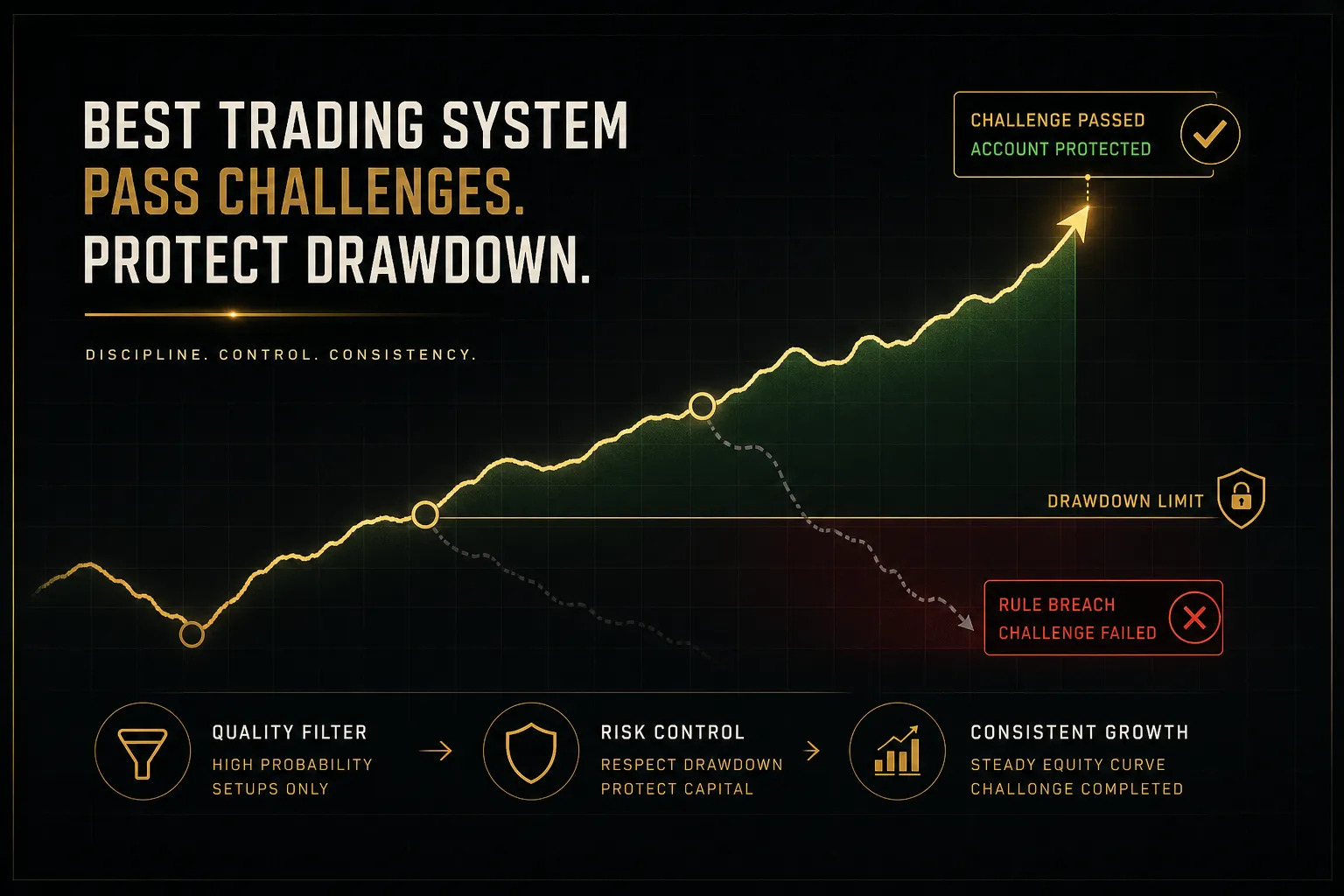
They’re behavioral ones: an impulsive entry the moment a signal prints, then a revenge trade, then a breached daily loss limit before lunch.
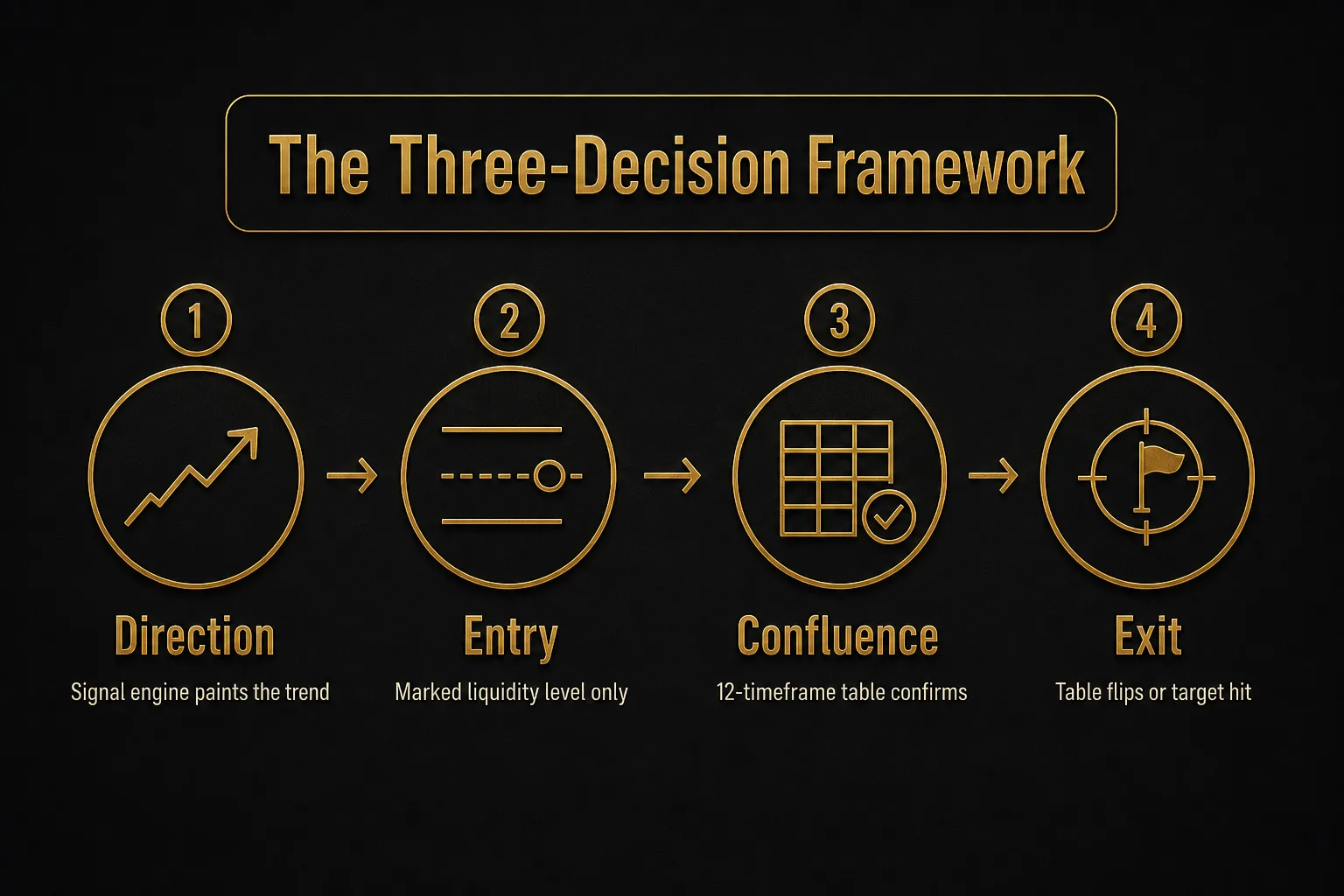
PipTrend’s core design principle addresses this directly by separating three decisions that most indicators blur together.
The smart signal engine gives direction only, printing color-coded candles: green for bullish momentum, red for bearish pressure, gray while a trend is still forming.
The entry comes from a marked price level, never from the signal itself.
And the exit is governed by a multi-timeframe confirmation table showing BUY, SELL, or NEUTRAL across 12 timeframes, from 1-minute to Monthly.
That separation is the whole point.
It’s what stops traders from buying tops and selling bottoms the second a signal appears.
The entry levels themselves are painted on the chart automatically: session highs and lows, previous day high and low, VWAP, supply and demand zones with mitigation tracking, and fair value gap detection. A Confidence Band marks where to look for pullback entries, acting as support in uptrends and resistance in downtrends.
Signals confirm on candle close and don’t change afterward. No repainting, no second-guessing what you saw an hour ago.
Best for: traders inside an FTMO, Topstep, Apex, The5%ers, or any other evaluation who know their strategy works but keep breaking their own rules. It covers Forex, Crypto, Indices, Commodities, and Stocks, so the same process follows you across markets and across firms.
The transparency angle is worth flagging.
PipTrend publishes trade ideas taken with the indicator on a public results page, with outcomes and verified cTrader statements including losses and break-evens.
Not a highlight reel.
Most competitors in this category show backtests and cropped screenshots.
Subscriptions also include a whipsaw filter that keeps you out of chop, session killzones for Asian, London, New York AM and PM windows adjusted to your timezone, real-time push, email and desktop alerts, and 18 free companion tools covering position sizing, pip value, risk-reward, expectancy, and more.
Pricing Tiers
Monthly Plan
$59.99/mo, billed monthly.
Price increases to $83.99/mo soon.
Best if you want to run it alongside a single challenge and reassess after your first payout.
Quarterly Plan
$45/mo, billed as $134.99 every 3 months.
Saves $180/year versus monthly (rising to $63/mo).
This tier matches the realistic timeline of most two-step evaluations, which rarely finish in 30 days.
Yearly Plan
$40/mo, billed as $479.99 once per year.
Saves $240/year versus monthly (rising to $56/mo).
The right choice if you intend to run multiple challenges or trade a funded account long term.
All plans include every PipTrend indicator, real-time alerts, all supported markets, community access, and all future updates.
Every tier comes with a 3-day free trial and a 30-day money-back guarantee, so you can test it on live charts before committing.
Checkout runs through Whop with major cards and PayPal.
Honest drawbacks.
It’s a paid subscription stacked on top of your challenge fee, which stings if you’re already budget-constrained.
And it doesn’t auto-trade or guarantee anything: the rules only work if you apply them consistently, on every trade, including the ones where you’re convinced you know better.
The system removes the decision. It cannot remove the trader who overrides it.
LuxAlgo: Best All-In-One TradingView Ecosystem Alternative
LuxAlgo is the strongest alternative if you’d rather assemble your own workflow than follow a fixed one. It’s the largest and most established TradingView toolkit ecosystem in this category.
The catalog is deep: a Signals & Overlays toolkit, Price Action Concepts for market structure, an Oscillator Matrix, plus screeners and alerts. LuxAlgo Quant lets you build indicators and strategies from natural-language prompts, and the Ultimate plan adds an AI Backtesting Assistant.
Pricing is accessible.
There’s a free plan with a library of indicators, Premium at $39.99/month, and Ultimate at $59.99/month, with annual and promotional rates varying.
Best for: experienced traders who already know their entry and exit criteria and want a large toolbox to express them, plus anyone who enjoys backtesting their own ideas.
The drawback is directly relevant to challenge traders.
Breadth creates clutter, and more tools mean more opportunities to find a reason to take a trade you shouldn’t.
LuxAlgo hands you components; you still have to design the repeatable entry, exit, and risk process yourself.
During a timed evaluation with a hard daily loss limit, that’s a real risk.
If you want a defined process out of the box, PipTrend’s fixed three-decision structure is the safer fit.
If you want raw flexibility, LuxAlgo wins.
Which Prop Firm Should You Choose? A Decision Summary
Match the firm to your market and your weakness, not to the biggest advertised profit split.
Pick FTMO if you trade forex or CFDs and want brand recognition, documented objectives, and account sizes from 10K to 200K. It’s the default answer for most traders reading this, and the One-Step option suits traders who dislike a two-stage grind.
Pick Topstep if you trade futures and want the clearest combine-to-funded progression available, starting at $49/month for a 50K on the Standard Path. Budget for data and platform costs on top.
Pick Apex Trader Funding if you trade futures on a tight budget and want to pressure-test a strategy cheaply before committing to a pricier program.
Verify current trailing drawdown mechanics first.
Pick The5%ers if drawdown room matters more than speed to a large account.
Slower scaling, fewer heartbreaks.
Pick Funded Trading Plus if you’re U.S.-based and payout speed is your top priority. Confirm your state isn’t restricted before you pay.
Pick E8 Markets if a consistency rule has ended a challenge you should have passed. Fewer restrictions, more freedom in how your profits distribute.
Whichever you choose, the firm doesn’t determine whether you pass.
Your process does.
Pair the evaluation with a rules-based TradingView trading system so direction, entry, exit, and position size are decided before the candle opens rather than during it.
That’s the argument for something like PipTrend: fixed rules beat live judgment when there’s a hard daily loss limit hanging over every click.
Three final checks before you spend money.
First, run the firm’s exact rules on a demo account for at least two weeks and see whether you’d have breached anything.
Second, confirm the drawdown type, static or trailing, and if trailing, whether it follows intraday equity or closed balance.
Third, read the current payout eligibility conditions, consistency rule, and news trading restriction on the firm’s live terms page.
Terms change.
Reviews go stale.
The terms page is the only source that counts on the day you buy.
Frequently Asked Questions
What is the most trusted prop firm in 2026?
FTMO and Topstep are the two most trusted prop firms in 2026, based on operating history and the volume of independently reported payouts. FTMO leads on the forex and CFD side; Topstep leads for futures.
Trust in this industry comes down to two things: how long the firm has been paying traders, and how clearly it publishes its rules. Both firms document trading objectives, loss limits, and payout processes in detail rather than burying them.
Which prop firm pays out the fastest?
Funded Trading Plus and Apex Trader Funding are the two most frequently cited for fast payout cycles.
Both emphasize quick processing as a core selling point.
That said, payout speed is largely self-reported and varies with payment method, verification status, and request volume. Check reviews from the last 60 days rather than year-old testimonials, and always confirm eligibility conditions (minimum trading days, minimum profit) before assuming you qualify.
What is the best prop firm for a small account?
The5%ers and Apex Trader Funding offer the best entry points for traders with limited capital. Apex runs frequent discount promotions on low-cost futures evaluations, and The5%ers scales fees with account size while offering models that avoid a large upfront challenge fee.
FTMO’s 10K simulated account is also worth considering if you want the brand’s track record at the lowest available tier.
Starting small is almost always the right call: a smaller account you survive beats a large one you breach in week one.
Are prop firms worth it for beginners?
Prop firms can be worth it for beginners, but only after you’ve proven you can follow risk rules on a demo account.
Buying a challenge before that is expensive tuition.
Here’s the pattern worth internalizing: most challenge failures come from breaching a daily loss limit, not from an inability to find profitable trades.
Traders lose because of position sizing and emotional overrides, not analysis.
Spend 30 days trading demo under your target firm’s exact rules.
If you finish without a single breach, you’re ready to pay.
Which prop firm has the most generous drawdown?
The5%ers and E8 Markets are consistently noted for more forgiving drawdown structures compared with strict two-step programs that pair a 5% daily loss limit with a tight maximum loss.
Generosity has two dimensions, though.
The size of the drawdown, and whether it’s static or trailing.
A static drawdown that stays fixed at your starting balance is far more forgiving than a trailing one that follows your equity high, even if the percentage looks identical on the sales page.
Can you use TradingView indicators with prop firms?
Yes, TradingView indicators like PipTrend are generally permitted by prop firms. They run on your own charting platform and provide analysis; they don’t place trades automatically on the funded account.
The restrictions firms care about are automation and copy trading: expert advisors, bots, HFT tactics, and account-management services. A manual indicator that tells you direction and marks entry levels sits outside those categories at nearly every major firm.
Still, confirm the specific firm’s EA and automation policy in writing before your first trade.
Rules differ, and one email now is cheaper than a voided payout later.
Risk Disclaimer: Trading involves risk. Past performance doesn't guarantee future results. Only trade with money you can afford to lose. PipTrend is a tool to assist your trading decisions, not financial advice.