FTSE 100 Futures Explained: The Real Contract Mechanics
On this page
Why FTSE 100 Futures Confuse Traders
Search “FTSE 100 futures” and you will get three different answers to the same question.
One page says the contract trades almost around the clock. Another says the session ends at 21:00 London. A third quotes a £1 point value.
All three can be technically correct, because they are describing different products.
The ICE FTSE 100 Index Future is a standardized, exchange-cleared contract with fixed specifications. A broker’s “UK 100” CFD or spread bet is an over-the-counter product priced off that future, with hours, spreads, margin and expiry set by the broker rather than an exchange.
Blend the two and you end up with a mental model that fits neither.
That is where costly mistakes start: misread point values, surprise expiries, positions held through a settlement process the trader never intended to face.
This guide separates the verified contract facts (exchange, ticker, contract multiplier, tick size, tick value, hours, settlement method) from the broker-specific layer sitting on top of them. Then it covers the parts that actually decide whether a trade works: margin as collateral, futures basis, rollover discipline, and position sizing.
No hype about leverage.
Leverage is arithmetic, and the arithmetic works in both directions with equal enthusiasm.
Understanding the FTSE 100 Contract
The index and the future are two separate things, and conflating them is the single most common error in retail FTSE trading.
The FTSE 100 cash index is a real-time calculated benchmark, maintained by FTSE Russell, tracking the 100 largest qualifying companies listed in London.
You cannot buy it.
It is a number.
The future is a tradable contract, listed on ICE Futures Europe, whose price reflects where the market expects that number to sit at a specific future date.
Same underlying story, different instrument, different price.
Contract Specifications at a Glance
These are the specifications that matter for sizing, risk and expiry planning. Always confirm current details against the exchange contract page before trading, since exchanges do periodically amend hours and margin parameters.
| Specification | Detail | Why it matters |
|---|---|---|
| Exchange | ICE Futures Europe (London) | Determines the rulebook, clearing, and the exchange permissions your broker needs |
| Official ticker | Z | Platforms may display aliases such as FTSE, UKX or FT100; the exchange symbol is Z |
| Underlying | FTSE 100 cash index (FTSE Russell) | Index composition and weightings drive the contract’s sensitivities |
| Contract multiplier | £10 per full index point | At an 8,500 index level, one contract carries roughly £85,000 notional exposure |
| Minimum tick size | 0.5 index points | Sets the smallest possible price increment and the practical spread floor |
| Tick value | £5 per tick | Converts stop distance in points directly into pounds at risk |
| Contract months | Quarterly: March, June, September, December | Liquidity concentrates in the front month, so rollover is a scheduled event |
| Last trading day | Third Friday of the delivery month (subject to exchange calendar) | Defines your roll deadline, not a suggestion |
| Settlement | Cash settlement against the Exchange Delivery Settlement Price (EDSP) | No shares change hands; the position converts to a cash debit or credit |
| Currency | Pounds sterling | Non-UK accounts carry FX exposure on top of index exposure |
| Daily settlement | Daily mark-to-market with variation margin | Gains and losses are cash-settled every day, not deferred to exit |
One detail deserves emphasis because beginners routinely get it wrong.
The Exchange Delivery Settlement Price is not simply the last traded index tick on expiry day. It is derived from a defined methodology built around the London intraday auction, which means the final settlement level can differ from the screen price you were watching minutes earlier.
Futures vs Cash Index and CFDs
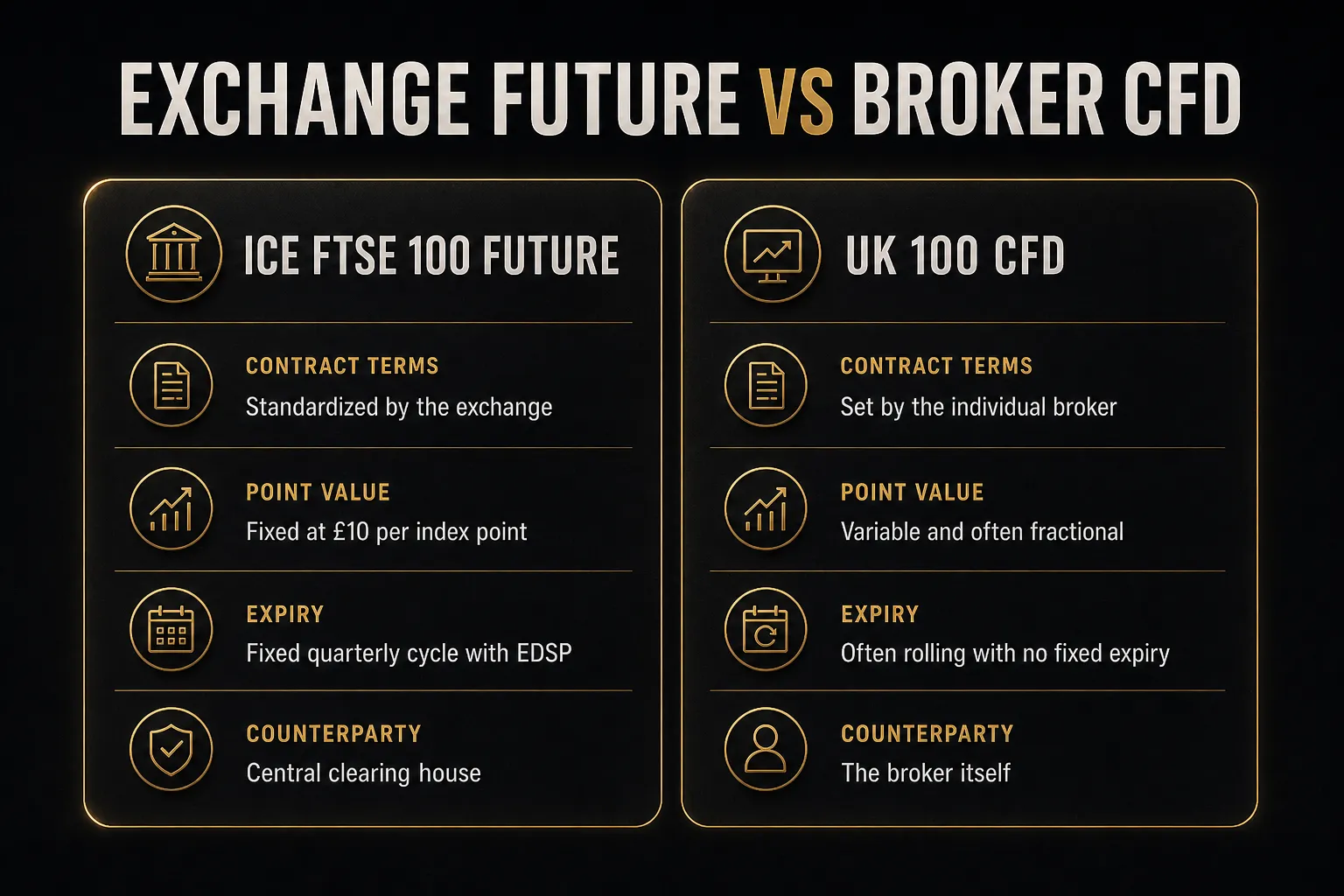
A broker-created UK 100 CFD or spread bet references the same market but is not the same instrument.
The counterparty is your broker, not a clearing house.
Spreads, financing charges, margin percentages and expiry behaviour are commercial decisions the broker makes.
Neither product is inherently better.
The future gives you standardized terms, central clearing, transparent volume and open interest data, and a contract size that suits hedging a meaningful equity book. The CFD gives you smaller granularity and simpler account plumbing, at the cost of a broker-defined pricing layer.
What you cannot do is take a rule learned on one product and apply it blindly to the other.
A 25-point move is £250 on the exchange future. On a CFD sized at £2 per point, it is £50.
Same chart, different consequence.
When and Where Futures Trade
“Nearly 24 hours” is the phrase most traders remember, and it causes trouble twice a year when clocks change. The London order book and the New York clock drift in and out of alignment, and a trader who hard-codes “the FTSE opens at 8pm my time” will eventually turn up an hour late.
Trading Hours Across Time Zones
The ICE order book for the FTSE 100 future typically runs from the early hours of London time through to the evening, with a daily close and a short break before the next session.
Broker CFD quotes often extend beyond that window.
Below are the reference points that matter, expressed in both offset regimes.
| Session event | London time | New York (5-hour offset: GMT/EST and BST/EDT) | New York (4-hour offset: DST mismatch weeks) |
|---|---|---|---|
| ICE order book opens | 01:00 | 20:00 previous day | 21:00 previous day |
| London cash equities open (LSE) | 08:00 | 03:00 | 04:00 |
| UK data releases cluster | 07:00 and 09:30 | 02:00 and 04:30 | 03:00 and 05:30 |
| US cash equities open | 14:30 | 09:30 | 10:30 |
| London cash equities close | 16:30 | 11:30 | 12:30 |
| ICE order book closes | 21:00 | 16:00 | 17:00 |
The mismatch weeks are the trap.
The US switches to daylight time in mid-March, roughly two weeks before the UK moves to BST, and the UK returns to GMT in late October about a week before the US leaves EDT. During those windows the London-New York gap narrows to four hours.
Three other schedules get confused with the order book. Block-trade reporting windows allow off-book transactions to be reported within exchange rules, so a printed trade does not always mean the order book was active.
Broker CFD quote hours are a commercial decision and frequently start earlier or end later.
And charting platforms often stitch together extended data, producing candles at times when almost nothing traded on the exchange.
US Access and Order Types
Traders in the United States can access the ICE FTSE 100 future, provided their broker holds ICE Futures Europe permissions and the account is enabled for foreign futures.
Several large futures brokers offer exactly that.
What US retail clients generally cannot access are UK-style CFDs and spread bets, which are not permitted for retail distribution there.
Outside core London cash hours, the mechanics get less friendly. Spreads widen, resting depth thins, and a market order that fills at one tick during the London morning can slip several points at 02:30 London time.
Practical implications: prefer limit orders in thin sessions, treat stop orders as market orders once triggered, and check whether your broker supports stop-limit on the contract. Overnight gaps between the evening close and the next session open can jump straight through a stop level.
That risk does not disappear because your platform draws a continuous line.
Margin, Basis, and Real P&L
Here is the sentence that saves accounts: margin is a deposit, not a maximum loss. Traders who internalise that one distinction behave completely differently from those who do not.
Margin Is Collateral, Not Risk Cap
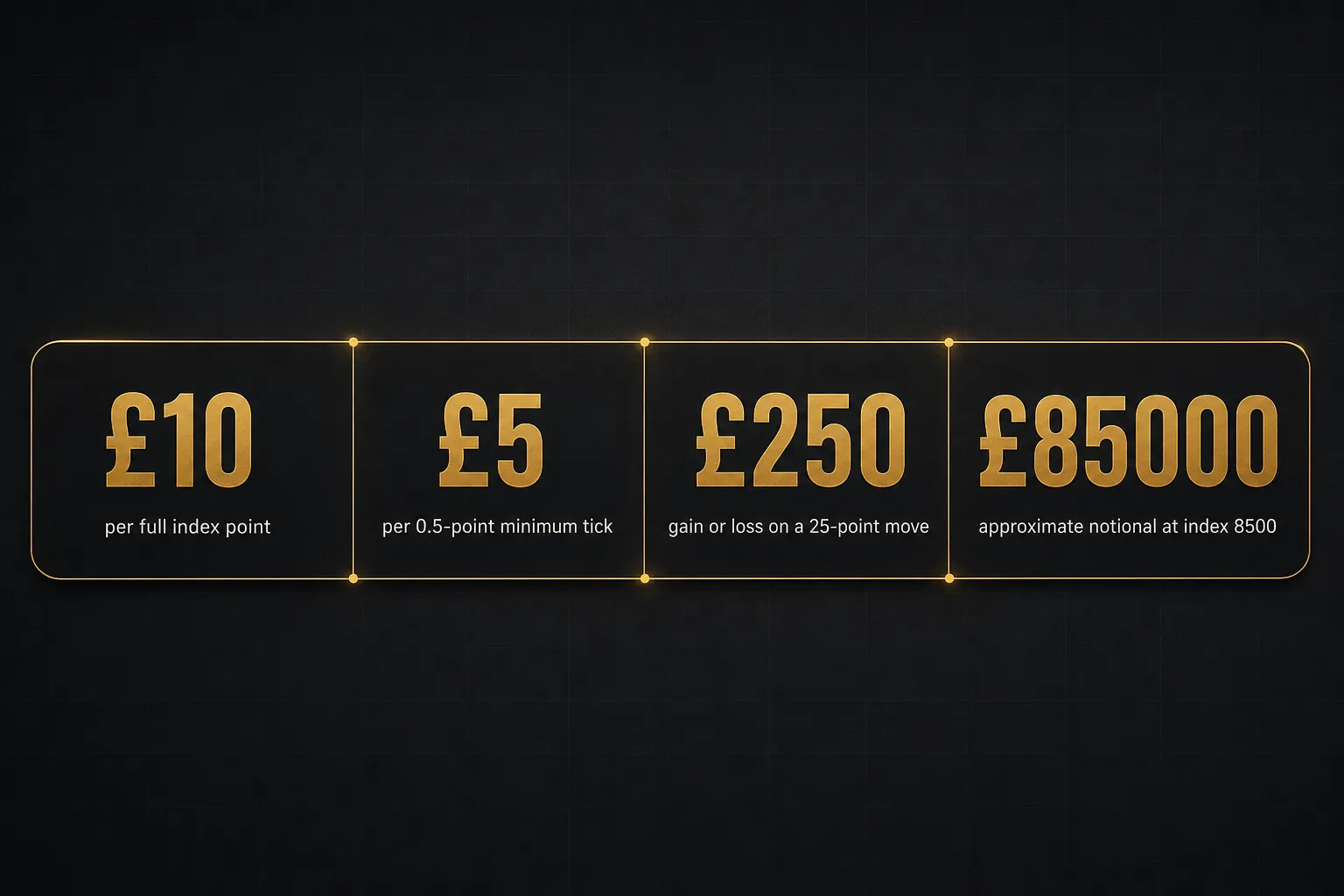
Notional contract value is the index level multiplied by £10. With the FTSE 100 near 8,500, a single contract represents about £85,000 of index exposure.
That is the number your position actually controls.
Initial margin is the collateral the clearing house requires to open that position, often a low single-digit percentage of notional. Maintenance margin is the level your collateral must stay above.
Fall below it and you face a margin call.
Because the contract is marked to market daily, profits and losses move as variation margin in and out of your account every session.
You do not wait until you exit to feel the damage.
You feel it tonight.
Losing more than your posted margin is not an exotic scenario. It is the ordinary consequence of a large adverse gap on a fully sized position.
Why the Basis Moves the Price
The future rarely prints at the same level as the cash index, and that difference is the futures basis. It is not a pricing error, and it is not an arbitrage gift.
Basis reflects three components.
First, the implied financing cost of holding index exposure until expiry, anchored to short sterling rates and UK gilt yields. Second, expected dividends paid by index constituents before expiry, which the futures holder does not receive.
Third, short-term supply and demand between hedgers and speculators.
When expected dividends over the contract’s life exceed financing cost, the future can trade below the cash index.
When financing dominates, it trades above.
The theoretical level is often called fair value, and the gap between screen price and fair value tells you something about positioning pressure.
The FTSE 100 is also unusually international for a “UK” index. Roughly three quarters of constituent revenue is earned outside the UK, which makes the sterling exchange rate a direct driver: a weaker pound tends to flatter reported overseas earnings.
Watch these inputs alongside UK domestic data:
- Brent crude oil and refining margins, given the index’s heavy energy weighting.
- Industrial metals and iron ore, which move the large mining constituents hard and fast.
- US dollar direction, which affects commodity pricing and translated earnings simultaneously.
- China growth data, a genuine driver of UK-listed miners despite the London listing.
- Bank of England policy and global rate expectations, which reset discount rates and financing costs.
- UK CPI, labour market and GDP prints on the economic calendar, which move gilt yields and domestic-facing names.
A 25-Point Move in Practice
Take a long position at 8,500 in the front-month contract.
Price reaches 8,525.
That 25-point favourable move equals 50 ticks at £5 per tick, so £250 per contract, before commission, exchange fees and any slippage on entry or exit.
Now reverse it.
Price falls to 8,475 and the mirrored result is a £250 loss per contract, again before costs.
Identical arithmetic, opposite direction, no discount for good intentions.
Scale that honestly.
Three contracts and a 60-point adverse gap is £1,800 gone before you have made a single decision.
That is why sizing comes before signal selection, not after.
Rollover, Expiry, and Risk Rules
Quarterly expiry is the deadline nobody sets a reminder for… and then wonders why their position vanished into a cash settlement.
Rollover is mechanical, predictable and entirely avoidable as a problem.
How to Roll the Contract
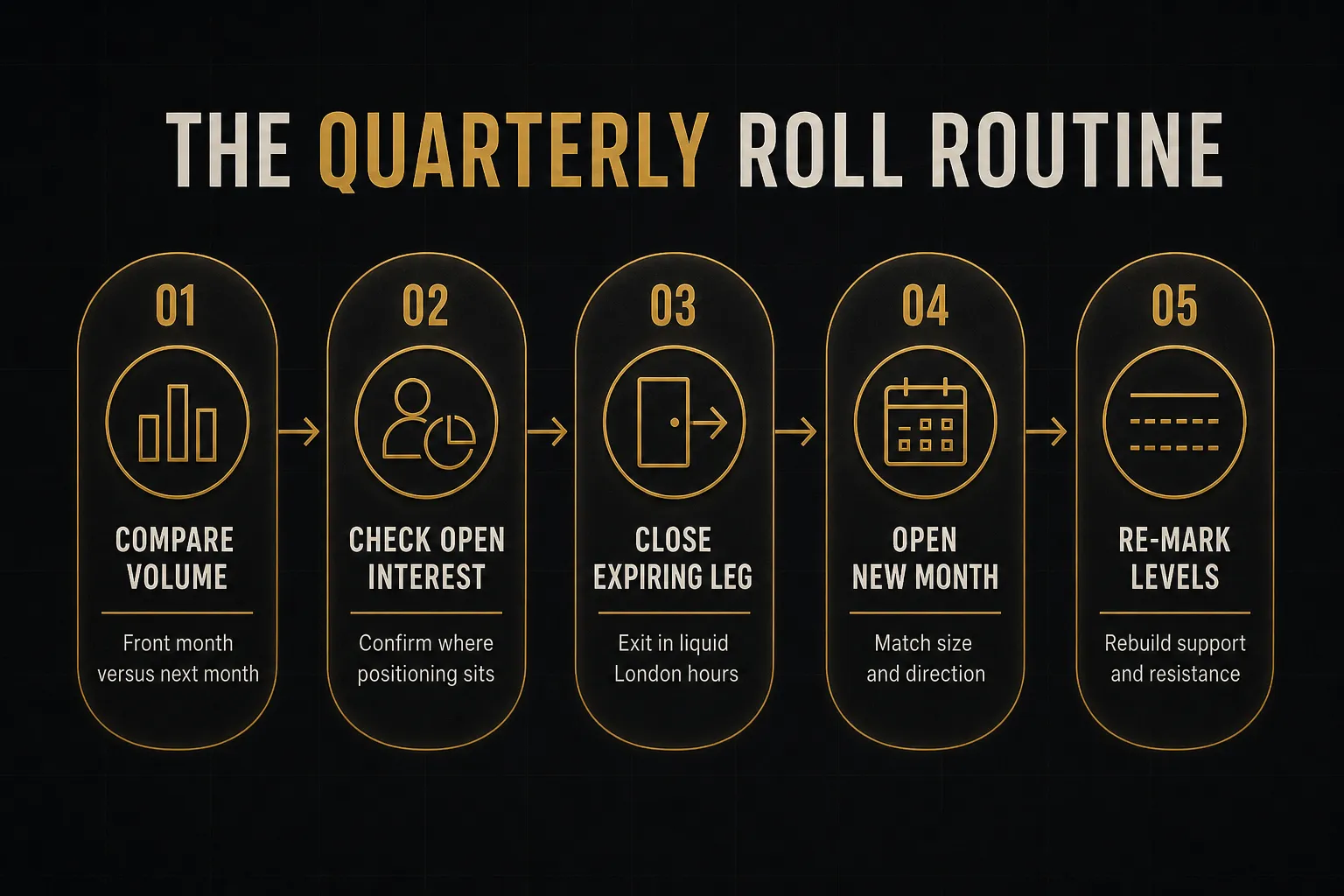
- Identify the active contract. Compare volume and open interest between the current quarterly month and the next. The active contract is the one attracting the bulk of both, not the one your platform happens to default to.
- Watch the migration window. Liquidity typically shifts from the expiring month to the next month in the days before the third Friday. Track it daily rather than guessing, because the crossover date varies by quarter.
- Close the expiring position first. Exit the front month in the liquid part of the London session, when depth is best and the spread is at or near the 0.5-point minimum tick.
- Open the equivalent position in the new month. Match direction and contract count. Some brokers support a calendar spread order that executes both legs together at a defined differential, which reduces execution risk.
- Treat the price difference as basis, not a market move. If the next month trades 15 points away from the expiring month, that gap is financing and dividend expectation. It is not a signal.
- Re-anchor your levels after the roll. Continuous charts splice contracts together and can shift historical prices. Re-mark support and resistance on the contract you now hold, or your levels are describing a price series you cannot trade.
Expiry Day Mechanics
- Know the last trading day. For the ICE FTSE 100 future it is the third Friday of the delivery month, adjusted for exchange holidays. Confirm the exact date on the exchange calendar each quarter.
- Understand how the EDSP is formed. The exchange delivery settlement price is calculated from the defined London auction methodology, not the last screen tick, so the final number can land away from where the future was quoting minutes before.
- Decide deliberately whether to hold into settlement. Because the contract is cash settlement, holding to expiry converts your position into a cash adjustment at a price you did not choose. Fine if intended, painful if accidental.
- Close or roll before the final hours if you have a directional view. Expiry sessions can carry unusual order flow from index rebalancing and hedge unwinds, which distorts short-term market structure.
Sizing Trades and Confirming Signals
- Fix a risk percentage first. Decide what fraction of account equity a single losing trade may cost, commonly between 0.5% and 2%. This is a policy, set once, not a per-trade negotiation.
- Convert stop distance into pounds. Stop distance in points multiplied by £10 gives risk per contract. A 30-point stop is £300 per contract, so a £10,000 account risking 1% (£100) cannot trade even one contract on that stop. That answer is information, not an obstacle to argue with.
- Set the stop from structure, then size to it. Place the stop where your idea is objectively wrong, using support and resistance, prior session extremes and volume profile nodes. Never shrink a stop to justify a bigger position.
- Adjust for realized volatility. When realized volatility expands, the same structural stop needs more room, which means fewer contracts. Constant sizing through changing volatility is how account curves break.
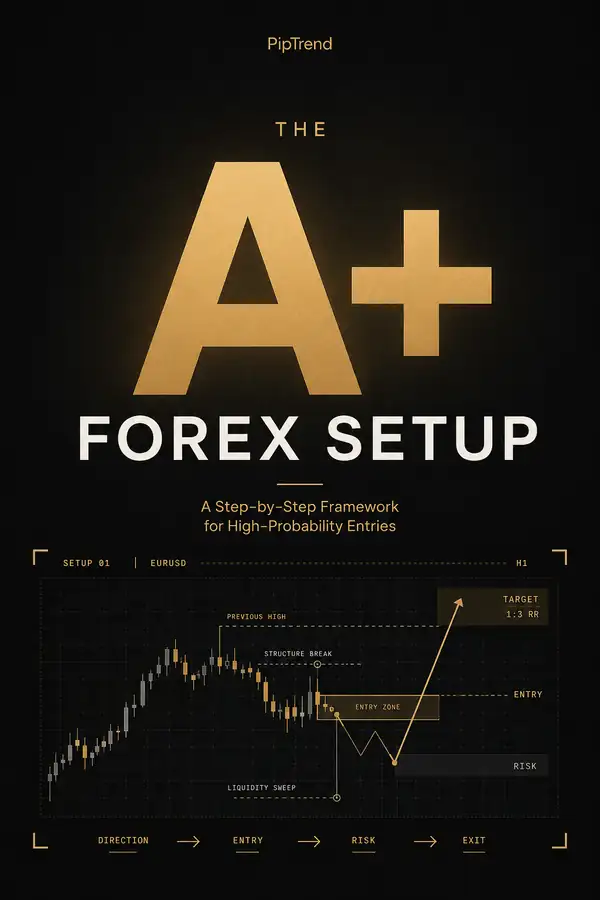
- Read direction across timeframes before entry. A multi-timeframe alignment view, for example a tool like PipTrend’s 12-timeframe alignment table used here purely as an educational example, answers one question: is trend agreement present or is the market conflicted? Direction and entry are separate decisions.
- Enter at a marked price level, not on signal appearance. Define the level in advance, wait for price to reach it, and accept the trades you miss. Chasing costs more than patience over any meaningful sample.
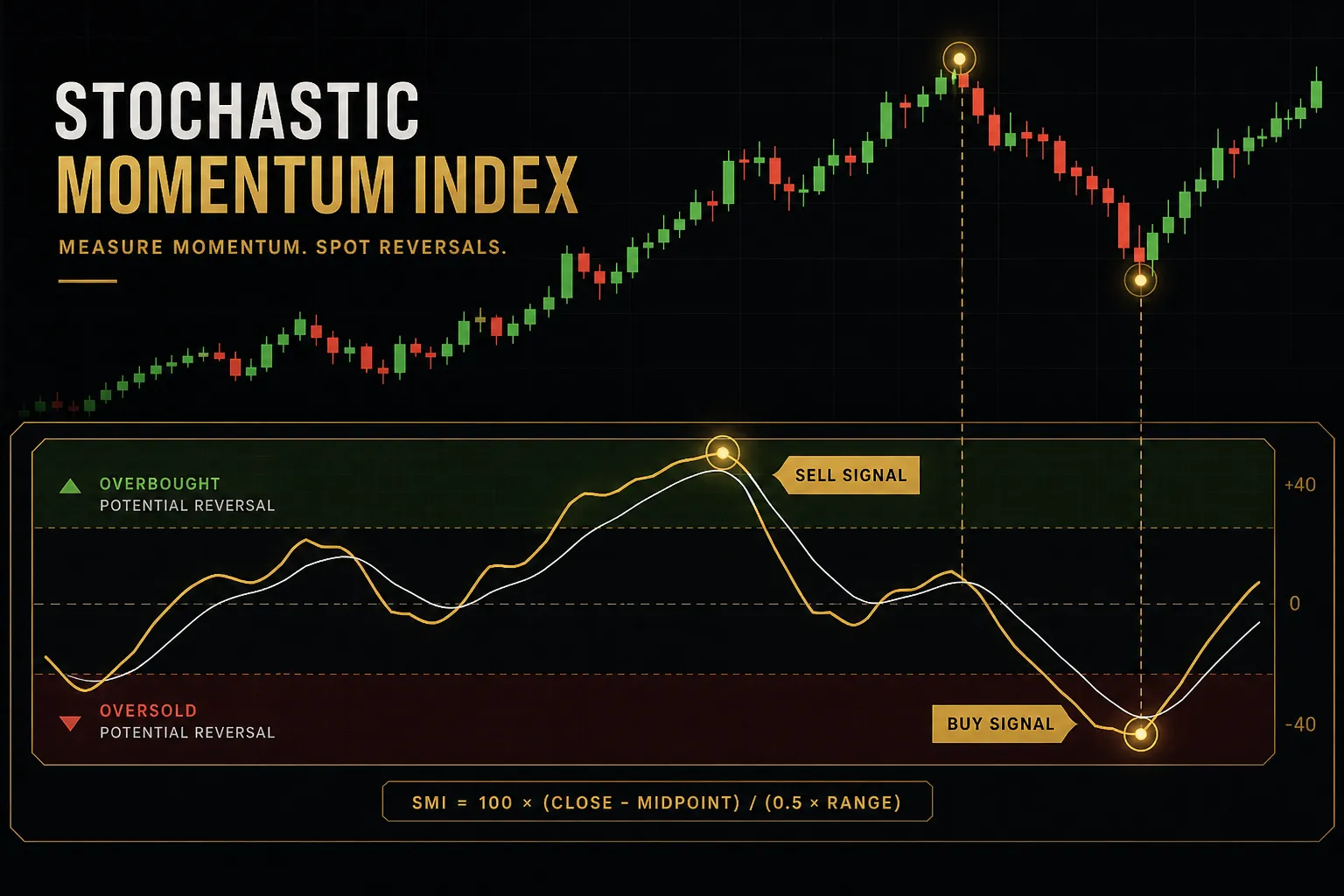
- Avoid stacking correlated indicators. Three momentum oscillators calculated from the same closing prices give one opinion in three costumes. Add information, not reassurance.
- Pre-plan scenario risk. Reduce or flatten around high-impact releases such as Bank of England decisions, UK CPI and US payrolls; assume overnight gaps can bypass stops; expect thinner books and wider spreads during late-December and August holiday periods.
FTSE 100 Futures FAQ
What is the FTSE 100 futures ticker?
The official ICE Futures Europe symbol is Z.
Broker platforms frequently display the same contract under aliases such as FTSE, UKX, FT100 or a proprietary code, with a month and year suffix identifying the contract (for example the March 2026 delivery month).
Always confirm you are looking at the exchange-listed future rather than a broker’s cash CFD before placing an order.
What time do FTSE 100 futures open and close?
The ICE order book for the FTSE 100 future runs from the early hours of London time into the evening, closing around 21:00 London, with a break before the next session opens.
Broker UK 100 CFD quotes often run closer to 24 hours from Sunday evening to Friday evening with a short daily maintenance break, which is why published hours differ across websites.
Use the time-zone table above, and remember the London-New York offset narrows to four hours during the two daylight-saving mismatch windows each year.
How much is one point worth on FTSE 100 futures?
One full index point is worth £10 per contract, and the minimum 0.5-point tick is worth £5.
Those values are fixed by the contract specification, so a 40-point move is £400 per contract regardless of your broker.
CFD and spread bet point values are chosen by the trader or broker and are usually far smaller.
Can you trade FTSE 100 futures in the US?
Yes, through a broker that holds ICE Futures Europe permissions and enables foreign futures trading on your account.
Several established US futures brokers provide that access, subject to their own margin and eligibility rules.
UK-style CFDs and spread bets on the FTSE 100, by contrast, are generally not available to US retail clients.
What is the difference between FTSE futures and CFDs?
The future is a standardized, centrally cleared exchange contract; the CFD is an over-the-counter agreement with your broker.
That means the future has a fixed £10 multiplier, a fixed quarterly expiry cycle, EDSP cash settlement and transparent volume and open interest data.
The CFD offers flexible sizing and often no fixed expiry, but carries broker-set spreads, overnight financing and counterparty exposure.
How do you roll over FTSE 100 futures?
Monitor volume and open interest as they migrate from the expiring quarterly month to the next, then close the expiring contract and open the same position in the new month.
Do this in liquid London hours, and treat the price difference between the two months as futures basis driven by financing cost and expected dividends rather than a directional move.
After rolling, re-mark your key levels on the new contract instead of trusting a spliced continuous chart.
Trading FTSE Futures With Discipline
The decision is simpler than the product landscape suggests.
If you want direct exchange exposure, transparent positioning data, or a genuine hedge against a UK equity book, learn the specifications and the rollover calendar properly and trade the future. If you want smaller, more flexible sizing, understand exactly how CFD pricing, financing and expiry differ before assuming the two products behave alike.
They do not.
One concrete action before your next trade: verify the active contract month, convert the session times into your own time zone for the current daylight-saving regime, and check the economic calendar for high-impact releases in your holding window.
Yesterday’s chart setup may be sitting on a contract that is about to expire.
Leverage and international revenue exposure cut both ways with perfect symmetry. A repeatable checklist beats reacting to one signal, one headline, or one confident opinion… including your own.
Sources
Risk Disclaimer: Trading involves risk. Past performance doesn't guarantee future results. Only trade with money you can afford to lose. PipTrend is a tool to assist your trading decisions, not financial advice.