
The difference between profitable forex traders and those who blow their accounts often comes down to technique. While the forex market offers incredible opportunities with its $7.5 trillion daily volume, success requires more than just enthusiasm. Modern forex trading techniques blend systematic analysis, disciplined execution, and risk management into a cohesive approach that removes emotion from your decisions. Whether you're just starting or refining an existing strategy, understanding how professional techniques work together creates the foundation for sustainable profitability.
Understanding Core Forex Trading Techniques
Forex trading techniques represent systematic approaches to identifying, entering, and managing currency trades. These methods range from rapid-fire scalping strategies to patient position trading that holds trades for weeks or months.
The foundation of any effective technique starts with market structure analysis. This involves identifying whether a currency pair is trending, ranging, or transitioning between states. Professional traders recognize that different market conditions demand different approaches. Applying a breakout strategy during a ranging market typically leads to false signals and losses, just as range-trading techniques fail during strong trends.
Trend Following Strategies
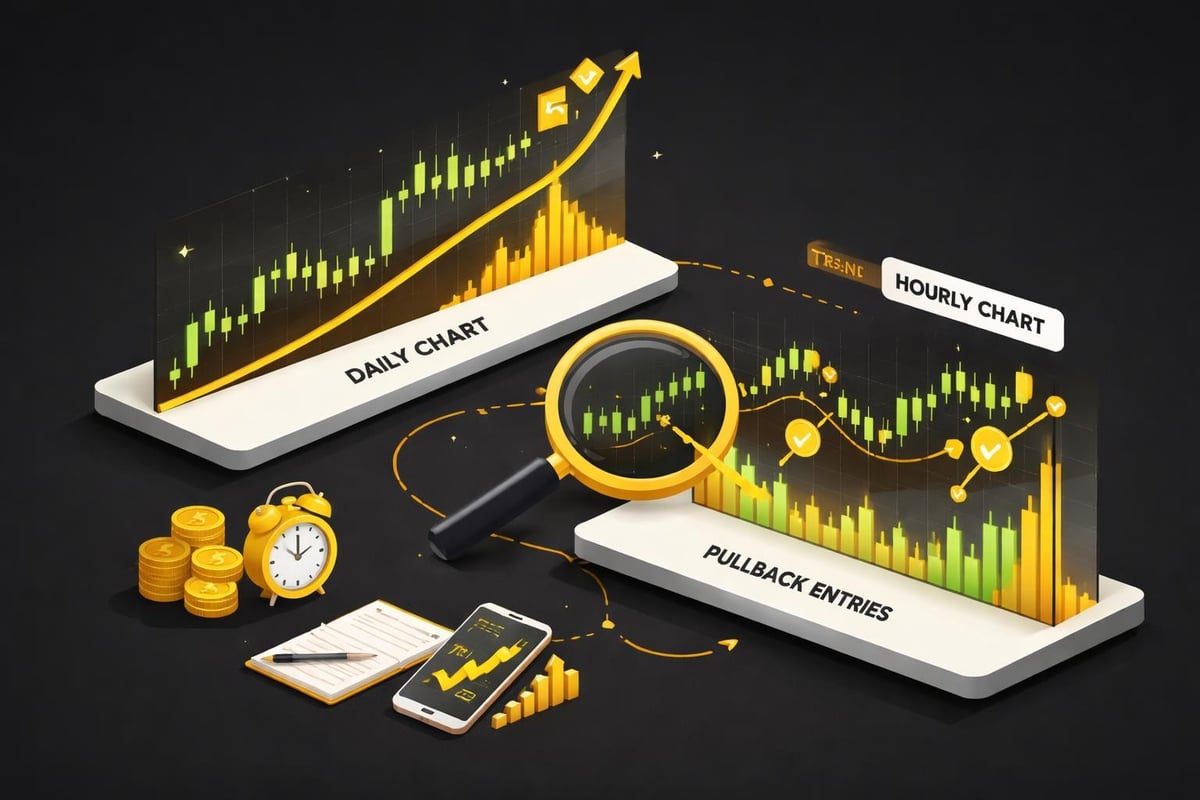
Trend following remains one of the most reliable forex trading techniques because it aligns with a fundamental market truth: prices move in sustained directional waves. Rather than predicting reversals, trend followers identify established momentum and ride it until clear evidence suggests exhaustion.
Key components of trend following include:
- Identifying the primary trend across multiple timeframes
- Waiting for pullbacks to enter in the trend direction
- Using moving averages or trendlines to confirm trend strength
- Exiting when trend structure breaks or momentum diverges
The challenge with trend following lies in distinguishing between temporary pullbacks and genuine reversals. This is where algorithmic trading systems excel, processing multiple data points simultaneously to filter noise from meaningful signals.
Price Action Trading Methods
Price action trading focuses exclusively on what price is doing without relying on lagging indicators. This technique interprets candlestick patterns, support and resistance levels, and chart formations to make trading decisions.
Successful price action traders develop pattern recognition skills that allow them to read market sentiment from price behavior alone. A pin bar rejection at a key support level tells a story about buyer strength. An inside bar following a strong directional move suggests consolidation before continuation.
The advantage of price action techniques is their universality. These patterns work across all currency pairs and timeframes because they reflect human psychology. However, mastering price action requires screen time and practice to distinguish high-probability setups from mediocre ones.
Advanced Entry and Exit Techniques
Getting into trades represents only half the battle. Professional forex trading techniques emphasize precise entry timing and strategic exits that maximize reward while controlling risk.
Scalping for Quick Profits
Scalping involves capturing small price movements by executing numerous trades throughout the day. Scalpers typically hold positions for minutes or even seconds, targeting 5-15 pip gains repeatedly.
This technique demands:
- Extremely tight spreads to ensure transaction costs don't consume profits
- Lightning-fast execution through quality brokers with minimal slippage
- Intense focus to monitor positions continuously
- Strict discipline to cut losses immediately when trades move against you
Scalping works best during high-liquidity sessions when spreads tighten and price moves cleanly. The London and New York session overlaps create ideal conditions for this aggressive technique.
| Scalping Characteristic | Requirement | Why It Matters |
|---|---|---|
| Timeframe | 1-minute to 5-minute charts | Captures micro-movements |
| Trade Duration | Seconds to minutes | Minimizes exposure to reversals |
| Risk Per Trade | 0.25-0.5% of account | Allows for high trade frequency |
| Win Rate Needed | 60-70% | Compensates for small reward:risk ratio |
Swing Trading Techniques
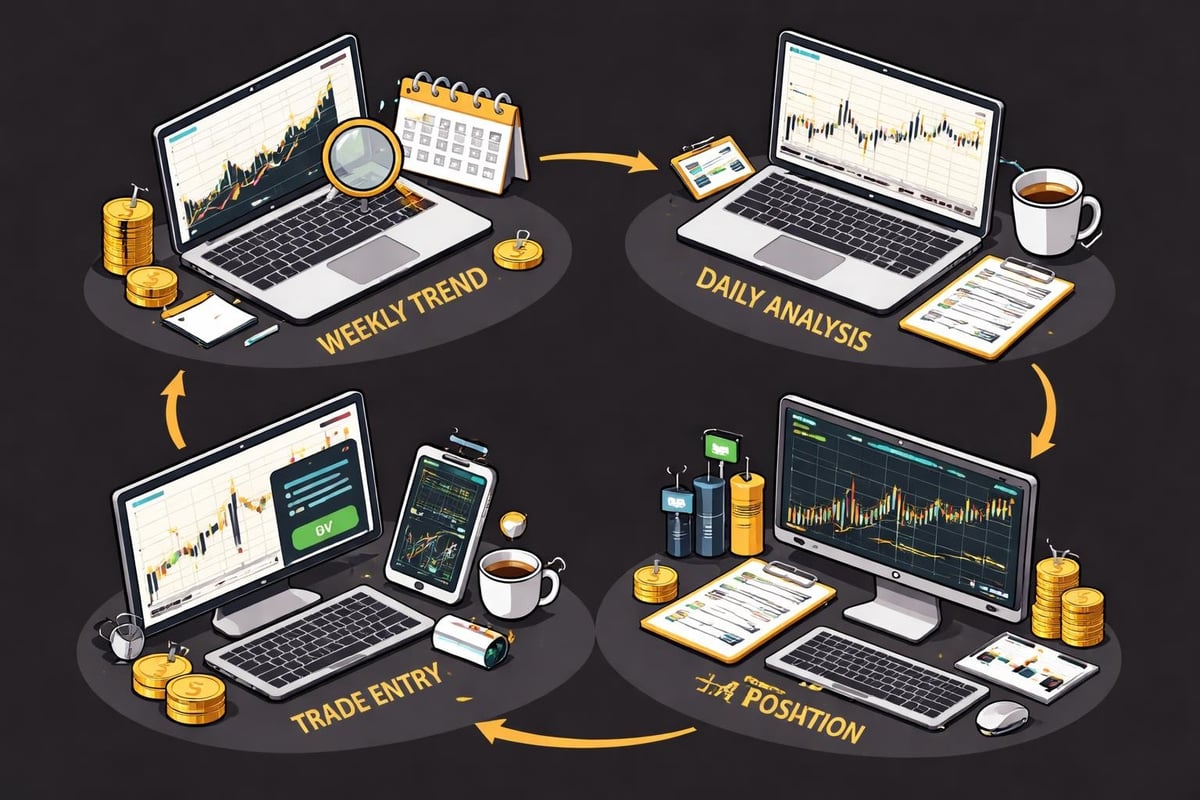
Swing trading captures larger price moves by holding positions for several days to weeks. This approach suits traders who cannot monitor charts constantly but want more profit potential than scalping offers.
Swing traders combine technical analysis with forex signals to identify trades that benefit from multi-day trends. They enter after confirming a trend shift and hold through minor retracements, exiting only when momentum clearly reverses.
The key advantage of swing trading is time efficiency. You analyze markets during specific windows, set your orders, and let trades develop. This technique also avoids the transaction costs that plague high-frequency approaches.
Risk Management Integration
No discussion of forex trading techniques is complete without addressing risk management. Even the best entry strategy fails without proper position sizing and loss control.
Position Sizing Formulas
Professional traders calculate position sizes based on account balance, stop-loss distance, and acceptable risk percentage. The standard formula ensures no single trade can significantly damage your account:
Position Size = (Account Balance × Risk Percentage) ÷ Stop Loss in Pips
For example, with a $10,000 account risking 1% per trade and a 50-pip stop loss, you would trade 2 mini lots (20,000 units). This mathematical approach removes guesswork and protects capital during losing streaks.
Many traders using foreign exchange autotrading systems program these calculations directly into their algorithms, ensuring consistent risk application across all trades.
Stop Loss and Take Profit Strategies
Effective forex trading techniques incorporate strategic stop placement based on market structure rather than arbitrary pip distances. Stops belong beyond recent swing points, outside normal price volatility, where your trade idea is genuinely invalidated.
Common stop loss approaches:
- Below the most recent swing low for long positions
- Beyond consolidation boundaries for breakout trades
- At fixed ATR (Average True Range) multiples for volatility-based stops
- Behind key Fibonacci retracement levels
Take profit targets should offer at least 1.5:1 reward-to-risk ratios on average. Some traders scale out of positions, taking partial profits at 1:1 while letting the remainder run toward larger targets.
Multi-Timeframe Analysis Techniques
One of the most powerful forex trading techniques involves analyzing multiple timeframes to confirm trade setups. This approach dramatically improves win rates by ensuring all timeframes align before risking capital.
The typical structure uses three timeframes:
- Higher timeframe (daily or weekly) identifies the primary trend direction
- Medium timeframe (4-hour or 1-hour) spots intermediate structure and setups
- Lower timeframe (15-minute or 5-minute) times precise entries
You only take trades where the lower timeframe entry signal aligns with both higher timeframe trend and medium timeframe structure. This filtering eliminates countless low-probability setups that look appealing in isolation but fight against larger forces.
Session-Based Trading
Understanding forex market sessions represents another crucial technique. Different trading sessions exhibit distinct characteristics based on which financial centers are active.
| Session | Hours (EST) | Best Pairs | Characteristics |
|---|---|---|---|
| Tokyo | 7 PM – 4 AM | JPY pairs, AUD/USD | Lower volatility, range-bound |
| London | 3 AM – 12 PM | EUR pairs, GBP pairs | High volatility, strong trends |
| New York | 8 AM – 5 PM | USD pairs | High volume, news-driven |
| London/NY Overlap | 8 AM – 12 PM | All major pairs | Maximum liquidity and movement |
Session-aware techniques exploit these patterns. Range-trading strategies work well during Tokyo hours, while breakout techniques excel during London open volatility. Some of the best forex trading strategies specifically target session transitions when volatility spikes.

Indicator-Based Techniques
While price action purists avoid indicators, many successful traders use technical indicators to quantify market conditions and generate objective signals. The key is using indicators correctly rather than cluttering charts with conflicting tools.
Moving Average Systems
Moving averages smooth price data to reveal underlying trends. Simple techniques involve trading crossovers when a fast moving average crosses a slower one, signaling momentum shifts.
More sophisticated approaches use moving average angles and spacing to gauge trend strength. Widely separated moving averages indicate strong trends worth trading, while converging averages suggest weakening momentum and potential reversals.
Momentum Oscillators
RSI, Stochastic, and MACD indicators measure momentum and identify overbought or oversold conditions. These tools excel at timing entries within established trends and spotting divergences that warn of reversals.
Effective oscillator techniques include:
- Trading oversold bounces in uptrends and overbought pullbacks in downtrends
- Identifying hidden divergence that confirms trend continuation
- Using multiple oscillators for confirmation before entering trades
- Combining oscillator signals with price action for higher-probability setups
The challenge with indicators is avoiding over-optimization. Strategies that work perfectly on historical data often fail in live markets because they've been curve-fitted. Robust techniques use standard indicator settings and simple rules that remain effective across different market conditions.
Combining Techniques for Consistency
The most successful traders rarely rely on a single technique. Instead, they develop hybrid approaches that combine complementary methods. You might use trend following on daily charts, price action for entry refinement, and indicator confirmation before pulling the trigger.
This layered approach creates natural filtering. Each technique must confirm the others, dramatically reducing false signals. While you'll take fewer trades, the ones you execute will have significantly higher win rates.
Consider a complete trade setup combining multiple forex trading techniques:
- Daily chart shows clear uptrend with higher highs and higher lows
- Price pulls back to the 21-period moving average on the 4-hour chart
- A bullish pin bar forms at the moving average, showing rejection
- RSI on the 1-hour chart bounces from oversold territory
- Entry occurs on the 15-minute chart when price breaks above the pin bar high
Each element adds confidence while the combined setup offers a compelling risk-reward opportunity. This systematic approach removes the paralysis that comes from contradictory signals.
Backtesting and Forward Testing
Before risking real capital, professional traders validate their forex trading techniques through rigorous testing. Backtesting applies your strategy to historical data to see how it would have performed, revealing strengths, weaknesses, and optimal parameters.
Essential backtesting practices:
- Test across multiple currency pairs to ensure robustness
- Include different market conditions (trending, ranging, volatile)
- Account for spreads and slippage in performance calculations
- Avoid over-optimization by testing on out-of-sample data
Forward testing takes strategies into live markets with small position sizes or demo accounts. This reveals execution challenges, emotional responses, and real-world performance that backtests cannot capture. Many forex day trading strategies require several months of forward testing before traders commit significant capital.
Adapting Techniques to Market Conditions
Market conditions constantly evolve, and rigid techniques that worked last year may underperform today. Successful traders regularly review performance metrics and adapt their approaches to current conditions.
During high-volatility periods, wider stops and smaller position sizes prevent getting shaken out of good trades. Low-volatility environments favor range-trading techniques over trend-following. Economic uncertainty might push you toward safe-haven currencies and away from emerging market pairs.
The ability to recognize when your primary technique isn't working and pivot to alternatives separates consistently profitable traders from those who give back gains during unfavorable periods. This flexibility doesn't mean abandoning your core strategy, but rather understanding its optimal conditions and scaling back during suboptimal ones.
Building Your Personal Technique
While studying proven forex trading techniques provides valuable frameworks, developing a personal approach that matches your psychology, schedule, and risk tolerance proves essential for long-term success.
Some traders thrive on the intensity of scalping while others prefer the patience swing trading requires. Your technique should align with your strengths. If you cannot monitor charts during London open, don't build a strategy around that session. If you struggle with quick decisions, avoid techniques requiring split-second entries.
Start with a proven foundation, test it thoroughly, then refine based on your experiences. Document every trade to identify patterns in your winners and losers. This data reveals which setups you execute best and which consistently cause problems. Over time, you'll develop an intuitive feel for high-probability situations that suit your unique trading style.
Mastering forex trading techniques requires understanding core strategies, rigorous testing, and disciplined execution that removes emotion from your decisions. The difference between random trading and systematic profitability lies in combining complementary techniques into a cohesive approach that works across different market conditions. If you're ready to stop second-guessing every trade and start trading with the clarity that comes from filtered, high-probability signals, PipTrend provides the multi-timeframe confirmation and trend clarity you need to execute your techniques with confidence.