
Imagine having access to the same advanced tools as Wall Street pros—this is now possible with ai signals. In 2025, these AI-powered insights are giving everyday traders a smarter, faster way to make decisions.
This guide will walk you through what ai signals are, why they’re transforming the market, and how you can use them to boost your trading results. We’ll break down the basics, explore different types and sources, and show you how to turn raw data into actionable strategies.
Ready to unlock the power of ai signals and gain a competitive edge? Let’s dive into the essentials, real-world examples, and the top platforms you need to succeed.
Understanding AI Signals: The Foundation of Modern Trading
AI signals are transforming the way traders and investors approach the markets. At their core, ai signals are automated trading indicators generated by advanced algorithms that analyze vast amounts of data. If you’re new to the concept, you can find a detailed primer at Signals in trading explained. These signals leverage machine learning, data analysis, and predictive modeling to identify potential buy or sell opportunities with greater speed and precision than ever before.
What makes ai signals so powerful is the technology behind them. Machine learning models process historical prices, chart patterns, and real-time data streams to spot trends humans might miss. Predictive modeling enables these systems to forecast likely market moves, while continuous data analysis ensures signals adapt as new information arrives. This combination of technologies forms the backbone of modern, AI-driven trading.
The evolution from traditional trading indicators to ai signals marks a major leap forward. In the past, traders relied on simple moving averages, RSI, or MACD. Today, AI-powered tools go far beyond, ingesting big data from social sentiment, financial news, and even hedge fund activity. This means ai signals can react to breaking news, viral social media trends, or large institutional trades—giving traders a crucial edge.
There are several types of ai signals, each offering unique insights:
- Buy/Sell Signals: Direct recommendations to enter or exit positions.
- Trend Alerts: Notifications about emerging or reversing trends.
- Predictive Analytics: Probabilistic forecasts of future price moves.
By blending technical, fundamental, and sentiment data, ai signals provide a more holistic market view than traditional tools. This integration helps reduce false positives and increases the odds of catching high-probability trades.
Transparency and reliability are essential when evaluating ai signals. Leading providers publish audited performance metrics, often boasting annual yields above 45%, as seen with some top competitors. Compared to human-generated signals, AI offers consistent objectivity, speed, and scalability. The table below highlights the differences:
| Feature | AI Signals | Human Signals |
|---|---|---|
| Speed | Real-time | Delayed |
| Bias | None | Possible |
| Data Processing | Massive, instant | Limited |
| Auditability | High (metrics) | Variable |
Real-world performance backs up the promise of ai signals. For example, AI systems correctly anticipated major moves in stocks like Nvidia, which surged +3,290%, and Palantir, which gained +1,130%. These results show how advanced signals can spot opportunities that manual analysis might overlook.
As we move deeper into 2025, understanding and leveraging ai signals is no longer optional—it’s the foundation for smarter, data-driven trading strategies.
Types and Sources of AI Signals in 2025
The landscape of ai signals in 2025 is more dynamic and diverse than ever before. Traders and investors now have access to a broad spectrum of signal types, each powered by advanced data sources and machine learning. Understanding these major categories is key to leveraging ai signals for smarter, faster, and more informed decision-making.
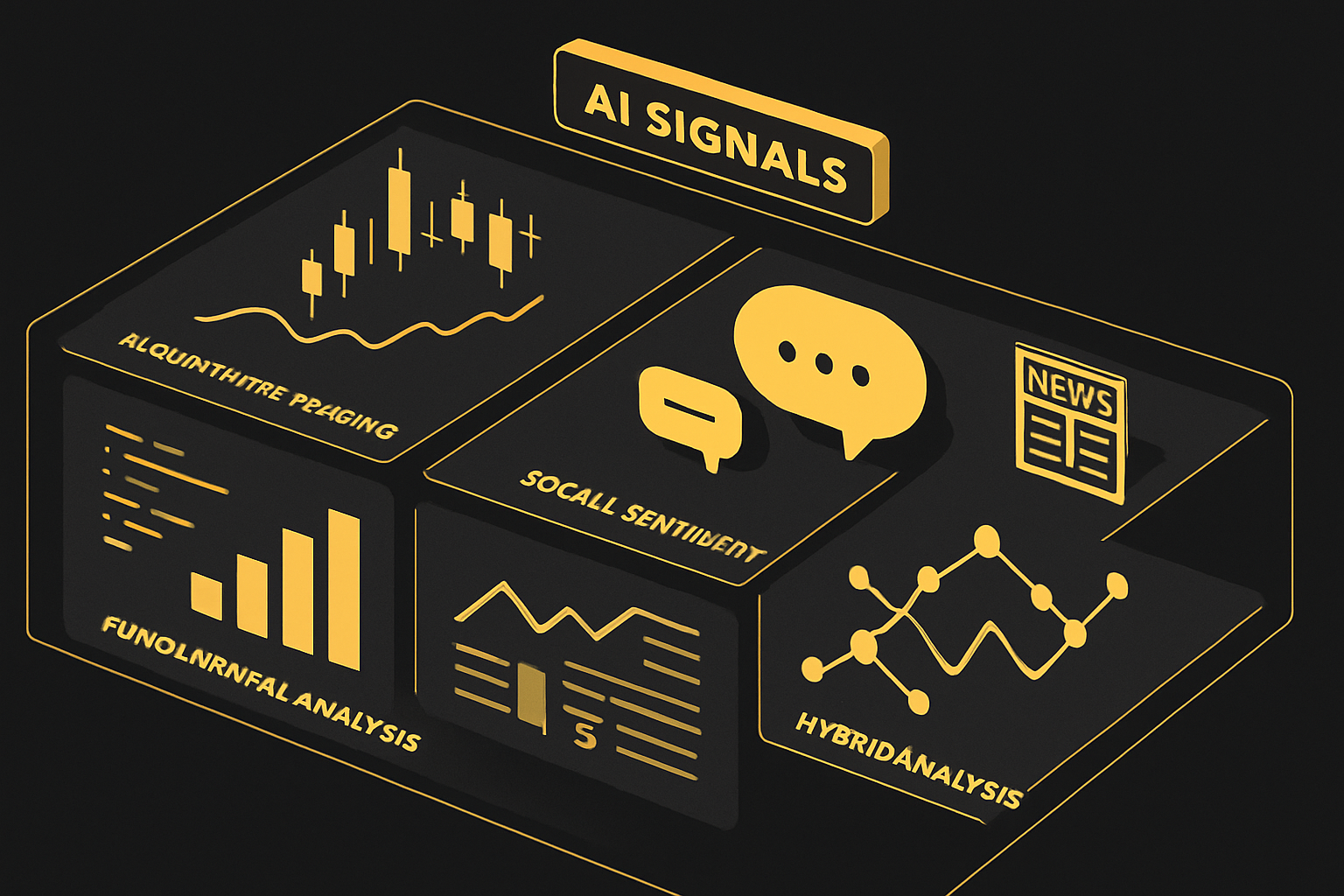
Algorithmic and Quantitative AI Signals
Algorithmic and quantitative ai signals form the backbone of many modern trading systems. These signals are generated by AI models that crunch vast amounts of quantitative data—like price, volume, volatility, and technical chart patterns—at lightning speed. For example, AI-powered strategies can automatically scan the Bitcoin and S&P500 markets, identifying optimal entry and exit points based on real-time market fluctuations.
A major advantage of these ai signals is their objectivity and speed. They can process thousands of data points per second, spotting trends far faster than any human. However, there’s always a risk of overfitting, where algorithms become too tuned to past data and miss new market behaviors.
To see how this technology is reshaping the industry, check out this overview of AI Trading Signals in 2025, which highlights how algorithmic ai signals are revolutionizing forex and crypto trading.
Social Sentiment and News-Based AI Signals
Social sentiment and news-based ai signals offer a unique edge by tapping into the pulse of the market. AI systems scan social networks, financial news, and trending topics in real time to gauge crowd psychology and emerging narratives. Apps like TradingView now deliver sentiment-driven ai signals that alert traders to sudden spikes in online hype or breaking news events.
For instance, when analysts or the public start buzzing about Tesla’s upcoming earnings or a potential ETF approval, ai signals can flag these shifts before the price reacts. This enables traders to act quickly on new information, capturing opportunities that might otherwise be missed.
The main benefit is speed and context awareness, but these signals can be volatile—markets sometimes overreact to hype, resulting in false positives. Still, for traders who want to stay ahead of the news cycle, social sentiment ai signals are a game changer.
Fundamental and Macro-Economic AI Signals
Fundamental and macro-economic ai signals delve deeper into the economic engine behind asset prices. These signals are generated by AI models that analyze company earnings, sector growth, macroeconomic indicators, and even central bank policies.
For example, when the Federal Reserve announces a policy change or a government stimulus is introduced, ai signals can trigger alerts based on predicted impacts across markets. Many investors now combine these signals with traditional fundamental research, letting AI sift through massive amounts of financial data for actionable insights.
The integration of ai signals with classic analysis ensures traders don’t miss out on the bigger picture. While not as fast as purely quantitative signals, fundamental ai signals add depth and long-term perspective to any investment strategy.
Multi-Source and Hybrid AI Signals
Multi-source and hybrid ai signals represent the next evolution in trading intelligence. These advanced systems blend technical, sentiment, and fundamental data to create a holistic view of the market. By cross-referencing multiple data streams, hybrid ai signals deliver higher accuracy and help filter out noise.
Apps offering 360-degree analysis now provide tailored investment recommendations based on a combination of chart patterns, news events, and economic trends. This reduces the chance of false positives and increases the confidence level in each signal.
The true power of multi-source ai signals lies in their adaptability. As markets evolve, these systems learn and update, ensuring traders have access to the most relevant and timely insights across all asset classes.
How to Use AI Signals: Step-by-Step Guide for 2025
Ready to harness the power of ai signals for smarter trading in 2025? This step-by-step guide walks you through every stage, from choosing the right tools to executing and refining your strategy. Whether you’re a beginner or looking to level up, these steps will help you navigate the world of ai signals with confidence.
Step 1: Choosing the Right AI Signal Tool or Platform
Selecting the best platform for ai signals is your foundation. Prioritize reliability, transparency, and audited results. Look for compatibility with your preferred devices—mobile, desktop, or web-based solutions like TradingView.
Compare top-rated platforms using reviews and user feedback. For instance, StocksToBuyNow AI boasts a 4.7/5 rating from over 1,100 users, reflecting strong satisfaction. Explore features such as real-time alerts, multi-asset support, and broker integrations.
Don’t overlook user support, educational resources, and active communities. Engaged support and learning tools can make a huge difference, especially as you start using ai signals.
Step 2: Setting Up and Customizing AI Signals
Once you’ve picked a platform, it’s time to set up your ai signals. Start by creating an account and selecting your preferred markets—forex, crypto, stocks, or indices.
Most tools allow you to customize alerts based on timeframes, asset classes, and notification methods (like mobile or email). Multi-timeframe dashboards and session liquidity analysis can help you tailor signals to your strategy.
If you’re new to ai signals, use default settings initially. As you gain experience, gradually personalize your alerts and preferences to match your trading style and risk appetite.
Step 3: Interpreting AI Signals and Understanding Output
Understanding ai signals output is crucial for making informed decisions. Learn to decode buy/sell signals, trend alerts, and confidence metrics. Visual cues—such as chart overlays, color codes, or dashboards—make interpretation easier.
Many platforms now offer explanations and event-driven predictions alongside signals. For example, you might see real-time ai signals for Bitcoin’s range trading or ETF-related moves. To dive deeper into how these systems work and improve your understanding, check out this guide on AI and trading strategies.
Always check the context and reasoning behind each signal. This practice helps you build trust in the ai signals and sharpens your decision-making skills over time.
Step 4: Executing Trades Based on AI Signals
With ai signals interpreted, the next step is action. Translate the signals into real trades—plan your entries, exits, and set stop-loss levels to manage risk.
Use position sizing and diversification to protect your capital. Avoid overtrading, even if signals come frequently. Many modern platforms allow seamless integration with brokers, enabling fast execution directly from the ai signals dashboard.
Whether you’re trading short-term volatility or building long-term positions, align each trade with your overall strategy and risk tolerance.
Step 5: Monitoring, Adjusting, and Reviewing Performance
Tracking the performance of your ai signals is essential for growth. Use built-in analytics to review trade outcomes, monitor signal accuracy, and spot trends in your results.
Adjust your settings and strategies as needed. For example, some users report growing their portfolios from $1,200 to $8,000 in just four weeks by continuously refining their approach. Transparent metrics let you see what’s working and where to improve, keeping your strategy data-driven.
Step 6: Leveraging Community and Expert Support
Don’t underestimate the value of a supportive community when working with ai signals. Access to 24/7 expert advice, peer forums, and live streams can accelerate your learning curve.
Participating in communities like StocksToBuyNow AI or TradingView offers exposure to new ideas, real-time insights, and practical feedback. Many traders credit their success to sharing experiences and learning from others’ wins and mistakes, making your journey with ai signals more collaborative and informed.
Best Practices for Maximizing AI Signals in 2025
Unlocking the full power of ai signals means more than just following recommendations—it’s about integrating technology into a well-rounded trading plan. These best practices will help you maximize performance, minimize risks, and stay ahead in the dynamic markets of 2025.
Building a Robust Trading Strategy with AI Signals
Creating a resilient trading strategy starts with understanding how ai signals fit into your overall approach. Don’t rely solely on signals—blend them with your own market research and solid risk management. Diversify across different asset classes, timeframes, and types of ai signals to smooth out volatility.
Set clear, realistic goals. Are you aiming for short-term gains or steady long-term growth? For example, many traders use Dollar Cost Averaging (DCA) to manage risk in volatile markets. Compare strategies in the table below:
| Strategy | Timeframe | Use of AI Signals |
|---|---|---|
| DCA | Long-term | Entry timing |
| Swing Trading | Mid-term | Trend detection |
| Scalping | Short-term | Rapid alerts |
Remember: even the best ai signals can’t predict every move. Use them as a guide, not a guarantee.
Avoiding Common Pitfalls and Misconceptions
Over-reliance on ai signals is a common trap. Without understanding the market context, you could misinterpret alerts or jump into trades without proper analysis. Always combine ai signals with fundamental and technical insights.
Don’t overlook risk controls. Proper position sizing and stop-loss strategies help protect your capital when a signal doesn’t play out. Avoid the temptation to overtrade—frequent signals can lead to decision fatigue and costly mistakes.
Misreading confidence levels is another issue. Not every alert carries the same weight. Learn to distinguish high-probability signals from weaker ones. The lessons from Bitcoin’s dramatic price swings and false breakouts underscore the importance of staying disciplined.
Ensuring Transparency and Data-Driven Decisions
Transparency is crucial when working with ai signals. Choose platforms that provide audited results, open performance metrics, and clear explanations of how signals are generated and backtested. This allows you to verify claims like a +45% annual yield rather than taking them at face value.
Dive deeper by exploring resources such as the Category: AI in trading, which compiles expert articles and case studies to help you make informed, data-driven decisions. Understanding the inner workings of ai signals empowers you to separate hype from proven value.
Monitor your trades and regularly review performance analytics. Adjust your strategy as needed based on real-world results and transparent data.
Staying Updated with AI Technology and Market Trends
AI technology and financial markets never stand still. Stay updated with new features, regulatory changes, and emerging best practices for ai signals. Most reputable platforms offer educational resources, live streams, and expert analysis to help you stay sharp.
Participate in community forums and webinars to learn from experienced traders and developers. Platforms like StocksToBuyNow AI frequently release updates, such as new MacBook ARM betas or in-depth trading videos, to keep users ahead of the curve.
Continuous learning is your edge. By staying engaged and informed, you’ll be ready to adapt as ai signals evolve and markets shift.
Real-World Case Studies: AI Signals in Action
Nothing demonstrates the power of ai signals better than real-world stories. Across the globe, traders and investors are leveraging ai signals to transform their portfolios, navigate volatile markets, and make smarter decisions. Let’s explore how this technology is reshaping outcomes for individuals and institutions alike.
Success Stories from Individual Investors
Many retail investors have seen dramatic results by integrating ai signals into their trading routines. Take Sarah, a part-time trader, who grew her retirement portfolio from $242,000 to $360,000 in just two months. She credits ai signals for helping her spot high-probability entries and avoid emotional trading.
Another user, Alex, adopted ai signals to learn options trading. With real-time alerts and clear explanations, he executed profitable trades even during volatile markets. Community forums and live streams provided support, allowing him to refine his strategies and boost confidence.
Key benefits reported by individuals include:
- Faster decision-making with instant buy/sell alerts
- Reduced risk of emotional or impulsive trades
- Ability to diversify across assets and strategies
For many, ai signals have become indispensable tools, bridging the gap between novice and expert trading. These stories highlight the accessibility and transformative impact of ai signals for everyday investors.
Institutional Use: Hedge Funds and Professional Traders
On Wall Street, ai signals are now standard practice among hedge funds and professional traders. Former directors from Goldman Sachs and Bank of America have championed AI-driven models for identifying high-growth stocks, achieving returns of 5x to 30x on select trades.
Institutions value ai signals for their ability to process vast amounts of data rapidly, including price action, news, and social sentiment. According to AI in Investment Industry Statistics, more than 60% of asset managers now use AI tools for trade execution, portfolio optimization, and risk management.
A typical institutional workflow includes:
- Integrating ai signals with proprietary trading systems
- Running backtests to validate signal accuracy
- Using ai signals to time entries and exits during high-impact events
The scale and speed of institutional trading underscore the edge provided by ai signals. Performance benchmarks show that AI-driven funds consistently outperform traditional strategies, especially during market uncertainty.
Market Events and AI Signal Predictions
Ai signals have proven especially valuable during major market events. For example, when news broke about Bitcoin ETF approvals, ai signals detected shifts in trading volume and sentiment before prices surged. Traders who acted on these signals captured significant gains.
Similarly, ai signals anticipated volatility around Tesla’s earnings releases, providing early alerts for both bullish and bearish moves. By analyzing news, social chatter, and technical data, ai signals enabled users to position themselves ahead of the crowd.
Ai signals aren’t just reactive—they predict trends and highlight opportunities in real time. This predictive power helps traders navigate unpredictable market events with greater confidence and agility.
Lessons Learned: What Worked and What Didn’t
Reflecting on years of market data, users and professionals have learned valuable lessons from both successes and setbacks with ai signals. One key takeaway is the importance of adaptive learning—constantly updating strategies based on new market conditions and signal performance.
Common pitfalls include over-reliance on ai signals without understanding the broader market context or neglecting risk management. Comparing results from 2020 to 2025 shows that ai signals have become more accurate, but human oversight remains crucial.
In summary, the most successful users combine ai signals with research, discipline, and a willingness to learn from both wins and losses. This balanced approach maximizes the benefits of ai signals while minimizing risks.
Top Tools, Apps, and Platforms for AI Signals in 2025
Navigating the world of ai signals in 2025 means choosing the right tools to stay ahead of the market. With so many platforms and apps available, traders need reliable, transparent, and user-friendly solutions. Let’s break down the top options and what makes each stand out.
Leading AI Signal Platforms and Apps
The best ai signals platforms in 2025 combine real-time alerts, multi-asset coverage, and seamless user experience. Popular choices like StocksToBuyNow AI and TradingView offer:
- Real-time ai signals for stocks, crypto, forex, and indices
- Multi-timeframe dashboards for holistic analysis (Multi-timeframe analysis tools)
- High user ratings (e.g., 4.7/5, 1.1K+ reviews)
- Compatibility with mobile, desktop, and TradingView integration
Some platforms leverage cutting-edge technology, like large language models, to enhance sentiment-driven trading. For instance, an LLM-Enhanced Trading System can combine news, social sentiment, and technical indicators to generate actionable ai signals.
Comparison Table: Top AI Signal Platforms
| Platform | Assets Supported | Key Features | Rating |
|---|---|---|---|
| StocksToBuyNow AI | Stocks, crypto | Real-time signals, mobile & desktop | 4.7/5 |
| TradingView | Multi-asset | Charting, community scripts, alerts | 4.6/5 |
| PipTrend | Forex, indices | Multi-timeframe, trend detection | 4.5/5 |
Broker Integrations and Execution Tools
For ai signals to be truly effective, integration with broker platforms is essential. Leading brokers like eToro, Fidelity, Interactive Brokers, and Robinhood now support direct execution based on AI-generated signals.
- In-app broker recommendations streamline the trading process.
- Seamless execution reduces latency between receiving a signal and making a trade.
- Some tools offer one-click trading from within the ai signals app, ideal for both new and experienced traders.
Using these integrations, traders can act on ai signals instantly, minimizing missed opportunities.
Community and Educational Resources
A strong community and access to educational materials set top ai signals platforms apart. Look for:
- Live streams and trading rooms for real-time learning
- Expert advisory and Q&A sessions
- Peer forums for sharing insights and strategies
Platforms like StocksToBuyNow AI and TradingView foster active communities where users learn from each other and adapt to changing markets. Educational videos, strategy guides, and ongoing webinars help users make the most of ai signals.
Evaluating Pricing, Transparency, and Support
Pricing models for ai signals tools vary. Some offer free basic plans; others require subscriptions or in-app purchases.
- Transparent pricing and clear refund policies are must-haves.
- Lifetime updates and expert support add long-term value.
- Platforms should provide audited performance metrics, so users can verify results.
When comparing features, prioritize providers offering robust support and transparent data, such as those with advanced multi-timeframe analysis tools.
What to Look for When Choosing an AI Signal Provider
Selecting the right ai signals platform comes down to a few core factors:
- Proven reliability and accuracy
- Transparent, easy-to-understand signals
- Strong community reputation and ongoing development
- Educational support and responsive customer service
Choosing wisely ensures that your ai signals provide a genuine edge in 2025’s fast-moving markets.
Ready to put these AI trading strategies into action? If you’re looking for a way to simplify your trades, cut through market noise, and act on reliable, real-time signals, PipTrend has you covered. It’s designed for traders like us who want clarity and confidence—no more second-guessing or missing out on opportunities. With instant alerts and smart, customizable tools, you can finally focus on what matters: making better decisions and growing your portfolio. If you’re curious to see the difference AI can make in your trading journey, See Your Trading Improve With PipTrend.