On this page
The AI Trading Bot Gold Rush
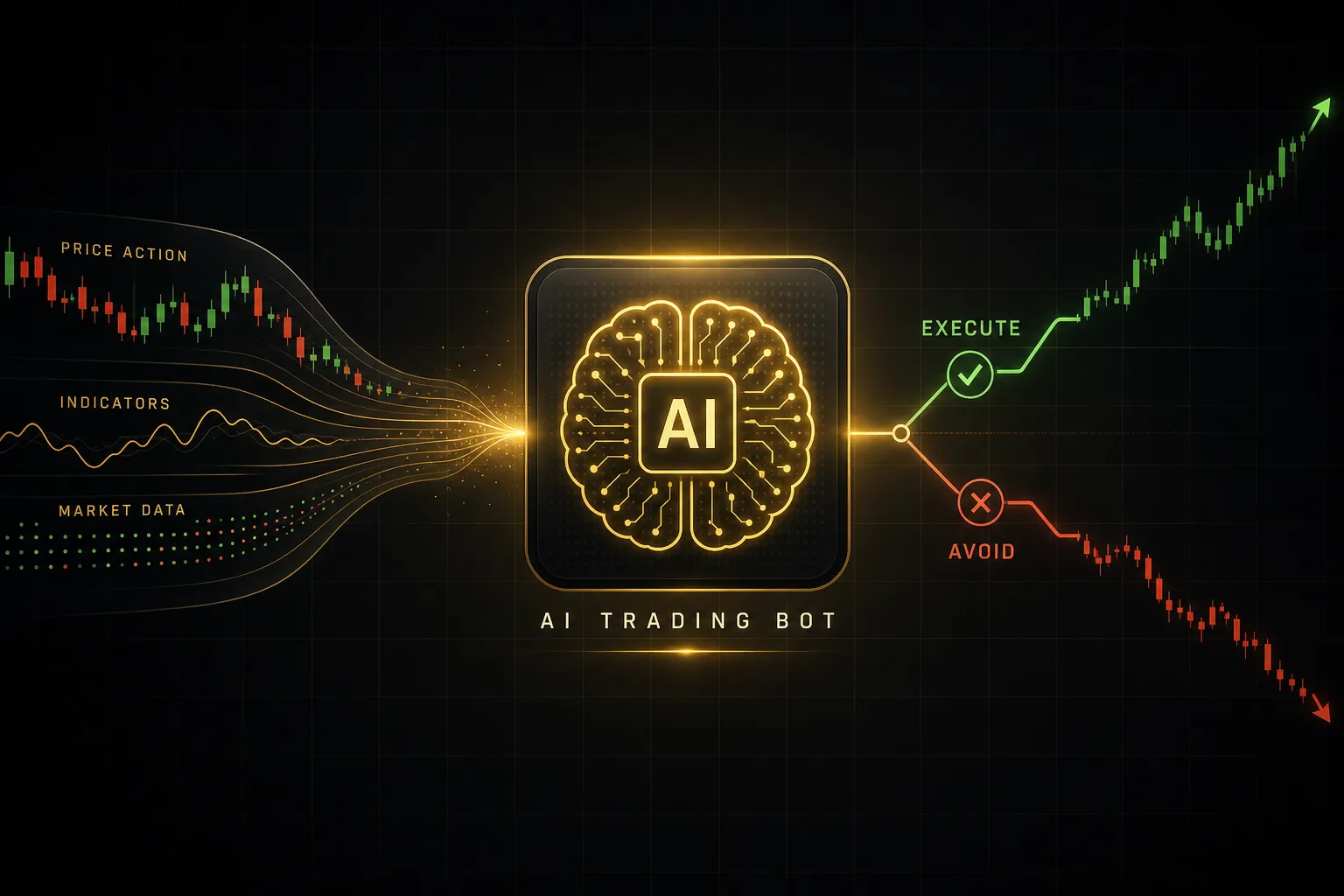
Scroll through any trading feed and you’ll find the same screenshot: a rising equity curve, a bot logo, and a caption about “passive income while you sleep.” The volume of these posts exploded after large language models went mainstream, and it hasn’t slowed down since.
Three things collided to create this moment. Retail traders got cheap API access to brokers and crypto exchanges, machine learning tooling became free and well-documented, and the word “AI” acquired marketing power that “algorithm” never had.
This guide takes a neutral, evidence-based position. Some AI trading bots genuinely use machine learning models to forecast price behavior. Many others are rebranded if-then automation with a neural network sticker on the box.
Telling the two apart is most of the work.
Here’s the tension worth stating upfront.
Regulators including the CFTC, FINRA, the SEC, and NASAA have all issued warnings about unrealistic AI auto-trading claims, while academic research keeps finding the same awkward gap: a model can predict price direction better than a coin flip and still lose money once you subtract spreads, commissions, and slippage.
Predictive accuracy and profitability are different problems. Solving the first does not solve the second.
So what follows is the full picture. What these systems actually do under the hood, how the data-to-order pipeline works, why backtests lie, a concrete pre-live testing sequence you can run yourself, and the honest answer to when human oversight beats full autonomy.
No hype.
No promise that a bot will replace your job.
Just the mechanics, the failure modes, and a framework for deciding whether automation fits how you actually trade.
What Is an AI Trading Bot, Really?
Ask ten vendors what makes their product “AI” and you’ll get ten different answers, several of which involve a moving average crossover. The category has no policed definition, which is exactly why the label gets stretched.
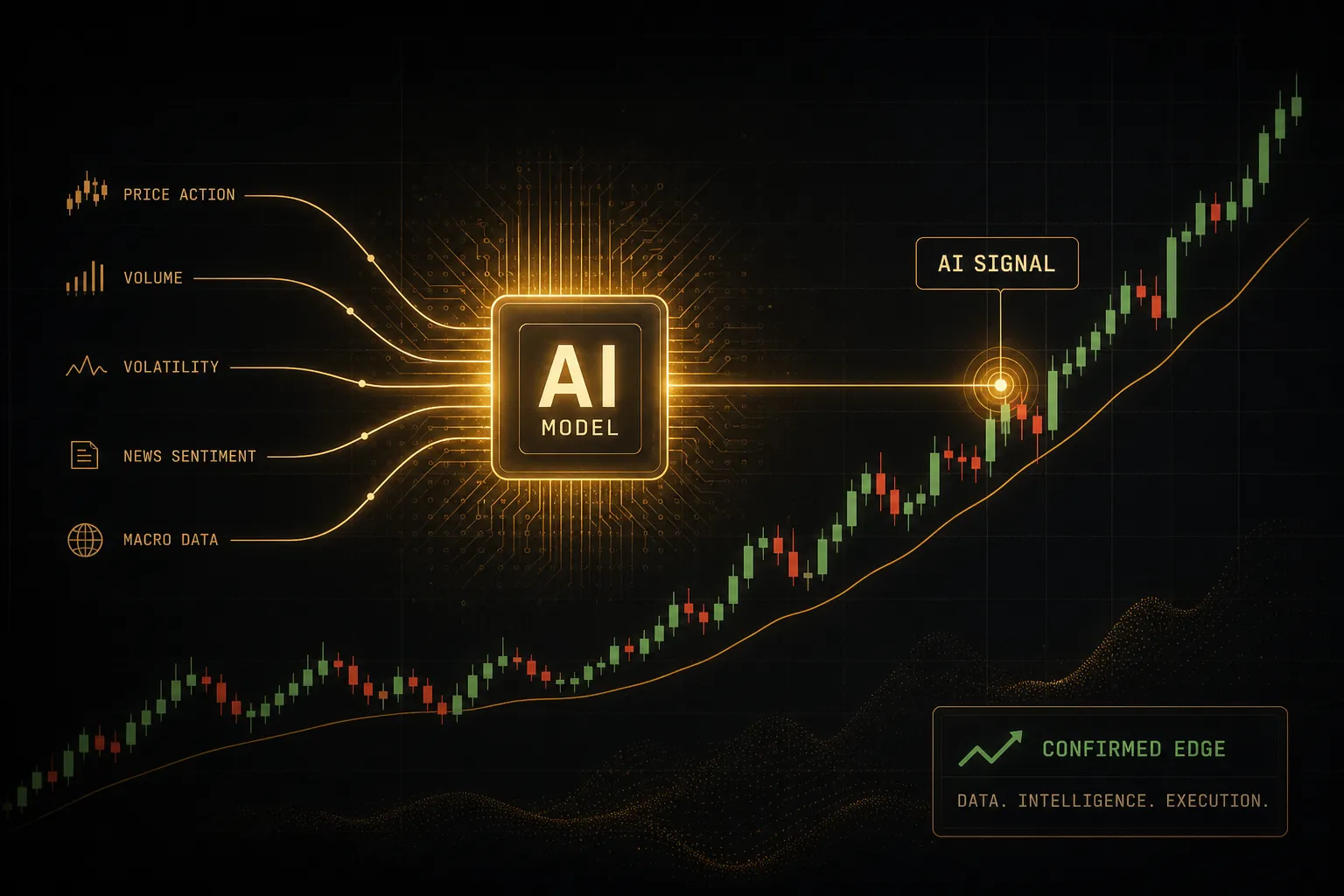
A genuine AI trading bot is software that uses machine learning, deep learning, natural language processing, or reinforcement learning to identify patterns in market data and produce trading decisions or probability estimates. The defining feature is learning: the system’s behavior is derived from data rather than hand-coded by a developer.
Machine Learning vs Rule-Based Automation
Rule-based automation is deterministic. If RSI drops below 30 and price closes above the 200-day moving average, buy.
Every time, forever, until a human changes the code.
A machine learning model works differently. You feed it labeled historical data, it optimizes internal parameters to minimize prediction error, and the resulting decision boundary might involve hundreds of interacting features that no human explicitly wrote down.
Common approaches split into a few families. Supervised models like gradient-boosted trees and LSTMs forecast next-period returns or classify direction.
Reinforcement learning agents learn a trading policy by simulating thousands of episodes and optimizing cumulative reward.
NLP pipelines run sentiment analysis on news, earnings calls, and social posts to generate a directional tilt.
Both approaches can work.
Both can fail.
But calling a rules engine “AI-powered” tells you nothing about its edge, and the distinction matters when you’re evaluating what you’re actually buying.
There’s also a middle category worth naming: automated trading systems built on feature engineering plus a thin statistical layer. Technical indicators get transformed into inputs, a logistic regression or small ensemble sits on top, and the whole thing gets marketed as deep learning.
It isn’t, though it may still be useful.
Where Marketing Hype Creeps In
The CFTC has published direct advisories warning that AI branding is being used to promote unrealistic or outright fraudulent auto-trading claims, frequently by providers who are not registered to handle customer funds. The pattern is consistent enough that regulators can describe it as a template.
The tells are fairly reliable.
Guaranteed monthly percentage returns. Screenshots instead of broker statements. A “proprietary algorithm” that cannot be described even at a high level. Referral bonuses that scale with recruitment rather than performance.
Add one more: results that show no losing months.
Every real strategy has drawdowns.
A track record without them is either curve-fitted, cherry-picked, or fabricated.
Legitimate operators tend to do the opposite. They disclose the company entity, publish losing trades alongside winners, explain the general methodology, and never touch your funds directly.
Can ChatGPT Trade Your Account?
No.
Not on its own, and not without a chain of custom infrastructure you build or buy separately.
Large language models are text engines. They can summarize an earnings report, extract sentiment from a news flow, draft strategy code, or explain why a setup looks weak. What they cannot do is connect to your broker, size a position, and submit an order without an API integration, authentication keys, risk limits, and a human deciding what the guardrails are.
People do build these pipelines. An LLM generates a sentiment score, a separate risk module decides whether to act on it, and an execution layer routes the order. That’s a real architecture, and it works about as well as the weakest component in the chain.
What it isn’t: typing “trade my account profitably” into a chat window. Any service claiming that ChatGPT is autonomously running a fund on your behalf is describing something that doesn’t exist in the way they’re implying.
Inside the AI Trading Pipeline
Every automated trading system, AI or not, moves through the same five stages. Understanding them tells you where an edge can exist and, more usefully, where things break.
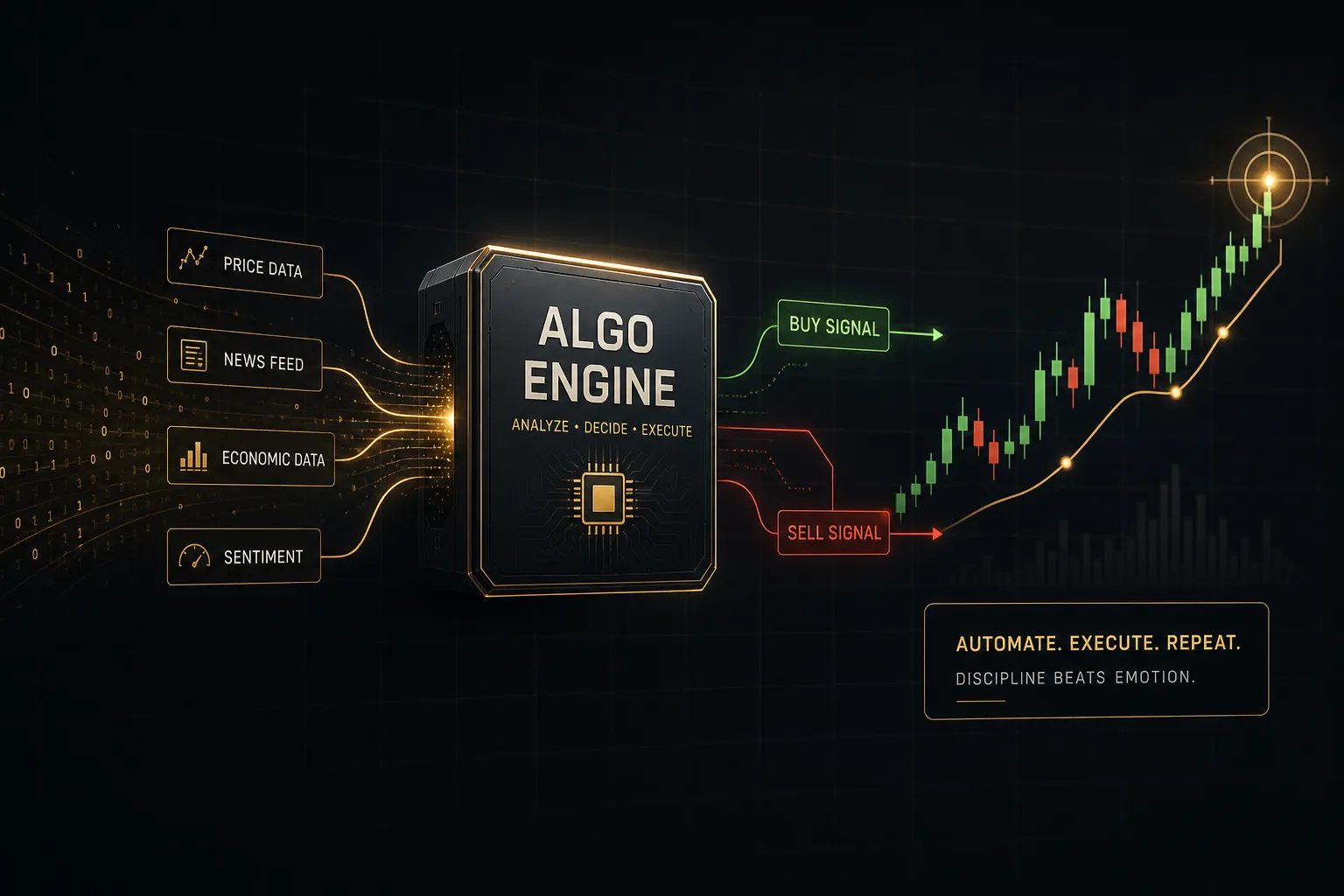
- Data ingestion. The system pulls price and volume bars, and often order book depth, tick data, or alternative feeds like news sentiment, funding rates, and macro releases. Data quality dominates everything downstream: a single misaligned timestamp or unadjusted split can poison an entire model.
- Feature engineering and preprocessing. Raw data becomes model inputs. Returns get normalized, technical indicators get computed, rolling volatility gets calculated, and everything gets aligned so that no future information leaks into a past observation. This stage is where most quantitative work actually happens, and it’s the least glamorous part of the pipeline.
- Signal generation. The machine learning model, or the rules engine, produces an output: a direction, a probability score, or an expected return. A good system emits a confidence alongside the call, because a 51% probability trade and an 80% probability trade should not be treated identically.
- Position sizing and risk parameters. Before any order exists, the system decides how much to risk. Fixed-fractional sizing risks a set percentage of equity per trade, typically 0.5% to 2%. Volatility-based sizing scales position size inversely to recent ATR so that a quiet instrument and a wild one contribute similar risk. Hard limits belong here too: maximum open positions, daily loss cap, correlation ceilings.
- Order routing and execution. The order travels through a broker or exchange API. Latency, spread, and slippage all bite here, and they bite hardest on small-cap, illiquid, or fast-moving instruments. A strategy that backtests at mid-price and executes at the ask can lose its entire edge in the gap between the two.
- Monitoring and feedback. Live performance gets compared against expected distributions. If realized drawdown exceeds the backtest’s worst case, or win rate drops two standard deviations below expectation, the system flags model drift. Without this stage, you learn your bot broke only after the account balance tells you.
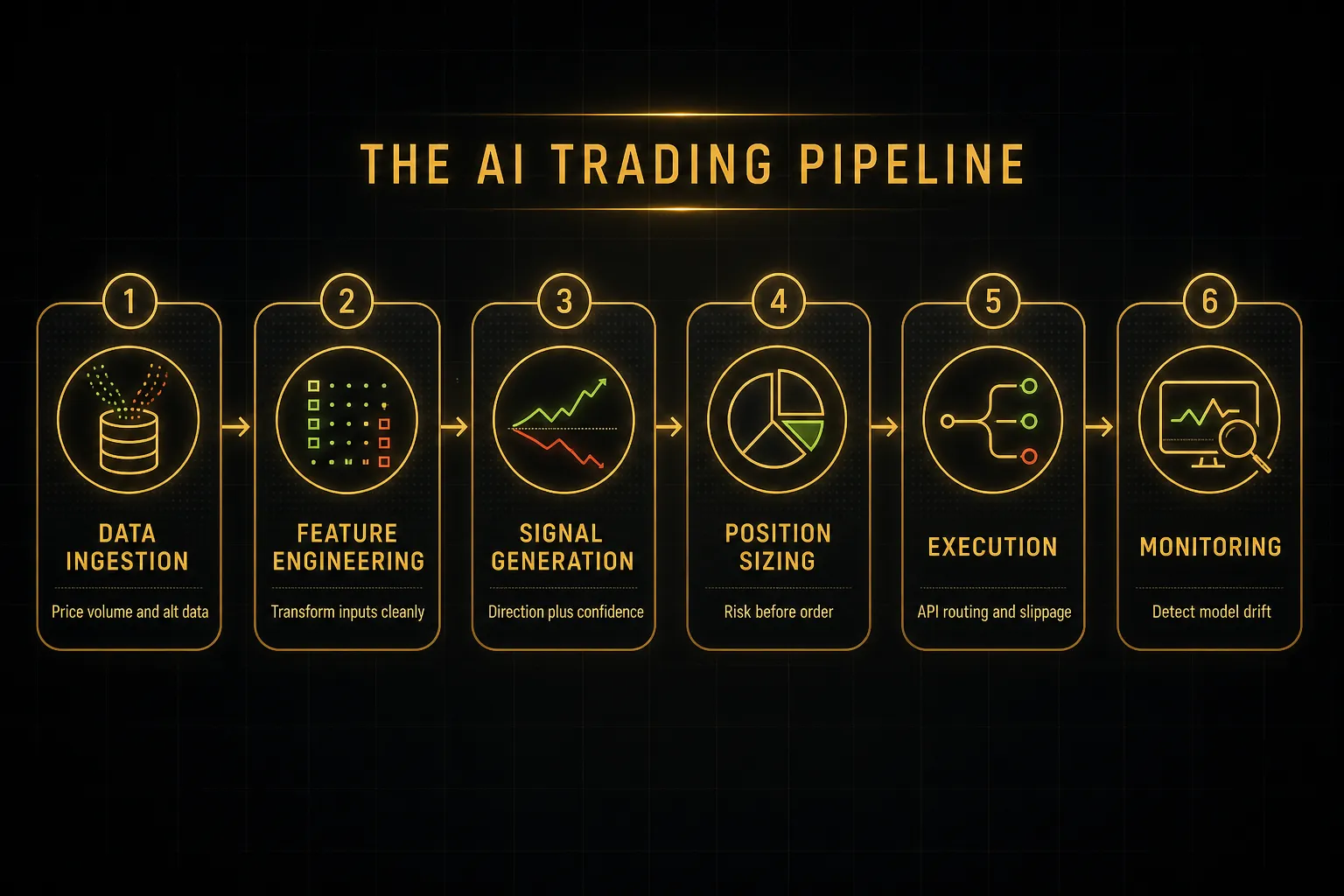
Notice how little of this is “the AI.” The model occupies one stage out of six. Sizing, execution quality, and monitoring determine whether a mediocre signal survives or a good one gets destroyed.
Why Bots Fail After Backtesting Well
The most common trading bot story goes like this. Backtest shows 140% annual return with a 12% maximum drawdown. Live trading shows a slow bleed for four months.
Nothing in the code changed.
This gap between simulation and reality is so consistent it should be assumed by default.
Here’s what causes it.
Backtesting Traps That Inflate Returns
Look-ahead bias is the quiet killer. Your model uses a daily close to make a decision that’s executed at that same close, or references a fundamental figure on the date it applied to rather than the date it was published. The backtest sees information the live system never will.
Survivorship bias shows up when your historical universe only contains instruments that still exist. Test a stock strategy on today’s index constituents and you’ve quietly excluded every company that went to zero. Crypto is worse: thousands of tokens have died, and most historical datasets don’t include them.
Overfitting, or curve-fitting, is the most seductive failure. You test 400 parameter combinations, pick the best one, and celebrate.
But with enough attempts, random noise produces a beautiful equity curve. The parameters describe the past rather than any repeating market behavior, and out-of-sample performance collapses.
Unrealistic fills finish the job.
Backtests that assume mid-price execution, zero slippage, unlimited liquidity, and no commission routinely overstate returns by 30% to 60% on higher-frequency strategies. A system taking 800 trades a year with an assumed 0.02% cost error is off by 16% annually before anything else goes wrong.
Accuracy Is Not the Same as Profit
This is the finding that surprises most newcomers.
Research on machine learning price prediction routinely reports directional accuracy in the 52% to 58% range on liquid instruments, which sounds like an edge.
Then net returns come back negative.
The arithmetic explains it.
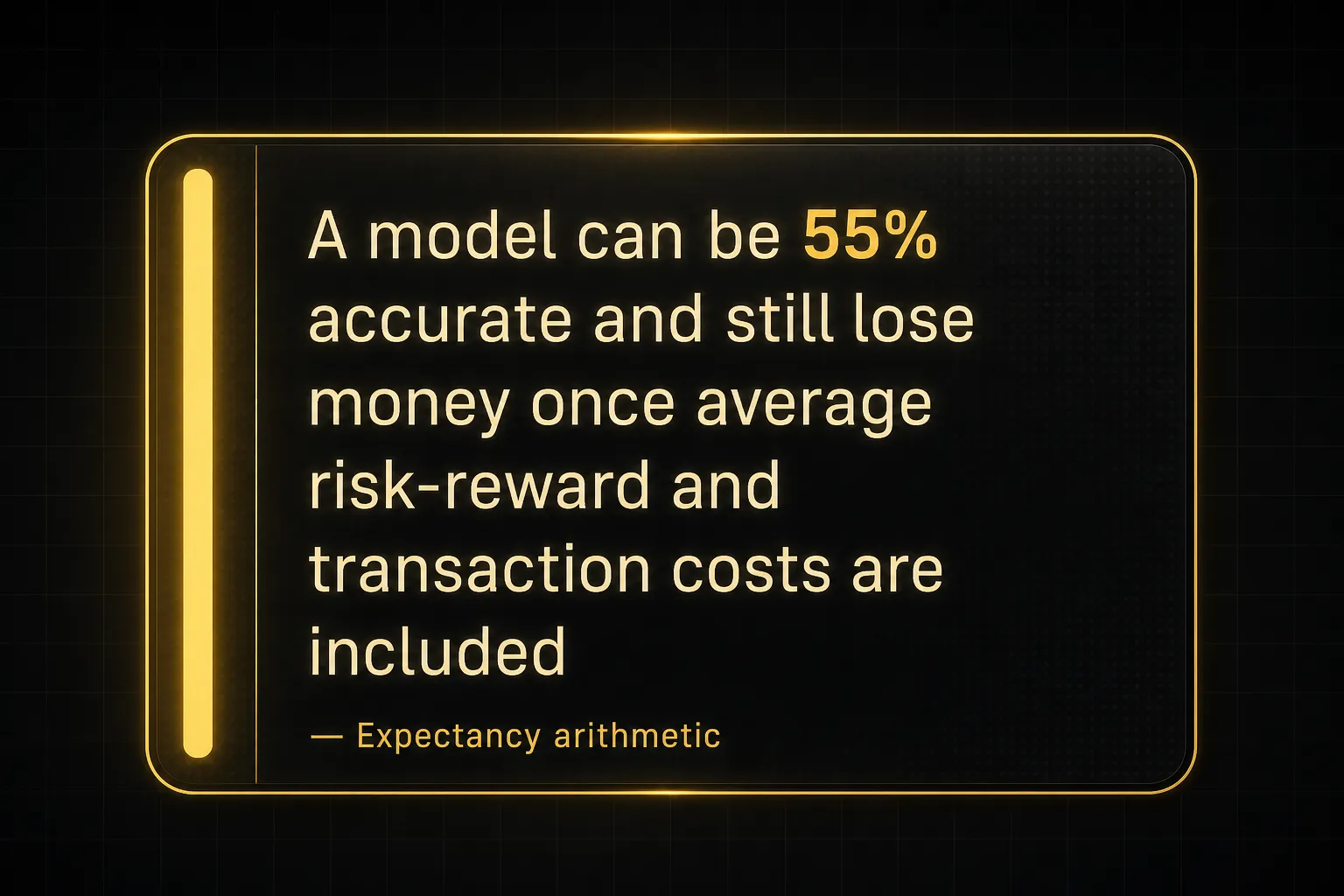
Suppose your model is right 55% of the time. If your average winner is 0.8R and your average loser is 1.0R, expectancy per trade is (0.55 × 0.8) minus (0.45 × 1.0), which equals negative 0.01R.
You are accurate and unprofitable at the same time.
Now add costs.
Spread, commission, and slippage of 0.05R per trade turn a marginal negative into a reliable one.
High accuracy with poor risk-reward is a losing combination, and it’s the most common one in retail machine learning projects.
The inverse is also true and far more useful.
A system right 38% of the time with 3R average winners produces strong positive expectancy. Risk-adjusted returns come from the payoff structure, not the hit rate.
Market-Regime Risk
A model learns the statistical structure of the data it was trained on.
Change the structure and the model doesn’t know it’s now guessing.
A bot trained through 2023 and 2024 low-volatility trends learned that pullbacks get bought. Drop it into a high-volatility, mean-reverting regime and the same logic produces a string of losses that looks nothing like the backtest distribution.
FINRA has specifically flagged this out-of-sample degradation as a core risk for AI-driven models: performance in conditions that differ from training data is fundamentally unpredictable.
Correlation shifts compound it.
A portfolio of six “uncorrelated” strategies can turn into one trade during a liquidity event, and your maximum drawdown assumption goes with it.
Operational Risks Nobody Mentions
Model risk gets all the attention.
Plumbing failures cost more money.
- API permission misconfiguration. Keys granted withdrawal rights when they only needed trade rights. If the provider is compromised, so are your funds.
- Exchange and broker outages. Your bot has an open position and the venue goes down during a volatility spike. There is no automated solution to an exchange that won’t accept orders.
- Stale or gapped data. The feed freezes, your model acts on a price from four minutes ago, and it enters against a move that already happened.
- Duplicate or orphaned orders. A retry loop after a timeout sends the same order twice, leaving double exposure with a single stop attached.
- Connectivity loss. Your VPS reboots mid-session. Positions sit unmanaged until it comes back.
- No kill switch. Every live system needs a single, tested action that flattens positions and halts new orders. If you’ve never used it, you don’t know it works.
Testing an AI Bot Before You Trade
The good news: you can evaluate almost any bot with a disciplined sequence before a single dollar is at risk.
The bad news: doing it properly takes weeks, and that’s exactly why most people skip it.
Treat testing as the product.
The strategy is a hypothesis until validation survives contact with data the model never saw.
A Practical Testing Sequence
Run these stages in order.
Failure at any stage means stop, not “proceed with smaller size.”
- In-sample backtest. Test on historical data with realistic costs baked in: actual spread, commission, and a slippage assumption at least double what you think is fair. If it only works with zero costs, it doesn’t work.
- Walk-forward analysis. Optimize on a rolling training window, test on the following untouched window, then roll forward and repeat. Twelve consecutive walk-forward windows tell you far more than one glorious full-history backtest. Consistency across windows matters more than the headline number.
- Out-of-sample testing. Hold back a continuous block of data, ideally spanning a different volatility regime, and never touch it during development. Run it once at the end. If performance drops more than 40% versus in-sample, you’ve curve-fitted.
- Paper trading. Run live data through the full pipeline with simulated fills for at least 30 to 60 trading days, or 50 trades minimum. This is where data feed gaps, timezone bugs, and API errors surface. Most systems fail here for reasons entirely unrelated to the model.
- Small-size live deployment. Go live with 10% to 25% of intended capital. Paper fills and real fills differ, sometimes dramatically. You are measuring execution quality, not strategy quality, at this stage.
- Predefined shutdown rules. Write down, before funding, the conditions that stop the system: maximum drawdown threshold, number of consecutive losses, or a win rate falling below a floor for 30 trades. Decide when sober so you don’t have to decide when losing.
Metrics That Actually Matter
Total return is the least informative number in trading.
It says nothing about how much pain generated it or whether the result was luck.
- Sharpe ratio. Return per unit of total volatility. Above 1.0 is respectable for a retail system; anything above 3.0 in a backtest should trigger suspicion rather than excitement.
- Sortino ratio. Same idea but penalizing only downside volatility, which is more honest for strategies with asymmetric payoffs.
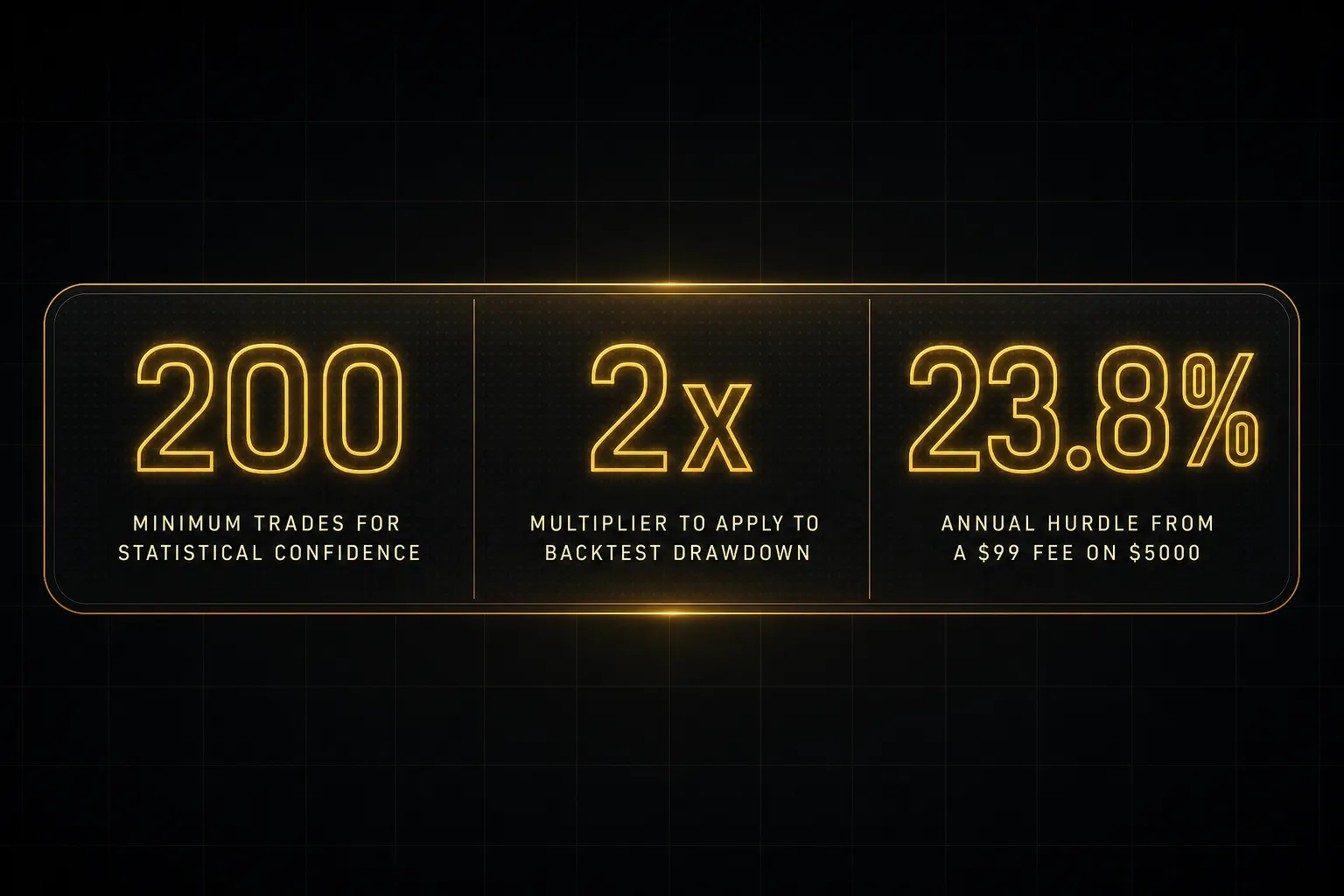
- Maximum drawdown. The largest peak-to-trough decline. Assume live drawdown will exceed backtest drawdown by 1.5x to 2x, then ask whether you’d still hold through it.
- Win rate versus average risk-reward. Always read them together. Neither number means anything alone, and expectancy is the only combination that pays.
- Net performance after all costs. Spread, commission, swap or funding, slippage, and the bot’s subscription fee. A $99 monthly subscription on a $5,000 account is a 23.8% annual hurdle before the strategy earns a cent.
- Trade count. Forty trades is noise. Two hundred trades across varied conditions is the minimum for any statistical confidence in a result.
Signals With Oversight vs Full Autopilot
There’s a distinction that determines everything about your risk exposure, and most marketing deliberately blurs it: does the tool suggest trades, or does it place them?
Signal tools generate ideas.
You review context, decide whether to take the trade, and control your own broker account. The tool never holds keys or funds.
Your worst case is a bad idea you can decline.
Execution bots place live orders through API access.
You’ve delegated the decision and, depending on permissions, a degree of account control.
Your worst case is a malfunctioning system trading through a regime it wasn’t built for while you sleep.
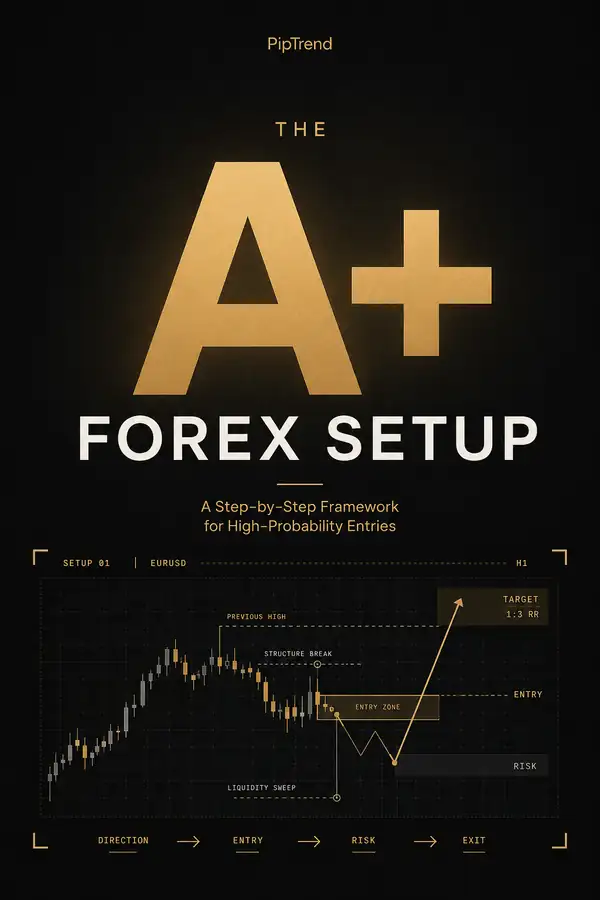
PipTrend’s TradingView indicator suite is a useful example of the human-in-the-loop model. Rather than promising autonomous profit, it separates the decision into three distinct components: direction, entry level, and exit timing, evaluated across 12 timeframes so a trader can see whether short-term and higher-timeframe context agree before committing.
The trader still pulls the trigger.
That’s the point.
And the trade outcomes are published with verified cTrader statements that include the losing trades, which is a meaningfully different posture from a screenshot of an equity curve.
Full autonomy isn’t wrong.
But it earns its place only after the oversight version has proven itself, and only if you can actually monitor and intervene when conditions shift.
Common Questions About AI Trading Bots
Are AI trading bots real or a scam?
Both categories exist, and the label tells you nothing. Genuine machine learning trading systems run at hedge funds, proprietary firms, and among skilled retail quants, and they work with modest, hard-won edges.
At the same time, the CFTC and NASAA have flagged a large volume of AI-branded auto-trading offers that are rebranded rules automation or outright fraud. Legitimacy depends entirely on the operator: who they are, what they disclose, and whether they touch your money.
Can AI trading bots make consistent profits?
No system produces consistent profits without losing periods, and any provider claiming otherwise is describing something that does not exist. Every strategy with positive expectancy still experiences losing weeks, months, and occasionally losing years.
Regulators treat guaranteed-return language as a primary red flag for exactly this reason. Realistic expectations look like positive expectancy over hundreds of trades, punctuated by drawdowns you planned for in advance.
What is the best AI trading bot for beginners?
The best starting point for a beginner is a transparent signal tool with manual confirmation, not an autonomous execution bot. You learn why trades work, you keep full control of your account, and a software failure cannot empty it.
Look for tools that publish verified broker statements including losses, explain their methodology, and require no API access to your funds. Move toward automation only after you can evaluate a signal’s quality yourself.
How much money do you need to use an AI trading bot?
Subscription costs, not minimum deposits, set the real floor. A $99 per month tool on a $2,000 account needs roughly 59% annual returns just to break even on fees, which is not a realistic hurdle.
A practical rule: your annual subscription cost should stay under 5% of account equity. That puts a $99 monthly product at a sensible minimum of around $24,000, or push you toward cheaper and free alternatives while you build capital.
Can an AI trading bot lose all your money?
Yes, and there are three separate routes to it. Strategy failure during a regime shift, operational failure such as a runaway order loop or a lost stop, and counterparty failure if the provider or exchange holds your funds and disappears.
Leverage accelerates all three. Mandatory protections include a hard daily loss limit, position size caps, API keys with trading permissions only and no withdrawal rights, and a kill switch you have personally tested.
How do I know if an AI trading bot is legitimate?
Work through a concrete checklist before funding anything. Verified company registration with a searchable entity number, a disclosed operator identity rather than an anonymous brand, and clear custody arrangements where you keep funds in your own broker account.
Then test practically: run a small withdrawal early, demand independently verifiable results such as audited or broker-issued statements rather than screenshots, and confirm any API keys you issue carry trading permissions only. If a provider resists any of these, that resistance is your answer.
Trade the Process, Not the Hype
No AI system removes market risk.
It can only change how decisions get made, which is valuable, but it doesn’t alter the fact that markets shift and every edge decays.
The systems that survive share traits that have nothing to do with the model architecture.
Disciplined position sizing. Validated out-of-sample testing. Honest accounting of costs. Monitoring that catches drift before the drawdown does.
The “AI” label is the least predictive attribute on that list.
So here’s the one concrete step worth taking before you fund anything. Run the system in a demo or paper account for a defined period, at minimum 30 trading days or 50 trades, and calculate net results after spread, commission, slippage, and subscription fees.
Write the number down.
Compare it to the marketing claim.
And the decision framework is simple enough to state in two lines.
Choose full automation only if you can genuinely monitor the system and intervene when conditions change. If you can’t, favor AI-assisted signals with manual approval, where a bad idea costs you nothing because you can simply decline it.
The bots that work aren’t the ones with the best marketing.
They’re the ones whose owners did the boring validation work first.
Sources
- CFTC: Customer Advisory: AI Won’t Turn Trading Bots into Money Machines
- FINRA: Ai apps in the industry
- FINRA: Algorithmic trading
- Investor.gov: Artificial Intelligence (AI) and Investment Fraud: Investor Alert
- ScienceDirect: Artificial intelligence methods for financial market prediction: A systematic review
Risk Disclaimer: Trading involves risk. Past performance doesn't guarantee future results. Only trade with money you can afford to lose. PipTrend is a tool to assist your trading decisions, not financial advice.