On this page
Why “Is AI Trading Profitable” Has No Simple Answer
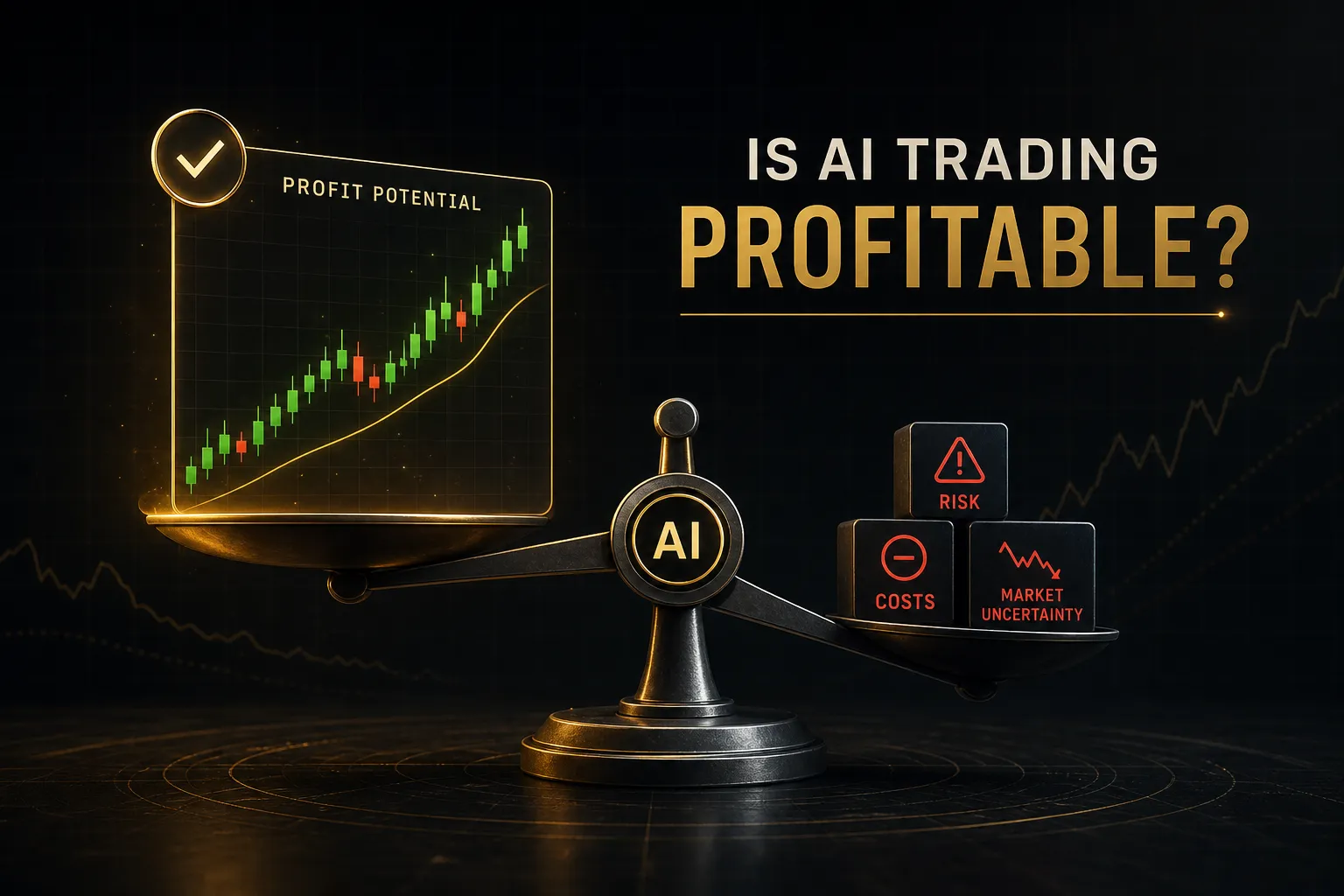
Ask ten traders whether AI trading is profitable and you will get ten confident, contradictory answers. That is not because the question is hard. It is because most people are answering a different question than the one being asked.
AI genuinely improves some things. Pattern recognition across thousands of instruments, research that used to take a weekend compressed into minutes, and execution that never gets bored, scared, or revenge-trades at 2am. Those are real advantages.
What AI does not do is guarantee a profit after costs. No machine learning model has repealed the bid-ask spread, and none has found a permanent edge that survives crowding, fees, and regime change simultaneously.
The honest answer depends almost entirely on one distinction: are you talking about AI as decision support, or AI as a fully autonomous system that places and manages live orders?
Those two things have completely different risk profiles, failure modes, and realistic return expectations. Lumping them together is how marketing departments blur the line.
So this article uses a single evaluation lens throughout, and it is deliberately unglamorous:
Net-of-costs returns. Maximum drawdown. Out-of-sample validation. Live monitoring over multiple market conditions. If a system cannot survive all four tests, it is not profitable, no matter how clean the backtest curve looks.
Equity curves in sales pages are not evidence. Verified live statements are.
Keep that distinction in mind and most of the noise in this industry sorts itself out quickly.
The Many Faces of “AI Trading”
The term “AI trading” is doing a spectacular amount of heavy lifting. It covers products that share almost nothing in common except a marketing label, and the differences between them determine whether you are taking a controlled risk or handing your capital to a black box.
Here are the five categories you will actually encounter, and what each one can and cannot do:
- Generative AI chatbots. Large language models can summarize earnings reports, explain technical indicators, or draft a trading plan. They can also hallucinate price data, quote figures from stale training cutoffs, and state a wrong number with perfect confidence. They cannot place orders, manage position size, or enforce a stop loss.
- Signal and indicator tools. These output a direction or a setup: bias, entry zone, stop, target. A human reviews it and decides whether to take it. The trader remains the risk manager, which is both the limitation and the safety valve.
- Machine learning strategies. Models trained on historical price, volume, order flow, or alternative data to produce predictive analytics on short-horizon moves. Performance depends heavily on retraining cadence and whether the training data covered the current market regime.
- Copy-trading services. You mirror another account. The “AI” here is frequently either a filter for selecting traders to follow or, uncomfortably often, just a label. Your outcome is the leader’s outcome, minus slippage and fees.
- Fully autonomous execution bots. These place, size, and close trades with no human in the loop. Highest convenience, highest tail risk. A logic error or an unhandled market event compounds across every trade until someone notices.
Decision Support Tools
Decision support keeps a human between the model and the market. That single checkpoint filters out an enormous amount of damage: the 8am news spike the model did not understand, the illiquid session, the setup that technically qualifies but sits right under a major level.
The trade-off is throughput and discipline. Humans skip trades, hesitate, and override signals at exactly the wrong moment. A decision-support workflow only works if the trader actually follows a documented rule set rather than cherry-picking.
Automated Execution Systems
Automation removes hesitation entirely, which is the point. A bot takes the 47th consecutive signal with the same size as the first, and it does not care that the last six lost.
But automation also removes judgment. During a liquidity gap or a flash move, a poorly guarded AI trading bot will keep firing orders into a market that no longer resembles its training data.
Before trusting any of it, ask four questions: What data trains the model? Is it genuinely learned or just a rules engine with a new label? How often is it retrained? And can the outputs be audited after the fact?
Vague answers to any of these tell you what you need to know.
Prediction Accuracy vs Real Profit
A 70% win rate sounds unbeatable. It is not. A strategy that wins 70% of the time and loses three times more on its losers than it makes on its winners is a reliable way to go broke slowly.
Win rate is a vanity metric. What matters is expectancy: average win times win rate, minus average loss times loss rate, minus every cost incurred getting there. And the cost stack is where most theoretical edges go to die.
- Bid-ask spread on every entry and exit
- Commissions per round turn
- Slippage, which widens exactly when volatility spikes and your signals fire most
- Financing and swap costs on overnight positions
- Market impact once your size exceeds available liquidity
- Leverage and borrowing costs
- Platform, data, and subscription fees
Here is what that looks like in practice. Four hypothetical strategies, identical starting gross returns in some cases, wildly different outcomes once transaction costs are applied.
| Strategy Profile | Round Trips / Year | Gross Backtest Return | Est. Cost Per Trade | Net Return After Costs |
|---|---|---|---|---|
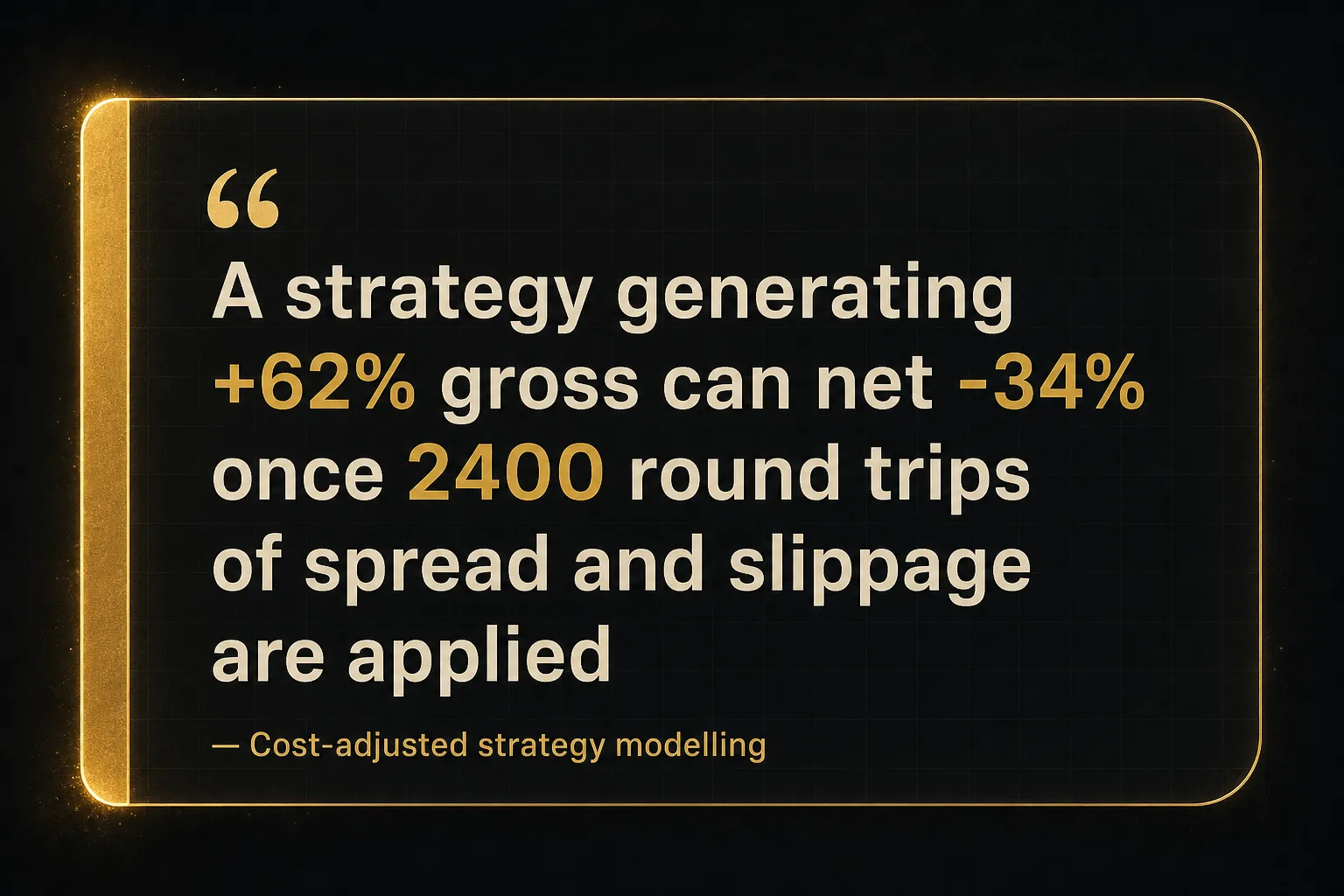
| High-frequency ML scalper | 2,400 | +62% | 0.04% | -34% |
| Intraday signal system | 480 | +38% | 0.06% | +9% |
| Swing trend follower | 90 | +24% | 0.08% | +17% |
| Position / macro model | 18 | +15% | 0.12% | +13% |
Look at the first row. A genuinely strong gross edge, obliterated by turnover.
The scalper needed to clear roughly 96% in annual costs just to break even, and it did not come close.
Now look at the bottom row. Lower gross return, but almost all of it survives. Fewer trades means fewer opportunities for the spread to take its cut.
This is the part sales pages never show. Backtest engines default to optimistic fill assumptions, and many ignore slippage entirely. Add realistic execution and roughly half the strategies that looked promising turn negative.
So where does AI’s real edge come from? Mostly consistency and speed, not prophecy. A model that applies the same rules 500 times without fatigue, and executes within milliseconds of a trigger, captures edges that a human trader leaks through hesitation and inconsistency. That is valuable.
It is just not magic.
Validating an AI Strategy Before Going Live
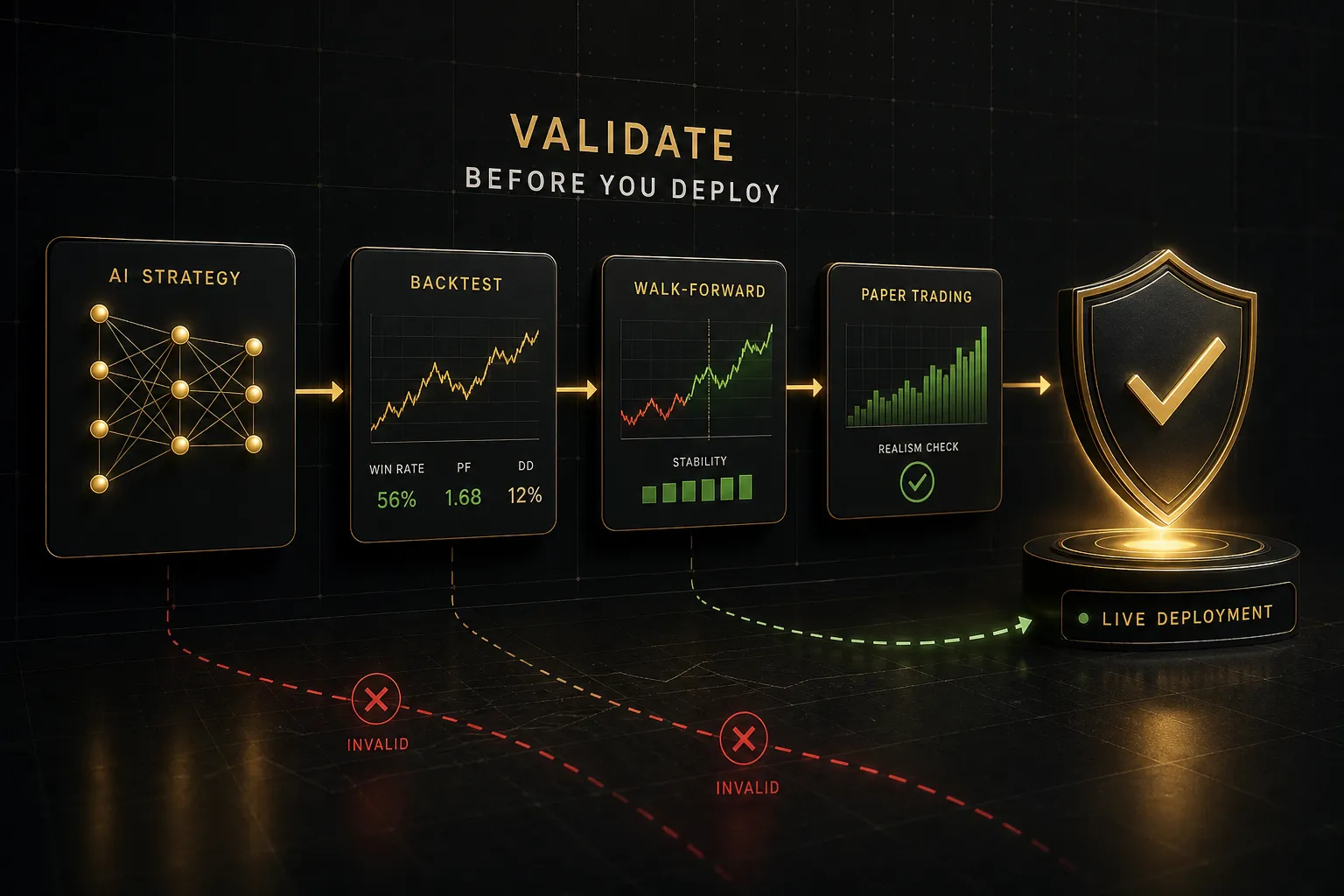
Most failed algorithmic systems did not fail in live trading. They failed during development, and nobody noticed for six months.
Common Backtest Traps
Five specific errors account for the overwhelming majority of backtests that look brilliant and then die on contact with real markets.
Look-ahead bias means your strategy used information it could not have had at decision time. Classic example: a signal that uses the daily closing price to decide on an entry at the open of that same day. It works perfectly in testing and is impossible in reality.
Data leakage is subtler. You normalize your features using the mean and standard deviation of the entire dataset, including the future. The model quietly learns the shape of data it should never have seen.
Survivorship bias shows up when your stock universe only contains companies that still exist. Test a strategy on today’s index members over ten years and you have unknowingly filtered out every bankruptcy and delisting.
Regime change breaks models trained on a single market environment. A mean-reversion system trained exclusively on 2015 to 2019 ranges will be shredded by a sustained trend.
Overfitting from repeated parameter tuning is the most common trap of all. Test 400 parameter combinations and some will look spectacular purely by chance. That is not an edge.
That is noise wearing a costume.
From Backtest to Real Money
The path from idea to funded account should be slow and deliberately annoying. Each stage exists to kill a strategy that does not deserve capital.
- Run the initial historical backtest. Build and test on a defined in-sample period, keeping a meaningful slice of history completely untouched. Document your assumptions on fills, spreads, and commissions before you see any results.
- Test out-of-sample on unseen data. Run the frozen strategy on the held-back period without adjusting a single parameter. If performance collapses, the edge was fitted, not found. Resist the urge to “just tweak one thing”.
- Apply walk-forward analysis. Roll the training and testing windows forward repeatedly across the full history. Walk-forward analysis reveals whether the strategy adapts or whether it only worked in one lucky stretch of market history.
- Benchmark against something simple. Compare net results to buy-and-hold, a moving-average crossover, or a standard indicator strategy. If your neural network cannot beat a 50/200 crossover after costs, the complexity is pure liability.
- Paper trade across multiple market conditions. Not “four weeks” but a window that actually contains a trending phase, a ranging phase, and at least one high-volatility event. Calendar time is meaningless; market variety is everything.
- Deploy live with deliberately small size. Start at a fraction of intended risk, typically 10 to 25%, for a minimum of 50 to 100 trades. Live execution reveals slippage and latency that no simulator models correctly.
- Compare live results to paper results. A gap of more than 20 to 30% between simulated and live performance means your cost assumptions were wrong. Fix the model before scaling, not after.
- Scale only on evidence. Increase size in steps tied to a documented rule, such as after 50 additional trades within expected drawdown. Never scale because a run of wins made you feel confident.
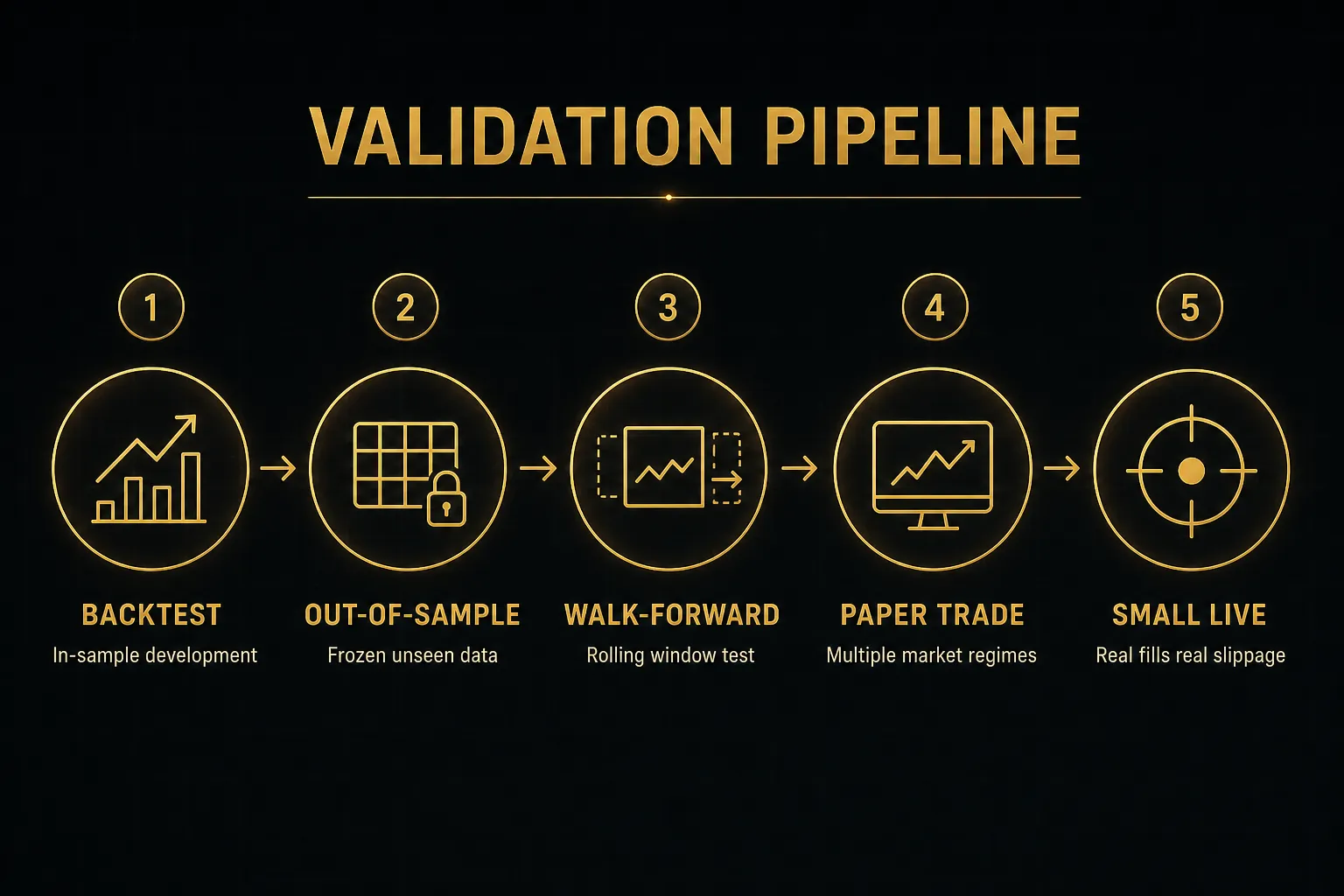
Skipping stages does not save time. It just moves the failure from a spreadsheet to your account balance.
Risks, Market Shocks, and Spotting Fake Platforms
The uncomfortable truth about automated systems: they fail fastest precisely when markets are most dangerous.
When Models Break Down
A machine learning model is an interpolation machine. It performs well inside the range of conditions it has seen and behaves unpredictably outside it. Markets specialize in producing conditions nobody has seen.
Consider what happens during a surprise central bank decision. Spreads widen from 0.8 pips to 15. Liquidity evaporates for 30 seconds. A model whose training data contained only normal-session spreads now sizes positions as if execution costs are trivial.
Flash crashes are worse. Stop orders convert to market orders, fill hundreds of points away, and the bot dutifully re-enters because its signal still reads valid. Then there are slow regime transitions, where a momentum model keeps buying strength for eleven consecutive losses as the market quietly shifts to mean reversion.
Which brings up the part nobody discusses enough: maximum drawdown and the psychology of watching it. A system with a historical 22% drawdown will, at some point, exceed it.
Sitting through a 15-trade losing streak while an algorithm keeps firing takes a specific kind of discipline, and most people override the system at the exact moment they should not.
Risk of ruin is the mathematical version of the same problem. At 2% risk per trade with a 45% win rate, a 20-trade losing streak is not a freak event.
It is a statistical inevitability given enough trades.
Red Flags of Guaranteed-Profit Schemes
Before sending money anywhere, run this checklist. Any single failure is reason enough to walk.
- Guaranteed returns of any kind. “8% monthly, risk-free” is not an investment product. It is a description of fraud. Legitimate operators publish losses.
- Backtests only, no live statements. Verified live trading records from a broker or platform are the minimum bar. A curve in a PDF proves nothing.
- No regulatory or registration detail. Check the jurisdiction, the registration number, and whether the entity is actually authorised for what it is selling.
- Opaque broker relationships. If the platform requires a specific unknown broker, or holds client funds directly, ask who benefits from your losses.
- Withdrawal friction. Minimum lock-up periods, “verification fees” before payout, or pressure to reinvest gains are textbook exit-scam mechanics.
- Undisclosed data sources. If nobody will say what the model trains on, assume there is no model.
- Conflicts of interest. Affiliate commissions paid on deposits, not performance, align the operator with your account opening rather than your results.
- Pressure and scarcity tactics. “Only 12 seats left” belongs in a webinar funnel, not a financial service.
What Transparent Signal Use Looks Like
The opposite of a black box is boring, and boring is the point.
PipTrend offers a useful reference model here. Its public results page carries verified cTrader statements that include the losing trades and the break-evens, not a filtered highlight reel. That is a meaningfully higher standard than a screenshot of an equity curve.
Just as important is how it frames its own role. It separates direction (the trading signal itself) from entry (marked price levels a human chooses to act on or ignore). That is decision support with a person in the loop, not a system claiming to predict the market.
The most trustworthy operators in this space describe what their system does not do. Anyone describing only upside is selling, not disclosing.
Verified statements, published losses, a human review step, and no guaranteed-return language. Four signals that cost nothing to check and eliminate most of the bad actors immediately.
Frequently Asked Questions
Can AI really make money trading?
Yes, but reliably only when the system’s net-of-costs return beats a simple benchmark across out-of-sample periods. Institutional quant funds demonstrate this works at scale, though they operate with execution costs, data quality, and infrastructure that retail traders cannot match.
For retail, the realistic version is modest: AI improves consistency and reduces emotional errors. It rarely produces the returns advertised in promotional material.
What percentage of AI traders are profitable?
Most retail algorithmic accounts underperform after transaction costs, consistent with broader retail trading data showing roughly 70 to 80% of active accounts lose money over time. Adding automation does not change the underlying cost arithmetic.
Publicized success stories are heavily distorted by survivorship bias. Traders who blow up rarely post their statements, so the visible sample looks far better than the actual population.
Is AI trading better than human trading?
AI is better at execution consistency, speed, and processing volume; humans remain better at context, judgment during unprecedented events, and knowing when not to trade. The strongest results usually come from combining them rather than choosing one.
A model will take the 200th signal identically to the first. A human will notice that the market just changed in a way the training data never contained.
Are AI trading bots worth it?
Only if the bot demonstrably beats your own manual results after all costs, across multiple market regimes, and within a drawdown you can actually tolerate. Most retail bots fail at least one of those three conditions.
Factor in subscription fees honestly. A bot charging $99 monthly on a $5,000 account needs a 23.8% annual return just to cover its own cost before you earn a cent.
What is the most profitable AI trading strategy?
There is no universal winner, and any source claiming otherwise is selling something. Edge depends on your cost structure, timeframe, instrument liquidity, and execution discipline, not on the algorithm in isolation.
The same strategy can be profitable for a low-cost institutional desk and deeply unprofitable for a retail account paying wider spreads. Turnover is usually the deciding variable: lower-frequency approaches survive retail costs far more often than high-frequency ones.
How do I know if an AI trading bot is legit?
Demand four things: verified live-trading statements that include losing periods, a checkable regulatory registration, a disclosed methodology and data source, and the complete absence of guaranteed-return language. Any operator that refuses one of these has answered your question.
Also check withdrawal terms before depositing, not after. Restricted withdrawals are the most common feature across collapsed platforms.
The Realistic Verdict on AI Trading
AI trading is profitable when, and only when, it clears a specific bar: after-cost performance that beats a sensible benchmark across multiple unseen periods, with drawdown you can sit through without intervening.
That is the whole decision rule.
Everything else is noise. Win rates, model architectures, the number of data points in the training set… none of it matters if the net return after spreads, slippage, and fees fails to beat a moving-average crossover.
So here is the concrete next step. Before funding any AI-driven account, ask for a verified live track record covering losses, then run the system in parallel with your own paper-traded benchmark for at least one full market cycle, meaning a trend, a range, and a volatility shock. If it cannot outperform under those conditions, you have saved yourself the tuition.
And a final reframe worth sitting with. Most retail traders do not lose because they lack predictive power. They lose because they size inconsistently, override their own rules, and chase after losses.
That is where AI actually helps. Not prediction, but process: the same rules applied the same way, trade after trade, with every decision auditable afterward.
Chase a magic model and you will spend years disappointed. Build a repeatable process, use AI to enforce it, and measure everything net of costs.
That version works.
Sources
Risk Disclaimer: Trading involves risk. Past performance doesn't guarantee future results. Only trade with money you can afford to lose. PipTrend is a tool to assist your trading decisions, not financial advice.