DAX Live Futures Explained for Real Traders
On this page
What Are DAX Live Futures?
Type “DAX live futures” into Google and you’ll get a dozen sites showing you a number.
Almost none of them tell you where that number came from.
The actual instrument is the FDAX contract, traded on the Eurex exchange in Frankfurt. It’s a cash-settled futures contract tracking the DAX 40 index, Germany’s benchmark of 40 large-cap listed companies.
When professional traders say “DAX futures,” they mean FDAX or one of its smaller siblings.
What you see on most free websites is something else entirely.
It might be a 15-minute delayed exchange feed. It might be a CFD price labelled “Germany 40” that your broker derived from the futures market and marked up.
It might be the cash index itself, which stops updating at 17:30 CET while the futures keep trading for hours.
These are three different numbers.
On a volatile afternoon they can sit 60 points apart.
A price quote without a stated source and contract month is not market data. It’s decoration.
That gap between what traders think they’re watching and what they’re actually watching causes real losses. Someone sees “DAX -80” on a widget at 20:00 CET, panics about their overnight position, and discovers the widget froze at the Xetra close three hours earlier.
This guide covers the practical mechanics: contract specifications for the full-size, mini, and micro versions, how point value translates into euros, why futures prices diverge from the cash index, when the market actually opens in your time zone, how contract rollover works four times a year, and a repeatable process for turning all of that into trading decisions.
No indicator worship.
No promises about a magic entry signal.
Just the plumbing you need to understand before you risk capital on a market that moves €25 per point, per contract, per tick.
FDAX, Mini and Micro DAX Futures
Eurex lists three sizes of DAX futures, and the difference between them is the difference between a €1,000 loss and a €40 loss on the same market move.
Choosing the wrong one is the fastest way for a retail account to die.
Here are the specifications side by side.
| Contract | Symbol | Point Value | Tick Size | Tick Value | Exchange |
|---|---|---|---|---|---|
| DAX Futures (full size) | FDAX | €25 per index point | 0.5 points | €12.50 | Eurex |
| Mini-DAX Futures | FDXM | €5 per index point | 0.5 points | €2.50 | Eurex |
| Micro-DAX Futures | FDXS | €1 per index point | 0.5 points | €0.50 | Eurex |
| DAX 40 Cash Index | DAX | Not tradable directly | n/a | n/a | Xetra calculation |
| ”Germany 40” CFD | Broker-specific | Broker-defined (often €1) | Broker-defined | Varies | OTC (no exchange) |
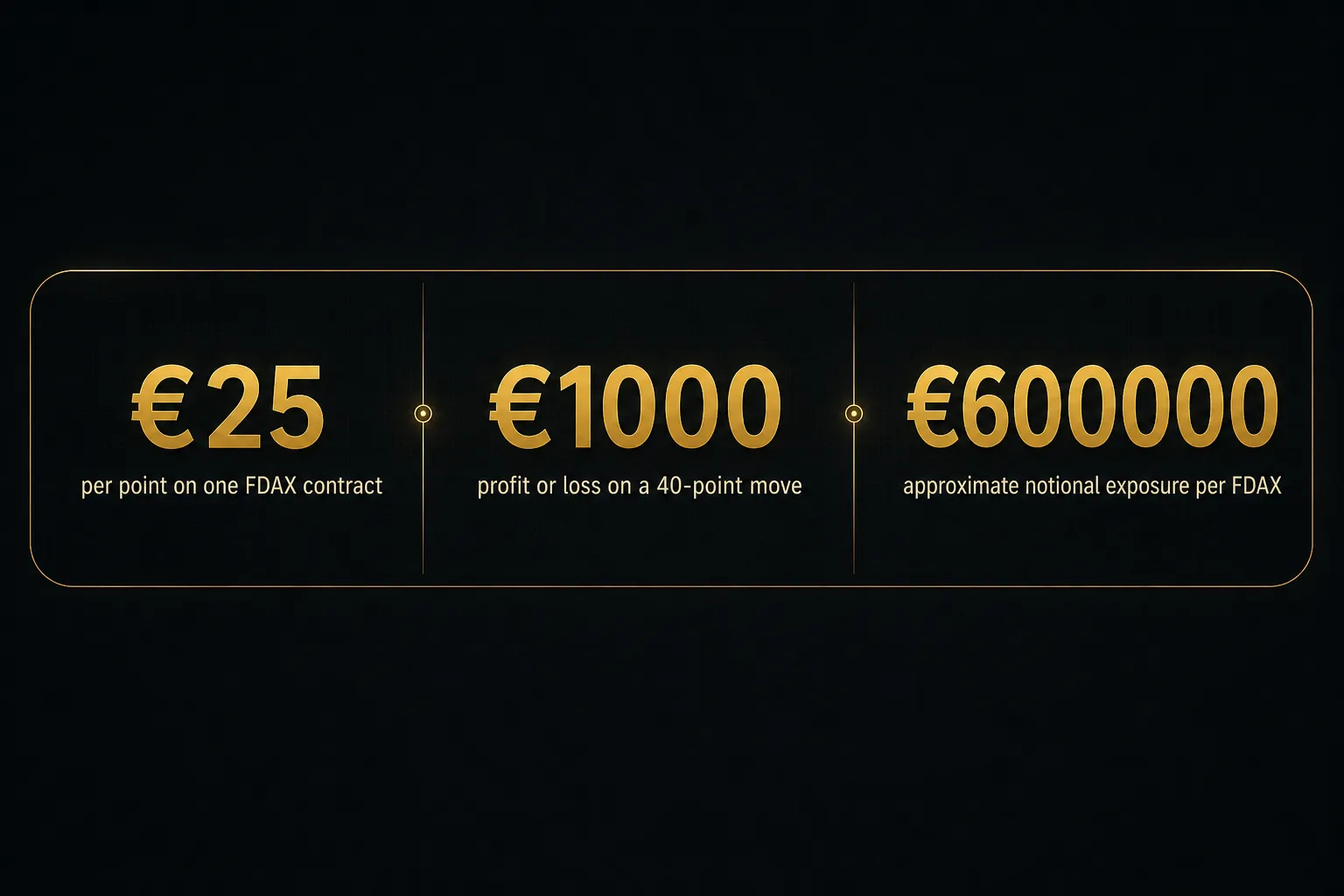
With the DAX 40 trading around the 24,000 level in 2026, a single FDAX contract carries roughly €600,000 in notional exposure.
That is not a beginner instrument.
The Micro-DAX futures contract, at €1 per point, gives you the same market with 1/25th the risk per tick.
DAX Futures vs the DAX 40 Index
The DAX 40 index is a calculation, not a tradable product. Deutsche Börse computes it continuously from the prices of 40 constituent stocks during the Xetra cash session, which runs 09:00 to 17:30 CET.
Outside those hours, the index number simply stops moving.
It sits there like a photograph.
The futures, meanwhile, trade nearly around the clock on Eurex.
That’s the whole point of the contract.
When a US inflation print lands at 14:30 CET or an Asian session sells off at 03:00, FDAX prices react and the cash index does not.
One more structural detail worth knowing: the DAX is a performance index, meaning dividends paid by its constituents are reinvested into the index calculation. Most global benchmarks are price indices.
This affects the fair-value relationship between the futures and the cash, which we’ll come back to.
Futures, CFDs, and Broker Instruments
A “Germany 40” or “DAX 30/40” CFD is not a futures contract.
It is an over-the-counter derivative issued by your broker, priced off the underlying futures or index, with the broker as counterparty.
That distinction has consequences.
Exchange-traded futures execute against a central order book with visible depth, standardised tick sizes, and central clearing. CFD fills happen against the broker’s book, spreads can widen without warning during news, and re-quotes are possible.
CFDs do have advantages.
Position sizing is flexible down to fractions of a contract, there is no rollover to manage manually on cash-index CFDs, and account minimums are lower. Many traders start there for good reason.
But when someone quotes you a “live DAX price,” ask two questions.
Which exchange, and which contract month?
If neither has an answer, treat the number as a rough indication and nothing more.
Is the Price Really Live?
Here’s a test.
Open any free DAX chart and look for a small grey label near the price, often reading “Delayed” or “D” or “15 min.” Roughly three-quarters of free financial sites show delayed Eurex data because real-time redistribution requires paying exchange licence fees.
Delayed data is fine for context.
It is useless for execution.
A 15-minute lag on a market that can travel 150 points in that window is not a small inconvenience.
Exchange-direct feeds come through your futures broker’s platform or a paid market data subscription, and they carry a monthly Eurex fee, typically in the range of a few euros for non-professional users up to considerably more for professional status.
If you are not paying something, somewhere, you are almost certainly on delayed data.
Three quick verification checks: compare the timestamp on the quote against your own clock, watch whether the price updates continuously or in jerky 15-minute jumps, and check whether the site names its data provider anywhere in the footer.
US Trading Hours and Time Zones
Eurex trades FDAX from roughly 01:10 CET through 22:00 CET, with the deepest liquidity concentrated between 08:00 and 22:00. The core European session most traders care about runs 09:00 to 17:30 CET, aligned with the Xetra cash market.
Translated for US traders during standard time, the Xetra open at 09:00 CET lands at 3:00 AM Eastern, midnight Pacific. The US equity open at 9:30 AM ET is 15:30 CET, which is why the DAX often sees a second volatility burst in the mid-afternoon European hours.
Now the part that catches people every single year.
Europe and the United States change their clocks on different weekends. Europe shifts on the last Sunday in March and the last Sunday in October, while the US shifts on the second Sunday in March and the first Sunday in November.
That leaves roughly three weeks in spring and one week in autumn where the normal 6-hour gap between CET and Eastern time becomes 5 hours. Traders with alarms set for the DAX open show up an hour late.
It happens constantly.
Why Futures and Cash Prices Diverge
Pull up the FDAX front-month contract and the DAX 40 cash index at 11:00 CET and they will not match.
That difference is called the basis, and it is not an error.
Futures fair value is driven by two forces pulling in opposite directions: the cost of financing a position until expiry, and the dividends you forgo by holding the future instead of the shares. Higher interest rates push the future above the cash; expected dividends pull it down.
Because the DAX is a performance index that already reinvests dividends, the dividend drag is muted compared to price indices like the S&P 500. The net result in a positive-rate environment is that FDAX typically trades at a modest premium to the cash index, and that premium shrinks steadily as expiry approaches.
The practical takeaway: never treat a futures quote and an index quote as the same number when calculating levels. A support level marked on the cash index chart sits at a different price on the futures chart.
And because the futures session opens hours before Xetra, overnight FDAX action is what sets the tone for the 09:00 CET cash open. Traders watching only the index see a gap appear out of nowhere.
Traders watching the futures saw it forming at 04:00.
Point Value and Profit Math
The arithmetic here is simple.
The consequences of getting it wrong are not.
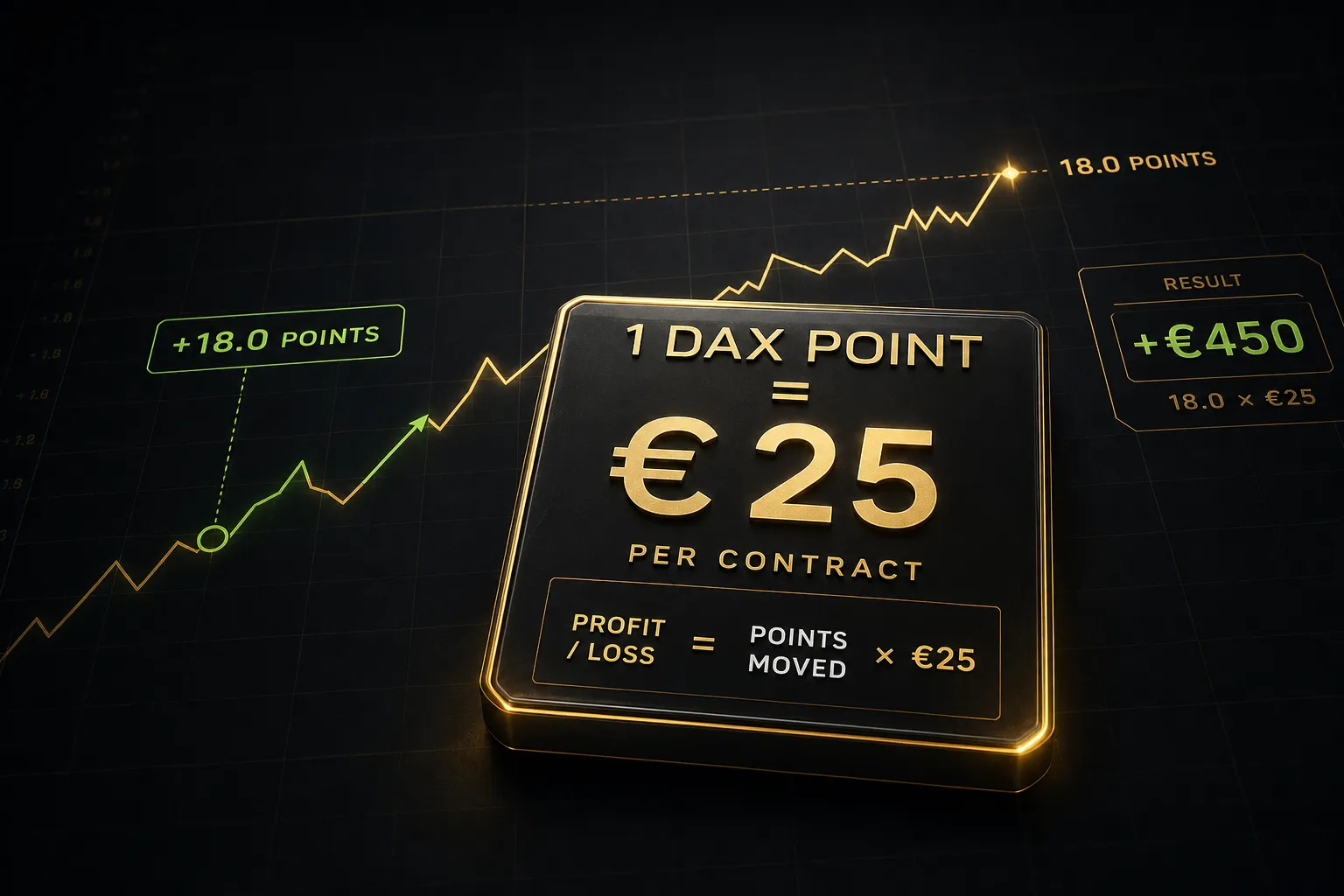
Everything reduces to one formula: points moved × point value × number of contracts = profit or loss in euros. Work through it deliberately before you place a single order.
- Identify your point value. FDAX pays €25 per index point, Mini-DAX FDXM pays €5, and Micro-DAX FDXS pays €1. This number is fixed by the exchange and never changes with market level.
- Measure the move in index points. If you buy at 24,150 and sell at 24,190, that’s 40 points. The DAX routinely moves 200 to 400 points in a single session, so 40 points is an ordinary intraday swing, not a big win.
- Multiply through for each contract type. That same 40-point move produces €1,000 on one FDAX, €200 on one FDXM, and €40 on one FDXS. Same market, same trade, three completely different account outcomes.
- Read the ladder in ticks, not points. All three contracts move in 0.5-point increments. One tick equals €12.50 on FDAX, €2.50 on FDXM, and €0.50 on FDXS. When you see the DOM flicker one level, that’s the money changing hands.
- Convert your stop-loss into euros before entering. A 30-point stop on FDAX is €750 at risk per contract. On the micro it’s €30. If you cannot say your euro risk out loud before clicking buy, you are not ready to click buy.
- Separate margin from exposure. Initial margin is the good-faith deposit Eurex and your clearing broker require to hold the position, often somewhere in the low thousands of euros for FDAX depending on volatility. It is not the size of your position.
- Understand what leverage actually means here. With the DAX near 24,000, one FDAX contract controls roughly €600,000 of notional exposure on a few thousand euros of margin. Gaps and fast markets mean losses can exceed the margin you posted, and you remain liable for the difference.
- Watch the daily settlement. Futures are marked to market every session. Profits and losses move in and out of your account daily, and if equity drops below maintenance margin, the broker issues a call or liquidates the position without asking.
One habit separates traders who survive from those who don’t: sizing by euro risk, never by contract count.
“I’ll trade one contract” is not a risk decision. “I’ll risk €200 on this idea” is.
A Repeatable Process for Trading DAX Futures
Most losing DAX traders don’t lack an indicator. They lack a sequence they run every morning without negotiating with themselves.
What follows is that sequence, broken into three parts: managing the contract itself, preparing before the open, and validating a signal before committing capital.
Rollover and Contract Expiry
DAX futures expire quarterly, on the third Friday of March, June, September, and December. Final settlement is based on the intraday auction price of the DAX 40 on that morning.
After expiry, the contract ceases to exist.
Handling that transition properly matters more than most retail traders realise.
- Know your front-month contract. The front-month contract is the nearest expiry and carries the overwhelming majority of volume and open interest. Trading a back month means wider spreads and thinner books for no benefit.
- Roll early, not on expiry day. Liquidity migrates to the next quarter roughly one week to a few days before expiry. Most active traders roll when the next contract’s volume exceeds the current one, typically the Monday or Tuesday of expiry week.
- Roll as a spread, not two separate trades. Close the expiring position and open the new one simultaneously where your platform supports calendar spreads, which reduces the risk of being flat or double-exposed during a fast market.
- Expect a price jump at rollover. The new front month usually trades at a different price than the expiring one because of the basis. Your chart will show a gap that has nothing to do with market direction.
- Understand back-adjusted charts. A continuous futures contract chart stitches expiries together, and back-adjustment shifts all historical prices to remove roll gaps. That means a support level you drew six months ago no longer sits at the price it actually traded at.
- Keep a rollover note in your journal. Record which contract you were in for every trade. Backtesting against the wrong series produces results that look great and mean nothing.
Premarket Checklist
The 20 minutes before the Xetra open decide the quality of your day.
Run the same list every session, in the same order, so nothing gets skipped when things feel urgent.
- Overnight range. Mark the high and low from the Eurex session since the previous close. These often become the day’s first tested levels.
- Prior day high, low, and close. The most-watched reference points on any DAX chart. Note where the current price sits relative to all three.
- German data calendar. ZEW sentiment (mid-month, 11:00 CET), Ifo Business Climate (late month, 10:00 CET), and flash PMIs (09:30 CET) all move the index within seconds of release.
- ECB decisions and speeches. Rate announcements land at 14:15 CET with the press conference at 14:45. Expect wide spreads and erratic fills through that window.
- US index futures direction. The DAX correlates strongly with S&P 500 and Nasdaq futures, particularly after 15:30 CET. Fighting that correlation is expensive.
- Bund yields. Sharp moves in German 10-year yields shift equity valuations and often lead the DAX by a few minutes.
- EUR/USD. A large share of DAX constituent revenue comes from exports, so a strengthening euro is a headwind for the index and a weakening euro a tailwind.
- Volatility regime. Check the VDAX or simply the last five sessions’ average range. A 400-point-range environment demands different stops than a 150-point one.
Confirming Signals Before Entry
An indicator crossing is not a trade.
It’s a suggestion that has to survive four filters before it earns your money.
- Trend direction across timeframes. If the daily and 4-hour structure is up and your 5-minute chart flashes a short, you’re trading against the dominant flow. That trade needs a much better reason to exist.
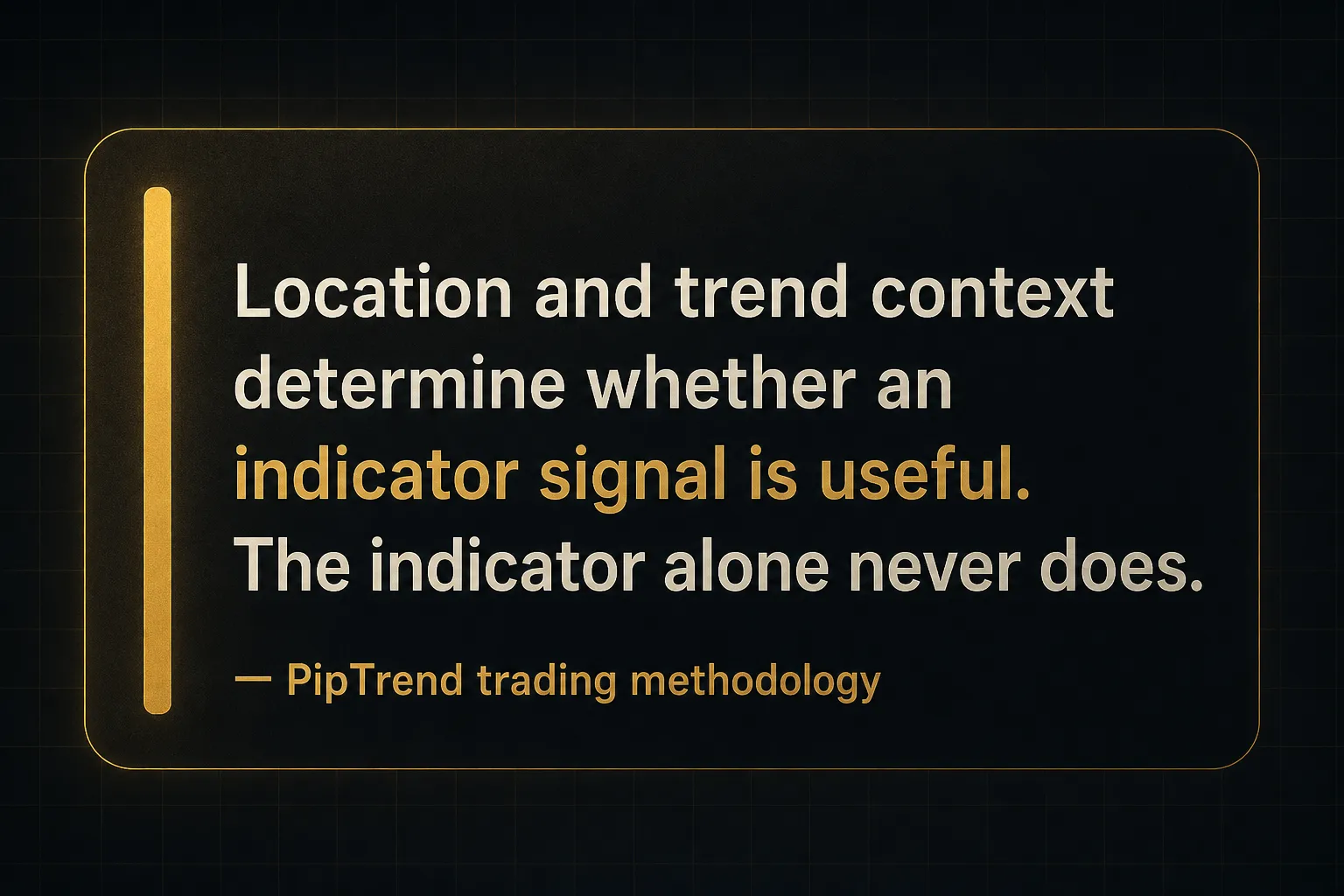
- Location. A buy signal in the middle of a range is noise. The same signal at a tested support level, a prior day low, or a defined demand zone is information. Location does more work than any oscillator.
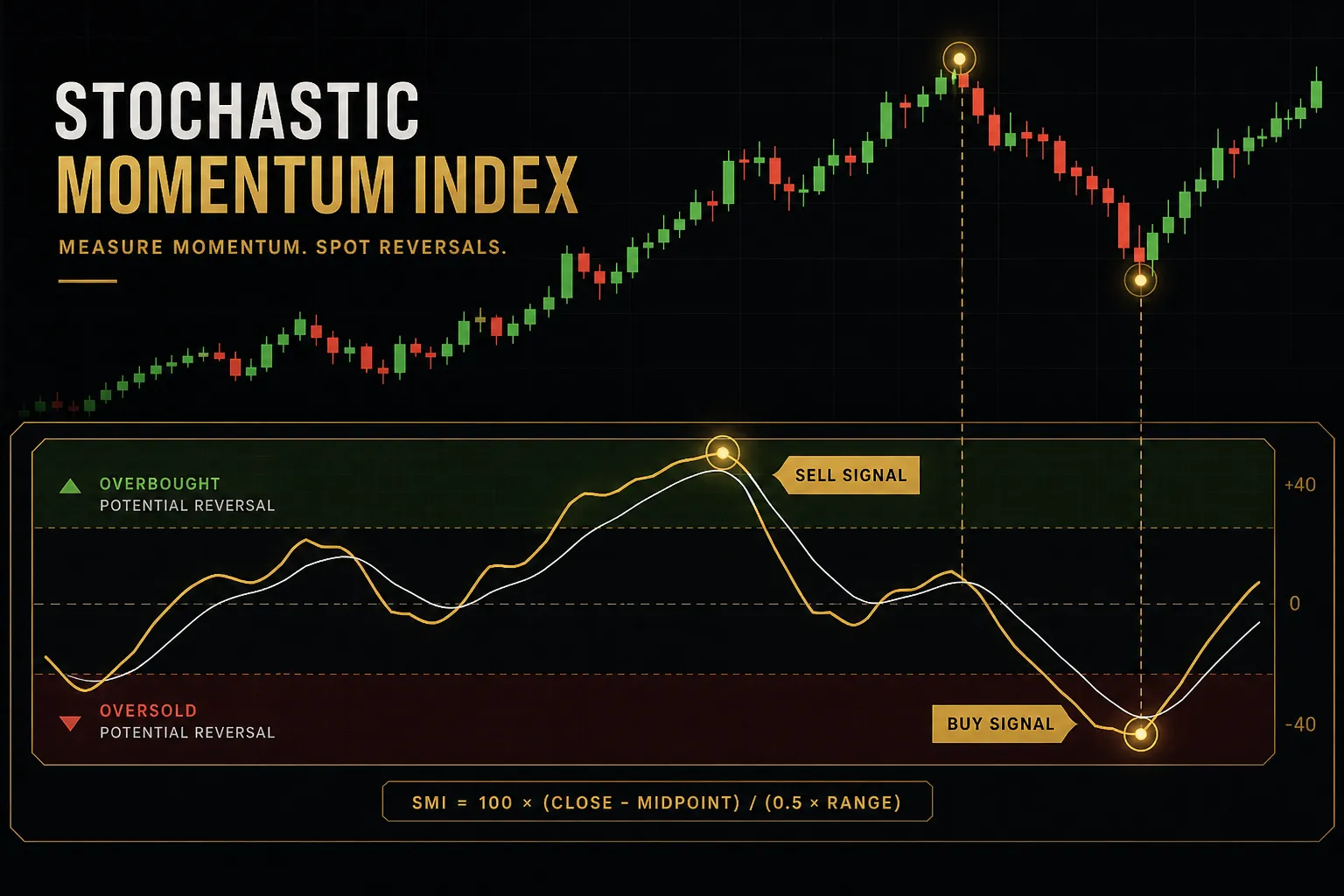
- Volatility context. RSI, MACD, and moving averages behave completely differently in trending versus ranging markets. RSI overbought readings are exit signals in a range and continuation signals in a strong trend. The indicator isn’t right or wrong, the context is.
- Risk-to-reward before entry. Measure the distance to your invalidation level and to your first realistic target. If the ratio is below roughly 1.5 to 1, skip it. There’s another setup coming.
- Multi-timeframe confirmation. Tools like PipTrend’s multi-timeframe table exist to solve exactly this problem, showing directional bias across several timeframes at once so you’re not extrapolating a 5-minute wiggle into a market view.
- Separate the signal from the entry. A signal tells you direction and bias. The entry is a specific price, with a specific stop, at a specific level. Keeping those two decisions separate stops you from chasing.
- Fixed stop and position size, always. Decide the stop level and the euro risk before the order goes in, and let the contract count fall out of that math. On FDAX a 30-point stop is €750; if that exceeds your per-trade risk budget, trade the mini or the micro instead.
Common Questions About DAX Futures
What is the current DAX futures price?
No article can tell you that, and any page claiming to should state its data source and delay. You need a live FDAX front-month quote from a Eurex-licensed feed, usually through a futures broker platform or a paid data subscription.
Free charts are typically delayed 15 minutes, and “Germany 40” widgets often show a broker CFD price rather than the exchange contract. Check the timestamp and the contract month before acting on any number.
What time do DAX futures open and close?
Eurex trades FDAX from roughly 01:10 CET to 22:00 CET, Monday through Friday, with the liquid core session running 08:00 to 22:00 CET. The Xetra cash market underlying the DAX 40 index trades only 09:00 to 17:30 CET.
For US traders on standard time, the Xetra open is 3:00 AM Eastern. Remember that European and US daylight-saving changes fall on different weekends, so the offset shifts by an hour for a few weeks each spring and autumn.
Is DAX futures the same as Germany 40?
No.
“Germany 40” is a broker-branded CFD priced off the DAX 40 index or its futures, traded over the counter with the broker as counterparty, not on Eurex.
FDAX, FDXM, and FDXS are exchange-listed, centrally cleared contracts with standardised specifications and a visible order book. The instrument comparison earlier in this guide breaks down why that difference affects spreads, execution, and counterparty risk.
How much money do I need to trade DAX futures?
Initial margin on FDAX typically runs in the low thousands of euros per contract, but the figure is set by Eurex and adjusted upward by individual clearing brokers, and it rises during volatile periods. Treat any published number as a ballpark that changes.
Margin is not the same as adequate capital.
A realistic FDAX account needs enough equity to absorb multiple losing days without breaching maintenance margin, which usually means well beyond the minimum deposit. Micro-DAX futures at €1 per point are the sensible starting point for smaller accounts.
What is the difference between DAX futures and DAX CFDs?
Futures are exchange-traded and centrally cleared; CFDs are over-the-counter contracts with your broker.
That single structural difference drives everything else.
Futures give you transparent pricing, standardised tick sizes, order book depth, and quarterly expiries requiring rollover. CFDs offer flexible position sizing, lower entry capital, and no manual rollover, but with broker-set spreads, potential financing charges on held positions, and counterparty exposure.
Is DAX futures good for day trading?
Yes, for adequately capitalised and disciplined traders. The DAX offers strong intraday volatility, deep liquidity in the front-month contract during European hours, and clean reactions to scheduled news.
That same volatility is the risk.
A 200-point adverse move is a routine session and costs €5,000 on a single FDAX contract. Day trading the DAX works when position size matches the instrument’s range, which for most retail accounts means FDXM or FDXS rather than the full-size contract.
Trading the DAX With Discipline
If you take one habit from this guide, make it the boring one: before reacting to any DAX quote, confirm the data source and the contract month.
Delayed feed or live? Front month or back? Futures or CFD?
Ten seconds of checking prevents the expensive kind of surprise.
The next step is practical.
Build your own premarket checklist from the items above, keep it to one page, and run it every session for a month on a demo account or the smallest position size available.
Track what the checklist caught and what it missed.
Refine it.
Only then scale up.
Consistency in DAX futures doesn’t come from finding the indicator that finally works. It comes from having a process you execute the same way on your best day and your worst one… which is far less exciting than the search for a perfect signal, and far more profitable.
Sources
Risk Disclaimer: Trading involves risk. Past performance doesn't guarantee future results. Only trade with money you can afford to lose. PipTrend is a tool to assist your trading decisions, not financial advice.