How Much Money You Actually Need to Start Forex

On this page
The Deposit Isn’t the Real Question
Brokers will happily open your account for $0. Some advertise $5.
Others say $100 and call it “beginner friendly.”
None of those numbers answer the question you’re actually asking.
A forex minimum deposit is a marketing threshold, not a trading budget. It tells you what the broker needs to open a ledger entry, not what you need to survive a normal losing streak.
Here’s the gap nobody explains at signup: a $100 account, sized correctly under standard risk rules, often can’t place a single trade.
The math produces a position smaller than the smallest lot the broker will accept.
So the trader does the only thing available and sizes up, which means risking three, four, sometimes eight times what the rulebook allows.
That’s not trading.
That’s a countdown.
This guide breaks the question into three separate numbers, because they genuinely are three different numbers:
- Access capital: what the broker requires to let you in.
- Survivability capital: what you need to apply real position sizing and absorb a drawdown without wiping out.
- Income capital: what you need before trading profits become meaningful money.
And there is no single universal figure, because the honest answer depends on three variables: how far away your stop-loss sits, how volatile your chosen pair is, and how much of your account you’re willing to lose per trade.
A scalper on EUR/USD with a 10-pip stop and a swing trader on GBP/JPY with a 120-pip stop need very different forex account balance figures to execute the same 1% risk rule.
Let’s build the numbers from the ground up.
Deposit vs Real Trading Capital
Why the Minimum Deposit Misleads Beginners
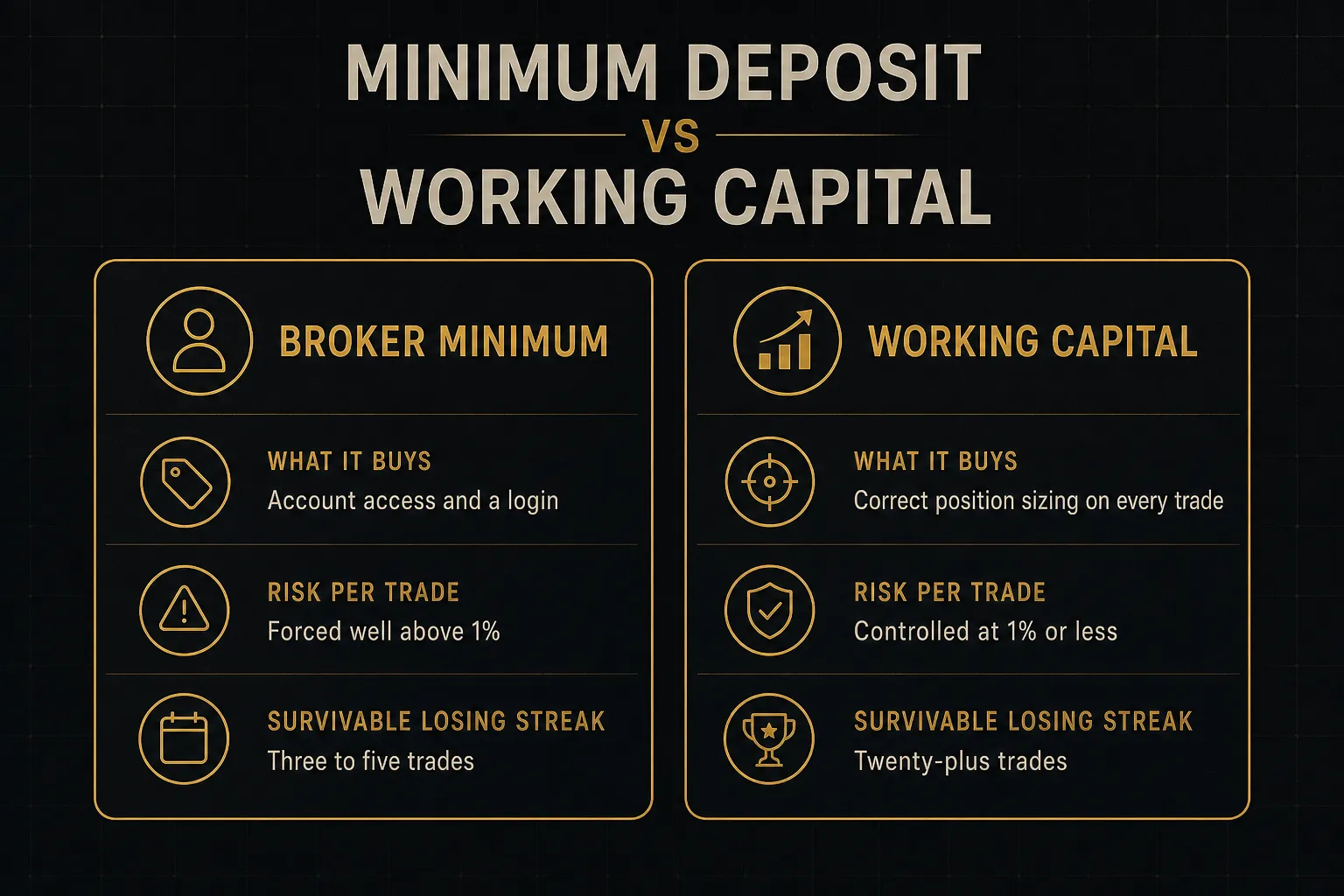
A $50 or $100 minimum buys you one thing: access. It does not buy you a functioning risk management setup, and those are not the same purchase.
Think of it like buying a car with $500. Technically, a car exists at that price.
Whether it survives the drive home is a separate conversation.
The 1% risk rule says no single trade should cost you more than 1% of your account balance if the stop-loss is hit. It’s the most widely taught guideline in retail trading, and for good reason: it keeps any one bad idea from becoming a catastrophe.
Now apply it to $100.
One percent is one dollar.
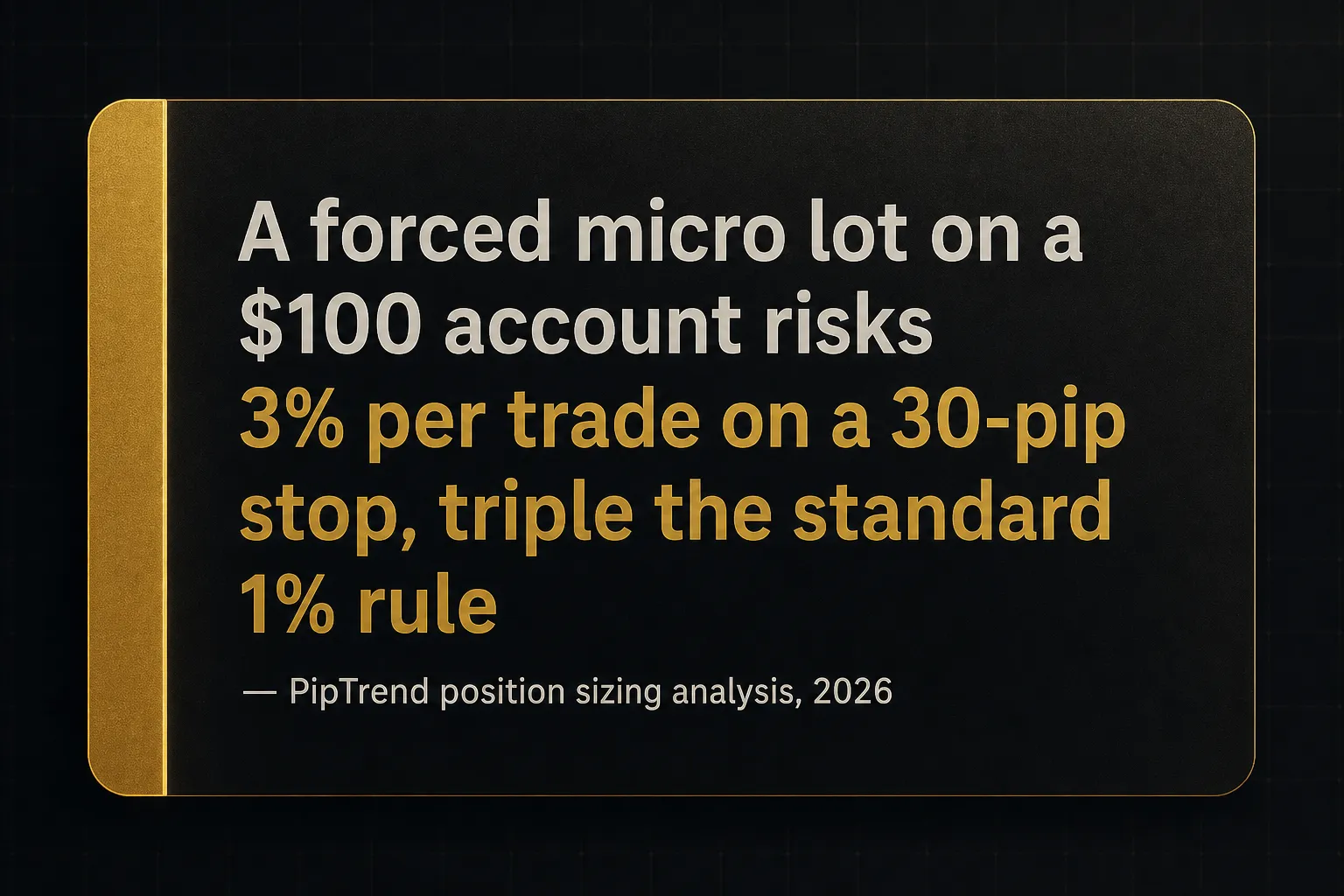
If your stop-loss sits 30 pips from entry, you need a position where each pip is worth about 3.3 cents. On EUR/USD, one micro lot (1,000 units) is worth roughly $0.10 per pip.
You’d need a third of a micro lot.
Most brokers won’t fill that.
The micro lot is the floor.
A handful offer nano lots (100 units, about $0.01 per pip), which solves the arithmetic but introduces a different problem: your profits become rounding errors.
So the $100 trader faces a fork.
Take the smallest available micro lot and risk $3, which is 3% of the account, or don’t trade at all.
Most people choose the first option and tell themselves it’s fine.
Three Goals: Learn, Grow, or Live
Before you name a number, name the job. Capital requirements change completely depending on what you want the account to do.
Capital to learn. You’re testing whether you can follow a plan, keep a forex trading journal, and read a chart without guessing.
A demo account does this for free.
If you want the psychological weight of real money, $100 to $300 in a micro or nano account is enough, provided you accept that the goal is process, not profit.
Capital to grow. You have a strategy with a measurable edge and you want compounding returns to do their work.
This is where $1,000 to $5,000 starts making sense.
At $2,000, a 1% risk equals $20, which gives you room to size properly on stops between 20 and 100 pips.
Capital to live on. Here the math flips.
You’re no longer asking what percentage you can make, you’re asking what dollar figure you need monthly and working backwards.
That number is almost always six figures, and we’ll get to why.
The most expensive mistake in retail forex isn’t a bad trade. It’s funding a “grow” strategy with “learn” money and expecting it to hold together.
One Trade Across Four Account Sizes
Abstract rules get slippery.
So let’s run the exact same trade through four different account balances and watch what happens.
The setup: long EUR/USD, 30-pip stop-loss, 1% risk per trade. The pair is chosen deliberately, since EUR/USD has the tightest spreads and the most predictable pip value of any major.
If a small account struggles here, it will struggle everywhere.
Pip values used: standard lot (100,000 units) = $10 per pip, mini lot (10,000) = $1, micro lot (1,000) = $0.10, nano lot (100) = $0.01.
| Account Balance | 1% Risk ($) | Required Pip Value | Ideal Position Size | Smallest Tradable Size (Micro) | Actual Risk If Forced |
|---|---|---|---|---|---|
| $100 | $1.00 | $0.033 / pip | 333 units (0.0033 lots) | 1,000 units (0.01 lots) | $3.00 = 3.0% |
| $500 | $5.00 | $0.167 / pip | 1,667 units (0.017 lots) | 1,000 units (0.01 lots) | $3.00 = 0.6% (undersized) |
| $1,000 | $10.00 | $0.333 / pip | 3,333 units (0.033 lots) | 3,000 units (0.03 lots) | $9.00 = 0.9% |
| $5,000 | $50.00 | $1.667 / pip | 16,667 units (0.167 lots) | 16,000 units (0.16 lots) | $48.00 = 0.96% |
Read the last column twice.
The $100 account cannot express a 1% risk on a 30-pip stop.
Its minimum trade is triple the intended risk, which means seven consecutive losses cost it roughly 19% of equity instead of 7%.
The $500 account has the opposite problem, which sounds nicer but isn’t.
Rounding down to 0.01 lots means it risks 0.6% instead of 1%, so it’s structurally under-deployed.
Every winning trade returns less than the strategy is designed to produce, and compounding returns slow to a crawl.
At $1,000 the rounding error drops to a tenth of a percent.
At $5,000 it becomes irrelevant.
That’s the threshold where position sizing stops being a compromise and starts being a decision.
Now change one variable.
Swap EUR/USD for GBP/JPY, where a reasonable swing stop might be 90 pips instead of 30.
The required pip value drops to a third, which means the $1,000 account now needs 1,111 units and is back to rounding problems.
The $5,000 account handles it comfortably at 0.05 lots.
Stop-loss distance is the hidden input in every capital question.
Wider stops demand either smaller positions or bigger accounts.
There is no third option, and traders who refuse to accept that end up manufacturing one by over-risking.
Margin, incidentally, is rarely the binding constraint.
At the U.S. retail cap of 50:1 for majors, a 0.03 lot EUR/USD position ties up roughly $65 of margin requirement.
Your $1,000 account has plenty.
The limit isn’t margin.
It’s risk.
Hidden Costs That Drain Small Accounts
Spreads, Commissions, and Swaps
Transaction costs scale with position size, which sounds fair until you remember that small accounts are forced into disproportionately large positions.
Then the costs stop scaling and start compounding against you.
Here’s what actually comes out of the account on every trade:
- Spread. The gap between bid and ask, paid the instant you enter. A 1.5-pip EUR/USD spread on 0.01 lots costs $0.15. On the $100 account from our table, that’s 0.15% of equity gone before price moves. The $5,000 account trading 0.16 lots pays $2.40, which is 0.048% of equity. Same trade, roughly three times the relative cost.
- Commission. Raw-spread accounts charge separately, commonly $3.50 per standard lot per side, so $7 round turn. On a micro lot that’s $0.07. Sounds trivial until you see brokers who apply minimum ticket charges, which quietly make small trades the worst value on the menu.
- Swap or overnight financing. Positions held past the daily rollover accrue or pay interest based on the rate differential between the two currencies. With rate spreads still wide across major pairs in 2026, a single micro lot on the wrong side can bleed $0.10 to $0.40 per night. Hold it for a week and you’ve paid a meaningful fraction of a $100 account.
- Triple swap Wednesdays. Most brokers book three days of financing on Wednesday to cover the weekend. Swing traders on small accounts routinely miss this and wonder where the equity went.
- Slippage. Your stop-loss is a request, not a guarantee. Around scheduled news, a 30-pip stop can fill at 38. On the $100 account risking 3% by force, that 8-pip overshoot turns a planned $3 loss into $3.80, roughly 3.8% of the account.
Stack them.
A round-trip micro lot trade held two nights might cost $0.15 spread, $0.07 commission, and $0.40 swap.
That’s $0.62, or 0.62% of a $100 account, on a trade designed to risk 1%.
When Your Lot Size Doesn’t Fit
Volatility doesn’t negotiate.
If a pair’s average true range demands an 80-pip stop, tightening to 25 pips because your account is small doesn’t reduce your risk.
It just guarantees you get stopped out by noise.
Undercapitalized traders typically respond one of three ways, and all three are bad:
- Over-risk. Take the minimum lot anyway and accept 3% to 8% risk per trade. Five losses in a row, which is entirely normal, costs 15% to 35% of the account.
- Under-stop. Place a stop tight enough to fit the math. Win rate collapses, because the stop now sits inside the pair’s normal intraday range.
- No stop. The worst and most common. Trade without protection, ride a loser, and eventually meet a margin call.
The clean solution is boring: trade pairs whose volatility matches your capital, or add capital.
Nano-lot brokers genuinely help small accounts here, letting a $200 balance size correctly on a 60-pip stop.
Just verify the broker offering them is a regulated forex dealer, because nano lots are disproportionately common at offshore shops.
Leverage, Drawdown, and Real Income
What Leverage Actually Changes
Leverage is the most misunderstood number in retail forex, and the confusion is expensive.
A leverage ratio of 50:1 or 500:1 changes exactly one thing: how much margin the broker sets aside to hold your position.
It does not change your risk.
It does not change your expected return.
It does not make a mediocre strategy profitable.
Your actual risk on any trade is determined by two things only: position size and stop-loss distance.
Multiply them and you get your dollar exposure.
Leverage never enters that equation.
Consider it concretely.
A $1,000 account trading 0.03 lots with a 30-pip stop risks $9, whether the broker offers 30:1 or 1000:1.
The high-leverage account simply has more unused margin sitting idle.
What high leverage genuinely does is remove a guardrail.
At 50:1, the U.S. cap enforced for CFTC-registered dealers, a $1,000 account physically cannot hold more than 0.5 standard lots.
At 500:1, it can hold five.
The regulation isn’t protecting you from leverage.
It’s protecting you from yourself.
Leverage expands what you’re allowed to do. It never improves what you should do.
Drawdown Math and Losing Streaks
Losing streaks are not a sign that something broke.
They’re arithmetic.
At a 45% win rate, the probability of any given seven-trade sequence being all losses is about 1.5%.
Trade 200 times a year and streaks of seven will appear, probably more than once.
Plan for them or they’ll plan for you.
Now the recovery math, which is where undercapitalized accounts die. Losses compound downward, so the gain needed to get back to breakeven is always larger than the loss itself.
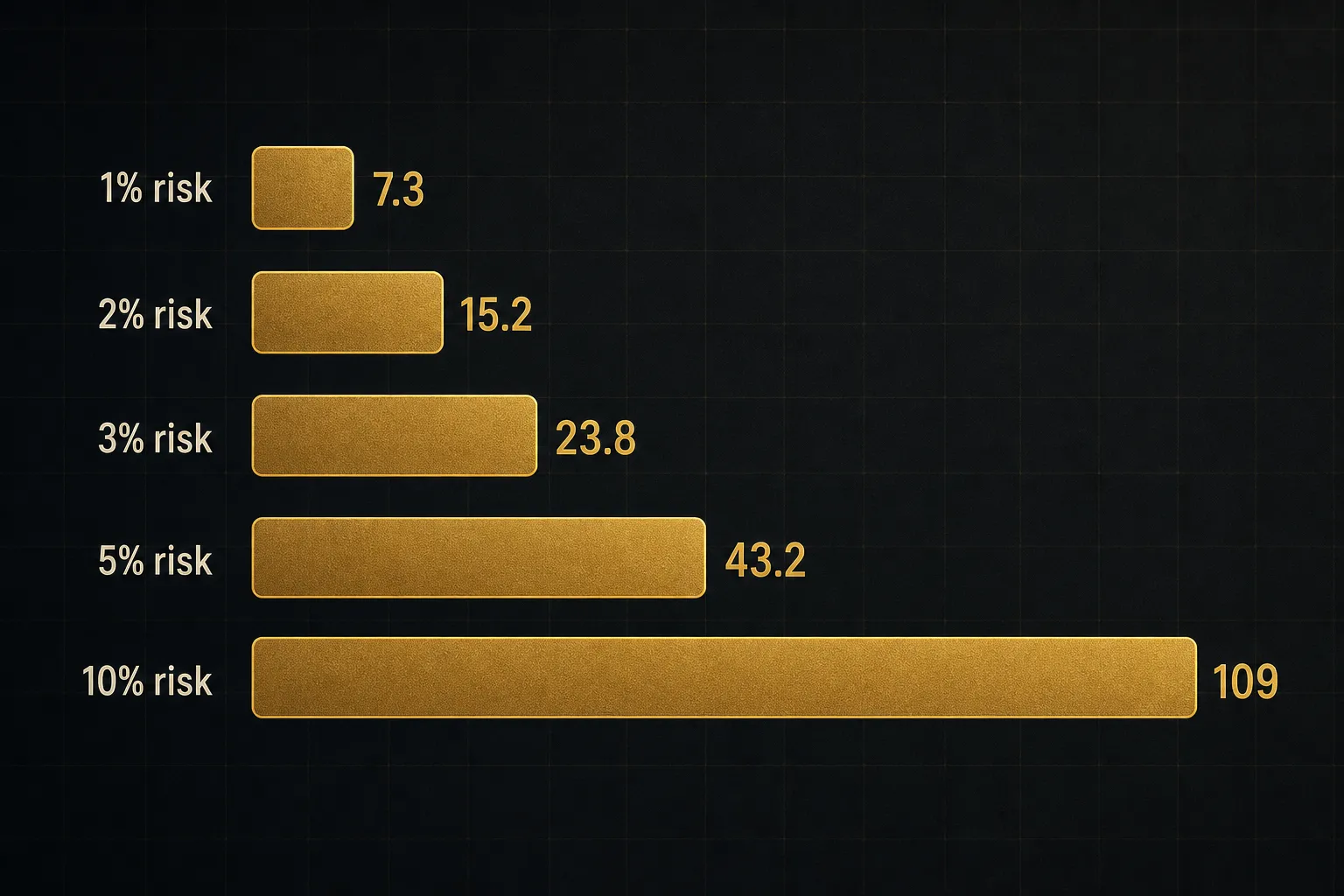
Those figures are the percentage gain required to recover from seven consecutive losses at each risk level.
At 1% risk, you’re down 6.8% and need 7.3% back.
Annoying, not fatal.
At 3% risk, the level our $100 account is forced into, you’re down 19.2% and need 23.8%. At 10%, a level plenty of small accounts reach after a few frustrated revenge trades, you’re down 52% and need to double the account.
This is risk of ruin in plain numbers.
It isn’t about being wrong.
It’s about how much each wrong answer costs.
And it explains why the same strategy can be profitable at $5,000 and lethal at $150.
For income planning, the realistic math looks like this.
A disciplined retail trader with a validated edge might target 2% to 4% monthly, net, averaged across good months and bad.
Not daily.
Monthly, with drawdowns included.
At 3% monthly, a $10,000 account produces roughly $300 a month.
That supplements a phone bill, not a mortgage.
Replacing a $4,500 monthly salary at that same rate requires around $150,000 in trading capital, and that’s before you account for the fact that withdrawing profits eliminates compounding entirely.
Anyone promising a full-time income from $2,000 is describing a lottery ticket, not a business.
Why Signals Can’t Replace Capital
Better entries help.
They genuinely do.
A tool that applies multi-timeframe confirmation and filters setups against the higher-timeframe trend will improve your win rate and risk-reward ratio compared to trading off a single 5-minute chart and a hunch.
Services like PipTrend build around exactly that logic: precision entry levels, defined stops, and signal confirmation across timeframes so you’re not acting on a lone indicator twitch.
PipTrend also publishes verified performance results, which is the standard any signal provider should be held to.
If a service won’t show audited numbers, that silence is the answer.
But here’s the limit.
A better entry improves your expected value per trade.
It doesn’t change the fact that a $100 account risking 3% per trade needs only a handful of losses to become untradeable.
Edge and capital are separate inputs, and no amount of the first fully compensates for absence of the second.
Signals tell you where.
Capital determines how long you get to keep showing up.
Skill without staying power is just a well-argued way to lose.
Forex Capital: Common Questions
Can I Start Forex With $100?
Yes, but only as a learning exercise, not as a risk-managed trading account. A $100 balance can open a live micro account at most brokers and will teach you how order execution, slippage, and the emotional weight of real money actually feel.
What it cannot do is support proper position sizing.
As the table showed, the smallest micro lot on a 30-pip EUR/USD stop risks $3, or 3% of the account.
Seven losses, a completely routine sequence, wipes out nearly a fifth of your capital.
If you start here, treat it as tuition.
Keep a trading journal, log every setup, and measure whether you follow your rules.
Judge yourself on process adherence, not profit.
Is $500 Enough to Trade Forex?
$500 is enough to trade with genuine discipline, but not enough to grow meaningfully. At 1% risk, you’re managing $5 per trade, which supports a 0.01 lot micro position on stops up to roughly 50 pips.
The constraint is granularity.
Between $3 and $10 of risk, micro lots move in chunky increments, so you’ll frequently be under-risked or slightly over-risked rather than precise.
Nano-lot brokers solve this if you can find a regulated one.
The bigger issue is compounding speed.
A strong 4% month on $500 is $20.
Real, but not life-changing, and the temptation to over-risk to “make it worthwhile” is where most $500 accounts end.
How Much Should a Beginner Deposit?
Deposit an amount where your typical stop-loss distance produces a position size at least three times your broker’s minimum lot. That rule, not a fixed dollar figure, is the correct answer.
In practice, for a trader using 30 to 50 pip stops on major pairs with micro lots available, that lands between $1,000 and $3,000. For wider swing stops of 80 to 150 pips, it pushes toward $3,000 to $5,000.
And one non-negotiable: deposit only money you can lose entirely without affecting rent, debt payments, or emergency savings.
Capital you need back on a deadline is the single strongest predictor of undisciplined trading.
Can I Trade Forex With $10?
No, not in any sustainable sense.
Ten dollars is demo territory or extreme-leverage territory, and the second one is not trading.
A few offshore brokers accept $10 deposits and offer 1000:1 leverage, which lets you open positions where a 5-pip move wipes the account. The margin call arrives before you’ve finished reading the chart.
If $10 is what you have available, use a demo account. It costs nothing, executes on the same price feed, and lets you build a 100-trade sample of your strategy while you accumulate real capital.
What Does It Take to Make $100 a Day?
Making $100 a day consistently requires roughly $50,000 to $70,000 in trading capital at realistic return expectations. That figure surprises people, so here’s the arithmetic.
$100 per day across about 21 trading days is $2,100 monthly.
At a sustainable 3% monthly net return, you need $70,000.
At an aggressive but defensible 4%, you need $52,500.
The danger of daily targets is structural.
Markets don’t distribute opportunity evenly, so a fixed daily number forces you to trade on days with no valid setups.
That pressure produces oversized positions and forced entries, which is exactly how accounts die.
Target monthly averages instead, and accept that some weeks you do nothing.
How Much Capital Funds Full-Time Trading?
Full-time forex trading realistically requires $100,000 to $250,000, depending on your cost of living and return consistency.
Below that, you’re not trading for a living, you’re gambling with your rent.
Work it backwards.
Need $5,000 monthly after tax?
At 3% monthly net, that’s $167,000.
At a more conservative 2%, it’s $250,000.
And because you’re withdrawing profits to live on, the account never compounds, which means every month starts from the same base.
Most successful full-time traders also hold six to twelve months of living expenses outside the trading account.
A drawdown month is inevitable.
Having to withdraw during one is how a temporary setback becomes permanent.
Match Your Capital to Your Goal
The number you need depends entirely on what you’re asking the account to do. Three clean answers:
Learning. Demo, or under $200 in a micro or nano account.
Success is measured in journal entries and rule adherence, not dollars.
Spend at least 100 trades here.
Growing. $1,000 to $5,000 with strict 1% risk per trade.
This is the zone where position sizing becomes precise, transaction costs fade into the background, and compounding actually has something to work with.
Living. $100,000 or more, managed conservatively, with a separate cash buffer outside the account.
Anything less and you’re relying on returns that no consistent trader delivers reliably.
One last thing, and it matters more than any figure above.
Before you fund anything, verify the broker’s regulation.
In the United States, that means confirming CFTC and NFA registration through the NFA’s public BASIC database, which takes about ninety seconds.
Elsewhere, check the FCA, ASIC, or your local equivalent.
An unregulated broker can make your capital question academic.
It doesn’t matter how well you size positions if the firm holding your money disappears.
Start with the right number.
Then verify who’s holding it.
Sources
Risk Disclaimer: Trading involves risk. Past performance doesn't guarantee future results. Only trade with money you can afford to lose. PipTrend is a tool to assist your trading decisions, not financial advice.