Forex Trading for Beginners: A Risk-First Field Guide
On this page
Most people who open a forex account lose money.
That’s not pessimism, it’s the disclosure text regulated brokers are legally required to publish, and the numbers typically land somewhere between 65% and 80% of retail accounts.
The reason isn’t that currencies are unpredictable. It’s that beginners learn entries before they learn risk.
This guide flips that order.
Getting Your Bearings in the Forex Market
Forex trading is the act of buying one currency while simultaneously selling another, betting that the exchange rate between them will move in your favour. Every quote has two halves: the base currency (first) and the quote currency (second).
When you buy EUR/USD at 1.0850, you’re buying euros and paying for them with dollars. If the rate climbs to 1.0900, your euros are worth more dollars.
That’s the whole idea.
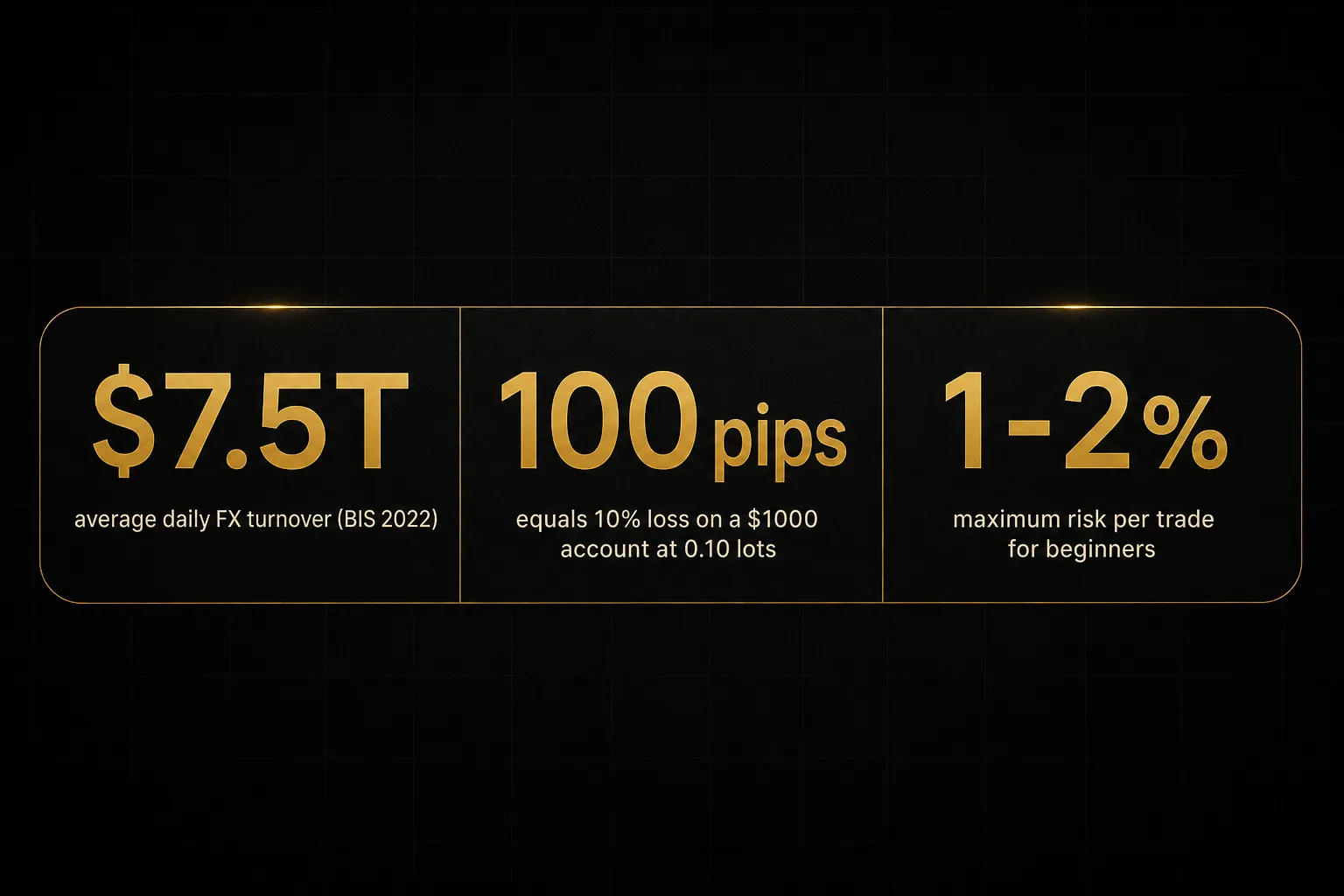
The foreign exchange market is the largest financial market on earth. The Bank for International Settlements triennial survey put average daily FX turnover at roughly $7.5 trillion in April 2022, a figure that dwarfs global equity volumes.
Retail traders account for a small sliver of that flow.
Institutional FX vs Retail CFDs vs Futures vs ETFs
Here’s what surprises newcomers: when you “trade forex” with a retail broker, you usually aren’t touching the interbank market at all. You’re entering an over-the-counter contract with your broker, priced off institutional feeds.
In most of the world that contract is a CFD (contract for difference). In the US, retail spot forex is offered by a small number of NFA-registered dealers under a different framework, and CFDs on currencies are prohibited.
The alternatives are worth knowing.
Currency futures trade on regulated exchanges like the CME, with standardized contract sizes and central clearing. Currency ETFs trade in a normal brokerage account, carry no margin and leverage by default, and suit longer holding periods.
Each vehicle has different costs, tax treatment, and counterparty exposure.
The 24-Hour Market Myth
Forex is often sold as a 24/7 market.
It isn’t.
Trading runs roughly 24 hours a day across five weekdays, opening Sunday evening ET and closing Friday evening ET.
Hold a position past 5pm ET and you pay or receive a rollover (swap) charge based on the interest rate differential between the two currencies. Hold over Wednesday night and you’re typically charged triple to account for weekend settlement.
Liquidity also swings dramatically.
The London-New York overlap (roughly 8am to noon ET) carries the tightest spreads and heaviest volume, while the late Asian session on a minor pair can be thin enough that a modest order moves price.
How Currency Pairs and Costs Work
Everything in forex is measured in pips.
Get comfortable with pip math and the rest of the mechanics fall into place quickly.
Pips, Lots, and Leverage With Real Numbers
A pip is the fourth decimal place on most currency pairs: 0.0001. On JPY pairs it’s the second decimal: 0.01.
If EUR/USD moves from 1.0850 to 1.0865, that’s 15 pips.
Pip value depends on your lot size.
A standard lot is 100,000 units of the base currency, a mini lot is 10,000, and a micro lot is 1,000.
- Standard lot (1.00): about $10 per pip on EUR/USD
- Mini lot (0.10): about $1 per pip
- Micro lot (0.01): about $0.10 per pip
Now the margin math.
You have a $1,000 account and open a 0.10 lot EUR/USD position at 1.0850. That’s 10,000 euros of notional exposure, roughly $10,850.
At 50:1 leverage, the required margin is about $217. Your broker shows plenty of “free margin” left, which is exactly where beginners get into trouble.
Price moves 100 pips against you.
At $1 per pip, that’s a $100 loss, 10% of your account, from a move EUR/USD can make in a single session on a CPI print.
Now imagine you’d opened 0.50 lots because the margin allowed it.
Same 100 pips.
$500 gone.
Half the account.
Leverage doesn’t increase your profits. It increases your position size, and position size is what determines both profit and how fast you go broke.
That’s the point people miss.
Higher leverage doesn’t just expand buying power, it shrinks the distance between your entry and a margin call. A 500:1 account with a full standard lot on $1,000 gets liquidated on a move most traders wouldn’t notice.
The Real Cost of a Trade
Your broker’s marketing shows the spread.
It rarely shows everything else.
Here’s what actually comes out of your return on every trade.
| Cost | Typical size (EUR/USD) | When it applies | How it erodes returns |
|---|---|---|---|
| Spread | 0.6-1.5 pips standard account; 0.0-0.3 pips raw account | Every trade, paid at entry | You start each trade at a loss. A 1-pip spread on 0.10 lots costs $1 before price moves. |
| Commission | $3.50 per side per standard lot on raw-spread accounts | Raw/ECN accounts only | $7 round turn per standard lot. Cheaper than wide spreads for high-frequency traders, worse for small size. |
| Slippage | 0-3 pips normally; 10-50+ pips on news | Market orders and stops in fast conditions | Slippage means your stop-loss fills worse than your planned level, so actual risk exceeds planned risk. |
| Swap / rollover | Roughly -$0.30 to +$0.70 per 0.10 lot per night | Any position held past 5pm ET | Negative carry quietly drains multi-day swing trades. Triple charged on Wednesdays. |
| Requotes | Rejection plus 1-5 pips of movement | Dealing-desk brokers in volatile markets | You’re denied your price and re-offered a worse one, usually when you most need the fill. |
Add it up.
A trader taking five round turns a day on 0.10 lots with a 1-pip spread pays roughly $5 daily, $100 a month, on a $1,000 account.
That’s 10% of capital per month in friction alone.
The bid and ask price gap is not a rounding error.
It’s the single most consistent drag on high-frequency retail accounts.
Risk Management Comes First
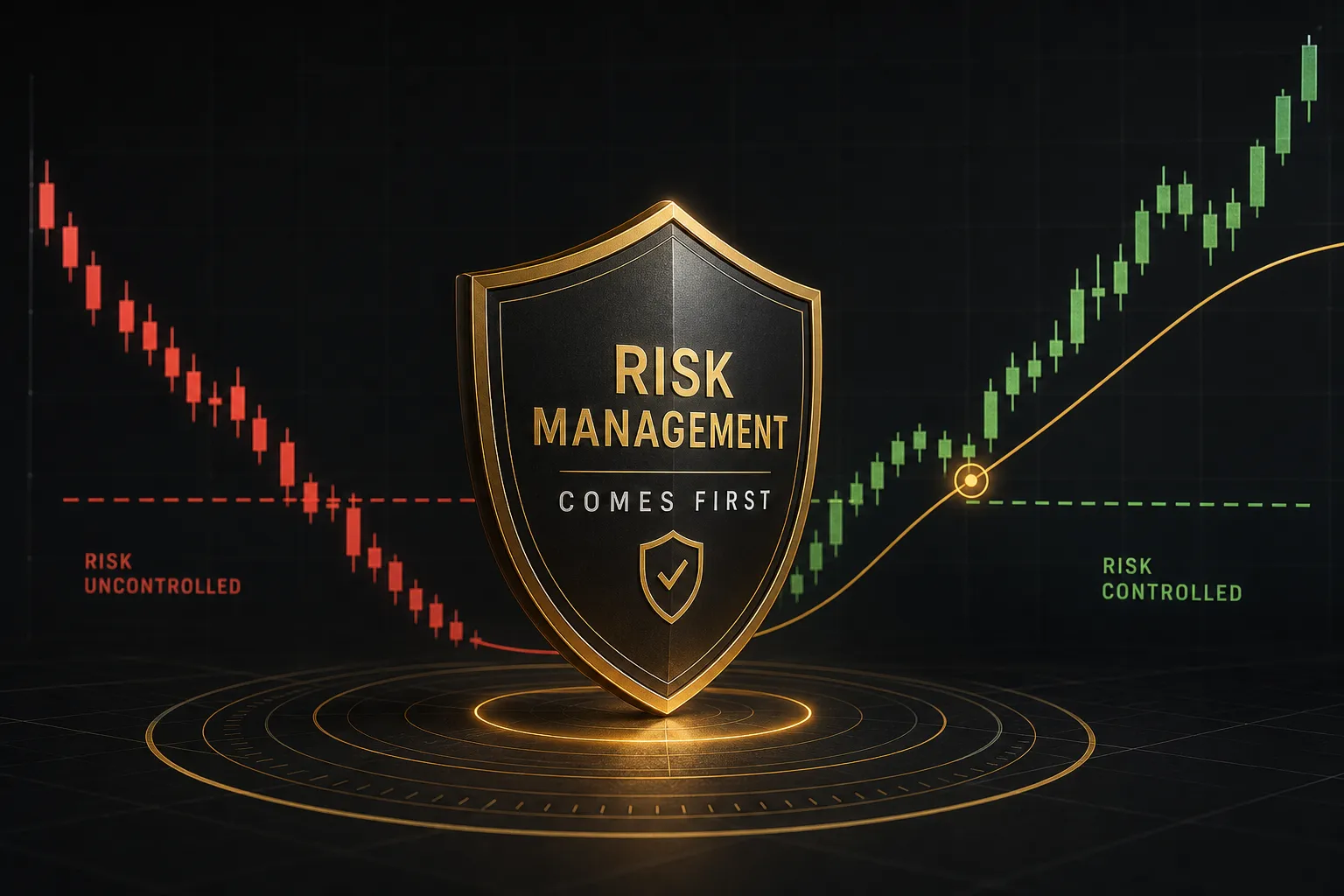
Ask a profitable trader what they focus on and they’ll talk about size, not setups. Position sizing is the one variable you fully control, and it determines whether a losing streak is an inconvenience or an extinction event.
Position Sizing Step by Step
Here’s the calculation, run on a realistic $2,000 beginner account.
Do this before every single trade, not after.
- Start with your account balance. Use the actual current equity, not what you deposited three months ago. In this example: $2,000.
- Choose your risk percentage. Pick 1% for a beginner, 2% as an absolute ceiling. At 1%, your maximum loss on this trade is $20.
- Measure your stop distance in pips. Find where the trade idea is wrong, not where you’d like the stop to be. Say your entry on GBP/USD is 1.2650 and structural invalidation sits at 1.2610. That’s a 40-pip stop.
- Divide risk by stop distance. $20 risk divided by 40 pips equals $0.50 per pip. That’s your maximum allowable pip value.
- Convert to lot size. Since 0.01 lots equals roughly $0.10 per pip, $0.50 per pip means 0.05 lots. Round down, never up.
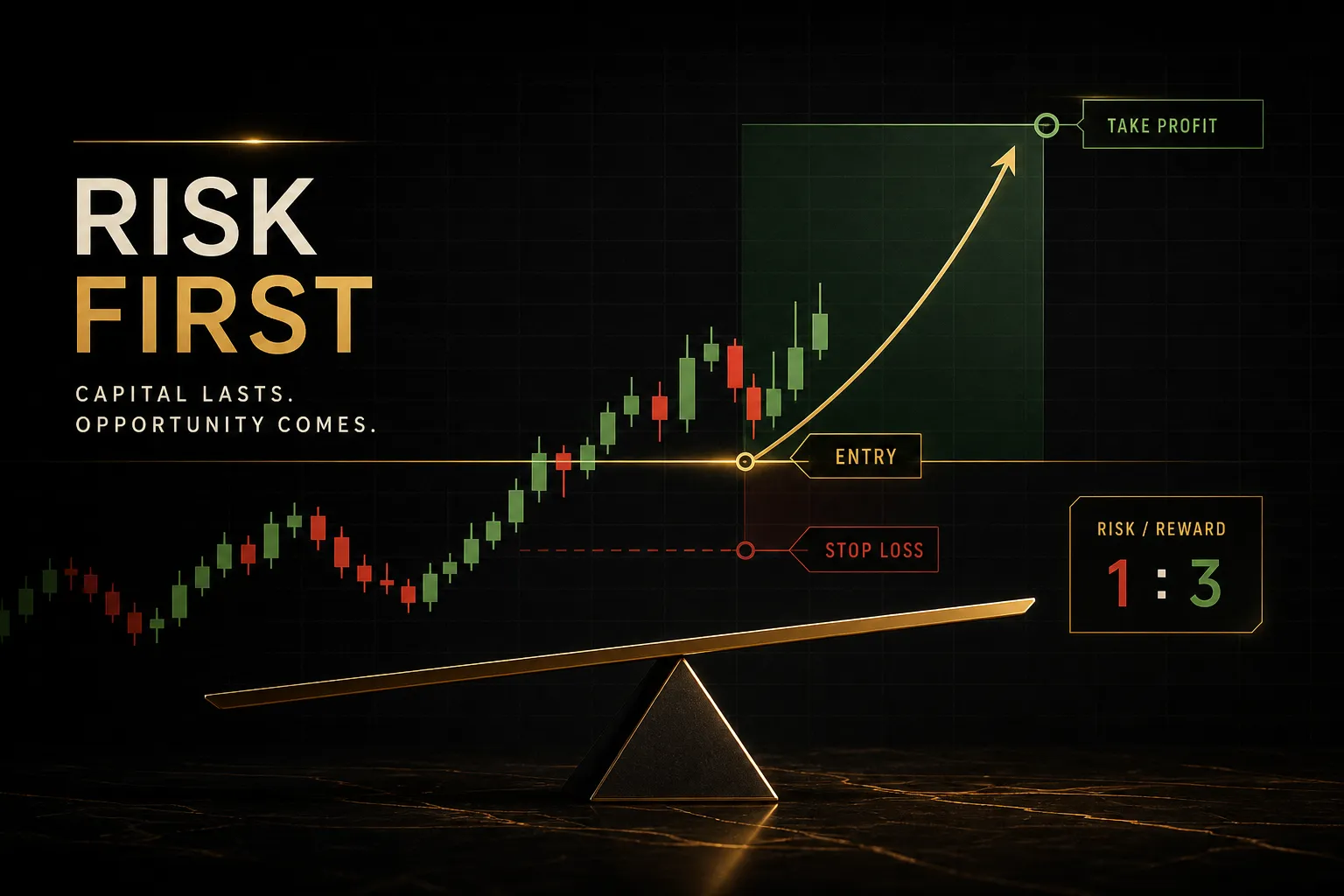
- Confirm the risk-to-reward ratio before entry. If your target is 1.2730, that’s 80 pips of reward against 40 of risk, a 2:1 risk-to-reward ratio. If the realistic target only gives 1:1, skip the trade.
- Place the stop-loss order with the entry, not after. A stop you intend to add later is not a stop. Set both the stop-loss order and the take-profit order at the moment of execution.
Why 1-2% and not 5%?
Run the math on a losing streak, which every strategy produces.
Ten consecutive losses at 1% leaves you down about 9.6%, recoverable.
Ten losses at 5% leaves you down 40%, requiring a 67% gain just to break even.
Losing streaks of six to eight trades happen routinely in a system winning 50% of the time.
Size for the streak, not the average.
Where a Stop-Loss Actually Belongs
Beginners place stops at round dollar amounts.
“I’ll risk $50, so 50 pips.”
That’s backwards, and the market has no idea what your account balance is.
A stop belongs where your trade thesis is proven wrong. Two defensible methods:
- Structure-based: beyond the swing low that defines your uptrend, or above the support and resistance level you expect to hold, with a small buffer for noise.
- Volatility-based: a multiple of Average True Range, commonly 1.5x to 2x the 14-period ATR. If EUR/USD’s daily ATR is 70 pips, a 15-pip stop on a daily setup is guaranteed to get hit by ordinary market volatility.
Set the stop first, then size the position around it.
The stop determines the lot size.
The lot size never determines the stop.
And then there’s news.
Central bank decisions, CPI releases, and US Non-Farm Payrolls can move a major pair 80 to 150 pips in seconds, gapping straight through your stop.
A perfectly constructed technical setup means nothing against an unexpected Fed dot plot.
Check the economic calendar every morning.
Flag high-impact releases for your pairs, then either flatten before them, reduce size, or accept explicitly that your stop may fill 20 pips worse than planned.
Those are the only three honest options.
Analysis, Signals, and a Real Trading Plan
Traders love arguing about whether charts or economics matter more. The useful answer: they operate on different clocks, and one regularly overrules the other.
Fundamental vs Technical Analysis
Fundamental analysis in forex is mostly about interest rates and the expectations around them. Currency values track relative monetary policy, inflation trajectories, employment data, growth differentials, and occasionally geopolitical shocks.
When the ECB signals cuts while the Fed holds, EUR/USD has a directional bias that persists for weeks.
No amount of chart drawing changes that current.
Technical analysis reads the footprint of that flow: price action, trend structure, moving averages, momentum oscillators, volume proxies.
It’s excellent for timing and location.
It’s useless as a defence against a surprise policy shift.
The practical hierarchy is simple.
Fundamentals set the bias, technicals set the entry, and when a major release contradicts your chart, the chart loses.
Why a Signal Isn’t a Trading Plan
Every indicator lies sometimes.
Moving averages lag by design, so they confirm trends late and whipsaw brutally in ranges.
Oscillators like RSI scream “overbought” throughout the strongest part of a move.
Worse, timeframes disagree constantly.
A 15-minute chart can be flashing a short signal while the daily is in a clean uptrend, and both readings are technically correct.
This is why signal confirmation across market regime beats any single indicator. Trending conditions reward trend following tools; ranging conditions punish them and reward mean reversion.
Identify the regime first.
A signal tells you what might happen. A plan tells you what you will do about it, including when you’re wrong.
A complete trading decision has six components: the directional source, a specific entry level, an invalidation point, a calculated position size, a management rule for what happens after entry, and a trading journal entry recorded the same day.
Miss any one and you’re gambling with extra steps.
A Structured Workflow With PipTrend
Here’s how that framework looks with an actual tool. PipTrend’s multi-timeframe table shows trend alignment across several horizons at once, which answers the first question: is this pair trending or chopping, and do the timeframes agree?
Colour-coded trend signals then give direction on the pair you’re watching.
That’s step one of six, and only step one.
For location, the platform marks reference levels: VWAP, session highs and lows, and supply and demand zones. Those become candidate entries and logical invalidation points, so a signal converts into an actual level with a measurable stop distance in pips.
PipTrend also publishes a public results page with verified statements, which matters for a different reason. Transparency lets you evaluate a signal source on real drawdowns and hit rates rather than screenshots.
No published track record guarantees future results, and any provider claiming otherwise is a red flag.
Use signals as an input to your process.
Never as a replacement for it.
Brokers, Learning Path, and Common Pitfalls

You can have a flawless strategy and still lose everything to a broker that won’t process withdrawals.
Counterparty risk comes before market risk.
Verifying a Broker Before You Fund an Account
Regulation is the first filter, and it takes ten minutes to check. In the US, retail forex dealers must be registered with the CFTC and be members of the NFA, verifiable free through NFA BASIC by firm name or ID.
Outside the US, look for the UK’s FCA, Australia’s ASIC, or a comparable tier-one regulator, and confirm the entity you’re actually signing with. Many brokers operate a well-regulated UK arm and an offshore arm with identical branding but very different protections.
Then run through four checks.
Search the regulator’s disciplinary history for the firm.
Read the withdrawal terms, specifically processing times, fees, and any bonus clauses that lock funds.
Confirm negative balance protection, which prevents you owing more than your deposit after a gap.
Verify that client funds are held in segregated accounts at a separate institution.
If any of those four answers is unclear on the website, that’s your answer.
A Staged Path From Demo to Live
The fastest route to live trading is the slowest one.
A realistic progression takes six to twelve months, and compressing it is the most common expensive mistake in this business.
- Education (4-6 weeks): mechanics, order types, pip and margin math until the calculations are automatic.
- Chart replay (4 weeks): bar-by-bar replay on historical data, making decisions without knowing what comes next.
- Backtesting (4-8 weeks): manual backtesting of one defined strategy across at least 100 trades, recording entry, stop, target, and outcome.
- Demo trading (8-12 weeks): a demo account at the exact size you’ll trade live, following the plan without deviation.
- Small live size (3+ months): micro lots, real money, real emotions. Consistency of process matters more than P&L here.
- Structured review (ongoing): monthly analysis of your journal for pattern-level errors, not individual trade regrets.
Psychology Traps and Tax Basics
Trading psychology isn’t a soft topic.
It’s the mechanism by which good plans get abandoned at the worst possible moment.
The recurring patterns are predictable.
Overtrading, taking marginal setups out of boredom.
Revenge trading, doubling size immediately after a loss to “get it back.”
Escalating size after a winning streak, right as mean reversion arrives.
Confirmation bias, hunting for the one timeframe that agrees with a position already open.
And the most expensive one: loss aversion, which makes traders cut winners early and hold losers indefinitely.
A journal is the only reliable detection tool, because none of these feel like errors while you’re committing them.
On taxes, US treatment depends on the instrument. Spot forex generally falls under Section 988 as ordinary income or loss, while regulated currency futures typically receive Section 1256 treatment with its 60/40 split.
Certain elections can change which applies.
That distinction can materially affect your after-tax return, and it varies with your account structure and filing situation. Confirm your specific treatment with a qualified tax professional rather than assuming one rule fits everyone.
Forex Trading Questions Answered
Is forex trading profitable?
Forex trading can be profitable, but it is not profitable for most retail traders. Broker disclosures required in regulated jurisdictions consistently show that roughly 65-80% of retail client accounts lose money.
The profitable minority share a pattern: strict risk per trade, a documented process, and enough sample size to let a positive expectancy play out. Consistency comes from risk management over hundreds of trades, not from any individual winning position.
How does forex trading work for beginners?
Beginners buy one currency against another through a regulated broker, using leverage and a stop-loss to define risk on each trade. The practical sequence is: learn the mechanics of pips, lots, and margin; build one repeatable strategy; test it on a demo account at realistic size; then trade live with micro lots.
The critical habit is calculating position size from your stop distance before every entry.
Get that right and the rest becomes a matter of refinement.
Can I start forex trading with $100?
Yes, technically, since micro lots let you trade 1,000 units at roughly $0.10 per pip.
But the math makes meaningful growth unrealistic.
Risking 1% of $100 is $1 per trade. With a 30-pip stop, that allows about 0.03 lots, and a strong month of 5% returns is $5, less than the spread costs on active trading.
A $100 account is fine for learning execution under real emotional conditions.
Treat it as tuition, not capital.
What is the best forex strategy for beginners?
The best beginner strategy is a simple trend-following approach on a higher timeframe with fixed rules for entry, stop, and size. Identify trend direction on the 4-hour or daily chart, enter on a pullback to a defined level, place the stop beyond structure, and size for 1% risk.
One clean process beats five indicators.
Stacking tools creates conflicting signals and gives you permission to trade whichever one agrees with your existing bias.
How many hours a day do forex traders work?
Most consistent retail traders actively work two to four hours a day, concentrated around a single session. The foreign exchange market runs nearly around the clock on weekdays, but hours logged and results have almost no correlation.
What matters is timing.
The London-New York overlap, roughly 8am to noon ET, delivers the tightest spreads and cleanest directional moves. Trading a thin session because you happen to be awake is how good setups turn into bad fills.
Is forex trading legal in the United States?
Yes, forex trading is legal in the US when conducted through a broker registered with the CFTC and a member of the NFA. US regulation is stricter than most jurisdictions in three specific ways.
Leverage is capped at 50:1 on major pairs and 20:1 on minors.
The FIFO rule requires the oldest position in a pair to close first.
And direct hedging, holding simultaneous long and short positions in the same pair, is not permitted.
Offshore brokers offering 500:1 to US residents are operating outside that framework.
Where to Go From Here
Do one thing before your next live trade.
Pick a single pair, then write out the complete plan on paper: where your directional bias comes from, the exact entry level, the stop price and why it sits there, the calculated lot size, and the rule that gets you out.
Then run it on a demo account for thirty trades without changing anything.
Not five trades.
Thirty.
That’s the minimum sample where you can tell process problems from normal variance.
No signal service, indicator, or system removes risk from currency trading.
The best of them structure your decisions so the risk is measured, sized, and survivable, which is a genuinely different thing from eliminating it.
Durable skill in this market doesn’t come from finding the perfect setup.
It comes from executing an ordinary one the same way, several hundred times, and reviewing the record honestly enough to improve it.
Sources
Risk Disclaimer: Trading involves risk. Past performance doesn't guarantee future results. Only trade with money you can afford to lose. PipTrend is a tool to assist your trading decisions, not financial advice.