On this page
MyForexFunds at a Glance
Search “my forexfund” or “my forex fund” and you will land on the same story: a Canadian company called MyForexFunds that grew into one of the largest retail prop firms on earth, then vanished almost overnight in August 2023.
The typo matters less than the confusion behind it.
There is no personal “forex fund” product, no managed investment vehicle, no separate company with a similar name. People searching that phrase are looking for MyForexFunds (MFF).
MFF was a forex proprietary trading firm. Traders paid a fee to attempt a forex evaluation challenge, hit a profit target without breaching a daily loss limit or maximum drawdown, and were then given a simulated funded trading account with a profit-share agreement.
Not a brokerage.
Not a fund.
No client capital held on your behalf.
That distinction sits at the centre of everything that followed.
This guide does something most articles on the subject skip: it separates four very different categories of information. What the company said about itself. What the CFTC alleged in court. What the court record actually shows. And what can be independently verified about MFF’s status in 2026.
Those categories get blended constantly online, which is how you end up with forum threads confidently declaring MFF either “proven innocent” or “proven fraudulent” when neither is accurate.
The MyForexFunds story is not really about one firm. It is a case study in how simulated funded accounts, drawdown mechanics, and counterparty risk actually work when the pressure comes on.
If you are considering any prop firm in 2026, the mechanics matter more than the drama.
A trailing drawdown rule you misunderstood will end your account faster than any regulator ever could.
The 2023 Collapse and CFTC Case
At its peak, MyForexFunds claimed more than 135,000 customers.
Then, in a single week, the doors closed.
The Allegations Against MyForexFunds
CFTC allegation. On 29 August 2023, the Commodity Futures Trading Commission filed a complaint in the U.S. District Court for the District of New Jersey against Traders Global Group Inc. (operating as MyForexFunds) and its CEO, Murtuza Kazmi.
The core allegation: MFF told customers they were trading real capital on live markets when, according to the CFTC, the overwhelming majority of accounts existed inside a simulated trading environment where the firm itself was the counterparty.
The complaint went further.
It alleged MFF acted as an unregistered dealer, and that the firm used tactics against profitable traders including added commissions and execution delays designed to push accounts toward a rule breach.
Company statement. MFF and Kazmi denied wrongdoing throughout.
Their public position was that the evaluation model was disclosed in the terms, that the firm operated as a prop firm rather than a broker, and that the CFTC had fundamentally mischaracterised the business.
Both sides cannot be right.
And critically, the case never reached a verdict on which one was.
The Freeze and Shutdown
Court record. The CFTC obtained an ex parte statutory restraining order. Assets were frozen, including a TD Bank account tied to the business, and a temporary receiver was appointed over company assets.
Verifiable event. MFF immediately halted new registrations, paused trading on existing accounts, and suspended payouts.
Traders who had passed evaluations and were mid-payout cycle simply lost access.
Support went quiet.
For a firm processing millions in monthly profit splits, the stop was abrupt enough that many traders assumed a hack before they saw the regulatory filings.

What the 2025 Dismissal Actually Means
Court record. In 2025, the case was dismissed with prejudice.
This is the single most misread fact in the entire MyForexFunds saga.
“With prejudice” means the plaintiff cannot refile the same claims.
The matter is closed permanently.
In practical terms, the CFTC cannot bring that action against those defendants again on those facts.
Here is what it does not mean.
It is not a court finding that the allegations were false. It is not a ruling on the merits after trial. It is not a judicial declaration that MFF operated lawfully or treated traders fairly.
Dismissals with prejudice arrive through several routes: settlement between parties, procedural defects in the case, jurisdictional problems, or a plaintiff’s decision to withdraw. Each produces the same docket entry and a completely different real-world meaning.
Supporters of the firm read the dismissal as vindication. Critics read it as a technicality.
The honest reading is narrower than both: the legal threat ended without the underlying factual questions ever being resolved by a judge or jury.
That is an uncomfortable place to leave a story.
It is also the accurate one.
What the dismissal definitively did not do is reverse the operational damage. Traders who lost account access in 2023 did not get it back because a docket closed two years later.
Is MyForexFunds Operating in 2026?
The question every searcher actually wants answered.
And the answer requires you to be strict about what counts as evidence.
As of 2026, MyForexFunds has not resumed operating as the large-scale retail prop firm it was before August 2023. There has been no verified return to broad public onboarding at anything resembling its former scale, and no independently confirmed pattern of new evaluation purchases converting into funded accounts and paid profit splits.
Announcements, teasers, and “we’re back” messaging are not the same as operational proof. Treat them as marketing until three things exist together.
First, working support channels with ticket responses from real staff inside a reasonable window.
Second, active funded logins where traders can demonstrate live dashboard access with current dates.
Third, third-party payout confirmation: dated bank or crypto receipts from multiple unconnected traders, not screenshots circulated by affiliates.
Affiliate incentives distort this badly.
A prop firm relaunch is worth a lot to anyone earning commission on evaluation fees, so early “confirmation” is often the least reliable evidence you will see.
Also check the boring registries.
A firm claiming U.S.-facing legitimacy should be traceable, and CFTC registration status or an entity search in the NFA BASIC database takes about ninety seconds. Absence there is not automatically damning for a prop firm, since simulated-account models often sit outside that framework, but presence or absence tells you which rulebook you are actually operating under.
Payout Status for Former Traders
Traders still owed money from 2023 are in a genuinely difficult position, and honest advice beats false hope.
Start by building the documentation file you would need for any dispute: account statements, dashboard screenshots with timestamps, the terms of service version in force when you traded, payout request confirmations, and every support email thread.
Reconstruct it now, because access disappears.
Then work the available channels.
Payment-processor disputes and card chargebacks have strict time limits that have long since expired for 2023 transactions. Class-action or group claims through a receiver process, where one exists, are usually the only realistic avenue for old balances.
Set expectations accordingly.
Recovery rates in collapsed prop-firm situations are historically low, and legal costs frequently exceed individual balances.
One structural point that changes everything: a prop-firm payout is a contractual business obligation, not a regulated client-money withdrawal.
When a regulated broker holds your funds, segregation rules and compensation schemes may apply. When a prop firm owes you a profit share, you are an unsecured creditor of a private company.
That is counterparty risk in its purest form, and it is the risk almost no evaluation buyer prices in.
How Funded Accounts Really Work
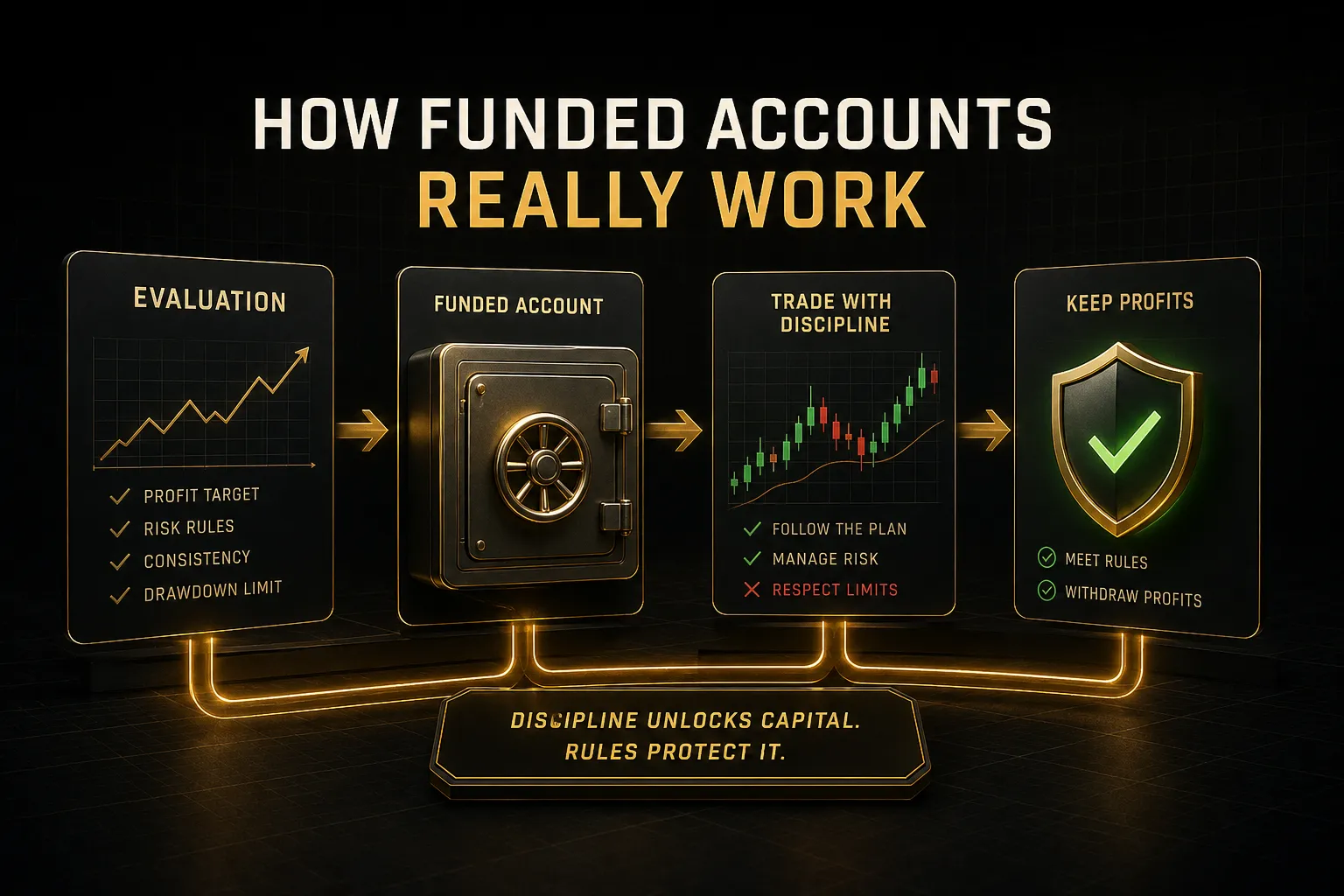
Most traders who fail evaluations do not fail because their analysis was wrong.
They fail because they misunderstood which number the firm was measuring.
Simulated vs Live Capital
Two business models wear the same clothing.
Understanding which one you are in explains where your profit share actually comes from.
| Factor | Simulated Funded Account (Retail Prop Model) | Live Prop Desk (Institutional Model) |
|---|---|---|
| Where trades execute | Demo or internal environment mirroring market prices | Real orders routed to real liquidity providers |
| Source of your payout | Firm revenue, largely evaluation fees | Actual realised trading profit on the desk |
| Entry cost to trader | Evaluation fee, typically $50 to $1,000 | None; hiring process, often salary plus split |
| Firm’s incentive if you profit | Payout is a cost against fee revenue | Payout comes from money the desk actually made |
| Your legal standing | Contractual counterparty to a private company | Employee or contracted trader |
| Market impact of your size | Zero; no order reaches the market | Real; slippage and fills are genuine constraints |
Neither model is inherently fraudulent.
The simulated model is a legitimate business when disclosed honestly, and the CFTC complaint against MFF centred precisely on whether that disclosure was honest.
But the incentive structure deserves your attention.
In a fee-funded model, every payout is an expense rather than a share of earnings.
That is exactly why rule enforcement, payout eligibility conditions, and consistency requirements deserve a careful read before you pay anything.
Balance Drawdown vs Equity Drawdown
Here is where accounts die quietly.
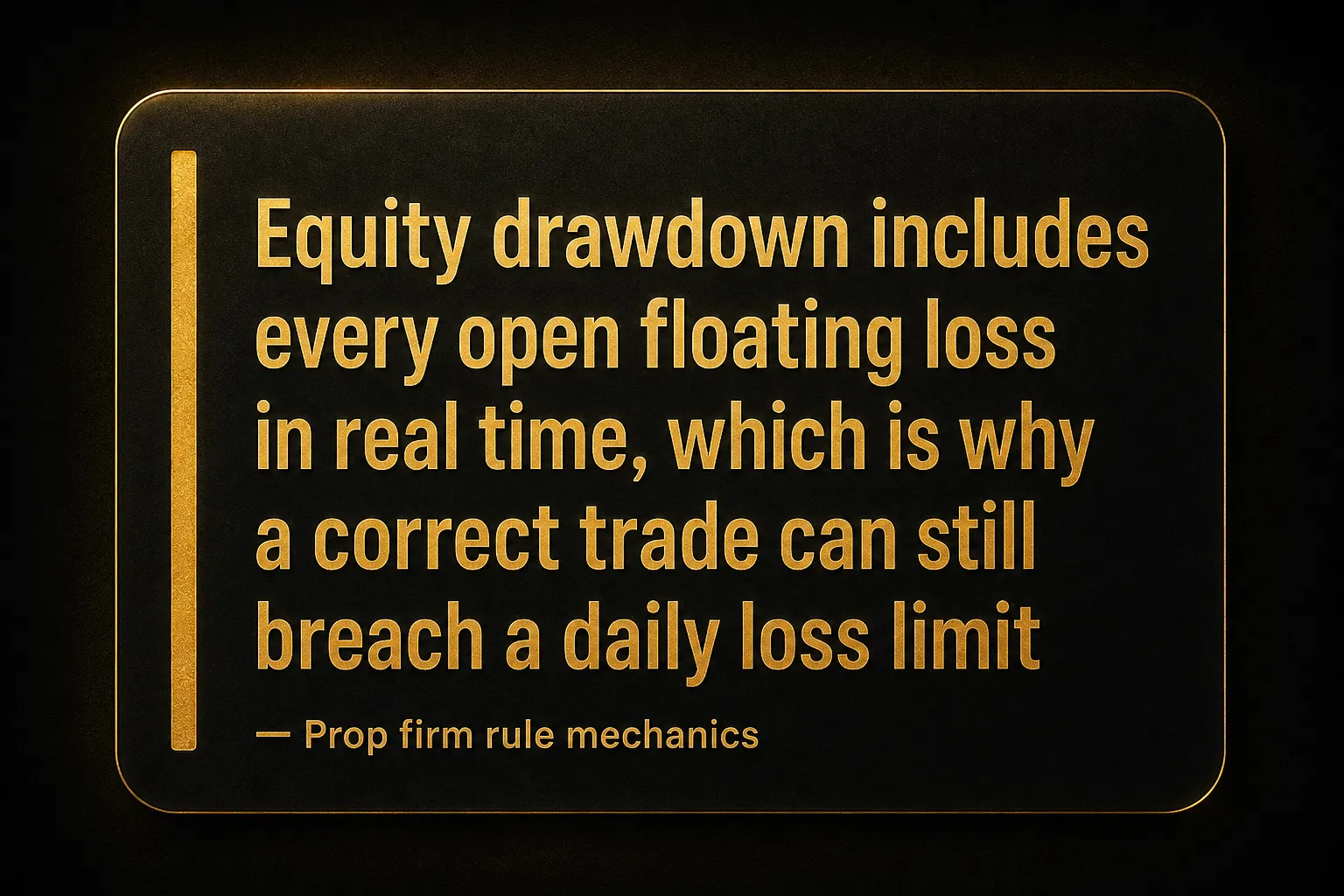
Balance drawdown counts only closed trades. Equity drawdown counts your balance plus every open floating loss, in real time.
Watch the wrong one and you can breach a limit while your screen tells you you are fine.
Work through a concrete example.
You are on a $100,000 simulated funded account with a 5% daily loss limit, which is $5,000, measured on equity.
- Morning: you close two losing trades for a combined realised loss of $2,400. Balance sits at $97,600. Comfortable, you think.
- Midday: you open three correlated EUR positions totalling 4 standard lots, all long, because your directional read is the same across all three.
- A scheduled data release hits. Price runs 55 pips against you before your stops trigger. Floating loss: roughly $2,200.
- Spread and slippage during the release widens the effective cost by another 4 to 6 pips per position, adding around $200.
- Commission on 4 lots round-turn: roughly $28.
Equity low point: about $95,170.
Your balance never showed a breach because two of those trades were still open. Your equity crossed $95,000.
Account terminated.
The directional call was correct thirty minutes later.
Irrelevant.
Equity is measured continuously, not at your convenience.
Now add trailing drawdown.
A trailing maximum drawdown follows your equity high-water mark upward. Grow that $100,000 account to $106,000 and an 8% trailing limit no longer sits at $92,000.
It has moved to roughly $97,520.
Traders who profit early and then increase risk per trade get caught here constantly.
Success tightened the floor beneath them and nobody sent a notification.
Three more mechanisms breach accounts on technically correct trades.
Weekend gaps can open past your stop-loss placement entirely, filling far worse than planned. Spread widening around rollover and news inflates floating loss without price moving in any meaningful way. And slippage on high-impact releases means a 20-pip stop can execute as a 45-pip loss.
Which is why position sizing against worst-case fills, not average fills, is the only defensible approach inside a hard drawdown limit.
Vetting Any Prop Firm Before You Pay
MyForexFunds was not an obscure operation.
It sponsored teams, ran heavy affiliate campaigns, and had thousands of positive reviews.
Size and visibility told traders almost nothing about counterparty risk.
Run this checklist before any evaluation fee leaves your account.
- Verify the legal entity and jurisdiction. Find the registered company name, number, and country in a government registry, not just on the website footer. If the entity is a recently formed shell in a jurisdiction with minimal disclosure requirements, price that in.
- Read the governing law and dispute clause. Ask yourself honestly whether you would ever pursue arbitration in that jurisdiction over a $4,000 payout. If the answer is no, the clause functions as a shield rather than a process.
- Check restricted countries and residency terms. Some firms void accounts retroactively for residency issues, including cases where a trader travelled and logged in from a restricted location.
- Map the full payment and payout terms. Minimum trading days, first-payout waiting period, payment methods, processing windows, minimum withdrawal thresholds, and consistency rules that cap how much of your profit can come from a single day.
- Find the rule-change policy. Can the firm amend the rulebook mid-evaluation and apply it to existing accounts? If the terms permit unilateral changes, your evaluation conditions are not fixed.
- Audit strategy restrictions against your actual method. Copy trading restrictions, expert advisor rules, news trading restrictions, latency-arbitrage bans, hedging limits, and correlated-position caps kill more funded accounts than bad analysis does. A trader running one EA across three prop accounts can be flagged for account correlation even with no intent to abuse anything.
- Search for verified payout evidence. Look for dated proof from unconnected traders across multiple months, and discount anything posted by affiliates earning commission.
- Check registry databases. A quick search for CFTC registration or an entity lookup in the NFA BASIC database clarifies which regulatory framework, if any, actually applies.
Trading Tools That Support Discipline, Not Shortcuts
Every failed evaluation eventually produces the same search: the indicator that would have prevented it.
That indicator does not exist.
Technical indicator limitations are structural, not a matter of finding a better setting.
Most indicators are derivative and lagging by construction. Some repaint, changing historical signals after the fact so backtesting results look far better than anything achievable live.
Overfitting compounds it.
Tune enough parameters against past data and you will build something that describes history beautifully and predicts nothing.
This is why forward testing on a demo or small account, across at least a few dozen trades and varied volatility conditions, matters more than any backtest curve.
Where tools genuinely help is consistency of execution.
A multi-timeframe table that shows trend alignment across, say, H1, H4, and daily in one view removes the chart-flipping that leads to inconsistent decisions under pressure. Marked entry and invalidation levels turn “I’ll watch it” into a defined stop, which is what makes position sizing arithmetic possible in the first place.
PipTrend is built around exactly that function: structured multi-timeframe context and pre-marked levels so your risk per trade is calculated before entry rather than negotiated afterwards. It supports discipline within a firm’s maximum drawdown limits.
It does not remove market risk, and no tool does.
Pair it with a forex trading journal recording entry reason, planned risk, actual fill, and rule proximity. That journal, not any signal, is what shows you the behavioural pattern that keeps breaching your limits.
Frequently Asked Questions
Is MyForexFunds coming back?
There is no independently verified return of MyForexFunds to full-scale retail operations as of 2026.
The 2025 dismissal removed the legal obstacle, but a closed court case is not the same as confirmed onboarding and payout activity.
Treat any relaunch claim as unproven until you see working support channels, active funded dashboards, and dated payout receipts from multiple unaffiliated traders.
Is MyForexFunds legit or a scam?
Neither label is supported by a court finding, and that is the honest answer.
The CFTC alleged serious misrepresentation, MFF denied it, and the case was dismissed with prejudice in 2025 without any judicial ruling on the merits.
A dismissal with prejudice means the claims cannot be refiled; it does not mean a judge found the allegations false or declared the firm’s conduct proper.
Why did MyForexFunds close?
MyForexFunds halted operations in August 2023 because the CFTC obtained a restraining order that froze company assets, including a TD Bank account, and installed a temporary receiver.
Losing access to operating funds and payment infrastructure made continued trading and payouts impossible.
The shutdown was a direct consequence of the enforcement action, not a voluntary business decision.
What happened to MyForexFunds payouts?
Payouts were suspended when the asset freeze took effect in August 2023, leaving traders with pending profit splits unpaid.
Because a prop-firm profit share is a contractual obligation rather than segregated client money, affected traders sit as unsecured creditors with no compensation-scheme protection.
Chargeback windows for 2023 transactions have long closed, so realistic recovery now depends on receiver or group-claim processes.
Can I still sign up for MyForexFunds?
No broadly verified public onboarding for MyForexFunds evaluations has been independently confirmed in 2026.
If you encounter a site accepting evaluation fees under that brand, verify the legal entity in a government registry and check whether it matches Traders Global Group Inc.
Brand names get reused, and paying a fee is the point of no return.
What are the risks of forex prop firms?
The primary risk is counterparty risk: your payout depends entirely on a private company’s willingness and ability to pay.
Layer on rule risk, where trailing drawdown, consistency requirements, and news trading restrictions can void accounts, plus the fact that most evaluation fees are simply lost.
Work the due-diligence checklist above, especially entity verification, rule-change policy, and third-party payout proof, before committing money.
The Real Lesson for Traders
The MyForexFunds story tempts traders into the wrong conclusion, which is that firm selection is the deciding variable.
It is not.
Survival in prop trading comes down to risk management, disciplined position sizing, and a journal that tells you the truth about your own behaviour. Change firms and change indicators all you want; a trader who risks 2% per position on three correlated pairs will breach a 5% daily limit at any firm on earth.
One concrete action before you pay for another evaluation.
Take the account size, find the daily loss limit in dollars, divide by your worst-case loss per trade including widened spread and 2x normal slippage, and see how many losers you can survive in one session.
If the answer is fewer than three, your size is wrong before you place a single order.
Reframe the whole exercise.
An evaluation is not a shortcut to capital.
It is a paid test of whether your process holds up under a hard rule set… and that result is worth knowing either way.
Sources
Risk Disclaimer: Trading involves risk. Past performance doesn't guarantee future results. Only trade with money you can afford to lose. PipTrend is a tool to assist your trading decisions, not financial advice.