
On this page
Why prop firm rules trip up good traders
Most failed prop firm challenges are not failures of trading skill.
They are failures of reading.
A trader can be net profitable for the month and still lose the account because one rule used a different reference point than the one they assumed.
The usual suspects are three terms that sound interchangeable: daily loss limit, maximum drawdown, and trailing drawdown.
They are not the same thing.
One resets every session, one measures total damage from a fixed point, and one follows your best performance upward like a shadow that never comes back down.
The vocabulary problem runs deeper.
Words like “drawdown,” “balance,” and “equity” mean different things at different firms.
One firm measures daily loss from your starting balance.
Another uses the prior day’s closing balance. A third uses whichever is higher, balance or account equity, at the start of the day.
A silent breach happens when your mental math uses one reference point and the firm’s server uses another. You don’t feel it coming. You just get the email.
This guide gives you prop firm rules explained at the formula level, not the marketing level. You’ll see the exact calculations behind each rule, a worked numerical example of a breach that catches profitable traders off guard, and a pre-trade checklist you can run before every position.
One more expectation to set.
The rules for a proprietary trading evaluation and the rules for a funded trading account are often different, sometimes in small ways and sometimes in ways that change your whole strategy.
We’ll treat them separately, because assuming they match is one of the most expensive mistakes in this business.
The core rules every evaluation uses
Strip away the branding and nearly every evaluation in 2026 is built from the same six components. The percentages vary by firm and by account type, but the architecture is remarkably consistent.
Here is the standard rule set you’ll find in almost any rulebook:
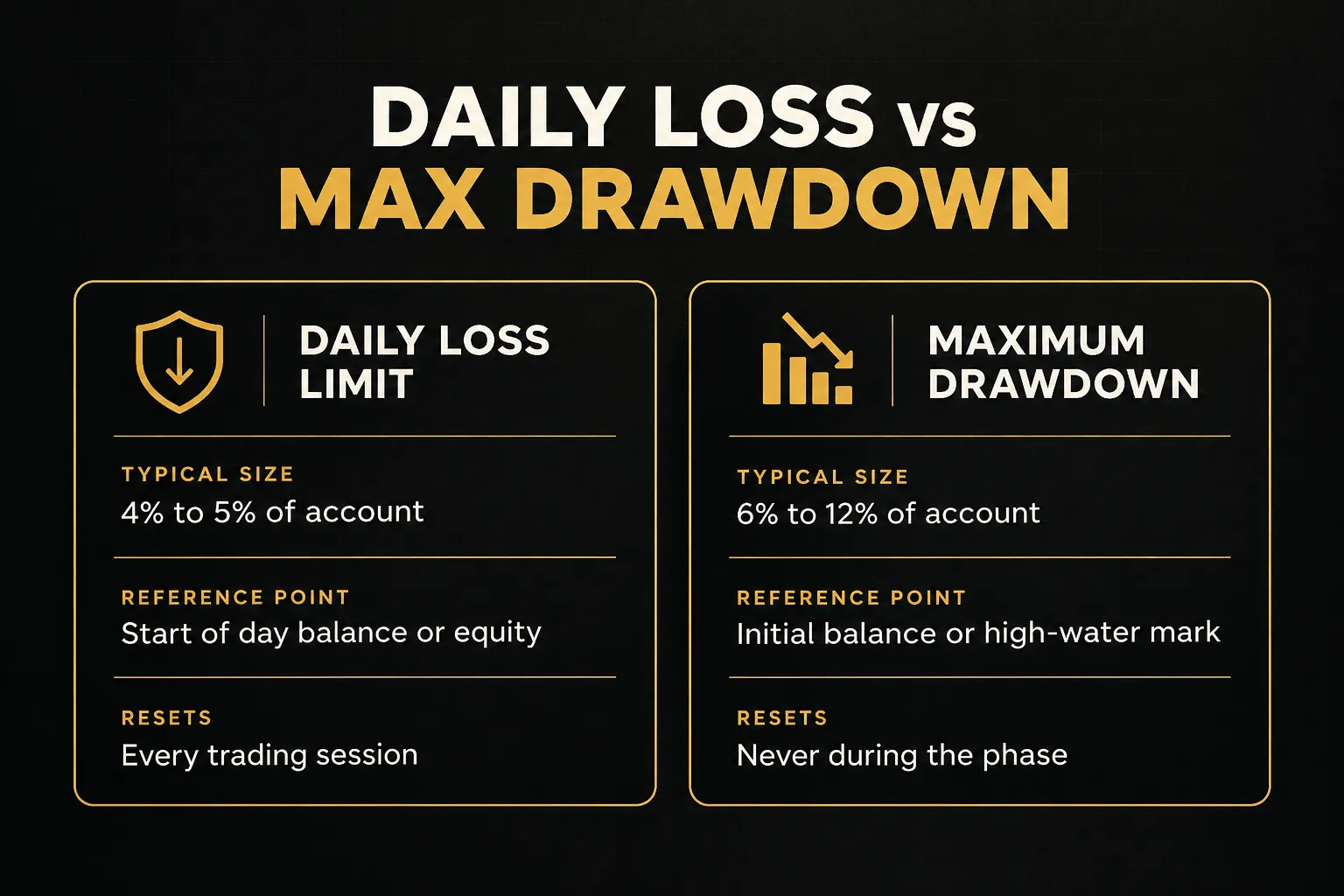
- Daily loss limit: The maximum amount you can lose in a single trading day, commonly set at 4% to 5% of the account. Cross it and the account is either paused or closed, depending on the firm.
- Maximum (total) drawdown: The deepest the account can fall overall, typically 6% to 12%. This is the hard floor that ends the evaluation if touched.
- Profit target: The gain you must reach to pass a phase, often 8% to 10% in phase one and around 5% in phase two for two-step models.
- Minimum trading days: A required number of days with at least one trade, usually somewhere between 3 and 10, designed to stop traders from passing on one lucky session.
- Consistency rule: A cap on how much of your total profit can come from your single best day. Not every firm uses one, and the ones that do apply it at different stages.
- Prohibited strategies: Practices the firm bans outright, such as latency arbitrage, tick scalping, copy trading between accounts, hedging across accounts, or trading during restricted news windows.
Daily loss vs maximum drawdown
Think of the daily loss limit as a speed limit and the maximum drawdown as a cliff edge.
One controls how fast you can lose.
The other controls how much you can lose in total.
- Daily loss resets on a fixed reference. Most firms anchor it to either the starting balance of the account or the end-of-day balance (or equity) from the previous session. On a $100,000 account with a 5% limit anchored to starting balance, your daily threshold is always $5,000 below the day’s opening reference.
- Max drawdown tracks a different anchor. Depending on the firm, it measures from the initial balance (a fixed floor) or from the account’s high-water mark (a moving floor). This single detail changes how much room you actually have.
- They operate simultaneously. You can be well inside your max drawdown and still breach the daily limit on one bad session. And the reverse is true too.
Static, end-of-day, and intraday drawdown
Here’s where firms diverge most.
The same “10% max drawdown” label can describe three very different mechanics.
- Static drawdown: The floor is fixed at a percentage below the initial balance and never moves. On a $100,000 account with 10% static drawdown, the floor is $90,000 forever, no matter how much profit you make.
- End-of-day drawdown: The floor is recalculated once per day using the closing balance or equity. Intraday swings don’t move the floor, which gives you breathing room during volatile sessions.
- Intraday drawdown: The floor is checked in real time against live equity. This is the strictest model because unrealized P&L counts immediately. A floating loss can breach the account even if you never close the trade and the price recovers ten minutes later.
That last point deserves emphasis.
Under equity-based intraday models, the firm doesn’t care that your stop loss hasn’t been hit.
It cares what your equity reads at the worst tick.
Trailing drawdown and the floor it creates
Trailing drawdown is the rule most likely to surprise a profitable trader. The floor rises as your account grows, but it never falls back down.
- The floor follows the peak. Every new high in balance or equity lifts the breach level. Gains don’t just add cushion; they also raise the bar beneath you.
- Some firms trail a percentage, others a fixed dollar amount. A 10% percentage trail on a $104,000 peak puts the floor at $93,600. A fixed $10,000 trail on the same peak puts it at $94,000. Small difference, real consequences.
- Many firms lock the trail. Once the floor reaches the initial balance (or initial balance plus a small buffer), it stops trailing and becomes static. Check whether your firm does this and at what level.
- Peak equity vs peak balance matters. If the trail follows equity, an open trade that briefly shows a large floating profit can raise your floor even if you close the trade for much less.
The math behind a breach
What does a breach actually look like on paper? Abstract rules become clear the moment you run the numbers, so here are two complete examples with real figures.
A trailing drawdown example, step by step
Assume a $100,000 evaluation with a 10% trailing maximum drawdown calculated on peak equity, using the percentage method. To isolate the trailing rule, we’ll set the daily limit aside (in practice it might fire first, which only strengthens the point).
- Start the account. Balance and equity both read $100,000. The breach floor sits at $90,000, which is 10% below the starting value.
- Grow the account. Over several days of closed winning trades, balance and equity reach $104,000. The firm records this as the new high-water mark.
- Watch the floor move. The new floor becomes $104,000 × 0.90 = $93,600. Your real cushion is now $10,400, not the $14,000 you might assume by comparing $104,000 to the original $90,000 floor.
- Open a position that turns against you. A swing trade (or a cluster of correlated positions) builds a floating loss of $10,500. Your balance still reads $104,000 because nothing has closed.
- Hit the breach. Equity drops to $93,500, which is $100 below the $93,600 floor. The account fails immediately, even though the balance shows a $4,000 gain and the trade was never closed.
- Compare with a static model. Under a 10% static drawdown, the floor would still be $90,000 and this trader would have $3,500 of room left. Same trades, same account size, opposite outcome.

Now add trading costs.
Commissions, spreads, overnight swaps, and slippage all reduce equity, so your real distance to the floor is always shorter than the theoretical one.
A standard lot on EUR/USD might cost around $7 in round-turn commission plus roughly $8 in spread at 0.8 pips. Ten trades a day burns about $150 before any market move, and a 1-pip slippage on a stop costs another $10 per lot.
Those numbers look small.
But on a day when you’re already $4,800 into a $5,000 daily limit, they decide whether you survive.
The consistency rule calculation
The consistency rule uses a simple formula: consistency ratio = best single day’s profit ÷ total cumulative profit. If the result exceeds the firm’s cap, you either fail the phase or must keep trading until the ratio drops below the limit.
- Identify the cap. Assume the firm sets a 45% maximum. No single day can account for more than 45% of your total profit.
- Run a passing case. Total profit is $10,000 and your best day made $4,000. The ratio is $4,000 ÷ $10,000 = 40%, which is under the 45% cap. You pass.
- Run a failing case. Total profit is still $10,000, but your best day made $5,500. The ratio is 55%, which exceeds the cap. You hit the profit target and still don’t qualify.
- Calculate the fix. To bring a $5,500 best day under 45%, total profit must reach $5,500 ÷ 0.45 = $12,222. That means roughly $2,222 more profit, earned without any new day exceeding the old best.
- Check where the rule applies. Some firms apply consistency only during the evaluation. Others ignore it in evaluation but enforce it for payout eligibility on the funded account. A few apply it at every stage. The rulebook’s exact wording is the only reliable source.
How rules shift from evaluation to funded
Passing the evaluation does not mean the rules you mastered still apply.
Many traders discover this on their first funded week… usually the hard way.
The drawdown calculation method is the first thing that can change.
An evaluation might use end-of-day trailing drawdown, while the funded stage switches to a static floor, or the reverse. Some firms lock the trailing floor only after the first payout, which means your risk tolerance should change at that moment too.
Allowed instruments can also narrow.
A firm might let you trade crypto CFDs or exotic pairs during evaluation and restrict them on funded accounts. Scaling plans add another variable: growing the account to a larger allocation may come with new drawdown percentages or a fresh profit threshold.
Payout conditions are the third moving piece. Minimum trading days per payout cycle, consistency caps, and minimum profit thresholds often appear only in the funded section of the rulebook.
Trading restrictions you must verify
Before placing a single funded trade, confirm five restrictions in writing.
Start with news-trading blackout windows, which commonly ban opening or closing positions within two to five minutes of high-impact releases like NFP or CPI. Some firms only restrict this on funded accounts, not evaluations.
Next, check weekend and overnight holding rules. Certain account types require all positions closed before Friday’s market close, while others allow swing holding but charge swap fees that eat into your drawdown buffer.
Then verify EA and copy-trading restrictions. As of 2026, many firms allow expert advisors but ban off-the-shelf EAs used by thousands of other traders, along with copy trading between accounts.
Finally, confirm hedging permissions and any minimum or maximum trade duration. A rule requiring trades to stay open at least one or two minutes can quietly disqualify a scalping strategy.
What happens when you breach a rule
Not every breach is fatal.
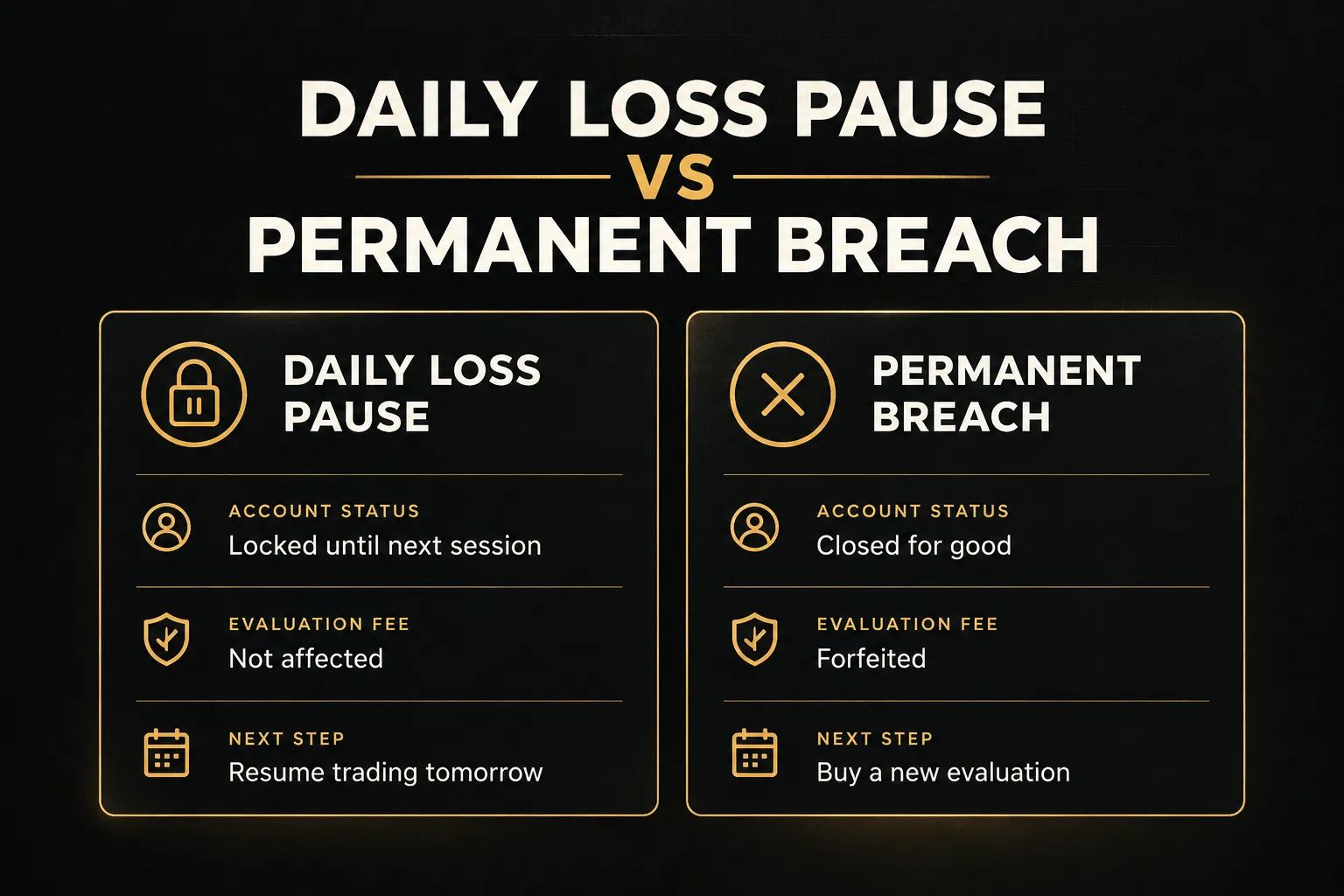
The distinction between a pause and a permanent breach determines whether you’re back tomorrow or buying a new evaluation.
A daily loss pause (sometimes called a soft breach) halts trading until the next session resets. Open positions may be closed automatically, but the account survives.
A permanent breach (hard breach) closes the account, forfeits the evaluation fee, and on funded accounts usually cancels any unpaid profit split.
One final protection: document the exact rulebook version you accepted.
Save a PDF or screenshot with the date.
Terms can and do change between the day you purchase an evaluation and the day you’re funded, and a dated record gives you something concrete if a dispute arises.
Trading inside the rules, not against them
The traders who pass consistently don’t treat the firm’s limits as targets.
They treat them as walls they never want to touch.
That mindset shift changes everything about how you size positions, plan sessions, and pick strategies.
Position sizing below the firm’s limit
Your personal daily cap should sit meaningfully below the firm’s daily loss limit. The gap absorbs slippage, cost drag, and the emotional pressure that builds after two consecutive losses.
- Set risk per trade at 0.5% to 1%. On a $100,000 account with a 5% daily limit ($5,000), 0.5% risk ($500 per trade) gives you ten full losses before a breach. At 1% ($1,000), you get five.
- Cap your personal daily loss at roughly half the firm’s limit. A self-imposed 2.5% stop ($2,500) leaves a $2,500 buffer for slippage, gaps, and the occasional stop that fills worse than planned.
- Size against the floor, not the balance. If you’re operating under trailing drawdown and your cushion has shrunk to $3,000, a 1% risk per trade calculated on a $104,000 balance ($1,040) is effectively 35% of your remaining room.
- Reduce size after a losing streak. Cutting position sizing by half after two or three losses slows the bleed and keeps you clear of the daily limit while you reassess.
A pre-trade compliance checklist
A checklist feels slow for the first week.
After that it takes under a minute, and it catches the kind of mistakes that end accounts.
- Confirm the reference method. Know whether today’s daily limit is measured from starting balance, prior end-of-day balance, or prior end-of-day equity, and write down today’s exact breach number.
- Check the economic calendar. Identify any high-impact releases during your session and confirm whether your account type restricts trading around them.
- Verify position limits. Make sure the trade stays within maximum lot size, maximum open positions, and any total exposure caps.
- Confirm holding rules. Check whether the position can be held overnight or over the weekend, and whether a minimum hold time applies.
- Calculate distance to the floor. Subtract your current equity from the max drawdown floor and compare it to the trade’s maximum loss including costs.
- Check consistency exposure. If today is already your best day, ask whether another winner pushes your consistency ratio above the cap.
- Log the entry reason. Record the setup, timeframe, and invalidation level. This creates an audit trail and keeps impulsive trades out of the account.
Strategy fit matters as much as daily discipline. Use this framework to match your style against common rule sets before you pay for anything:
- Scalping: Often conflicts with minimum trade duration rules and is the style most hurt by commissions eating into daily limits.
- Swing trading: Requires firms that allow overnight and weekend holding, and works better under static or end-of-day drawdown than intraday trailing models.
- News trading: May be restricted entirely around high-impact releases, especially on funded accounts.
- EA trading: Needs explicit permission and usually must be a unique, self-built system rather than a commercially distributed bot.
- Discretionary intraday: Usually fits most rule sets, provided daily risk is managed well below the limit.
Where tools like PipTrend fit in
Rule compliance is easier when your entries follow a repeatable process. Tools like PipTrend support that by using multi-timeframe confirmation and marked entry levels, so you’re acting on predefined setups rather than reacting to every candle.
That structure helps in two ways.
It filters out low-quality trades that tend to cluster on bad days, and it makes your position sizing and stop placement more predictable, which in turn keeps your daily loss within planned limits.
But be clear about the boundaries.
A signal tool supports discipline and filtering. It does not guarantee passing an evaluation, and it cannot prevent a breach if position sizing, news restrictions, or drawdown math are ignored.
The rules still apply to every trade you take.
Frequently asked questions
What is the 5% daily loss rule in prop firms?
The 5% daily loss rule caps how much your account can lose in a single trading day at 5% of a reference value.
On a $100,000 account, that’s $5,000.
The reference is usually either the starting balance or the previous day’s end-of-day balance or equity, so the exact breach level can shift daily depending on the firm’s method.
What is the 10% drawdown rule in prop trading?
The 10% drawdown rule sets the maximum total loss an account can sustain before it fails.
Under a static model, a $100,000 account fails at $90,000.
Under a trailing model, the floor rises with your peak, so a $104,000 high-water mark lifts the floor to $93,600 using the percentage method.
How do prop firms calculate drawdown?
Prop firms calculate drawdown by comparing current balance or equity against a reference floor.
Static drawdown uses a fixed floor below the initial balance.
End-of-day drawdown recalculates once per day from closing values.
Intraday drawdown checks live equity in real time, including unrealized P&L.
Trailing versions move the floor upward with each new high.
What happens if you break a prop firm rule?
Breaking a prop firm rule results in either a temporary pause or a permanent account closure.
A daily loss breach at some firms halts trading until the next session.
A maximum drawdown breach or prohibited strategy violation typically closes the account, forfeits the evaluation fee, and cancels unpaid profit splits on funded accounts.
What is the consistency rule in prop firms?
The consistency rule limits how much of your total profit can come from a single day.
It’s calculated as best day’s profit divided by total profit.
With a 45% cap, a $4,000 best day on $10,000 total (40%) passes, while a $5,500 best day (55%) fails.
Some firms apply it only at payout.
Can you hold trades overnight with a prop firm?
Most prop firms allow overnight holding, but weekend holding is often restricted.
Some account types require all positions closed before Friday’s market close, and certain firms ban holding through high-impact news.
Overnight swap fees also reduce equity, which shrinks your real distance to the drawdown floor.
Always check your specific account type’s rules.
Read the rulebook before you read the chart
Here’s the decision rule that saves the most money.
If your strategy conflicts with a firm’s restrictions, switch firms or switch strategies before you pay for an evaluation.
A scalper facing a two-minute minimum hold time, or a swing trader facing a no-weekend rule, is starting the challenge already behind.
Set realistic expectations about what you’re buying.
Evaluation accounts are typically simulated environments, and “funded” often means allocated or simulated capital with a profit split, not cash handed over to trade freely.
Knowing this keeps your focus where it belongs: on process and payout eligibility, not on the size of the number on the dashboard.
And now the one step to take today.
Download the exact rulebook version you accepted, note the date, and annotate it: circle the drawdown method, the daily loss reference, the consistency cap, and every restriction that touches your style.
Do that before your first trade.
Not after your first breach.
Sources
Risk Disclaimer: Trading involves risk. Past performance doesn't guarantee future results. Only trade with money you can afford to lose. PipTrend is a tool to assist your trading decisions, not financial advice.