
Most traders hit the same wall: they have a proven edge but lack the capital to scale it profitably. Props firms promise a solution by offering funded accounts in exchange for a share of your profits. Sounds perfect until you read the fine print and realize the evaluation process, withdrawal restrictions, and profit splits change the entire risk equation. Understanding how these firms operate, what regulations govern them, and whether their model aligns with your strategy will determine if you're setting yourself up for success or burning money on monthly fees.
How Props Firms Actually Make Money
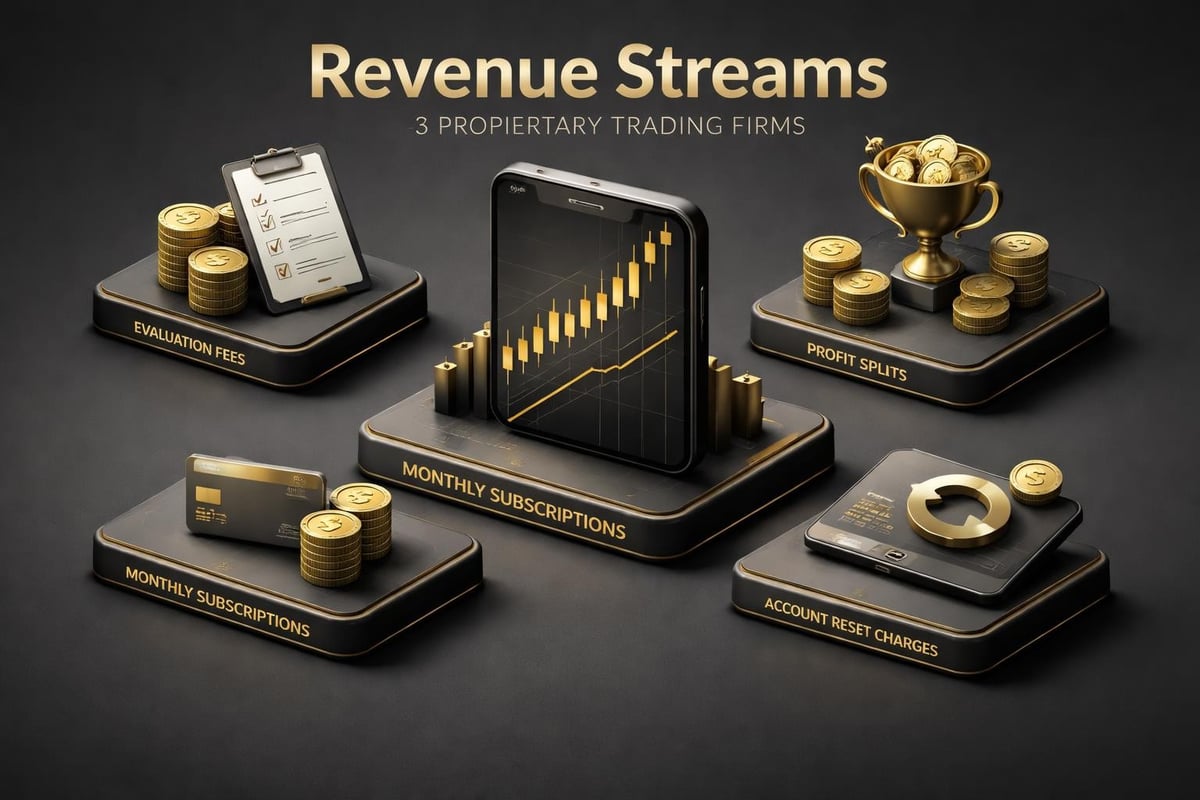
Props firms generate revenue through multiple streams that most traders overlook when signing up. The evaluation fee is the first revenue source. You pay anywhere from $100 to $500 for a challenge account, and most traders fail the evaluation within the first month. The firm keeps that fee regardless of your outcome. Even if you pass, many traders violate rules during the live funded phase and lose their account, forcing them to pay another evaluation fee to try again.
The profit split is the second revenue stream, but it only applies to the small percentage of traders who actually withdraw money. Most props firms advertise 70-80% profit splits, meaning you keep that portion of your gains while the firm takes the rest. This sounds fair on the surface, but when you factor in that the firm risks nothing while you paid for the evaluation and follow strict drawdown rules, the economics shift heavily in their favor.
Monthly subscription models have become more common in 2026. Instead of one-time evaluation fees, some props firms now charge $150-300 per month for access to their platform and capital. This guarantees recurring revenue whether you trade profitably or not. The model works well for the firm because even breakeven traders keep paying, hoping next month will be different.
Understanding proprietary trading at its core reveals why these business models exist. Traditional prop firms use their own capital and hire traders as employees. Modern retail props firms operate differently. They're essentially running a software-as-a-service business where your trading performance determines if they ever risk real capital on your behalf.
The Evaluation Process and Hidden Obstacles
The typical props firm evaluation follows a two-phase structure. Phase one requires you to hit a profit target, usually 8-10%, without exceeding a maximum drawdown of 4-6%. You also face a daily loss limit, typically 2-3% of the starting balance. Phase two reduces the profit target to 4-5% while maintaining the same drawdown rules. Only after passing both phases do you qualify for a funded account.
The daily loss limit kills more accounts than any other rule. You can be trading a solid strategy with a 2:1 risk-reward ratio, take two losses in a row, and instantly fail the evaluation. This rule doesn't reflect real trading conditions where position sizing and weekly performance matter more than arbitrary daily thresholds. The firms defend it as risk management, but it primarily serves to increase failure rates and generate repeat evaluation fees.
Consistency rules add another layer of difficulty that most traders discover too late. Some props firms require that no single day accounts for more than 40% of your total profits during the evaluation. This means if you catch a major trend move and bank 8% in one session, you might violate the consistency rule even though you hit your profit target. You're penalized for exactly what professional traders aim to do: capitalize on high-probability setups when they appear.
The time limits create artificial pressure that changes your trading psychology. Most evaluations impose a 30-60 day deadline to hit your targets. If your strategy relies on weekly timeframe setups or you trade only during specific sessions, you might not get enough quality opportunities within the evaluation window. This pushes traders to overtrade and take marginal setups they'd normally skip, which increases failure rates.
Regulatory Framework Affecting Props Firms
The regulatory landscape for props firms remains complex and varies significantly by jurisdiction. In the United States, regulations under the Volcker Rule restrict banking entities from engaging in proprietary trading, but most retail props firms operate outside this framework because they're not registered as banks or broker-dealers. This creates a gray area where oversight is limited.
FINRA oversight has expanded over proprietary trading operations in recent years, particularly around how firms structure their agreements with traders and whether those relationships constitute employment or independent contracting. The classification matters because it determines tax obligations, benefits, and legal protections. Most props firms categorize traders as independent contractors to avoid employment obligations, but regulators continue scrutinizing these arrangements.
In Europe, props firms face stricter requirements under MiFID II regulations, which mandate capital adequacy standards and reporting obligations. Some firms have relocated to less regulated jurisdictions to avoid these requirements, which should raise red flags for traders considering those platforms. The location of the firm's legal entity determines which regulatory body oversees it and what protections you have if disputes arise.
The regulatory gaps mean you have limited recourse if a props firm changes its terms, withholds payouts, or shuts down without notice. Unlike broker deposits that typically have insurance protection, your evaluation fees and profits held by props firms usually lack such safeguards. Reading the legal agreement carefully and researching the firm's regulatory status before paying any fees is essential, not optional.
Profit Splits and Withdrawal Reality
The advertised profit split rarely reflects what you actually receive when requesting a withdrawal. A firm might promote an 80% split, but the agreement often includes clauses about "realized profits" versus "unrealized profits" that complicate the calculation. Some firms only count closed trades, while others require you to have zero open positions before processing a withdrawal, forcing you to exit potentially profitable trades prematurely.
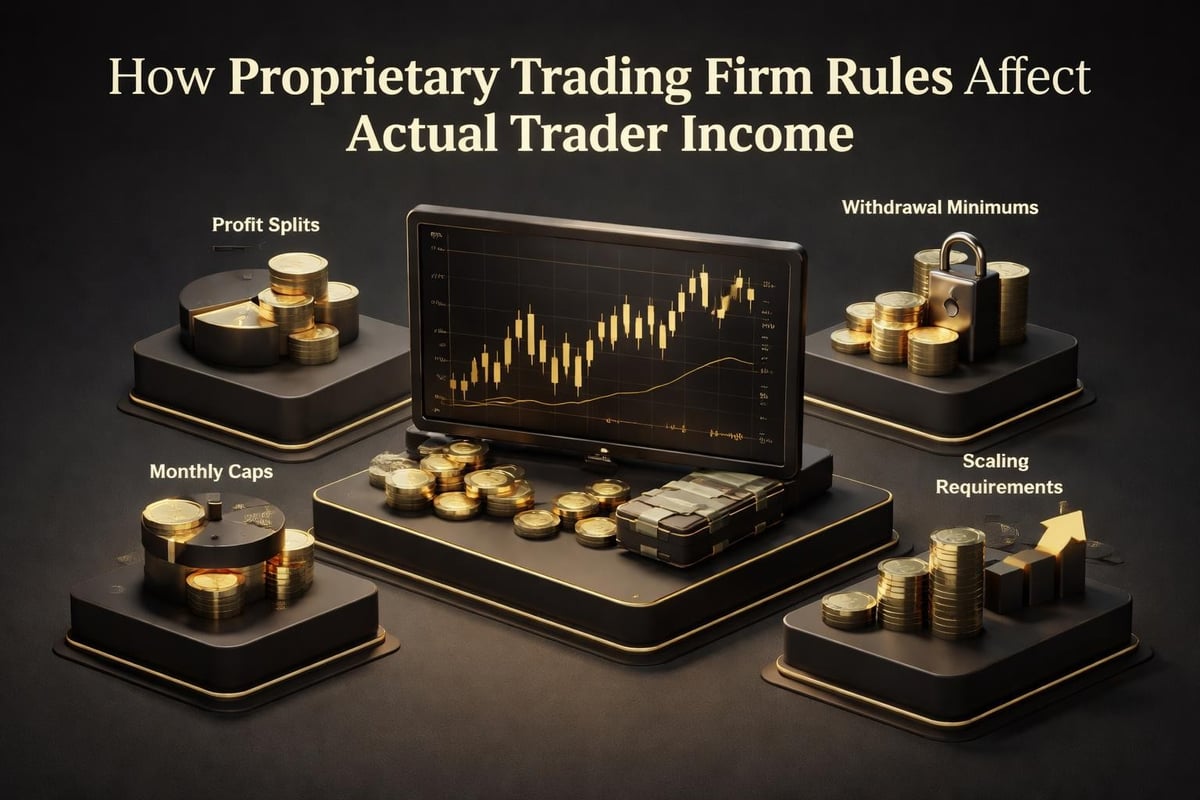
Withdrawal schedules impose another restriction that ties up your capital. Many props firms process payouts only once or twice monthly, and some require a minimum profit threshold before you can request funds. If you make $500 but the minimum withdrawal is $1,000, your money remains locked until you hit that target. This creates a situation where the firm holds your earnings for extended periods while you continue trading and risking those profits.
The scaling plans that props firms advertise sound attractive but come with conditions that make them difficult to achieve. They promise to increase your account size from $50,000 to $100,000 or beyond based on consistent performance. However, the consistency requirements for scaling are often stricter than the initial evaluation. You might need three consecutive profitable months with less than 3% drawdown to qualify for the next tier, which is harder than it sounds when trading live markets.
Some props firms have introduced profit caps that limit how much you can withdraw monthly regardless of your performance. A $200,000 funded account might have a $10,000 monthly withdrawal limit, meaning exceptional performance doesn't translate to exceptional income in the short term. The firm benefits from your trading results immediately through their profit share, while you wait months to access your full earnings.
Strategy Restrictions You'll Face
Props firms impose trading restrictions that fundamentally change how you can execute your edge. News trading is banned by virtually every firm because volatile price action during economic releases can trigger stop-loss hunts and create slippage that costs the firm money. If your strategy involves trading NFP, CPI, or Fed announcements, you'll need to adapt or find a different funding source.
Holding trades over the weekend is prohibited by many props firms to avoid gap risk. This eliminates swing trading strategies that rely on multi-day position holding and forces you into a day trading or scalping approach. If you've built your edge around 4-hour or daily timeframe setups, these restrictions make the funded account worthless because you can't trade your actual system.
Hedging and grid strategies face outright bans at most props firms. These firms operate on MetaTrader or similar platforms where they can detect multiple positions in the same instrument. Even if your strategy uses correlated pairs to manage risk, the firm might classify it as manipulation and terminate your account. The restrictions protect the firm's risk parameters but eliminate legitimate trading approaches that work in real markets.
Instruments allowed for trading vary widely between firms. Some props firms limit you to major forex pairs only, excluding exotics, commodities, or indices. Others allow broader access but impose different profit targets and drawdown limits per instrument category. If you've developed expertise in gold or oil trading, verify the firm actually funds those markets before paying evaluation fees.
Comparing Props Firms to Self-Funded Trading
The capital advantage that props firms offer comes with trade-offs that self-funded traders avoid entirely. With your own capital, you trade without daily loss limits, profit targets, or consistency rules. You can hold positions as long as your analysis supports them and scale size based on conviction rather than arbitrary risk parameters. This freedom allows your actual edge to work without artificial constraints.
The cost structure differs dramatically between the two approaches. Self-funded traders pay spreads and commissions but keep 100% of profits. Props firms charge evaluation fees, take 20-30% of your gains, and impose monthly costs in some models. For a trader making $5,000 monthly, the difference between keeping all of it versus 70% after fees is $1,500 per month or $18,000 annually. Over multiple years, that compounds significantly.
Psychology shifts when trading firm capital versus your own money. Some traders perform better with props firms because the evaluation structure forces discipline and removes the emotional attachment to personal savings. Others find the artificial pressure and rule-based trading creates stress that ruins their decision-making. Understanding which category you fall into requires honest self-assessment, not assumptions.
The learning curve argument favors self-funded trading for most developing traders. Paying $300 for an evaluation you'll likely fail three or four times costs $1,200 that could have funded a small live account where you learn real market conditions without arbitrary rules. The props firm model works best for traders who already have a proven edge and need capital to scale, not beginners hoping the structure will teach them discipline.
Many successful traders use a hybrid approach where they trade personal capital for income and strategy development while attempting props firm evaluations on the side with money they can afford to lose. This removes the pressure of needing the funded account to survive and allows you to trade both environments according to their optimal use cases. The props firm becomes a bonus opportunity rather than your primary path to profitability.
Using Indicators Within Props Firm Rules
Technical indicators become even more critical when trading props firm accounts because you need high-probability setups that work within strict risk parameters. Unlike discretionary trading where you can hold through temporary drawdowns, props firm rules demand precision entries and quick exits if the trade moves against you. This shifts your indicator selection toward tools that provide early entry signals and clear invalidation points.
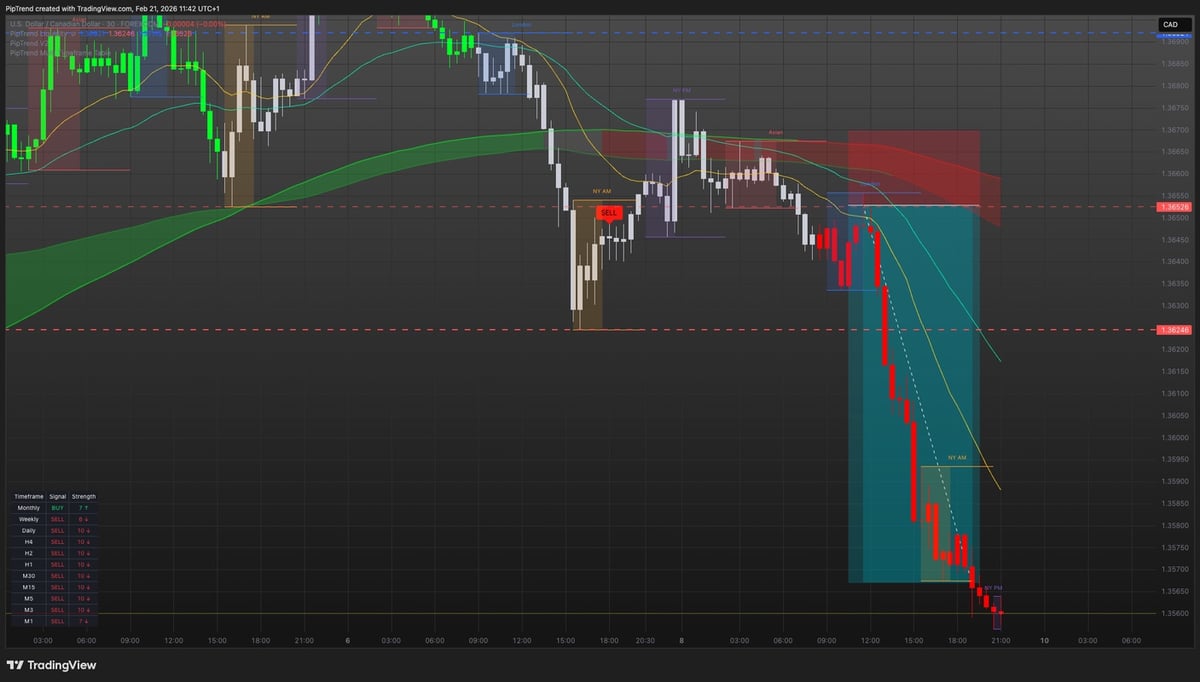
Trend confirmation across multiple timeframes helps you avoid the choppy conditions that generate losses during props firm evaluations. You need to see alignment on the 15-minute, 1-hour, and 4-hour charts before risking capital, because a single bad trade during evaluation can cost you the entire challenge. Indicators that show institutional momentum and session liquidity zones tell you when large players are actively moving price versus when you're trading retail noise.
PipTrend AI Trading Indicator addresses this exact challenge by filtering out low-probability setups and showing you when multiple timeframes align before you enter. For props firm traders, this means fewer trades overall but higher win rates, which is exactly what you need to pass evaluations without hitting daily loss limits. The multi-timeframe confirmation table shows you at a glance whether you should be looking for longs, shorts, or staying flat, removing the guesswork that causes overtrading during timed challenges.
Stop-loss placement becomes non-negotiable in the props firm environment because you're managing both your trade risk and the firm's daily loss limit simultaneously. Your indicator setup needs to provide logical stop-loss levels based on market structure, not arbitrary percentages. ATR-based stops work well because they adjust to volatility and keep you from getting stopped out during normal price oscillation. A 1.5x ATR stop on the 1-hour chart typically provides enough room while keeping individual trade risk under 1% of your account.
Position sizing calculators integrated with your indicator platform prevent the math errors that violate props firm drawdown rules. You need to calculate exact lot sizes based on your stop-loss distance and maximum allowable risk per trade. Even experienced traders make sizing mistakes when switching between account currencies or trading instruments with different pip values. Automation removes this error source and ensures you never accidentally risk 3% when the firm limit is 2%.
The Real Success Rate Data
Props firms rarely publish actual pass rates for their evaluation programs, but industry estimates suggest 5-10% of traders complete the initial evaluation successfully. Of those who get funded, another 50-60% lose their accounts within the first three months due to rule violations or drawdown breaches. This means roughly 2-5% of people who pay evaluation fees end up with sustained funded accounts that generate withdrawable income.
The time investment to profitability extends far beyond the evaluation period for most successful props firm traders. You might spend 3-6 months and $500-1,500 in failed evaluations before passing. Then you need 2-4 months of consistent funded trading before your first significant withdrawal. Total timeline from first evaluation attempt to meaningful income often runs 8-12 months, assuming you already have a working strategy when you start.
Experienced traders with documented track records fare significantly better than those using props firms as a learning platform. If you've already traded live markets profitably for 12+ months, your evaluation pass rate increases to 30-40% because you understand risk management and have the discipline to follow rules. The props firm model selects for traders who already know what they're doing rather than teaching new traders how to succeed.
Alternative paths to capital include forex broker leverage, personal loans, or partnering with private investors who provide backing in exchange for profit shares. Each option has trade-offs, but they avoid the artificial constraints that props firm evaluations impose. A trader with $5,000 using 1:100 leverage controls $500,000 in position size without daily loss limits or consistency rules, which might generate better results than a $100,000 props firm account with strict parameters.
Props firms offer genuine opportunities for skilled traders who need capital to scale proven strategies, but they're not the shortcut to trading success that marketing materials suggest. The evaluation structure, regulatory gaps, and profit-sharing models favor the firms significantly more than individual traders. Before paying any evaluation fees, verify your strategy works within their specific rules and honestly assess whether the constraints will improve or hinder your performance. If you're still building your edge and looking for the clarity to trade with conviction, PipTrend provides the signal filtering and multi-timeframe confirmation that removes guesswork from your entries, whether you're trading personal capital or working toward funded accounts.