Best Crypto Signals Providers in 2026: A Buyer-Focused Audit of Accuracy, Transparency, and Cost
On this page
Introduction: Why Most “Best Crypto Signals” Lists Don’t Help You Trade
This guide is for retail traders comparing paid crypto trading signals, TradingView crypto indicators, and Telegram or Discord communities before subscribing. You know what a candlestick is. You want to know which provider will help you trade better.
Most “best crypto signals providers” lists don’t answer that. They repeat vendor marketing, mix backtests with live results, and treat a screenshot of one winning Bitcoin trade as proof of crypto signal accuracy.
None of that tells you what happens to your account after 50 trades.
So we judged every provider on the same framework. That covers how signals are confirmed, how precise the entry is, and whether alerts fire intrabar or on candle close.
We also weighed risk controls such as stop-loss and take-profit levels or multi-timeframe filters.
The framework also covers total cost of ownership and cancellation and refund terms.
Then comes the question that matters most: are losing trades disclosed?
That last point separates verified trading results from a highlight reel. A provider that only shows winners is selling hope, not a crypto trading system.
And a backtest, however polished, is not a live record.
Our top pick for 2026 is PipTrend.
It is the only provider on this list that combines direction, entry, and hold decisions into one workflow. It also publishes trade outcomes with verified cTrader statements, losses included.
The other six providers earn their places in specific niches. We cover each one honestly below.
Quick Picks: Best Crypto Signals Providers Compared
Short on time?
The table below compares all seven providers on positioning, crypto signals pricing, alert behavior, and transparency. Use it to shortlist two or three options, then read the full reviews before you commit to annual billing.
| Provider | Best For | Starting Price (as of 2026) | Alert Type | Public Loss Disclosure | Our Rating |
|---|---|---|---|---|---|
| PipTrend | Best Overall / Best for a complete direction-entry-exit workflow | $40/mo (yearly, $479.99); $59.99 monthly | Push, email, desktop; signals confirm on candle close | Yes, losses and break-evens with verified cTrader statements | 4.8/5 |
| LuxAlgo | Broad multi-market indicator ecosystem | Free plan; Premium $39.99/mo annual | Custom alert creator; webhook automation on eligible plans | No public trade-by-trade record found | 4.5/5 |
| Flux Charts | Smart money concepts and visual backtesting | $59.99/mo billed annually ($719.88) | TradingView alerts | No public trade-by-trade record found | 4.4/5 |
| ChartPrime | Visual polish and guided education | ~$59/mo billed at $708/yr | Real-time signals with TP/SL levels | No public trade-by-trade record found | 4.2/5 |
| Zeiierman Trading | Largest indicator library | $37.99/mo yearly; $95.20 monthly | TradingView alerts plus two automated-strategy bots | No public trade-by-trade record found | 4.2/5 |
| Market Cipher | Experienced oscillator-based traders | $600 for 12 months (promo); no monthly plan | TradingView invite-only indicator alerts | No public trade-by-trade record found | 4.0/5 |
| AlgoXpert | Session-based day trading and order-flow structure | $58/mo yearly ($696); $79 monthly | TradingView alerts; claims non-repainting | No public trade-by-trade record found | 4.1/5 |
Monthly billing is where price gaps show most clearly. Among the four providers with a published month-to-month price, the spread is wide.
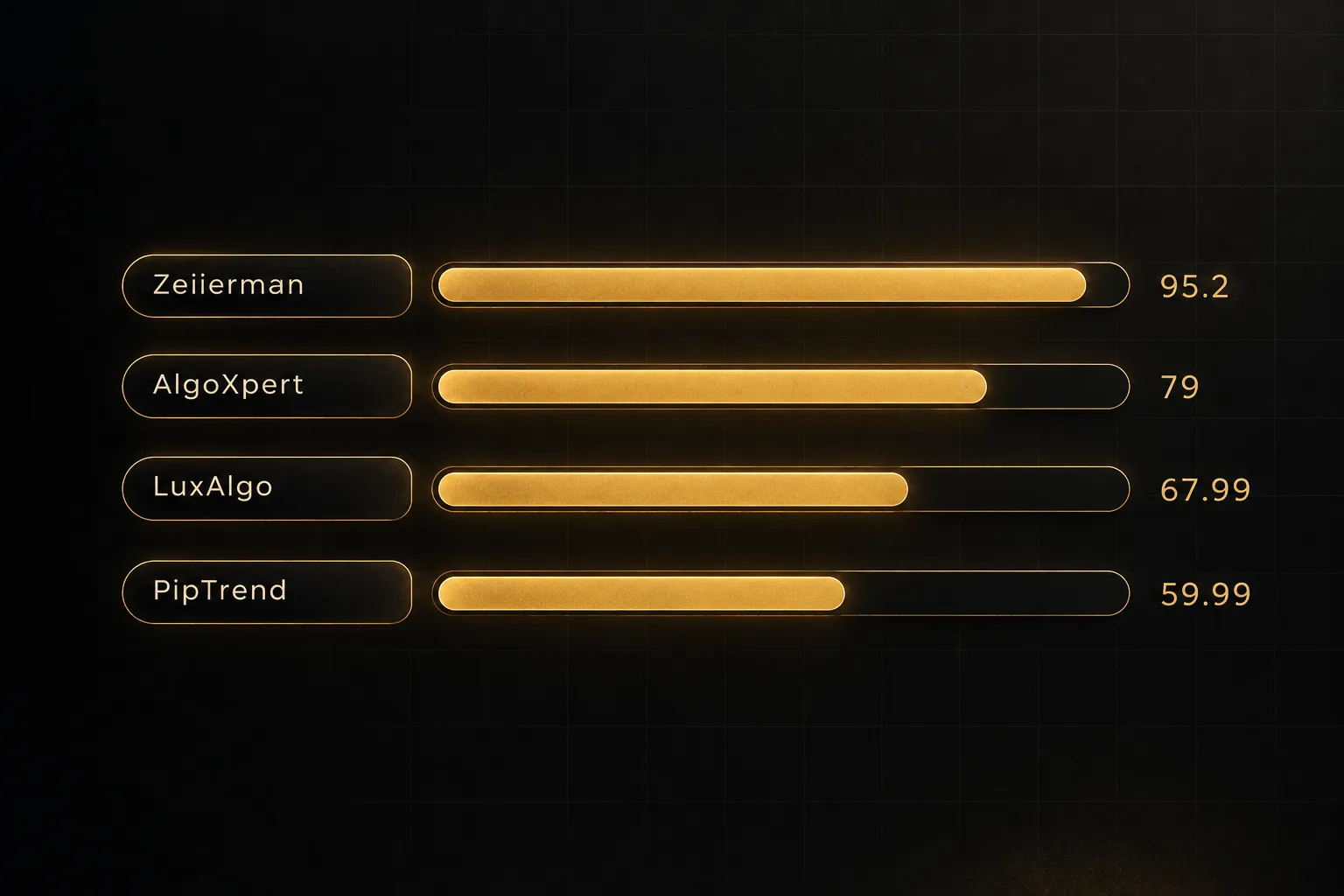
All prices reflect the providers’ published pricing at the time of writing and can change with promotions. Several vendors (including PipTrend) have announced or display higher standard rates once introductory pricing ends.
PipTrend: Best Overall for a Complete Direction-Entry-Hold Workflow
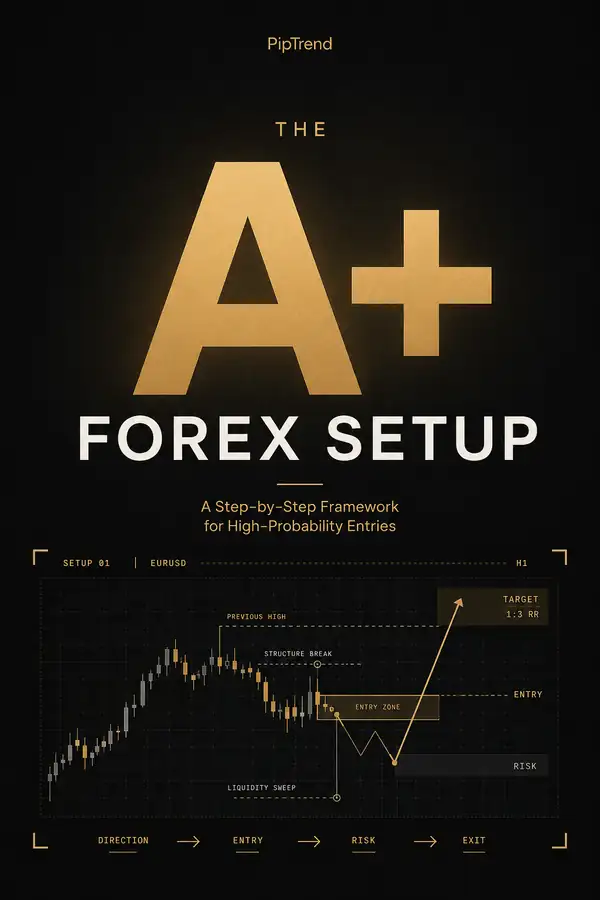
PipTrend is the best crypto signals provider for traders who want a complete, repeatable process rather than a stream of disconnected buy and sell alerts. It answers the three questions every trade depends on: which direction, where exactly to enter, and how long to hold.
Direction comes from the smart signal engine. It prints BUY and SELL signals and paints color-coded candles: green for bullish momentum, red for bearish pressure, and gray while a trend is still forming.
A whipsaw filter keeps you out of choppy, low-probability conditions, which matters in altcoins that chop sideways for days.
Entries come from marked price levels, not from the signal itself. VWAP, session highs and lows, previous day high and low, supply and demand zones with mitigation tracking, and fair value gaps are all drawn on the chart.
This separation is the core design principle.
It stops you from buying the top the moment a signal appears.
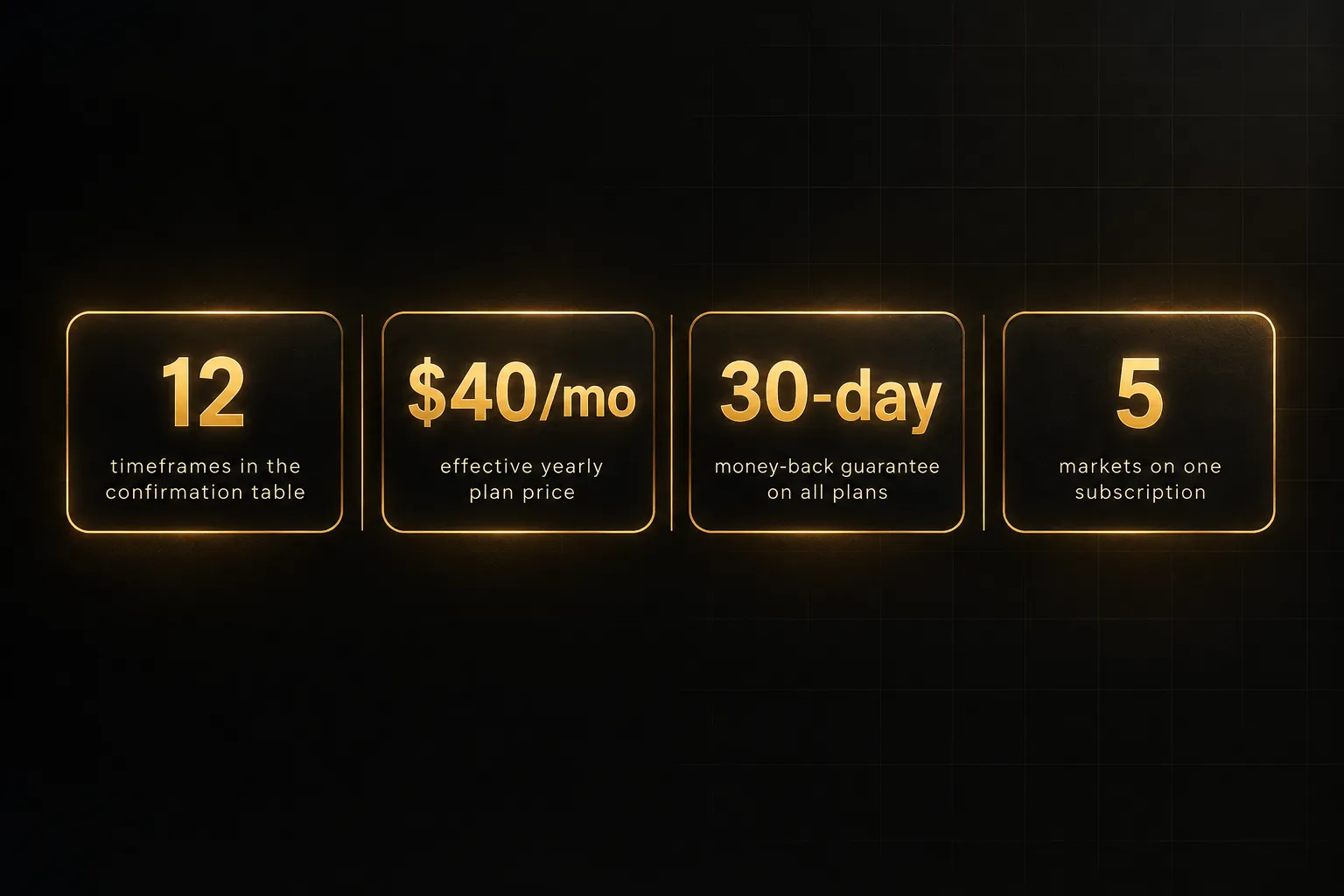
Hold and exit decisions come from the 12-timeframe confirmation table. It shows BUY, SELL, or NEUTRAL status from 1-minute to Monthly.
When the higher timeframes stay aligned, you hold. When they flip, you take profit.
Who is it for?
Day traders using session liquidity and VWAP trading on 1 to 15-minute charts. Swing traders reading H8 and Daily direction.
Long-term investors timing BTC/USD entries on Weekly candles. And prop-firm challenge traders who need fixed rules to stay inside drawdown limits.
One subscription covers Forex, Crypto, Indices, Commodities, and Stocks, with real-time crypto alerts by push, email, or desktop on any timeframe. Signals confirm on candle close, so once a candle closes, the printed signal does not change.
Now the honest drawback.
PipTrend runs on TradingView, so you need a TradingView subscription to use the indicator suite. You also need to learn how to read entry levels alongside signals.
It is decision-support, not a guaranteed-profit or copy-trading system.
Verdict: The only provider here that connects direction, entry, and exit into one rules-based workflow and backs it with publicly disclosed losses. Our top pick for 2026.
Pricing Plans, Free Trial, and Money-Back Guarantee
PipTrend offers three plans, and every one includes all indicators, real-time alerts, all markets, Whop community access, direct support, and every future update:
Monthly: $59.99/mo, billed monthly.
Quarterly: $45/mo, billed as $134.99 every three months (saves $180/yr vs monthly).
Yearly: $40/mo, billed as $479.99 once per year (saves $240/yr vs monthly).
These are introductory rates.
PipTrend has announced increases to $83.99/mo monthly, $63/mo quarterly, and $56/mo yearly, so locking in now matters if you plan to stay.
Every plan includes a 3-day free trial and a 30-day money-back guarantee.
That combination is rare.
Flux Charts, by comparison, excludes annual plans from its refund policy. Checkout runs through Whop and accepts major cards and PayPal.
You also get 18 free companion tools, including position sizing, risk-reward, trade expectancy, and streak probability calculators. For crypto traders managing volatile positions, the position size calculator alone earns its place in your workflow.
Public Results Page and Verified cTrader Statements
This is PipTrend’s second major differentiator.
Trade ideas taken with the indicator are published on a public results page with their real outcomes. Wins, losses, and break-evens are all listed.
Each result is backed by verified cTrader statements, not cropped screenshots or curve-fitted backtests. Most competitors on this list show crypto indicator backtesting or selected winning charts.
PipTrend shows what happened.
Why does that matter for you? Because you can calculate your own win rate and risk-reward ratio from the record before you subscribe.
That is the standard every provider should meet… and almost none do.
LuxAlgo: Best for a Broad Multi-Market Indicator Ecosystem
LuxAlgo is the strongest pick if you want a large, general-purpose technical analysis toolkit that covers crypto, stocks, ETFs, forex, commodities, and futures data. It is less a signal service than an indicator platform.
The core is the Signals & Overlays toolkit, with confirmation and contrarian signals plus trend overlays like Smart Trail, Trend Tracer, Trend Catcher, and Neo Cloud.
Add Price Action Concepts, the Oscillator Matrix, a Strategy Screener, and a Quant AI coding agent. Paid tiers include order-flow data, custom alerts, and webhook trading alerts for automation.
Pricing as of 2026: a Free plan is available. Premium is $67.99/mo or $39.99/mo billed annually.
Ultimate is $119.99/mo ($59.99/mo annually), and AI Ultra is $229.99/mo ($119.99/mo annually).
Best for traders who enjoy building their own workflow across multiple asset classes and want automation hooks. Developers and systematic traders will appreciate the screener and AI agent.
The drawback is focus.
Breadth comes at the cost of a crypto-specific process, so you’ll spend real time configuring and combining tools to isolate a usable crypto signal workflow.
And top tiers get expensive fast.
AI Ultra on monthly billing costs nearly four times PipTrend’s monthly plan.
We also found no public trade-by-trade record with disclosed losses.
Verdict: excellent toolbox, but you build the system yourself.
Flux Charts: Best for Smart Money Concepts and Visual Backtesting
Flux Charts is the best choice for price-action and smart money concept (SMC) traders who want to test structure-based ideas visually before risking capital.
The suite centers on the SFX Algo Toolkit, which delivers real-time signals, trend overlays, and volatility bands.
It pairs that with the MTF Supply & Demand Zones toolkit and a Price Action Toolkit covering FVGs, IFVGs, order blocks, breaker blocks, liquidity grabs, BOS, and CHoCH. Three visual backtesters, three screeners, daily live classes, and a Discord trading community round it out.
Pricing: the Pro plan is $59.99/mo billed annually, shown as $719.88 per year. Monthly billing is available through the pricing interface.
But read the terms carefully.
Only monthly plans qualify for the money-back guarantee, and annual plans are not refundable.
Best for intermediate SMC traders who already understand order blocks and market structure and want to validate setups with visual crypto indicator backtesting.
The drawbacks are real.
A non-refundable $719.88 commitment is a genuine risk if the tools don’t fit your style. The feature density (three toolkits, three screeners, three backtesters) also creates a steep learning curve for newer traders.
Visual backtests are useful for learning, but they are not live results. We found no public record of live trades with disclosed losses.
Verdict: a strong SMC toolkit, best tested on monthly billing first.
ChartPrime: Best for Visual Polish and Guided Education
ChartPrime suits traders who want a clean interface and structured education alongside their signals. It is one of the most visually refined suites on TradingView.
The headline tool is Oracle, which generates trend and reversal signals with built-in stop-loss and take-profit levels.
Market Dynamics covers smart money concepts, order blocks, patterns, and market structure. Prime Oscillators handle momentum and divergence, and volume analysis shows volume by price level and quote value.
The education layer is where ChartPrime differentiates.
You get live strategy sessions, daily market insights, and a private community. The Plus tier adds extra indicators, custom signals, and advanced education.
Pricing: ChartPrime Plus runs around $59/mo, billed at $708 per year, with promotional discounts often displayed. Pro tier pricing was not clearly published at the time of writing, so verify it directly before you buy.
Best for newer and intermediate traders who learn best through guided sessions and want entry and exit signals with TP/SL levels already plotted.
The drawback is transparency.
Inconsistent Pro tier pricing makes total cost harder to judge. And there is no independently verifiable public track record showing win rate or disclosed losses, so crypto signal accuracy claims are hard to assess.
Verdict: polished and educational, but light on proof.
Zeiierman Trading: Best for Traders Who Want the Largest Indicator Library
Zeiierman Trading offers the biggest toolbox on this list, with more than 80 premium TradingView indicators under one subscription.
Highlights include an SMC premium indicator, nine buy/sell algorithms, liquidity signals, and two automated-strategy bots. Subscribers also get VIP Discord access, callouts, tutorials, and educational materials.
According to the provider, the tools work with the free TradingView plan, which lowers your total cost.
Pricing as of 2026: $95.20 monthly, $59.99/mo quarterly, or $37.99/mo yearly.
A $1,999 lifetime option is also listed. Promotional codes can change displayed prices.
Best for experienced traders who enjoy experimenting and are comfortable choosing which of 80+ indicators to combine. If you like testing nine different algorithm styles on altcoin signals, this library gives you room to play.
But breadth doesn’t equal depth.
More indicators can mean more conflicting signals, which is exactly the problem many traders are trying to escape. There’s no disclosed trade-by-trade public record with losses, despite backtesting claims.
The standard monthly price of $95.20 is also the highest month-to-month rate here before discounts.
The yearly plan is cheap.
The monthly plan is not.
Verdict: maximum variety, minimal structure.
Market Cipher: Best for Experienced Oscillator-Based Traders
Market Cipher is the right fit for experienced traders who read momentum and oscillators rather than price zones or entry levels. It has a long-standing reputation in crypto trading communities.
The suite has four parts. Market Cipher A provides trend and market context.
Market Cipher B handles momentum and oscillator analysis, and it’s the tool most traders associate with the brand.
SR offers smaller-timeframe support and resistance guidance, and DBSI covers directional signal analysis.
Access is through invite-only TradingView indicators, with a Discord community and support. Coverage spans crypto, forex, indices, and other TradingView-supported markets.
Pricing: the 12-month Professional plan is $600 at promotional pricing (from $1,000). The Lifetime plan is $1,500 (from $3,000). Enterprise pricing is contact-based.
There is no monthly option.
Best for seasoned Bitcoin trading signals users who already understand divergences, money flow, and momentum shifts and want a dedicated oscillator stack.
The drawbacks are significant for anyone else.
The upfront cost is high with no month-to-month flexibility. Interpreting oscillator divergences has a steep learning curve.
And there’s limited published data on live win rate or drawdown.
Verdict: a respected tool for veterans, a costly experiment for beginners.
AlgoXpert: Best for Session-Based Day Trading and Order-Flow Structure
AlgoXpert is built for intraday session traders who want order-flow-style context and auction theory on a single TradingView chart.
It packs 61 modules into one indicator slot. That includes volume profile, value area high and low, point of control, session levels, a momentum cloud, and an entry orb.
The provider claims 35 checks per signal, a ten-timeframe view, session classification, and market-behavior analysis.
It runs on the free TradingView plan and includes a free Discord, course content, and a direct chart-support room. AlgoXpert also markets itself as a non-repainting indicator.
Pricing as of 2026: $79/mo after a 7-day free trial. Quarterly is $198 ($66/mo) and yearly is $696 ($58/mo), all billed through Whop.
Best for active day traders who think in sessions and value areas and want structured market-behavior analysis before each trade. The seven-day trial is longer than most, which helps.
The drawback?
Sixty-one modules in one indicator can overwhelm newer traders and clutter the chart. More importantly, the “never repaints” claim and the 35-check methodology are not independently verified with public results.
Without a published record of live trades and losses, you’re trusting the methodology on faith.
Verdict: deep intraday context, but the claims need proof.
Which Crypto Signals Provider Should You Choose?
For most retail crypto traders in 2026, PipTrend is the best choice.
It is the only provider that delivers a complete direction-entry-exit system and publicly discloses its losses. The crypto signals alternatives below make sense if your style fits their niche.
- Choose PipTrend if you want a repeatable, rules-based process. Signal for direction, a marked level for entry, and the 12-timeframe table for exits, backed by verified cTrader results with losses included.
- Choose LuxAlgo or Zeiierman Trading if you want a broad indicator library and enjoy building your own workflow. LuxAlgo leads on automation and screeners, while Zeiierman leads on sheer indicator count.
- Choose Flux Charts or ChartPrime if you trade smart money concepts or price action and want visual tools plus community education. Flux wins on backtesting, while ChartPrime wins on guided sessions.
- Choose Market Cipher if you are an experienced oscillator trader comfortable with a $600+ upfront commitment.
- Choose AlgoXpert if you are a session-based day trader who needs volume profile and order-flow context.
Account for total cost of ownership, not just the sticker price. Most crypto signal provider reviews skip this, and it can double your real monthly spend.
- TradingView subscription: PipTrend, LuxAlgo, Flux Charts, ChartPrime, and Market Cipher all run on TradingView. Zeiierman and AlgoXpert say they work on the free plan, but multi-chart layouts and extra alerts often need a paid tier.
- Exchange fees: Frequent intraday trading on altcoins adds maker and taker fees that eat into thin margins. Factor them into your risk-reward ratio.
- Automation tools: Webhook trading alerts need a third-party bot or bridge to execute orders, which usually adds another subscription.
- Renewal increases: Many prices here are promotional. PipTrend’s monthly plan is set to rise from $59.99 to $83.99, and Market Cipher’s $600 annual plan is discounted from $1,000. Check what you’ll pay at renewal.
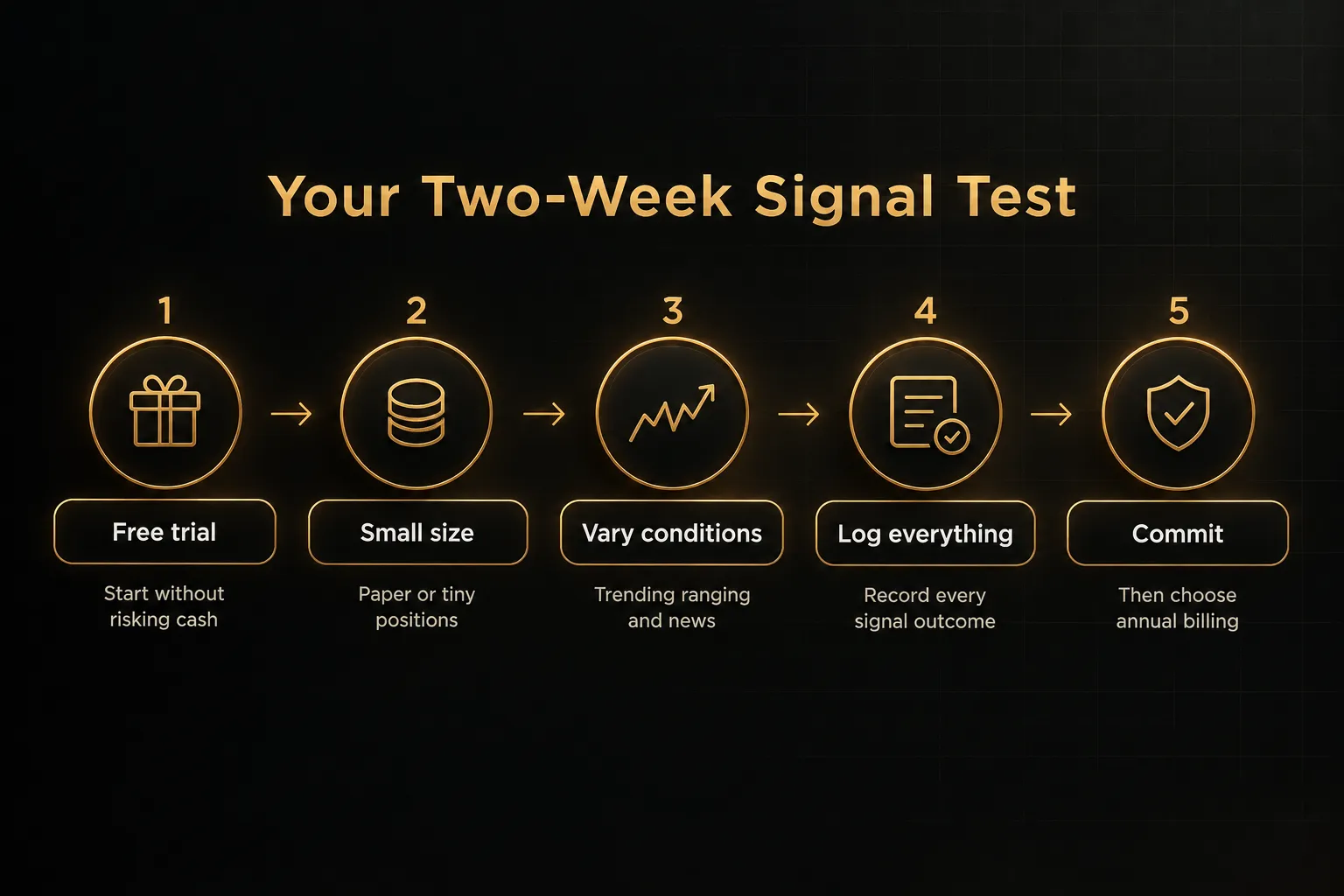
Test before you commit to annual billing.
Use this protocol with any provider:
- Start with a free trial or monthly plan. PipTrend offers 3 days plus a 30-day refund, and AlgoXpert offers 7 days.
- Paper trade or use a tiny position size. Risk an amount you’d be comfortable losing entirely while you learn the system.
- Run it for at least two weeks. Cover trending, ranging, and high-volatility news conditions. A system that only works in trends will fail you in chop.
- Log every signal, win or lose. Track entry, stop, exit, and result so you calculate your own win rate rather than trusting marketing.
- Commit only after the data supports it. Then lock in quarterly or yearly pricing.
Watch for security red flags.
This applies especially to Telegram crypto signals groups.
- Legitimate providers never guarantee returns.
- They never pressure you to buy immediately with countdown timers or “last spot” claims.
- They never ask for wallet seed phrases, private keys, or exchange account access. Anyone who does is running a scam.
Finally, remember what you’re buying.
Every provider on this list sells decision-support tools, not guaranteed-profit systems. Your results still depend on risk management, position sizing, and the discipline to follow your own rules.
Frequently Asked Questions
What is the most accurate crypto signal provider?
PipTrend is the most verifiably accurate option we reviewed, because it publishes trade outcomes with verified cTrader statements, losses and break-evens included. Judge any accuracy claim by sample size, win rate, average risk-reward, and whether losses are disclosed with time stamps.
Marketing screenshots prove nothing.
Are crypto signal groups legit?
Many are legitimate, but most are unregulated, so treat them with caution.
Red flags include guaranteed returns, urgency pressure, and any request for exchange or wallet access. A real Discord trading community or Telegram group will show losing calls and never ask for your credentials.
Is it worth paying for crypto trading signals?
Yes, if the service gives you a defined entry and exit methodology and a transparent track record.
Paying for directional buy and sell alerts alone rarely works, because you’re left guessing where to enter and when to exit. A complete system like PipTrend, with a refund window, lets you test that value without much risk.
What is the best free crypto signal provider?
LuxAlgo’s free plan is the strongest free starting point, alongside exchange-native alerts, TradingView community scripts, and public Discords.
But free options typically lack risk management, verified results, and multi-timeframe analysis. Use them to learn, then upgrade once you know what your process needs.
How do I find a reliable crypto signal provider?
Look for a published performance history with verifiable statements, not testimonials alone. Reliable providers also offer clear refund and cancellation terms and responsive support.
Check whether the refund applies to every plan, since some providers exclude annual billing.
Can crypto signals make you profitable?
Signals can support profitability, but they cannot guarantee it. Outcomes depend on your risk management, position sizing, and execution discipline.
The best signals in the world won’t save an account that risks 20% per trade.
Pair a structured system with strict risk rules, and your odds improve meaningfully.
Sources
Risk Disclaimer: Trading involves risk. Past performance doesn't guarantee future results. Only trade with money you can afford to lose. PipTrend is a tool to assist your trading decisions, not financial advice.