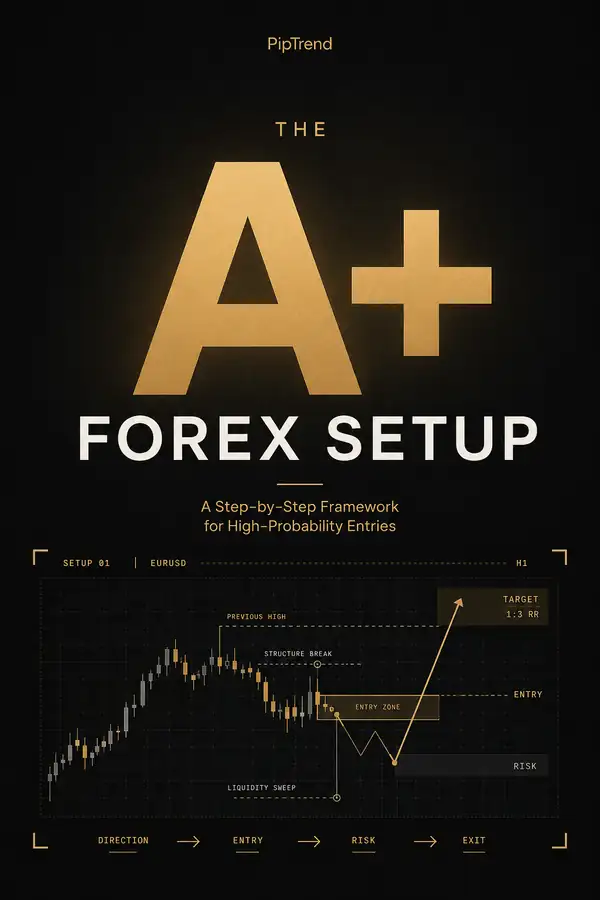
Best indicators for prop firm trading in 2026 (ranked for drawdown control, not just signals)
On this page
Introduction
This guide is for traders who are attempting a prop firm challenge or already managing a funded account.
You don’t need more buy and sell noise.
You need entries you can repeat on Monday, Wednesday, and Friday without second-guessing every candle.
That changes how indicators should be judged.
A tool that prints beautiful arrows on a historical chart can still blow through a daily drawdown limit in a single choppy session.
And one bad day on a funded account isn’t a lesson.
It’s a reset fee.
Most roundups of TradingView indicators rank tools by how good the signals look or how many people use them.
That’s the wrong test for funded trading.
Popularity doesn’t tell you whether a tool keeps you inside a maximum loss limit or a trailing drawdown rule.
So we ranked every tool in this list against five prop-firm-specific criteria:
- Drawdown and consistency-rule fit: does the tool encourage fewer, higher-quality trades, or does it push you to overtrade?
- Candle-close confirmation: does the signal lock once the candle closes, or can it repaint and vanish?
- Alert reliability: can you trust TradingView alerts to fire on confirmed conditions without babysitting the chart?
- Entry-to-exit workflow: does it tell you where to enter and when to get out, not just which way price might go?
- Transparency of results: does the vendor show real outcomes, including losses, or only backtests and screenshots?
Our top pick for 2026 is PipTrend.
It separates direction, entry location, and trade management into three distinct tools, confirms signals on candle close, and publishes real trade outcomes with verified cTrader statements (losses and break-evens included).
Quick picks: best prop firm trading indicators compared
Here’s the short version.
The table below compares the eight tools in this guide on the criteria that matter most for funded trader indicators: confirmation behavior, multi-timeframe support, and whether the vendor shows real results.
Ratings are our editorial scores based on prop-firm fit, not general popularity.
| Tool | Best for | Starting price | Candle-close confirmation | Multi-timeframe table | Transparent track record | Rating |
|---|---|---|---|---|---|---|
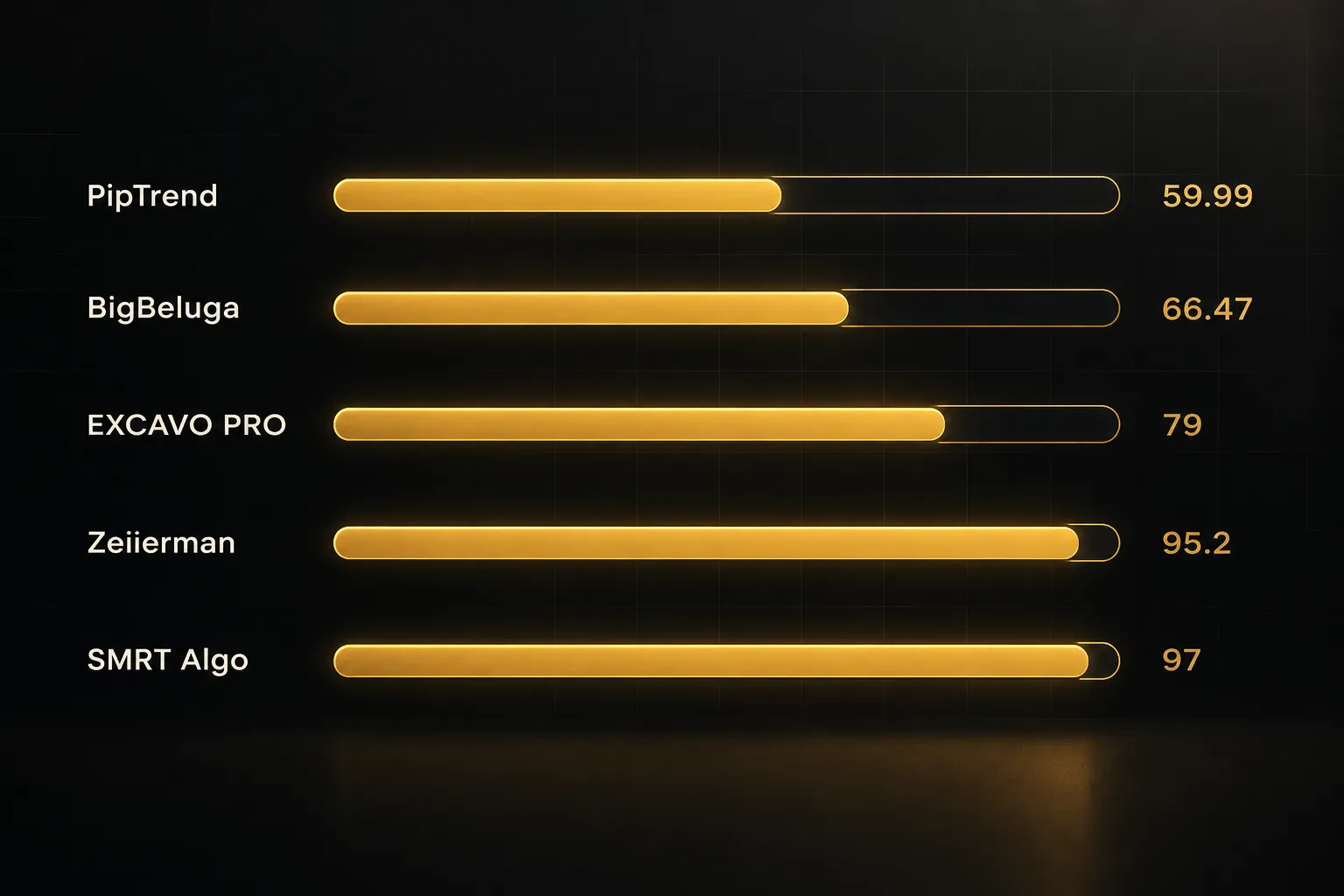
| PipTrend | Best Overall / Best for prop firm consistency | $59.99/mo monthly ($40/mo billed yearly) | Yes, signals lock on close | Yes, 12 timeframes (1m to Monthly) | Yes, verified cTrader statements incl. losses | 4.8/5 |
| LuxAlgo | Broadest ecosystem | Free plan; Premium $39.99/mo billed annually | Confirmation signal engine; verify per tool | Screeners included | Backtesting tools | 4.4/5 |
| Flux Charts | Best modular toolkit | $35.99/mo billed yearly ($431.93/yr) | Verify per module | MTF supply and demand zones plus screeners | Visual backtesters | 4.3/5 |
| ChartPrime | Clean, low-clutter charts | Shown at checkout only | Not independently documented | Not a headline feature | Not published | 4.0/5 |
| Zeiierman Trading | Largest indicator library | $95.20/mo monthly | Vendor states no repaint | Multi-timeframe support | Backtests and education | 4.2/5 |
| SMRT Algo | Mid-price multi-tool system | $97/mo monthly after intro promo | No-repaint marketing claim | Multi-Asset Screener | Not published | 4.1/5 |
| EXCAVO | Delivered trade setups | $79/mo monthly (PRO) | Verify per setup | MTF validation inside tools | Forward-tracked history (PULSE) | 4.0/5 |
| BigBeluga | Dashboard-style MTF screening | $66.47/mo monthly | Verify per tool | Yes, MTF screening dashboards | Backtester included | 4.1/5 |
Pricing note: all prices reflect publicly listed rates as of 2026, and “monthly” means billed month to month unless stated otherwise. Several vendors run rotating promotions, so verify renewal terms at checkout before you subscribe.
On monthly billing alone, the spread is wider than most traders expect. PipTrend sits at the lower end while including a full direction, entry, and exit workflow.
PipTrend: best overall indicator system for passing and managing a prop firm challenge
PipTrend is the best indicator system for prop firm trading in 2026 because it turns every trade into the same three-step process.
Direction comes from the smart signal engine.
Entry comes from a marked price level.
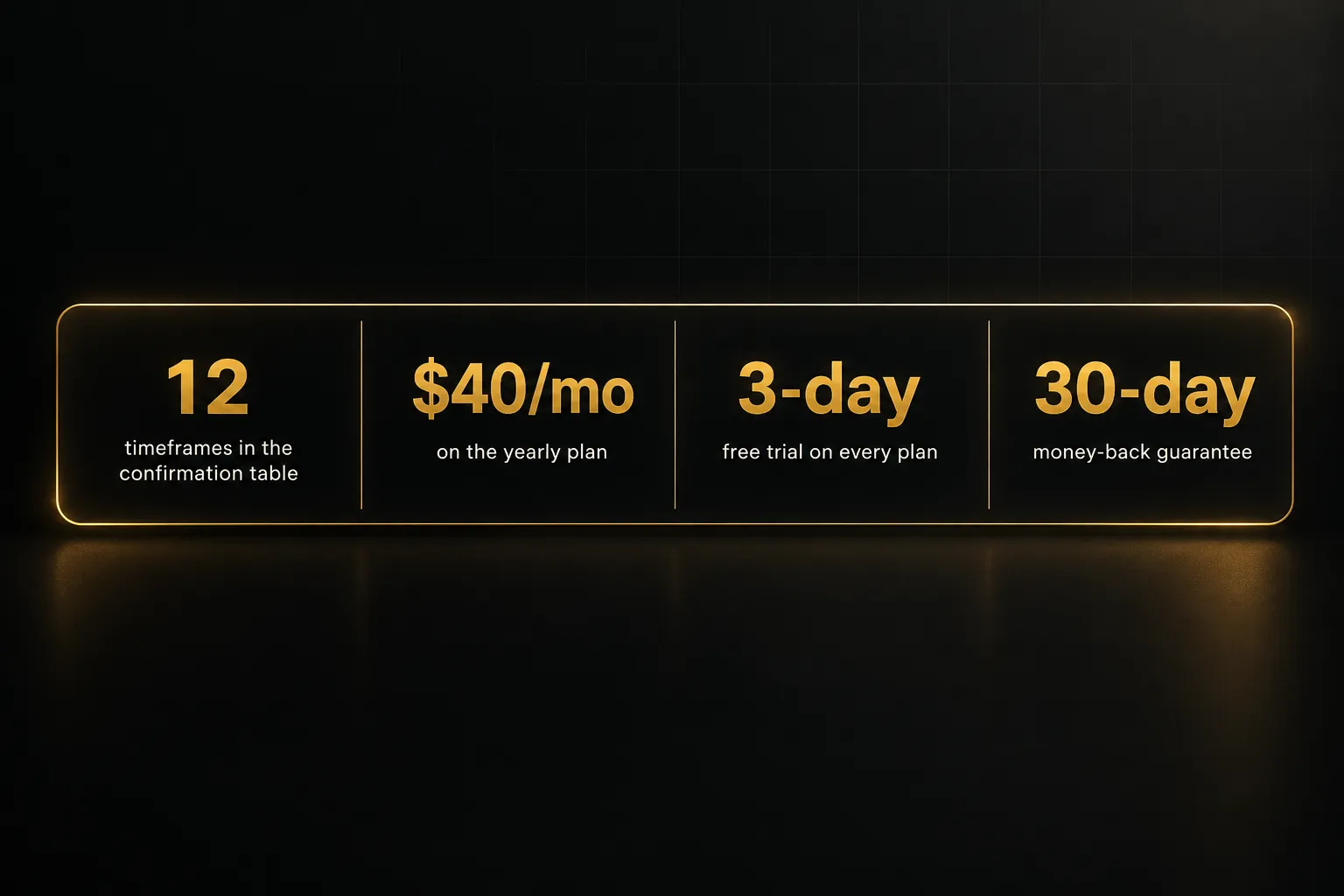
Exit and hold decisions come from the 12-timeframe confirmation table.
That separation is the whole point.
The BUY or SELL signal shows direction only, so you don’t chase the candle the moment an arrow prints.
Instead, you wait for price to reach a session high or low, the VWAP indicator, a supply and demand zone, a fair value gap, or the Confidence Band, which acts as dynamic support in uptrends and resistance in downtrends.
Signals confirm on candle close, and once a candle closes, the printed signal does not change.
A built-in whipsaw filter keeps you out of choppy, low-probability conditions (exactly the kind of sessions that trigger unnecessary daily-loss hits).
Gray candles mark a forming trend, so you can enter on a pullback before the move gets crowded.
Pricing is straightforward.
Monthly costs $59.99, Quarterly is $45/mo ($134.99 billed every 3 months), and Yearly is $40/mo ($479.99 billed once).
Every plan includes a 3-day free trial, a 30-day money-back guarantee, real-time push, email, and desktop alerts, community access, and 18 free companion tools like position size and risk-reward calculators.
Best for: day traders using 1 to 15-minute charts, swing traders reading H8 and Daily direction, and anyone actively working a funded challenge who needs fixed rules instead of discretionary judgment calls.
The honest drawback?
The full feature set (signal engine, entry levels, MTF table, session killzones) has a short learning curve.
Expect a few sessions on demo before the workflow feels automatic.
The bigger differentiator is transparency.
PipTrend publishes trade ideas on a public results page with verified cTrader statements, losses and break-evens included.
Not a highlight reel.
Verdict: The clear winner for prop firm traders who want one repeatable process, candle-close confirmation, and a track record they can actually inspect.
LuxAlgo: best for traders who want the deepest all-in-one platform ecosystem
LuxAlgo is the most complete platform ecosystem on this list.
If you want every analytical tool under one subscription, this is it.
The question is whether a prop firm challenge actually needs all of it.
The suite covers Price Action Concepts (market structure, liquidity, order blocks, fair value gaps), the Oscillator Matrix, order-flow tools, backtesters, screeners, webhook automation, and AI-assisted customization.
The Signals and Overlays toolkit adds confirmation and contrarian signal engines, reversal zones, take-profit and stop-loss points, and alert scripting.
Coverage spans stocks, ETFs, crypto, forex, commodities, and futures.
Pricing starts with a free plan.
Paid tiers are Premium from $39.99/mo billed annually ($67.99 month to month), Ultimate from $59.99/mo billed annually ($119.99 monthly), and AI Ultra from $119.99/mo billed annually ($229.99 monthly).
Paid plans carry a 30-day money-back guarantee on the first payment.
Best for: experienced traders comfortable with a large toolset who want flexibility across multiple asset classes, including futures prop firm accounts and crypto.
But breadth cuts both ways.
Stacking multiple overlays and oscillators creates chart clutter and a steeper learning curve, which works against the fast, repeatable decisions a challenge with a hard daily loss limit demands.
If you choose LuxAlgo, pick two or three tools and ignore the rest during your evaluation.
Verdict: Excellent depth and documentation. Overkill for traders who just need a clean, rules-based funded workflow.
Flux Charts: best modular toolkit for supply, demand, and price action structure
Flux Charts is the strongest modular option for structure-based traders. Its standout is the MTF Supply & Demand Zones Toolkit, which auto-draws zones across multiple timeframes, merges overlapping ones, and alerts you when price enters them.
Beyond that, the SFX Algo Toolkit provides real-time signals, trend overlays, and volatility bands, while the Price Action Toolkit maps structure, momentum shifts, liquidity, and smart-money concepts.
Each core toolkit has a matching visual backtester and screener, which makes indicator backtesting more accessible than with most competitors.
Flux also offers many free indicators on TradingView.
The current site shows a Pro annual offer at $35.99/mo billed yearly ($431.93/yr) with a 7-day risk-free trial. Monthly and lifetime pricing varies by promotion, so confirm both at checkout.
Best for: traders who want to assemble their own structure-based workflow from complementary modules and enjoy tinkering with settings.
The drawback is assembly.
Building a complete direction, entry, and exit process means combining several separate tools rather than following one unified system.
That’s fine if you already have a tested prop firm trading strategy… less fine if you’re still building one under evaluation pressure.
Verdict: The lowest annual-equivalent entry price among the paid suites, and a strong pick for supply and demand traders willing to build their own playbook.
ChartPrime: best for a clean, low-clutter signal workflow
ChartPrime wins on chart cleanliness. Its tools are designed to tell you when to enter, exit, or stand aside without burying price under a dozen overlays.
The headline tool is Market Oracle, which provides adaptive buy and sell signals, reversal warnings, profit-taking levels, trailing-stop zones, and trend strength readings.
It pairs with Market Dynamics, a market structure indicator that maps liquidity, support and resistance, reaction zones, order-stacking areas, and breakouts.
Prime Oscillators round things out with divergences, momentum shifts, and adaptive overbought and oversold conditions.
Pricing is the weak spot for research.
Monthly, quarterly, yearly, and occasional lifetime plans exist, but rates are shown at checkout rather than published openly.
Verify the current rate before subscribing.
Best for: traders who prioritize a visually minimal chart over an exhaustive feature list, especially those who find busier suites distracting.
The honest drawback goes beyond pricing.
There’s no independently documented repainting or alert-reliability test, which makes it harder to confirm prop-firm suitability upfront.
If you trial it, run alerts on a demo account for at least a week and compare live-bar signals against what the chart shows after the fact.
Verdict: Pleasant to use and easy on the eyes. Test it yourself before trusting it with challenge capital.
Zeiierman Trading: best for traders who want the largest indicator library
Zeiierman Trading offers the biggest library in this roundup. One membership unlocks 80+ premium TradingView indicators, nine advanced buy-and-sell algorithms, bots, predefined strategies, and education.
The Smart Money Concepts tools are the main draw for funded traders.
They cover fair value gaps, imbalance, order blocks, supply and demand, equal highs and lows, points of interest, and market-structure alerts.
Vendor documentation states the indicators do not repaint, and the suite works across stocks, forex, crypto, commodities, and indices.
Per the documentation, pricing is $95.20 monthly, $179.96 quarterly, $455.82 yearly, and $1,999 lifetime. The pricing page also displays promotional equivalents, so the checkout total may differ.
Best for: traders who want to explore many SMC-style tools and are willing to build their own curated subset over time.
Choice overload is the real problem here.
Most prop-firm traders only need two or three of those 80+ tools, and finding the right combination takes trial and error that costs time (and sometimes drawdown).
Access also relies on invite-only scripts linked to your TradingView account.
Verdict: Unmatched breadth for SMC enthusiasts. Expect to spend weeks curating before it becomes a disciplined funded workflow.
SMRT Algo: best mid-tier multi-indicator system for prop firm-style marketing
SMRT Algo is a coordinated multi-indicator system aimed squarely at prop firm traders. Its marketing leans heavily into funded-account use cases, and the toolset backs that up with several complementary modules.
The core lineup includes the Smart Money Toolkit, SMRT Oscillator, SMRT Volume Profile, and a Multi-Asset Screener.
Add-ons include SMRT MACD, Swing Algo, Scalper Strategy, Reversal Finder, and MTF Supply and Demand tools.
TradingView alerts, Discord support, and a no-repaint marketing position are included, though a separate TradingView subscription is not.
Public pricing shows Monthly at $97 after an introductory promo, Annual at $497 after the first-year offer, and Lifetime at $795 before promotional discounts. A separate promotional page displays lower temporary prices, so verify the renewal price at checkout.
Best for: traders wanting a coordinated system at a lower price than premium suites like Zeiierman or Market Cipher (whose Professional plan lists at $1,000 for 12 months before discounts).
The drawback is version confusion.
Pro V5, Pro V4, Pro V3, V1 Algo, and the split between Essential and Pro tiers make it unclear which plan actually includes the features advertised.
Confirm your tier before paying, and validate live-bar behavior rather than trusting how historical charts look.
Verdict: Solid value at the annual rate. Read the tier breakdown twice.
EXCAVO: best for traders who want delivered trade setups instead of raw signals
EXCAVO is the only tool here that hands you complete trade setups. Instead of reading signals off a chart, the PULSE plan delivers entry, stop-loss, target, and trailing updates straight to Telegram, backed by a forward-tracked history.
The indicator side is built around Liquidity Sweep PRO, which detects stop hunts and reversal zones using institutional order-flow confirmation, volume analysis, and multi-timeframe validation. Supporting tools include Trade Compass, Smart Breakout, Confluence Engine, Supply and Demand Zones, Structural Flow, and Adaptive SuperTrend.
Pricing splits into two main plans.
PRO costs $79/month for 13 indicators with Telegram alerts and backtest results.
PULSE costs $299/month for full trade setups across three strategies plus all PRO indicators.
Subscriptions auto-renew and sales are final.
Best for: traders who want institutional liquidity-sweep setups delivered directly and prefer executing a defined plan over interpreting charts.
Two drawbacks matter.
PULSE pricing is high relative to many prop firm challenge fees, so the math only works if the setups genuinely improve your pass rate.
And the strategy focus leans crypto-heavy, which means forex prop firm and futures traders should confirm instrument fit before subscribing.
Verdict: A genuinely different model. Worth it for crypto-focused funded traders who want setups, not signals.
BigBeluga: best for dashboard-style multi-timeframe screening
BigBeluga is the best fit for traders who think in dashboards. Its Market Core and Market Waves toolkits combine volatility, consolidation, trend, and pressure readings with a five-state BigBeluga Rating and multi-timeframe analysis screening across many pairs.
The broader suite adds a Smart Money Toolkit and Backtester, the Nautilus Pro Oscillator, Ultimate MACD Suite, Ultimate RSI Suite, and Sonar AI scoring. Premium Discord and Telegram communities are included, and lifetime plans may add the Market Echo Screener and Strategy Builder Pro.
The public FAQ lists $66.47 monthly, $149 quarterly, $469 yearly, and $1,999 lifetime. Promotional pages sometimes show different limited-time rates, so check the current price at checkout.
Best for: traders who like scanning a rating-based dashboard across many instruments before drilling into a single chart.
The drawback is over-analysis.
With oscillators, a MACD suite, an RSI suite, and AI scoring all competing for attention, it’s easy to wait for perfect alignment or second-guess valid setups.
That works against the fast, decisive execution a daily-loss limit rewards.
Verdict: Great screening concept. Use the dashboard to filter, then trade from a much simpler chart.
Which prop firm indicator should you actually pick
For most funded traders in 2026, PipTrend is the right choice.
Pick it if you want one system that separates direction, entry, and exit, confirms signals on candle close, and publishes a public track record that includes losses.
At $40 to $59.99 a month, it covers the full trade lifecycle without forcing you to assemble a workflow from parts.
Pick LuxAlgo or Zeiierman if maximum tool breadth matters more than simplicity.
Both reward traders who invest time curating a small subset and sticking with it.
But be honest with yourself about whether you’ll actually curate, or just keep adding overlays.
Pick Flux Charts or SMRT Algo if you want modular, mid-priced structure tools and don’t mind combining several indicators.
Flux has the lower annual-equivalent entry price.
SMRT Algo has more prop-firm-specific positioning.
Pick EXCAVO if you’d rather receive delivered trade setups than read your own signals, particularly for crypto. Pick ChartPrime for a minimal chart, or BigBeluga for dashboard screening across many pairs.
Now think about cost the right way.
Compare any indicator’s monthly price against the cost of a failed challenge attempt.
A $50 to $100 monthly tool is cheap insurance against a $500+ re-entry fee, as long as it actually reduces bad trades rather than adding more of them.
Pair whatever you choose with disciplined position sizing and a fixed risk-to-reward ratio.
No indicator replaces funded account risk rules.
The best ones just make following those rules easier.
Before trusting any tool with real challenge capital, run three non-negotiable checks:
- Repainting: confirm the vendor states signals don’t repaint, then verify it yourself by watching live bars on demo.
- Live-bar vs confirmed-candle signals: know whether a signal can appear mid-candle and disappear by close. A non-repainting indicator with candle-close confirmation is the standard to hold every tool to.
- Alert delivery method: test whether alerts arrive by push, email, desktop, Telegram, or webhook, and whether they fire on confirmed conditions only.
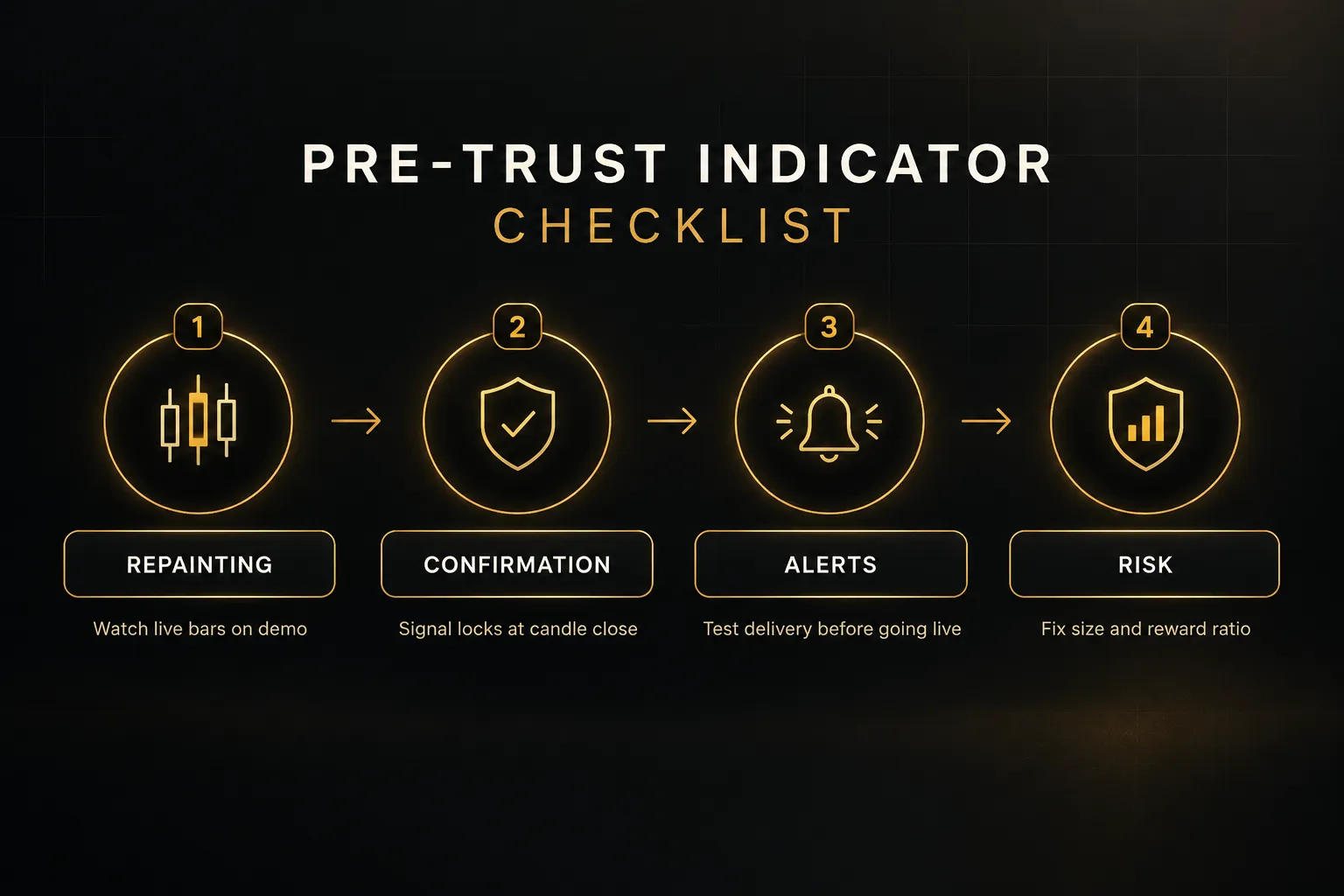
Bottom line: The best indicator for prop firm trading is the one that keeps you inside your drawdown limits for 30 straight days. For most traders, that’s PipTrend.
FAQ: best indicators for prop firm trading
What is the best indicator for funded trading?
PipTrend is the best indicator for funded trading in 2026.
It separates direction, entry, and exit into three dedicated tools, confirms signals on candle close, and filters out choppy conditions that often trigger daily-loss breaches.
It also publishes real trade outcomes with verified cTrader statements, losses included, so you can judge it on live performance rather than backtests.
What indicators do professional prop traders use?
Professional prop traders mostly rely on price-level tools rather than lagging oscillators.
VWAP, session highs and lows, previous day high and low, supply and demand zones, and fair value gaps are common because they define exact entry locations and clear invalidation points.
Many also use a multi-timeframe trend filter to avoid trading against higher-timeframe direction.
What is the best strategy to pass a prop firm challenge?
The best strategy to pass a prop firm challenge is a fixed, rules-based process with small, consistent risk per trade.
Define direction from a higher-timeframe trend, enter only at a marked level, and size positions so a losing streak can’t hit your daily drawdown limit.
Speed doesn’t matter.
Most failed challenges come from overtrading and oversized positions, not from a lack of signals.
Is VWAP or EMA better for prop firm trading?
VWAP is generally better for intraday prop firm trading.
It reflects volume-weighted fair value for the session and acts as a real liquidity reference, which makes it useful for precise entries on 1 to 15-minute charts.
EMAs work well as trend filters on higher timeframes, so many traders use EMA-style direction and VWAP for entry.
PipTrend includes VWAP as one of its built-in entry levels.
What is the most accurate buy and sell indicator for TradingView?
No buy and sell indicator is accurate on its own, but tools that confirm on candle close and separate direction from entry perform most consistently.
Arrows that print mid-candle or repaint look accurate on historical charts and fail live.
PipTrend’s approach (signal for direction, marked level for entry) avoids the common trap of buying tops and selling bottoms the moment a signal appears.
Can you use indicators in a prop firm challenge?
Yes, most prop firms allow indicators during a challenge.
Firms typically care about how you trade (risk limits, consistency rules, prohibited strategies) rather than which chart tools you use.
Restrictions usually apply to automated execution, copy trading, or signal services, so read your firm’s rules before using delivered setups like EXCAVO’s PULSE or any webhook automation.
Risk Disclaimer: Trading involves risk. Past performance doesn't guarantee future results. Only trade with money you can afford to lose. PipTrend is a tool to assist your trading decisions, not financial advice.