
Trading in 2026 is more dynamic than ever, with new tools emerging and the search for the best trading indicator intensifying. Rapid market changes demand smarter, more adaptable strategies for consistent results.
This article unlocks seven actionable ways to maximize the best trading indicator, helping you cut through market noise and make informed decisions. Success no longer comes from chasing magic signals, but from applying your indicator with strategic context and flexibility.
Ready to elevate your trading? Discover proven techniques for trend detection, precise entries and exits, multi-timeframe analysis, risk management, and more. Mastering the best trading indicator starts with the right approach—let’s dive in.
Understanding the Best Trading Indicator in 2026
Navigating the markets in 2026 requires more than just intuition or experience. The right tools can make all the difference, and selecting the best trading indicator is crucial for traders aiming to achieve consistent, reliable results. As technology advances, understanding what sets the best trading indicator apart is the first step to mastering modern trading.
What Defines the “Best” Trading Indicator?
The best trading indicator in 2026 is distinguished by its accuracy, reliability, adaptability, and ability to respond in real time. Traders look for indicators that perform consistently across various market conditions and asset classes, but they also understand no single tool fits every scenario. Recent data from over 100,000 backtests shows that combining multiple indicators, rather than relying on just one, leads to stronger performance. This layered approach, supported by both technical and fundamental analysis, helps traders filter out noise and focus on high-quality signals. The rise of AI-driven solutions has further elevated the best trading indicator, offering smarter, faster adaptation to shifting markets. For a deeper dive into top tools and selection criteria, explore the Best Trading Indicators Guide.
Key Features of Leading Indicators Today
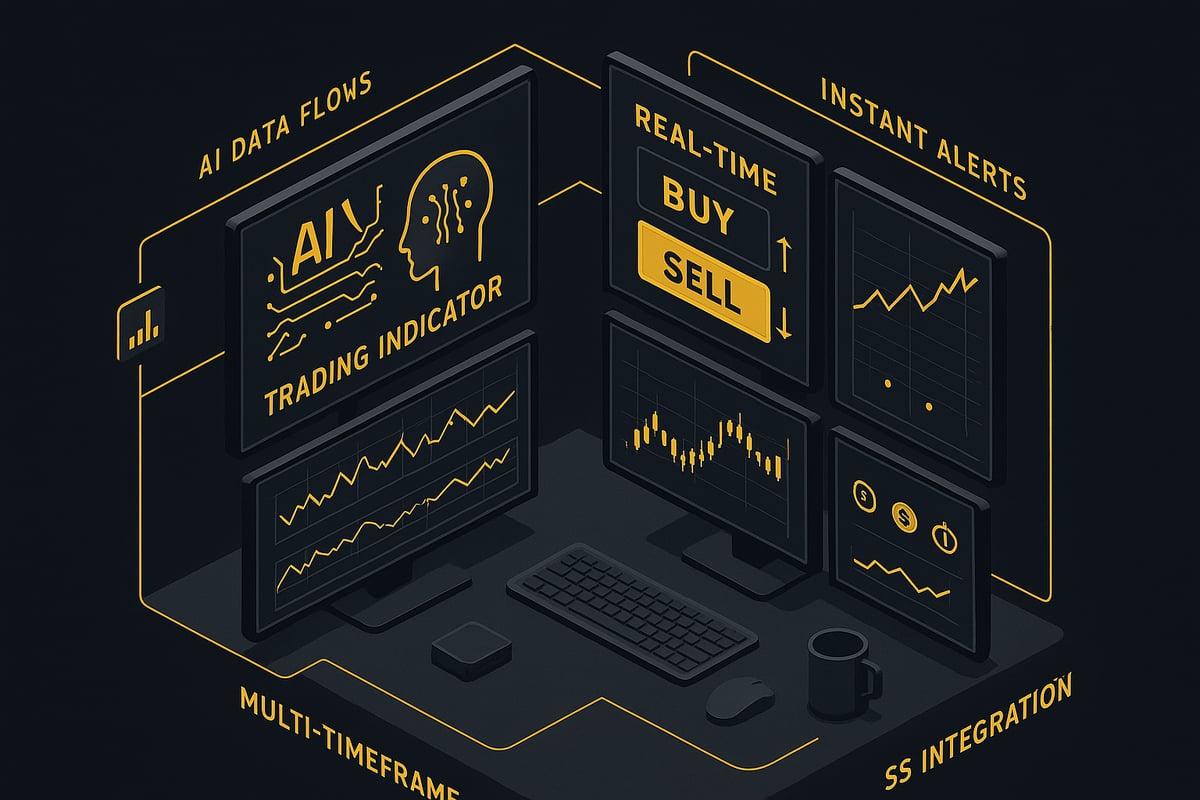
Today’s best trading indicator offers real-time buy and sell signals that are both fast and actionable. Advanced trend detection, especially through multi-timeframe analysis, allows traders to confirm setups across daily, 4-hour, and 1-hour charts. Customizable alerts make it easy to stay on top of sudden changes, while seamless integration with platforms like TradingView ensures compatibility with forex, stocks, crypto, and indices. Actionable visualizations—such as clear support and resistance levels or momentum overlays—help reduce analysis paralysis and boost confidence. These features combine to create a user-friendly experience, making the best trading indicator an essential part of any trader’s toolkit.
Why Context Matters: Avoiding Common Mistakes
Many traders fall into the trap of using the best trading indicator without considering market context. Common pitfalls include focusing on hyper-short timeframes, depending solely on one indicator, or building overly complex strategies that hinder performance. Research shows that simplicity paired with context leads to better outcomes. For example, selling when RSI exceeds 70 without assessing the broader trend can prompt premature exits. The most effective strategies combine trend, volatility, and momentum indicators, ensuring each signal is robust. Statistical evidence confirms that a layered approach—incorporating fundamental data, trend analysis, and precise timing—consistently outperforms single-metric systems. In 2026, mastering the best trading indicator means applying it within a broader, contextual strategy.
7 Ways to Use the Best Trading Indicator in 2026
Unlocking the full potential of the best trading indicator in 2026 requires more than simply following buy or sell signals. It’s about applying a strategic, adaptive approach that fits the ever-changing market landscape. By mastering these seven actionable methods, traders can achieve greater consistency, minimize risk, and stay ahead of the curve in competitive environments.
1. Way: Identify High-Probability Trends with Multi-Timeframe Analysis
The first step to leveraging the best trading indicator is mastering multi-timeframe analysis. This technique involves scanning for trend alignment across several chart intervals, such as daily, 4-hour, and 1-hour. When the indicator confirms a trend in multiple timeframes, the likelihood of a strong, sustained move increases dramatically.
For example, a trader might only enter long positions when both the 1-hour and 4-hour charts show a bullish trend. This dual confirmation filters out many false signals and reduces the chance of getting caught in short-lived whipsaws. Multi-timeframe strategies have consistently produced higher Sharpe ratios in backtests, reflecting improved risk-adjusted returns.
Setting up alerts for trend shifts across timeframes ensures traders can act quickly when conditions change. Imagine catching the start of a major move in forex or crypto because your indicator flagged a new alignment, giving you a timely edge.
To dive deeper into this approach, explore Multi-Timeframe Trading Strategies for practical tips and real-world examples.
Quick Tips:
- Focus on major timeframes for confirmation
- Use alerts for immediate notification of trend changes
- Combine multi-timeframe signals for higher conviction trades
By integrating multi-timeframe analysis, the best trading indicator becomes a powerful filter, reducing drawdowns and driving more consistent results.
2. Way: Time Entries and Exits Using Real-Time Buy/Sell Signals
Precision in timing entries and exits is crucial for success with the best trading indicator. Real-time buy and sell signals, especially those powered by AI, help traders act at optimal moments and avoid the pitfalls of emotional decision-making.
Consider entering a long position when your indicator issues a buy signal immediately after a pullback in an established uptrend. This approach leverages the indicator’s instant analysis of price action, allowing for entry at points of maximum potential with minimal delay.
Automated notifications—sent directly to your mobile device—mean you never miss an opportunity, even in fast-moving markets like crypto or indices. Supporting data shows that automated entries and exits can reduce slippage and improve average returns by minimizing hesitation.
Best Practices:
- Always confirm signals within the broader market context
- Avoid acting solely on a single alert; look for confluence
- Use mobile and desktop alerts for flexibility
By relying on real-time signals from the best trading indicator, traders can remove much of the guesswork, maintain discipline, and capitalize on fleeting opportunities.
3. Way: Combine Indicator Signals with Fundamental Filters
To enhance the reliability of the best trading indicator, pair its technical signals with fundamental analysis. This layered approach helps filter out low-quality assets and avoids “value traps” that might look attractive on a chart but are fundamentally weak.
For instance, only act on buy signals for stocks that also report positive earnings and maintain low debt ratios. This strategy ensures you are not just following technical momentum but also aligning with underlying business strength.
Competitor research shows that layered strategies—combining fundamentals with indicator signals—consistently outperform single-indicator systems. The process is straightforward: first, screen for fundamental strength, then apply the best trading indicator to time your entries and exits.
Example Table: Asset Filtering
| Stock | Indicator Signal | Earnings | Debt Level | Trade Action |
|---|---|---|---|---|
| A | Buy | Positive | Low | Enter (High Conviction) |
| B | Buy | Negative | High | Avoid |
| C | Sell | Positive | Low | Monitor/Exit |
This method not only improves win rates but also enhances risk management by focusing only on the highest probability trades.
4. Way: Enhance Risk Management with Dynamic Stop-Loss and Take-Profit Levels
Risk management is the backbone of any winning strategy with the best trading indicator. Instead of using static stops, dynamic stop-loss and take-profit levels generated by the indicator adapt to changing market conditions, providing a more flexible and effective safety net.
For example, if your indicator plots support and resistance bands, place your stop-loss just below the support line during an uptrend. This adjustment reduces the risk of premature stop-outs while allowing your trade more room to breathe.
Advanced indicators now offer automated suggestions for stops and targets, factoring in current volatility and price action. Studies show that adaptive stops improve risk-adjusted returns and help capture larger portions of trending moves.
Dynamic Risk Management Checklist:
- Use indicator-generated levels for stops and targets
- Adjust position size based on current volatility
- Monitor and update stops as trends evolve
By leveraging these adaptive levels, the best trading indicator not only protects capital but also maximizes profit potential.
5. Way: Avoid Overtrading by Filtering Out Low-Quality Setups
Overtrading is a common pitfall that erodes returns. The best trading indicator can help you avoid this by enforcing strict criteria for trade entry, keeping you out of choppy or range-bound markets where the odds are lower.
For example, only take trades when the indicator confirms a strong directional move, skipping periods of indecision or sideways action. This disciplined approach reduces FOMO and encourages patience—two traits essential for long-term success.
Backtest data consistently reveals that fewer, higher-quality trades outperform frequent, low-conviction trades. By focusing on only the best setups, traders also reduce transaction costs and emotional fatigue.
Scenario:
- Market is flat, indicator shows no clear trend: Stay sidelined
- Indicator flags “A+” setup: Take action with confidence
Integrating alerts for only top-tier setups ensures you focus on trades with the highest probability of success, preserving both capital and mental energy.
6. Way: Capture Breakouts and Trend Reversals with Advanced Signal Detection
The best trading indicator in 2026 excels at spotting early momentum shifts, breakout patterns, and trend reversals. Leveraging these advanced detection capabilities allows traders to enter at the inception of powerful moves, often before the broader market catches on.
Picture entering a crypto trade just as the indicator confirms a multi-timeframe breakout—giving you a head start on a significant rally. AI-driven features can also identify hidden divergences or volume surges, providing an extra layer of confirmation.
Recent research confirms that breakout and reversal strategies using advanced indicators have generated significant outperformance in volatile markets. However, it’s essential to validate signals with additional filters, such as volatility measures, to avoid false breakouts.
Tips for Breakout Trading:
- Wait for multi-timeframe confirmation before entry
- Combine indicator signals with volatility filters
- Monitor volume for additional confirmation
By utilizing these advanced features, the best trading indicator empowers traders to consistently capture high-momentum opportunities.
7. Way: Backtest and Optimize Strategies with Indicator Data
Continuous improvement is vital for maximizing any trading tool. By rigorously backtesting historical signals from the best trading indicator, traders can fine-tune strategies, optimize parameters, and adapt to evolving market conditions.
Import indicator data into your preferred backtesting software or use TradingView’s built-in strategy tester. Top-performing traders routinely run hundreds of backtests, tweaking sensitivity and settings to balance win rate with risk/reward.
It’s important to avoid overfitting—ensure your strategy remains robust across multiple assets and timeframes. Layered indicator approaches have consistently outperformed single-metric systems in backtests.
Backtesting Workflow:
- Import historical indicator data
- Adjust parameters (e.g., sensitivity, timeframes)
- Analyze performance metrics (win rate, drawdown, Sharpe ratio)
- Re-optimize periodically as market conditions change
By making backtesting and optimization a routine, the best trading indicator becomes a dynamic, evolving edge in your trading arsenal.
Integrating AI-Powered Indicators for Smarter Trading Decisions
Modern markets demand more than traditional tools. The best trading indicator in 2026 is defined by its ability to adapt, learn, and provide actionable insights in real time. Artificial intelligence is not just a buzzword, it is the engine driving a new generation of trading indicators that outperform static tools.
The Rise of AI in Trading Indicators
Artificial intelligence has fundamentally changed how traders use indicators. In the past, static rules often led to lagging signals and missed opportunities. Now, AI-driven tools analyze vast amounts of historical and live data to adapt instantly to evolving market conditions.
The best trading indicator today leverages machine learning to reduce false positives and spot trends faster than ever. Top traders in 2026 now consider AI-powered indicators essential for staying ahead of the curve. As outlined in AI in Trading Indicators, these solutions have become the standard for those seeking a competitive edge.
AI does not just speed up analysis, it empowers traders with smarter, more reliable signals. This shift has helped transform decision making, making it possible to respond to change with agility and confidence.
What to Look for in an AI Trading Indicator
Selecting the best trading indicator goes beyond flashy features. Start by evaluating real-time, actionable signals that adapt to multiple timeframes. Compatibility with major platforms, such as TradingView, ensures seamless workflow.
Customizable alerts are crucial for timely responses, while an intuitive setup reduces the learning curve. Reliable support and regular updates help traders stay current as markets evolve. A strong community and educational resources foster shared learning and troubleshooting.
When all these elements align, traders can focus on executing strategies with clarity, using the best trading indicator as a dependable guide rather than a source of confusion.
How PipTrend Simplifies and Strengthens Your Trading in 2026
PipTrend stands out as a leading example of the best trading indicator in 2026. This AI-powered tool delivers real-time buy and sell signals, multi-timeframe analysis, and instant alerts—all within the familiar TradingView environment.
Designed for forex, crypto, stocks, and indices, PipTrend offers automatic trend detection and fully customizable notifications. Whether you are new or experienced, the platform reduces analysis paralysis and builds confidence by highlighting only high-probability setups.
Pricing starts at $59.99 per month, with a free trial and lifetime updates included. PipTrend’s AI engine cuts through market noise, helping you avoid overtrading and focus on quality trades. Supported by a vibrant trading community and 24/7 customer service, it is ideal for those wanting to apply all seven ways to maximize the best trading indicator for consistent, smarter results.
Common Pitfalls to Avoid When Using Trading Indicators
Navigating the markets with the best trading indicator can unlock consistent results, but certain missteps can undermine even the most sophisticated strategies. Recognizing and avoiding these common pitfalls is essential for any trader committed to long-term success.
Over-Reliance on a Single Signal
One of the most frequent errors is treating the best trading indicator as a crystal ball. Relying solely on a single buy or sell signal without considering trend or fundamental confirmation can lead to poor trade outcomes. For example, entering a position just because an indicator flashes “buy” ignores critical context, often resulting in losses.
Research shows that single-indicator strategies consistently underperform those that blend multiple data points. To deepen your understanding of how various tools interact, explore Technical Indicators Explained, which provides clarity on the strengths and limitations of popular signals.
Instead of chasing every alert, integrate confirmations from other sources and always assess the broader market landscape before acting.
Ignoring Market Context and Volatility
Another pitfall is neglecting the environment in which the best trading indicator operates. Using overbought or oversold signals during strong trends can trigger premature exits, costing you potential profits. Markets are dynamic, and indicators must be interpreted within the prevailing trend and volatility levels.
Backtest data confirms that context-aware strategies outperform those that ignore market structure. Always check higher timeframes and current volatility before committing to a trade. This approach not only improves accuracy but also reinforces disciplined trading habits.
Remember, even the most advanced indicator is only as effective as the context in which it is applied.
Failing to Adapt and Optimize
Markets evolve, and static use of the best trading indicator can quickly lead to diminishing returns. As volatility shifts or new trends emerge, failing to adjust indicator parameters results in suboptimal performance. Top traders regularly review and refine their tools based on changing conditions.
Embracing ongoing learning and adaptation is vital. The rise of AI-powered strategies, as highlighted in AI’s Impact on Stock Trading, underscores the importance of staying current and flexible. Regular backtesting and optimization keep your strategies robust and responsive.
Commit to continuous improvement, and your trading approach will remain resilient as markets change.
After exploring these seven practical strategies for using the best trading indicator in 2026, you can see how much clarity and confidence the right tool brings to your trading decisions. If you are ready to put these ideas into practice and want real time buy and sell signals, multi timeframe analysis, and instant alerts all in one place, it is time to take action. Join other traders who are maximizing their results with AI powered simplicity and reliability. You do not have to trade alone or guess your next move—See Your Trading Improve With PipTrend.