Free Crypto Signals: A Beginner's Risk-First Guide
On this page
What Free Crypto Signals Really Are
Most beginners find their first trading signal the same way: a stranger in a Telegram group posts “BTC long, entry 64,200, target 68,000” and twenty people reply with rocket emojis. That alert feels like insider knowledge.
It isn’t.
Free crypto signals are trade alerts that tell you which asset to trade, which direction to take, where to enter, where to place a stop, and where to take profit. They are distributed at no cost through Telegram channels, Discord servers, X (formerly Twitter), YouTube, and signal platforms.
Some come from human analysts using technical analysis and price action; others are generated automatically by indicator-based bots.
Here’s the part most groups skip.
A signal is decision support, not a profit guarantee.
It should never replace your own stop-loss, your own position sizing, or your own judgment about how much you can afford to lose.
Regulators have been blunt about this.
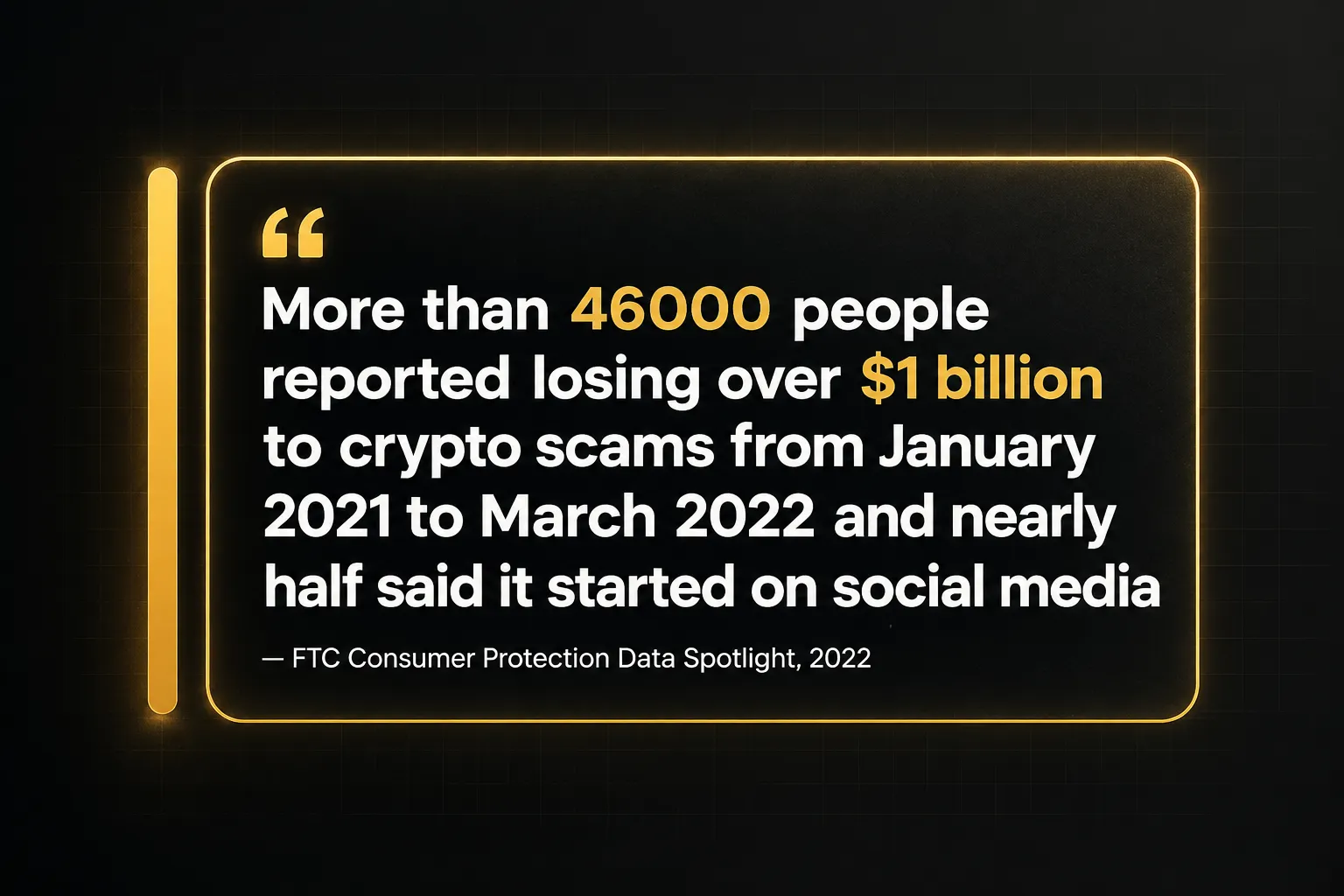
The FTC, SEC, CFTC, and FINRA have all issued warnings that unsolicited investment tips on social media are one of the most common entry points for crypto fraud, including pump-and-dump schemes and fake “account manager” scams.
So this guide takes a different angle.
You won’t find a list of “top 10 Telegram groups” here, because any such list goes stale in weeks. Instead, you’ll learn how to validate a signal, size a trade around it, and audit a provider’s track record.
Those skills work on every source, free or paid, as of 2026 and beyond.
How Crypto Signals Actually Work
A signal that says “ETH looking bullish, buy now” is not a signal.
It’s an opinion.
Real crypto trading signals carry enough structure that two different traders could execute the exact same trade and judge the outcome the exact same way.
Anatomy of a Legitimate Signal
Think of a signal like a flight plan.
If it doesn’t state the departure point, the destination, and the emergency landing strip, you shouldn’t board. A usable signal includes these components:
- Pair: The exact market, such as SOL/USDT, including the exchange if prices differ meaningfully between venues.
- Direction: Long (buy) or short (sell), stated plainly.
- Entry zone: A specific price or tight range where the trade is valid, not “buy around here.”
- Stop-loss: The invalidation level where the trade idea is wrong and you exit.
- Take-profit target(s): One or more levels where you scale out or close the position.
- Timeframe: Whether the setup is a 15-minute scalp, a 4-hour swing, or a multi-day position.
- Timestamp: The exact time the alert was published, ideally in UTC.
- Position type: Spot or futures, and if futures, the suggested leverage.
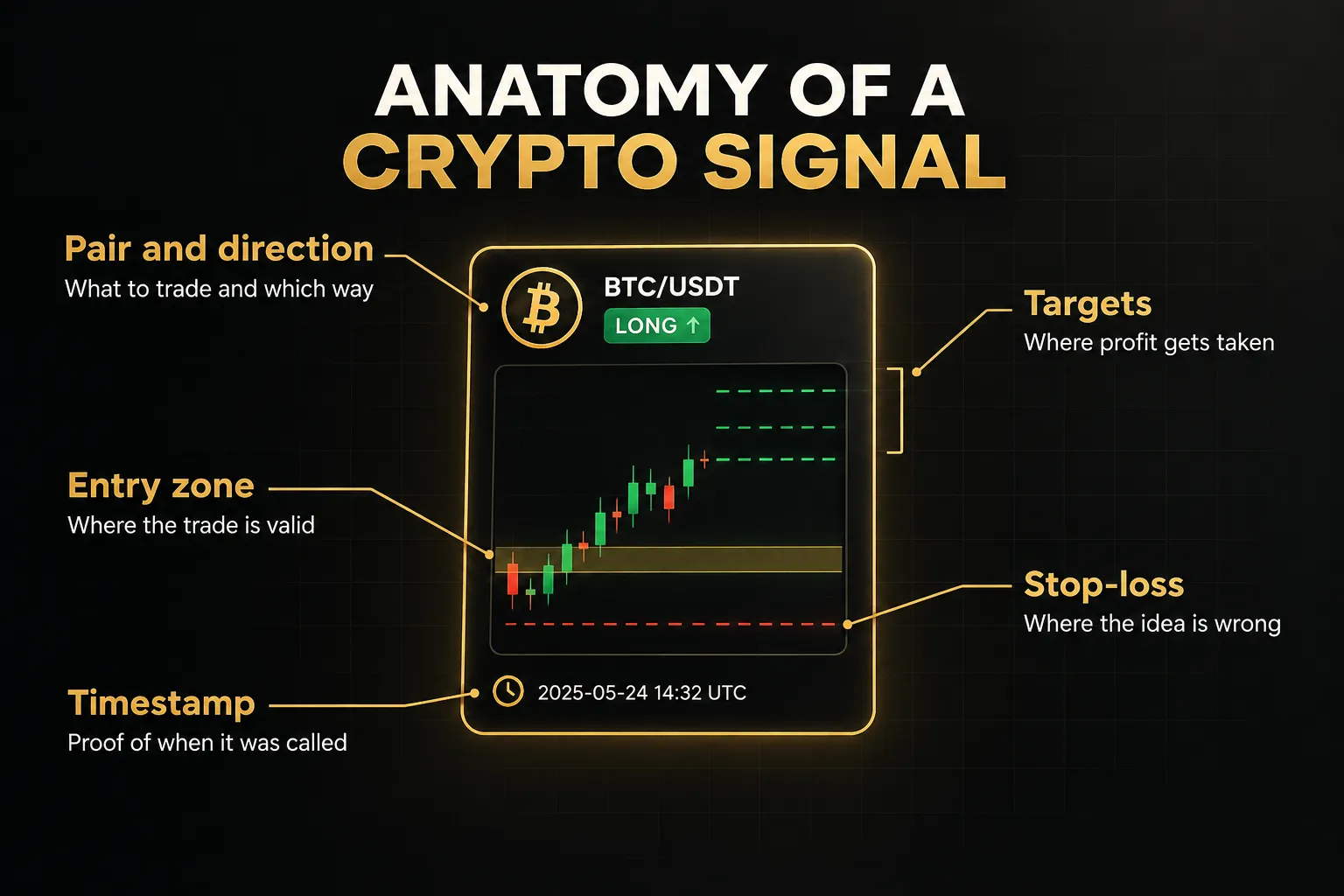
Two of these matter more than the rest: the timestamp and the invalidation level. Without a timestamp, a provider can claim any entry after the fact.
Without a stop-loss, a losing trade never officially “loses.” It just becomes a long-term hold that nobody mentions again.
That’s why signals missing either element can’t be audited.
And a track record you can’t audit is just marketing.
Spot vs Futures Signals
The same alert can be harmless or catastrophic depending on which market you trade it in.
A spot signal means you buy the actual coin. If price drops 30%, you’re down 30%, but you still own the asset and can’t be forcibly closed out.
A futures signal is a different animal.
You’re trading a contract with borrowed capital (leverage), paying or receiving periodic funding rates, and facing liquidation if price moves against you far enough. At 10x leverage, a roughly 10% adverse move can wipe out your entire margin on that position.
At 50x, it takes about 2%.
| Factor | Spot Signals | Futures Signals | What It Means for You |
|---|---|---|---|
| Leverage | None (1x) | Typically 2x to 125x depending on exchange | Leverage multiplies both gains and losses on the same price move |
| Liquidation risk | None; you hold the asset | High; position force-closed near margin exhaustion | A wick through your liquidation price ends the trade, even if price recovers |
| Funding rates | Not applicable | Paid or received every 8 hours on most perpetuals (often around 0.01% per interval) | Holding a crowded long for weeks can quietly drain returns |
| Margin calls | Not applicable | Required if using cross margin or adding to a losing position | One bad trade can pull collateral from your whole account |
| Capital required | Full position value | Fraction of position value (e.g., $100 margin for a $1,000 position at 10x) | Low entry cost tempts beginners into oversized exposure |
| Direction | Long only (on most retail platforms) | Long or short | Shorts add flexibility but also more ways to be wrong |
For beginners, the takeaway is simple.
Start with spot.
If a free group mostly publishes 20x futures calls, that tells you a lot about who it’s built for… and it probably isn’t someone protecting a first account.
Why Are These Signals Free?
Someone is paying for the analyst’s time, the bot hosting, and the community moderation. If it isn’t you, it’s worth asking who it is.
The answer usually falls into one of a handful of business models.
The most common is exchange referral income. Many free groups require or encourage you to sign up through an affiliate link, and the provider earns a share of your trading fees, sometimes 20% to 50% of them for life.
That creates an obvious incentive: more trades, more leverage, more fees.
Other revenue sources include premium tier upsells (“VIP gets the full targets”), paid advertising inside the channel, audience growth for later monetization, and, at the shady end, token promotion, where the group’s owners hold a small-cap coin before telling followers to buy it.
This incentive structure shapes what gets published. Free channels function as lead generation for paid tiers, so winning calls get screenshotted and pinned while losing calls are quietly deleted, edited, or never mentioned again.
Survivorship bias does the rest.
You see a wall of green and assume that’s the whole story.
A free signal group is a marketing funnel first and an analysis service second. That doesn’t make it worthless. It means you have to read it the way you’d read an ad.
It can also bias frequency. A provider paid per trade has every reason to post five setups a day, even when the market offers one good one.
Quality traders often sit on their hands for days.
Fee-driven channels rarely do.
None of this means “free” equals “scam.”
Plenty of educators publish free alerts to build credibility honestly. The point is to treat free as a business model you need to understand, not a reason for automatic trust or automatic distrust.
Vetting a Signal Provider
Vetting takes about an hour per provider.
Skipping it can cost you your whole account.
The process has two parts: screening for outright fraud, then evaluating whether a legitimate provider actually has an edge.
Red Flags Checklist
If a provider triggers even one of these, walk away.
These patterns line up closely with the scam typologies described in FTC, CFTC, and FINRA investor alerts.
- Guaranteed returns: Any promise of “95% accuracy,” “daily 10% profits,” or “no-loss strategy” is false by definition, because no trading method eliminates losses.
- Urgency and FOMO language: “Last chance,” “only 3 VIP spots left,” or “buy before the announcement” are pressure tactics designed to stop you from thinking.
- Requests to send crypto directly: A legitimate signal provider never needs custody of your funds. Anyone asking you to transfer coins “for managed trading” is the scam.
- Withdrawal-fee demands: If a platform shows big profits but demands a “tax” or “unlock fee” before you can withdraw, the profits are fake and the fee is the theft.
- Remote-access software: Requests to install AnyDesk, TeamViewer, or similar tools “to help set up your account” give a stranger control of your device and wallets.
- Unfamiliar deposit platforms: Being steered to a trading site you’ve never heard of, instead of a major regulated exchange, is a hallmark of fake-exchange fraud.
- Unsolicited DMs: Real analysts rarely cold-message strangers. Scammers impersonating channel admins do it constantly.
Metrics Beyond Win Rate
A provider who passes the fraud screen still needs to prove they’re profitable.
Start with the track record itself.
You want a complete, time-stamped, unedited log of every call, including losers, not a gallery of screenshots. Screenshots can be cropped, cherry-picked, or fabricated in seconds.
The best verification is your own forward log. Join the channel, record every signal the moment it appears, and check whether edited messages show an “edited” tag.
Two weeks of independent logging beats two years of provider-supplied claims.
Then measure the numbers that actually determine profitability:
- Average win and average loss: A 70% win rate is meaningless if the average win is 1% and the average loss is 3%. That combination loses 0.2% per trade on average.
- Risk-reward ratio: Compare the distance to target against the distance to stop. A 1:2 ratio means you can be wrong more often than right and still profit.
- Profit factor: Gross profit divided by gross loss. Anything below 1.0 loses money; a sustained figure above 1.5 is genuinely strong.
- Maximum drawdown: The largest peak-to-trough decline in the record. A strategy that dropped 45% before recovering will likely shake you out at the bottom.
- Fees and slippage: Round-trip trading fees of 0.1% to 0.2% per trade add up fast across 100 trades. Results that ignore them are inflated.
- Executable percentage: How many signals could a normal follower actually fill at the posted entry? If price had already run 3% by the time the alert reached you, that “win” wasn’t available.
Finally, benchmark against buy-and-hold.
If a provider made 25% over six months while Bitcoin rose 40% over the same window, the signals underperformed simply holding the asset, while adding fees, stress, and risk. Compare over the same period and adjust for the number of trades taken, since every trade carries cost.
Trading a Signal Without Blowing Up
Most blown accounts don’t die from a bad signal.
They die from a reasonable signal traded at an unreasonable size.
This section covers the mechanics that keep one loss from becoming a disaster.
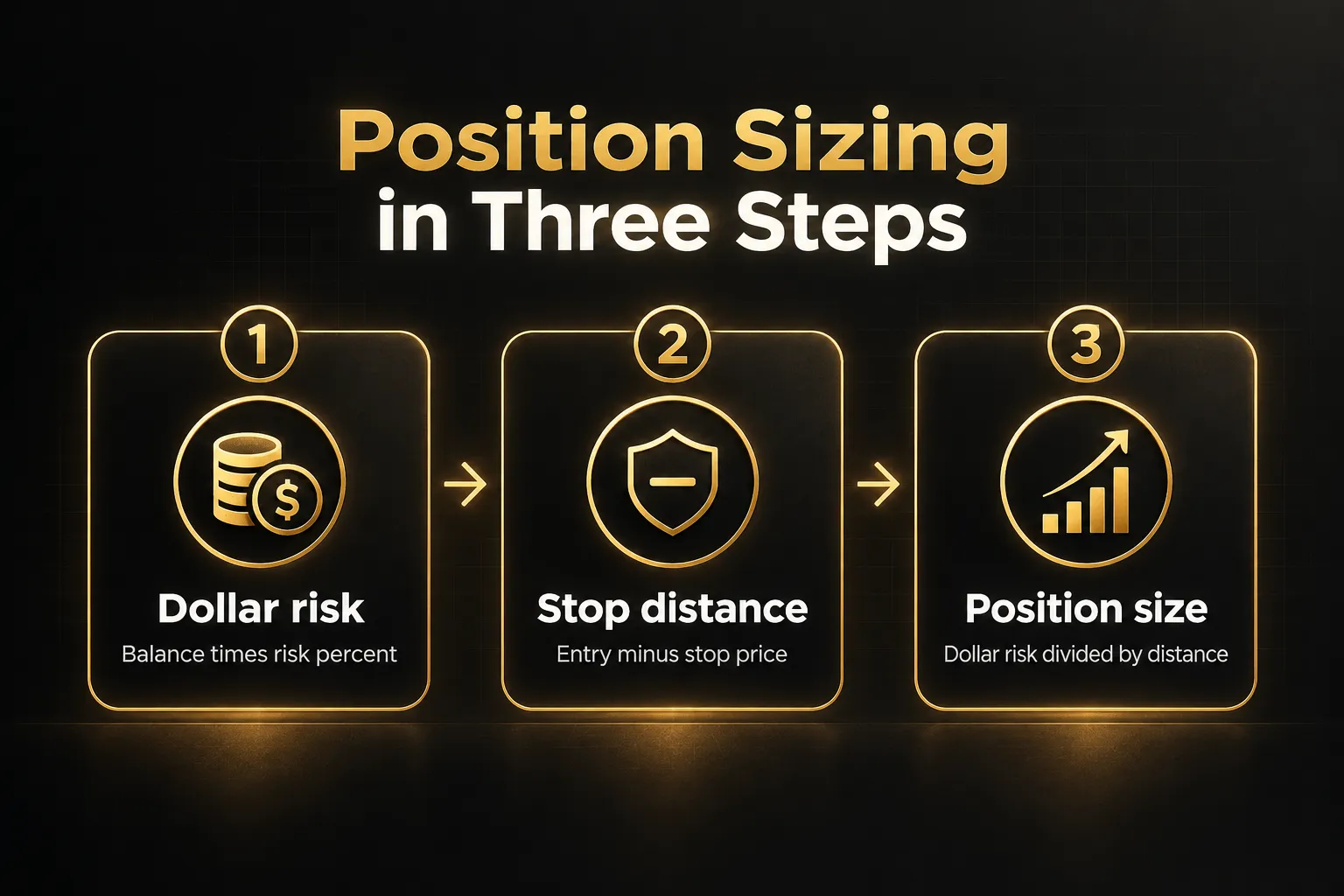
Position Sizing in Three Steps
Position sizing starts from how much you’re willing to lose, not how much you hope to make. Most professional risk frameworks cap risk per trade at 1% to 2% of the account.
At 1% risk, you’d need roughly 69 consecutive losses to halve your account. At 10% risk, it takes about 7.
- Set your dollar risk. Multiply your account balance by your risk percentage. A $5,000 account at 1% risk means you can lose $50 on this trade.
- Measure the stop distance. Subtract the stop-loss price from the entry price. If the signal says buy BTC at $60,000 with a stop at $58,800, the stop distance is $1,200 (2%).
- Calculate position size. Divide dollar risk by stop distance: $50 ÷ $1,200 = 0.0417 BTC, or about $2,500 of Bitcoin. If the stop hits, you lose $50 plus fees, exactly as planned.
Notice the result.
You’re buying $2,500 of BTC, half the account, yet only risking 1%.
The stop does the protecting, not a small position.
And if a signal has no stop, you can’t run this formula at all, which is reason enough to skip it.
Slippage, Delay, and Crowding
A signal can be profitable on paper and still lose money live. Three forces cause the gap:
- Notification delay: Telegram push notifications can lag by seconds to minutes, and you may not see the alert for an hour. On a volatile altcoin, a 2% move in that window can turn a 1:2 risk-reward setup into a 1:1 or worse.
- Spread and thin liquidity: Small-cap pairs often have wide bid-ask spreads and shallow order books. A market order for even $1,000 can fill noticeably above the posted entry price.
- Overcrowding: When thousands of followers receive the same alert at the same moment, their combined buy orders push price up instantly. The first fills get the entry; everyone else buys the spike.
- Exit congestion: Crowding works in reverse at the stop. If everyone’s stop sits at the same level, a cascade of sell orders can push the fill well below it, especially on futures where liquidations amplify the move.
The fix is discipline around the entry zone.
If price is already outside the posted range when you see the alert, the trade is gone. Chasing it changes the risk-reward math that justified the trade in the first place.
Paper Trading Before Real Money
How do you know a signal source works for you, with your delays and your execution?
You test it.
Paper trading (also called forward testing) means logging every signal in real time as if you’d traded it, without risking capital. Unlike backtesting on historical data, it captures the real-world friction described above.
Build a simple scorecard with these columns for every signal:
- Timestamp: When the signal was posted and when you actually saw it.
- Executable entry: The price you could realistically have filled at, not the posted price.
- Stop: The stop-loss level, so losses are recorded honestly.
- Target: Each take-profit level and whether it was reached.
- Outcome: Result in R-multiples (e.g., +2R, −1R), which makes trades comparable regardless of size.
- Fees: Estimated round-trip trading costs, plus funding for futures.
- Maximum adverse excursion (MAE): The worst point price reached against you before the trade resolved. High MAE on winners suggests stops are being nearly hit.
- Rule compliance: Did you follow your own sizing and entry rules? Yes or no.
Run this for at least 20 to 30 trades or 4 to 6 weeks, whichever takes longer.
Fewer trades than that and a lucky streak can look like skill. Then calculate win rate, average R, profit factor, and maximum drawdown from your own data.
Cross-checking also helps.
Before acting on any alert, confirm its direction with independent indicator confluence. Tools like PipTrend offer a multi-timeframe confirmation table that shows whether trend readings across several timeframes agree, along with a published results page that includes losing trades.
That combination is a good model for what transparency should look like: you can see the direction of a setup checked against other evidence, and you can see the misses, not just the hits.
If a signal says “long” but the higher timeframes are firmly bearish, that disagreement doesn’t automatically kill the trade.
But it should make you smaller, or patient.
Common Questions on Free Signals
Are free crypto signals worth it?
Free crypto signals are worth it only as a learning and idea-generation tool, not as a standalone strategy.
They can show you how experienced traders frame entries, stops, and targets. Whether they make money depends on the provider’s verified edge and your execution, which you can only measure through 20 to 30 paper trades.
What is the best free crypto signal?
There is no universally best free crypto signal provider.
The right source depends on your timeframe, whether you trade spot or futures, and how quickly you can act on alerts. The best provider for you is the one that passes the red-flag checklist and still shows positive expectancy in your own forward-tested scorecard after fees.
Are crypto signals legal?
Crypto signals are legal in many jurisdictions, but legality depends on local financial regulations.
Publishing general educational alerts to a public audience is usually treated differently from giving personalized investment advice, which may require a license. Rules vary by country, so check your local regulator’s guidance as of 2026.
How do I get free crypto signals on Telegram?
You get free crypto signals on Telegram by joining public channels run by analysts, educators, or signal platforms. Search for providers who publish full trade records rather than screenshots.
Never respond to unsolicited DMs claiming to be a channel admin, since impersonation scams are extremely common on Telegram.
Can I trust crypto trading signals?
You can trust crypto trading signals only as far as you can verify them.
Trust should come from a complete, time-stamped, unedited record and your own forward-test results, not from follower counts or testimonials. Even trustworthy signals still require your own stop-loss and position sizing.
How accurate are crypto signals?
Accuracy claims for crypto signals are unverifiable without full trade records and fee accounting. A provider advertising “90% accuracy” may be omitting losses, ignoring slippage, or using wide stops that make wins frequent but small.
Profit factor and maximum drawdown tell you far more than win rate alone.
The Bottom Line on Free Signals
Here’s your next step, and it fits in one sentence.
Pick a single free signal source, run it through the red-flag checklist and the metrics above, then paper trade every alert it publishes using the scorecard for 4 to 6 weeks before you fund an account.
Just one source.
Testing five at once muddies the data and tempts you to cherry-pick whichever looks best that week, which is the exact bias you’re trying to avoid in providers.
Keep the core principle in view.
A signal is a starting point for analysis, not a permission slip to skip the basics. Every trade still needs a defined stop-loss, a position size calculated from a fixed risk percentage, and a reason grounded in your own read of price action and confluence.
If a signal can’t survive those checks, it doesn’t deserve your money.
Simple as that.
The traders still standing after a few years rarely found a better alert. They found a better process and stuck to it on the boring days.
Free crypto signals will keep multiplying through 2026, with more bots, more channels, and more confident claims.
That’s fine.
You don’t need to find the perfect provider. You need a repeatable way to size, test, and audit whatever lands in your feed, because consistent process is what separates survivors from blown accounts.
Sources
Risk Disclaimer: Trading involves risk. Past performance doesn't guarantee future results. Only trade with money you can afford to lose. PipTrend is a tool to assist your trading decisions, not financial advice.