A Beginner's Guide to Free Forex Telegram Signals
On this page
Why Everyone’s Chasing Free Signals
Search “free forex signals telegram” and you’ll find thousands of channels promising 90% accuracy, daily pips, and life-changing returns. Most cost nothing to join.
That’s the hook.
The appeal makes sense.
A forex trade alert hands you a currency pair, a direction, and an entry price in seconds. It feels like skipping years of chart study, technical analysis, and painful losses, as if someone else has already done the hard part.
But here’s the problem nobody advertising these channels will tell you. Most “best channel” lists rank providers by follower count or affiliate payouts, not by verified performance.
A channel with 200,000 subscribers can be losing money every month, and you’d never know from the rankings.
Follower count measures marketing. It says nothing about whether a signal makes money.
This guide fixes that.
By the end, you’ll be able to audit a channel’s track record, calculate the real risk behind any signal, and decide whether an alert fits a repeatable process or is just noise dressed up as opportunity.
We’ll also cover the operational risks that catch beginners off guard. Impersonation accounts, cloned channels that copy a real provider’s name and logo, and phishing links asking for deposits or wallet access are all common on Telegram as of 2026.
Losing money on a bad trade is one thing.
Losing it to a fake admin in your DMs is worse.
Start with how the signals themselves are built.
How Telegram Trade Signals Work
“Free signal channel” sounds like one thing. It’s actually five different business models wearing the same label, and each one makes money from you in a different way.
Understanding which model you’re dealing with tells you more about a channel’s incentives than any screenshot of winning trades ever will.
Public Channels vs VIP Funnels vs Copy Trading
Beginners tend to lump these setups together.
They shouldn’t.
Here’s how they actually differ:
- Free public channel: Anyone can join and receive alerts at no charge. Some are run by hobbyists sharing their own currency pair analysis, but many exist primarily to build an audience that can be monetized later.
- Paid VIP upsell: The free channel posts a handful of signals (often the winners) while advertising a “VIP group” with more trades and higher accuracy. The free tier is the shop window. The paid tier is the product.
- Copy-trading service: Trades are executed automatically in your brokerage account, mirroring a provider’s positions. This removes manual execution but also removes your control, and you often need to grant account access.
- Unregistered adviser: An individual giving specific trading recommendations for compensation without the required registration. In the U.S., someone advising on forex for pay may need to register with the CFTC and join the NFA.
- Broker referral scheme: The channel requires you to open an account with a specific broker through their link. The admin earns a commission per deposit or per lot you trade, whether you win or lose.
That last model explains why so many “free” channels exist. If the admin earns rebates on your trading volume, they profit from activity, not accuracy.
More trades and bigger lot sizes mean more commission, which is the opposite of what protects your account.
What a Reliable Signal Must Include
A signal that says “BUY GOLD NOW 🚀” is not a signal.
It’s a guess with an emoji.
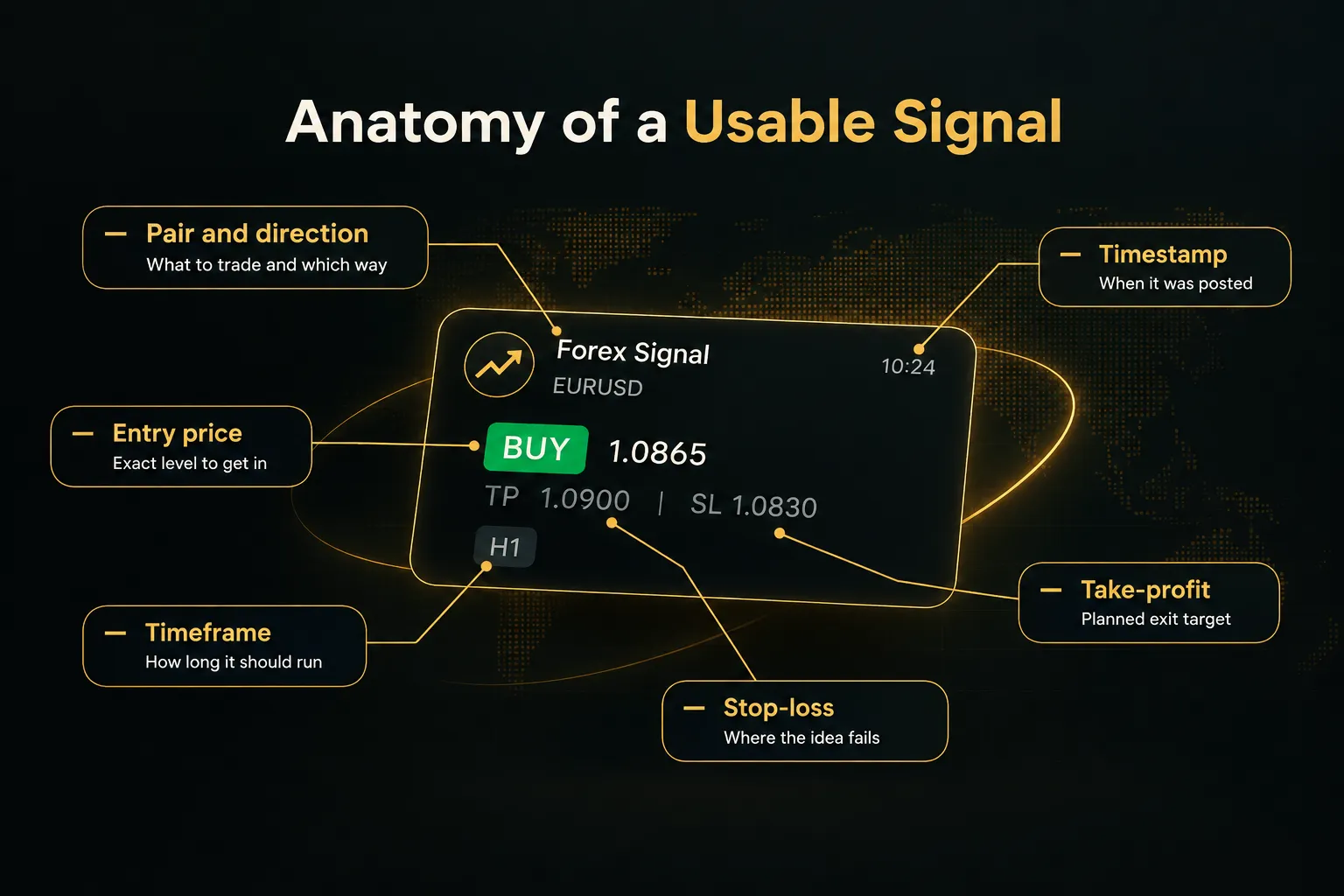
A usable alert needs these fields:
- Pair: The exact instrument, such as EUR/USD or XAU/USD, so there’s no ambiguity about what to trade.
- Direction: Buy or sell, stated clearly and only once per setup.
- Entry price: A specific level or tight range, not “market price,” because market price shifts every second.
- Stop-loss order: The price where the trade idea is proven wrong. Without it, you can’t calculate position sizing or risk.
- Take-profit level: One or more exit targets, which lets you work out the risk-to-reward ratio before you enter.
- Timestamp: When the signal was posted, so you can measure execution delay and verify results later.
- Intended timeframe: Whether it’s a 15-minute scalp or a multi-day swing, which tells you how long to hold and which chart to check.
Even a complete signal won’t produce identical results for everyone. Four factors change the outcome of the same alert:
- Spread: A trader with a 0.3-pip spread and one with a 2-pip spread enter at meaningfully different prices, which matters most on tight stops.
- Slippage: During news releases or thin liquidity, your order may fill several pips away from the requested price.
- Broker pricing: Different liquidity providers quote slightly different prices, so a stop that triggers at one broker may survive at another.
- Time-zone gaps: If a signal posts at 3 a.m. your time and you act at 7 a.m., you’re trading a different market than the one the provider analyzed.
Spotting a Scam Before You Lose Money
A Telegram channel can show a 95% win rate without ever lying in a single message. How? By controlling which messages you see.
How Fake Track Records Get Built
The most common tactic is simple: deleting losing calls. Telegram lets admins remove messages at any time, so a signal that hit its stop-loss can vanish within minutes.
New subscribers scroll back and see nothing but green.
The second tactic is editing old messages. An admin posts “Buy EUR/USD at 1.0850, SL 1.0820” and, after price drops to 1.0790 and bounces, quietly edits the entry to 1.0795.
The edit label is small and easy to miss.
The third trick is the most cynical.
Some channels post a buy call on one pair and a sell call on a correlated pair (or split subscribers into separate groups receiving opposite calls), then screenshot and promote whichever side won. With enough groups running in parallel, someone always “wins.”
If you can’t see the losses, you can’t evaluate the wins. A track record without losses isn’t a track record. It’s an advertisement.
Screenshots deserve extra skepticism.
A screenshot of a profitable MT4 or MT5 position proves only that someone, somewhere, held that position. It doesn’t show account size, how many other trades lost, or whether the account is a demo. Image editors can also fake them in under a minute.
Verifying a Provider’s Real Results
Real verification looks very different.
You want a timestamped broker statement covering months of activity, or a third-party tracking service connected directly to a live account. Better still is a public results page listing every signal, including losses and break-evens, in chronological order.
Look for these signs of a credible record:
- Signals logged before the outcome is known, with timestamps that can’t be edited.
- Losing streaks visible in the history, because every real strategy has them.
- Maximum drawdown disclosed alongside total returns.
- A sample size of at least 100 trades, not a cherry-picked week.
Next, check jurisdiction.
In the U.S., anyone advising on forex for compensation may need registration as a Commodity Trading Advisor. You can search the NFA BASIC database to confirm registration status and disciplinary history, and review the CFTC’s RED List of unregistered foreign entities soliciting U.S. customers.
Outside the U.S., the UK’s FCA, Australia’s ASIC, and most EU regulators publish warning lists of unauthorized firms. Check these before sending money or personal details.
It takes five minutes, and it can save you thousands.
Finally, watch for impersonation.
Scammers clone popular channels, copying names, logos, and pinned messages, then DM new members pretending to be the admin. Common pitches include “VIP slots closing today,” requests to deposit with an unknown broker, or links asking you to connect a crypto wallet.
The rule is simple.
Legitimate admins don’t DM you first. Never click deposit links or share login credentials, seed phrases, or ID documents through Telegram messages.
The Math Behind Every Signal
Here’s a fact that surprises most beginners: a provider with a 70% win rate can lose money every single month.
Accuracy alone tells you almost nothing.
Why Win Rate Can Lie
Four numbers matter more than forex signal accuracy.
Trading expectancy is the average amount you expect to win or lose per trade. The formula is (win rate × average win) minus (loss rate × average loss).
The risk-to-reward ratio compares the distance to your take-profit level against the distance to your stop-loss.
Profit factor divides gross profits by gross losses, so anything above 1.0 makes money and anything below loses it.
Maximum drawdown is the largest peak-to-trough decline in account equity, which tells you how painful the bad stretches get.
Now the 70% example.
Say a channel wins 70% of the time, but its average win is $50 and its average loss is $150. Expectancy works out to (0.70 × $50) minus (0.30 × $150), or $35 minus $45.
That’s a loss of $10 per trade, despite looking impressive on a marketing banner.
The table below compares two signals with an identical 55% win rate, each risking $50 per trade.
| Metric | Signal A | Signal B |
|---|---|---|
| Win rate | 55% | 55% |
| Average loss | $50 | $50 |
| Average win | $30 | $100 |
| Risk-to-reward ratio | 1:0.6 | 1:2 |
| Expectancy per trade | -$6.00 | +$32.50 |
| Profit factor | 0.73 | 2.44 |
| Net result over 100 trades | -$600 | +$3,250 |
Same accuracy.
Wildly different outcomes.
That’s why any provider advertising win rate without average win and loss size is hiding the number that actually matters.
Positive expectancy still doesn’t guarantee a smooth ride.
With a 55% win rate, the chance of losing 5 trades in a row on any given run is only about 1.8%. But across 100 trades, the odds that at least one 5-loss streak appears somewhere climb to roughly 60%, and the expected longest losing streak is 5 to 6 trades.
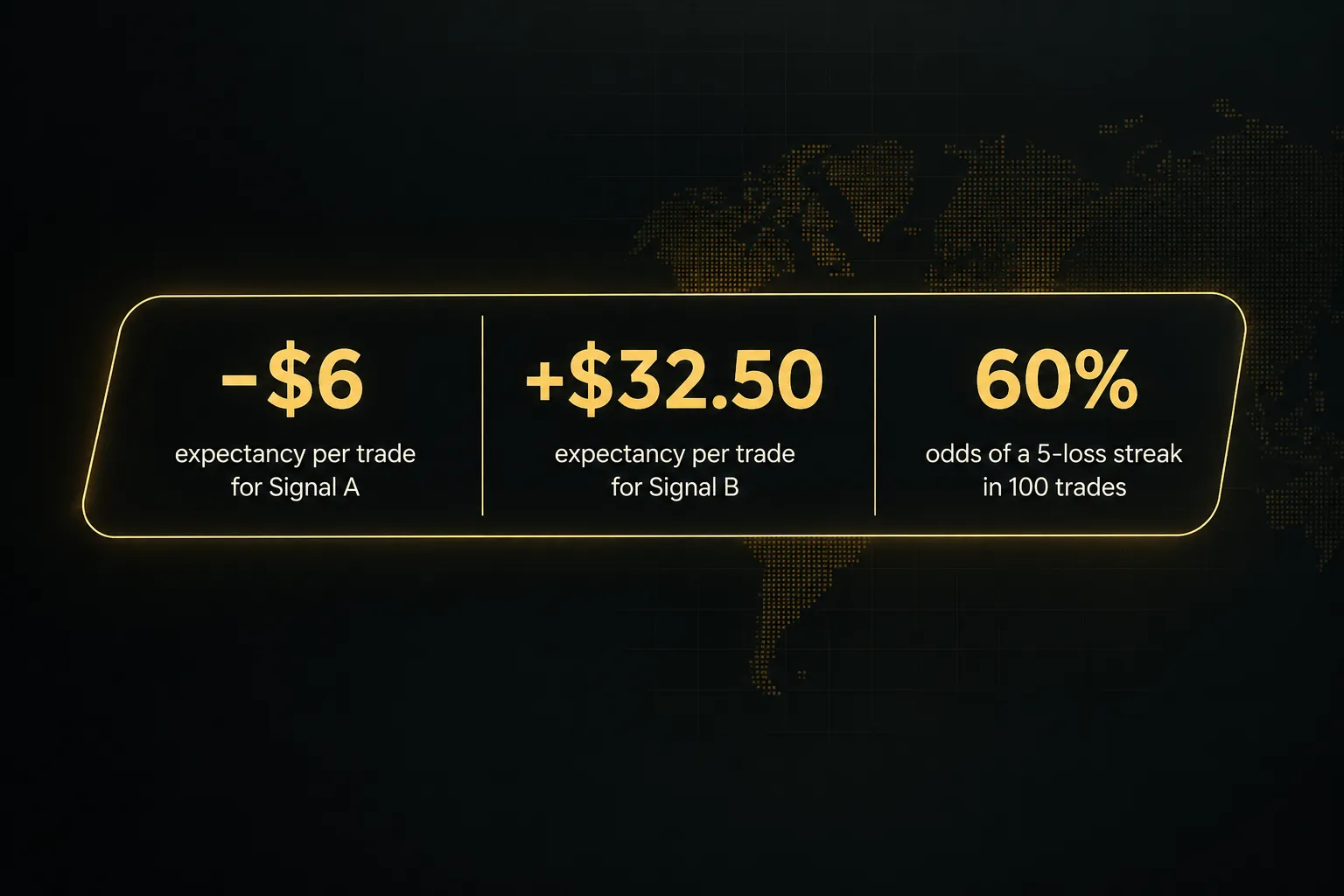
This is sequence risk.
At 1% risk per trade, six straight losses cost about 5.9% of your account. At 5% risk, the same streak wipes out roughly 26.5%, and that’s with a winning strategy.
Sizing a Trade From Entry to Stop
Position sizing turns a signal into a specific dollar risk. Here’s a full worked example.
You have a $5,000 account and risk 1% per trade, which equals $50. A signal says: buy EUR/USD at 1.0850, stop-loss at 1.0820, take-profit at 1.0910.
- Stop distance: 1.0850 minus 1.0820 equals 30 pips.
- Target distance: 1.0910 minus 1.0850 equals 60 pips, giving a 1:2 risk-to-reward ratio.
- Pip value: On EUR/USD with a USD account, one standard lot is worth about $10 per pip.
- Lot size: $50 divided by (30 pips × $10) equals 0.1667 lots. Round down to 0.16 lots.
- Actual dollar risk: 30 pips × $1.60 per pip equals $48.
- Potential profit: 60 pips × $1.60 equals $96.
Always round down, never up.
And factor in spread: a 1.5-pip spread effectively widens your stop to 31.5 pips, nudging real risk slightly higher.
Leverage and margin don’t change this math.
Leverage determines how much capital the broker locks up as margin, but your stop distance and lot size determine what you actually lose. Beginners who confuse the two often open positions five or ten times larger than their risk plan allows.
Turning Alerts Into a Repeatable Process
Most traders who fail with signals don’t fail because the signals were bad. They fail because they had no process for testing, logging, and understanding them.
A signal without a process is a coin flip with extra steps.
The protocol below turns alerts into data you can actually evaluate.
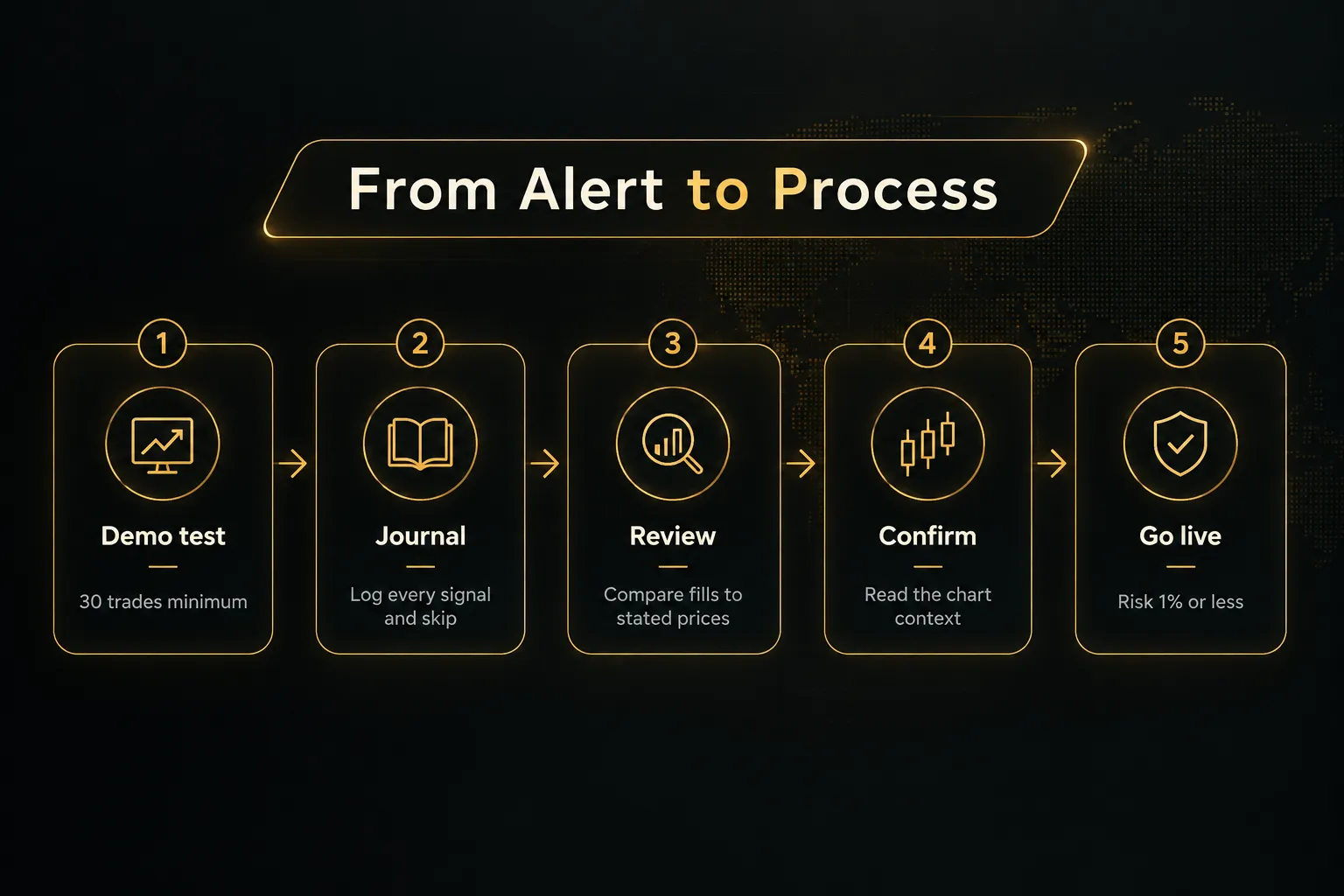
Demo Test Before Risking Capital
- Open a demo account with your intended broker. Use the same broker you’d trade live with, so spreads and pricing match real conditions as closely as possible.
- Commit to a minimum sample. Run at least 30 trades or 30 days, whichever comes later, before drawing conclusions. Fewer trades than that and luck dominates the results.
- Take every valid signal. Cherry-picking during demo testing distorts the data. You’re testing the provider, not your instincts.
- Record entry timing against the stated price. Note how far your fill was from the signal’s entry price. If you’re consistently 5 pips late, a strategy with 15-pip targets may not be viable for you.
- Calculate expectancy and drawdown at the end. Use your actual fills, not the provider’s claimed results. Only move to live trading if the numbers are positive.
Journal Every Signal, Including Skips
- Log skipped signals. Record every alert you didn’t take and why. If your skipped trades outperform your taken trades, your filter is hurting you.
- Measure slippage and spread. Note the difference between requested and filled price on entry and exit. Over 50 trades, two pips of average slippage can erase a thin edge entirely.
- Track time delay. Write down the minutes between the alert’s timestamp and your execution. Delays over 10 minutes on intraday signals often change the outcome.
- Add emotional notes. Were you anxious, bored, chasing a loss? A trade journal that captures mindset reveals patterns pure numbers miss, like moving stops after two consecutive losses.
Read the Chart, Don’t Just Copy
Blind copying teaches you nothing.
When a trade wins, you don’t know why, and when it loses, you can’t tell bad luck from a bad setup.
- Open the chart before entering. Check whether price sits near support, resistance, or a liquidity level. Context explains whether the signal’s logic holds up.
- Identify market structure. Look for higher highs and higher lows in an uptrend, or the reverse in a downtrend. A buy signal fighting a clear downtrend deserves extra scrutiny.
- Use multi-timeframe confirmation. Check that the higher timeframe (say, the 4-hour) agrees with the entry timeframe (say, the 15-minute). Alignment across timeframes generally improves trade quality.
- Understand the exit logic. Know why the stop sits where it does and what would invalidate the trade early. This is the skill that signals alone can’t teach.
Some tools are built around this approach rather than blind copying. PipTrend is one example of a transparent, system-oriented alternative.
Direction comes from its signal engine, entries come from marked liquidity levels on the chart, and exits come from a multi-timeframe table, so you can see the reasoning rather than just the instruction.
Its public results page also shows losses and break-evens alongside wins.
That’s the standard to hold any provider to, whether it’s a Telegram channel or a set of TradingView indicators. Look for non-repainting signals too: an indicator that redraws past arrows after the fact will always look more accurate than it really is.
Your Questions Answered
Are free forex signals on Telegram safe?
Free forex signals on Telegram are not inherently safe.
The signals themselves carry market risk, and the platform carries fraud risk from cloned channels and fake admins. Verify any provider’s results, never share login details or wallet access, and risk no more than 1% per trade until you’ve tested the signals yourself.
What is the best free forex signals Telegram channel?
No single channel is objectively best, because performance changes and most rankings are driven by affiliate deals. Judge any channel by verified, timestamped results including losses, disclosed drawdown, complete signals with stop-loss and take-profit, and confirmed regulatory status where required.
How do I get free forex signals on Telegram?
You get free forex signals by joining public Telegram channels through search or a provider’s official website. Confirm the channel link from the provider’s verified site rather than random DMs, since cloned channels are common.
Then run every signal through a demo account before trading live.
Can you make money from forex signals?
Yes, but only if the signals have positive expectancy and you execute them with discipline.
Win rate alone doesn’t determine profit; average win size versus average loss does. Consistent position sizing, tracking slippage, and surviving losing streaks matter as much as the signals themselves.
How do I know if a forex signal is real?
A real forex signal is posted with a timestamp before the outcome and includes pair, direction, entry, stop-loss, and take-profit. Check that past messages aren’t edited or deleted, that losses appear in the history, and that results are backed by a broker statement or public results page.
What is the most accurate forex signal provider?
No provider can be named most accurate without a large, independently verified sample, and accuracy alone is misleading. Ask for at least 100 logged trades, expectancy, profit factor, and maximum drawdown.
A provider with 50% accuracy and 1:2 risk-to-reward can outperform one claiming 80%.
The One Rule That Protects Your Account
If you remember one thing from this guide, make it this: never risk more than 1-2% on any signal you haven’t verified yourself. It doesn’t matter what accuracy the provider claims.
Claims are free; drawdowns are not.
Signals work best as one input, not a replacement for a trading process. Confirmation on the chart, disciplined position sizing, and clear exit rules are what turn an alert into a decision you actually understand.
The traders still standing in five years won’t be the ones who found the perfect channel.
They’ll be the ones who can explain why a trade worked… not just that it did.
Sources
Risk Disclaimer: Trading involves risk. Past performance doesn't guarantee future results. Only trade with money you can afford to lose. PipTrend is a tool to assist your trading decisions, not financial advice.