Free Forex Trading Signals: A Beginner's Guide That Works
On this page
The Truth About Free Forex Signals
A free forex signal is a suggestion, not a paycheck.
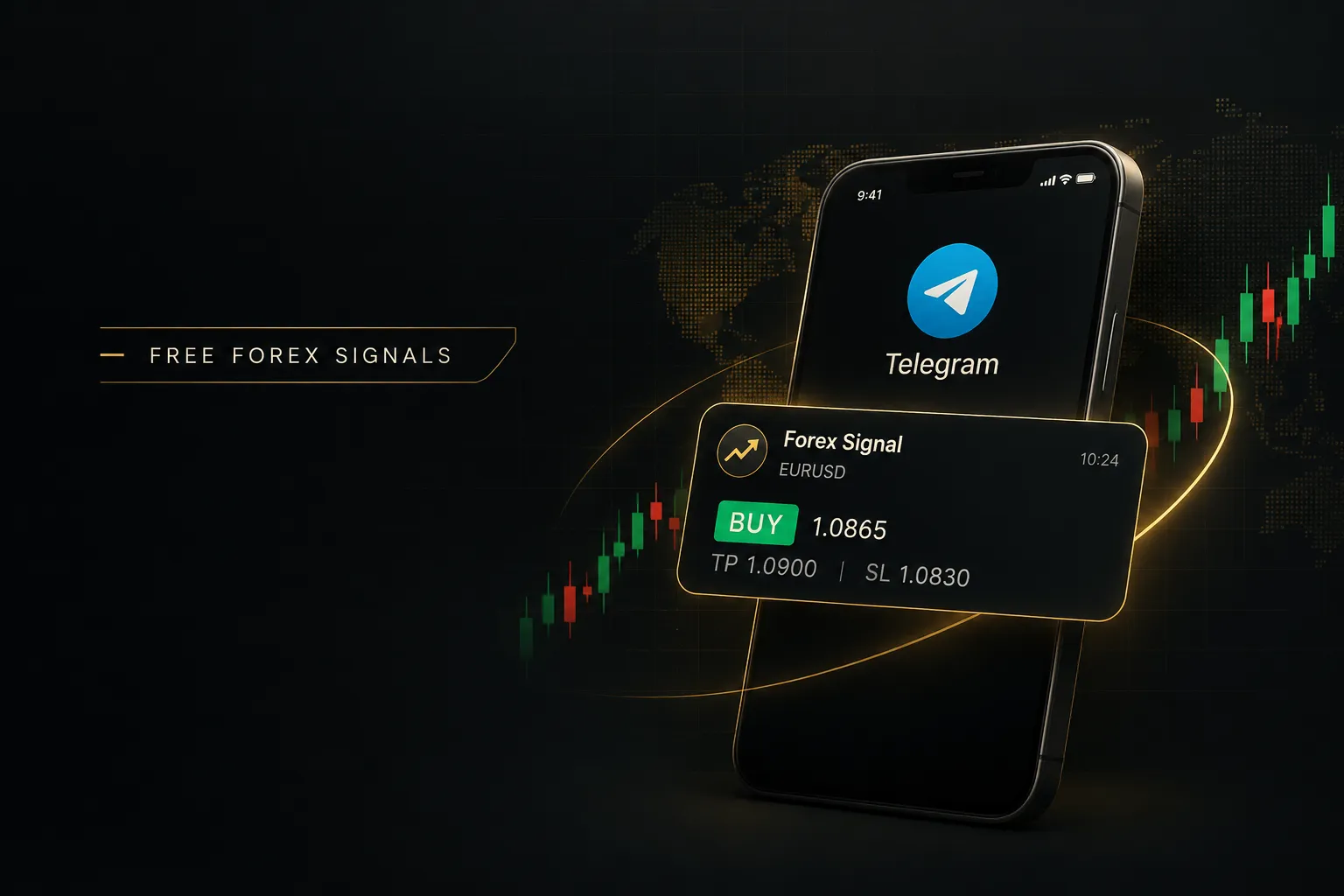
It tells you that someone, somewhere, thinks EUR/USD is worth buying at 1.0850 with a stop at 1.0820.
What it cannot tell you is whether that idea fits your account size, your broker’s spread, or your tolerance for a six-trade losing streak.
That distinction matters more than most beginners realise.
Treat signals as decision-support tools and they can sharpen your process.
Treat them as a substitute for a process and they will quietly drain your account.
This guide covers three things in order: how “free” signal services actually make money, how to test a provider before risking a cent, and how to size a position so a bad run doesn’t end your trading career.
Here’s the counterintuitive part that trips up almost everyone.
A signal service with a 70% win rate can still lose money.
If the average loser is three times the size of the average winner, the maths turns against you no matter how good the hit rate looks in a screenshot.
Win rate is a headline. Expectancy is the story.
One more thing, stated plainly: no indicator, signal service, or trading system can guarantee results.
Forex is leveraged, volatile, and unforgiving of overconfidence.
What follows is a framework for evaluating claims, not a promise that any particular source will work.
What Forex Signals Actually Are
Ask ten traders what a “signal” is and you’ll get four different answers, because the word gets stretched across tools that behave nothing alike. Getting the definitions straight saves you from buying a hammer when you needed a saw.
A forex signal is a specific, actionable trade idea: a currency pair, a direction, an entry price, a stop loss, and a take profit.
An indicator is different.
It’s a calculation drawn on your chart, like a moving average or RSI, that visualises data but never tells you what to do with it.
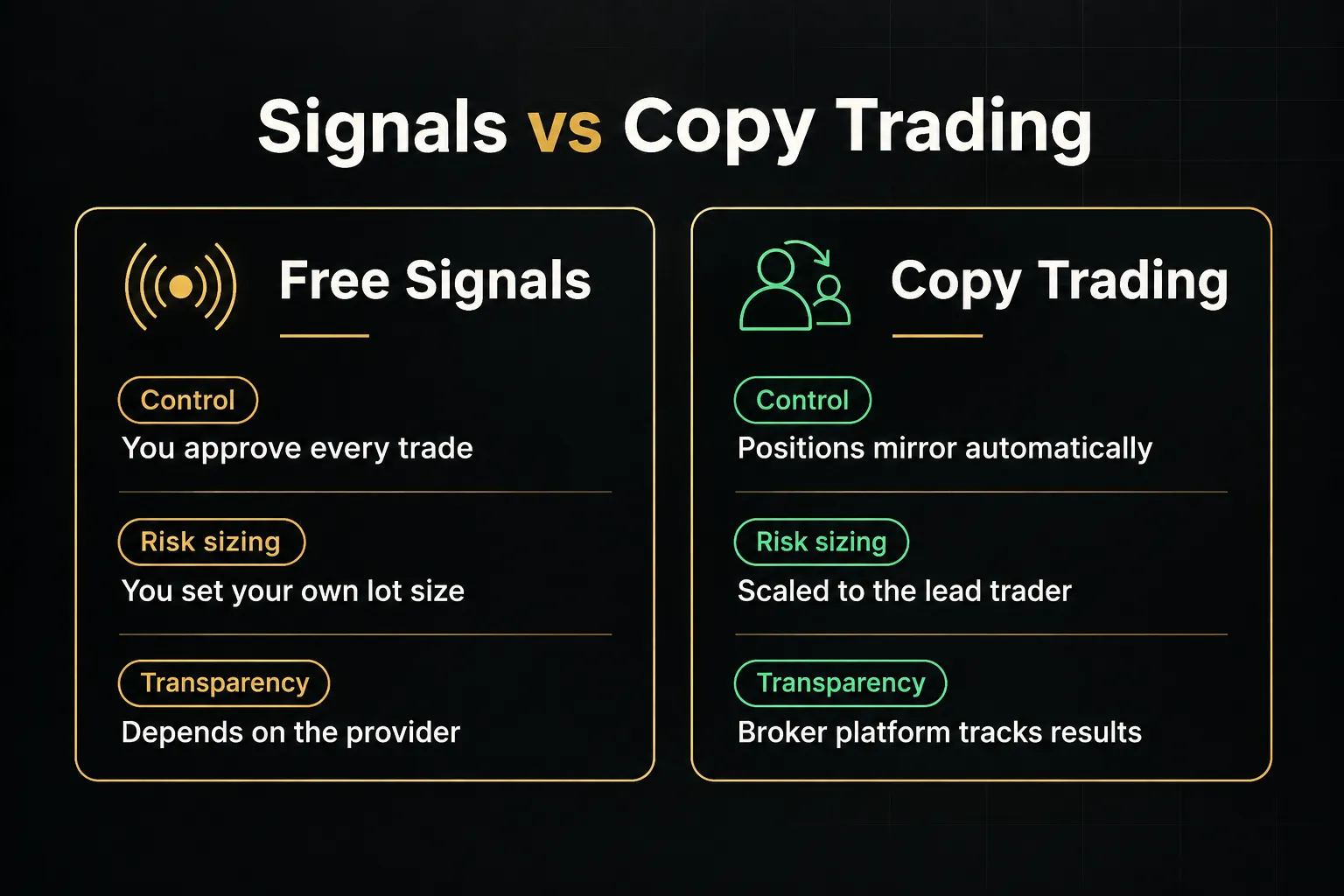
Signals vs Indicators vs Copy Trading vs EAs
Four tools, four levels of automation, four very different risk profiles:
- Standalone signal: A one-off trade instruction delivered by Telegram, email, app notification, or a web dashboard. You decide whether to take it, and you place the order yourself. Maximum control, maximum responsibility.
- Technical indicator: A chart overlay or oscillator that processes price and volume data. It produces conditions, not instructions. Two traders using the same indicator can reach opposite conclusions, which is exactly why a non-repainting indicator with clear rules is worth more than a flashy one with vague ones.
- Expert advisor (EA): A script that runs on your MetaTrader platform and executes trades automatically according to coded rules. No human confirmation step. An EA will happily trade through a central bank announcement while you sleep.
- Copy trading: Your account mirrors another trader’s live positions in proportion to your balance. You inherit their entire approach, including their leverage habits and their worst month. Convenient, but you’re outsourcing judgement entirely.
What a Complete Signal Should Include
Most free buy and sell alerts are incomplete. A trustworthy one publishes every field below, no exceptions:
- Currency pair and direction: “Buy GBP/JPY”, not “GJ looking bullish soon”.
- Exact entry price: A number, not a zone spanning 40 pips. Vague entries make any outcome defensible after the fact.
- Stop loss: A hard price level. Without it, you cannot calculate risk or position sizing.
- Take profit: One or more targets, so the risk-to-reward ratio is calculable before you click.
- Position size guidance: Usually expressed as a percentage of equity risked, never as a fixed lot size, because a 0.5 lot position means something different on a $2,000 account than on a $200,000 one.
- Timestamp: The moment the alert was published, in a stated timezone. This is the single field most often missing, and the one that makes forward verification possible.
A complete trading system goes further.
It defines trade management: when to move the stop to break-even, whether to scale out at the first target, what to do when a signal fires during a news release.
Most free services omit all of it, which means half the job is still yours.
Is a Free Signal Really Free?
Nobody runs a 40,000-member Telegram channel out of charity.
Understanding the revenue model behind a free service tells you what the provider is actually optimising for, and it’s rarely your account balance.
Who’s Actually Paying for It
Four funding models dominate the free signal space.
The most common is broker referral commission: the provider earns a cut of the spread or a per-lot rebate every time you trade through their partner link.
Notice the incentive.
They get paid on volume, not on whether you profit.
Second is affiliate marketing, where the free channel funnels you toward courses, prop firm challenges, or indicator subscriptions.
Third is the VIP upsell: free signals are the demo reel, and the “real” calls sit behind a monthly fee.
Fourth, and least visible, is lead generation, where your email and phone number become a retargeting asset sold or reused across campaigns.
None of these models is automatically disqualifying.
A provider earning rebates can still publish honest calls.
But when the disclosure is hidden, assume the conflict is shaping what you see.
Checking a Provider’s Track Record
The standard here is simple: a complete record, or no record at all.
Partial data isn’t evidence, it’s marketing.
Verified Results, Not Screenshots
Demand the full ledger.
That means wins, losses, break-even trades, cancelled or expired signals, the longest losing streak, and maximum drawdown measured peak to trough.
A results page showing only the last month’s winners tells you nothing about how the system behaves when its market conditions disappear.
Screenshots are the weakest form of proof.
They’re trivially edited, easily cherry-picked, and impossible to timestamp independently.
Prefer a public, dated posting history where every call, good or bad, stays visible.
Third-party verification through a broker-linked account or an independent tracking platform is stronger still.
Useful metrics to look for: profit factor (gross profit divided by gross loss, where anything above 1.3 over a large sample is meaningful), average risk-to-reward, and expectancy per trade.
Red Flags to Watch
- Anonymous admins with no verifiable identity, firm name, or regulatory registration.
- Losing calls deleted from the channel history, leaving a suspiciously clean feed.
- Member counts inflated by bots, paired with a thin, repetitive comment section.
- Countdown timers, “only 5 spots left”, and other pressure tactics pushing you toward a paid tier.
- Guaranteed returns, “90% accuracy”, or any claim that ignores spread and slippage.
- Requests for your broker login, funds, or remote access to your platform. This is where free signals cross into outright fraud.
Repainting and Hindsight Bias
Repainting is when an indicator or provider alters, moves, or removes past signals so the historical chart looks far better than live performance ever was.
An arrow that appears on the candle after the move completes is not a prediction.
It’s a description.
The test is straightforward and takes discipline rather than skill.
Screenshot the signal the moment it arrives, log the exact price and time, then compare against the provider’s own record a week later.
If the entry has drifted, the stop has widened, or the trade quietly vanished, you have your answer.
The same bias infects human providers.
Vague calls like “buy the dip on gold” can be retrofitted to almost any outcome.
Forward testing, tracking calls in real time from the moment they’re published, is the only reliable defence.
From Signal to Live Trade
The gap between a signal appearing on your phone and an order filling in your account is where most theoretical profit disappears.
It’s also the part nobody markets.
Why Your Entry Price Moves
A signal is written at a moment in time.
By the time it’s formatted, posted, pushed through Telegram’s servers, and read by you (perhaps twelve minutes later, perhaps during your commute), the market has moved on.
Three forces widen that gap.
Latency, the delay between publication and your click.
Spread widening, which happens at the London and New York session rollovers, during thin Asian liquidity, and around scheduled news.
And slippage, where your order fills at the next available price rather than the one you requested.
Chasing a signal that’s already run 15 pips in its favour destroys the risk-to-reward ratio the provider advertised.
If the trade was designed for 30 pips of risk and 60 of reward, entering late turns it into 45 risk for 45 reward.
Same trade, entirely different maths.
Stop losses deserve a similar reality check.
A stop caps your planned risk, but it cannot guarantee an exact fill during a weekend gap or a fast market.
A guaranteed stop, offered by some brokers for a fee, is the only version that does.
Add rollover charges on positions held past your broker’s server midnight, and the cost picture changes again.
Accuracy Isn’t Profitability
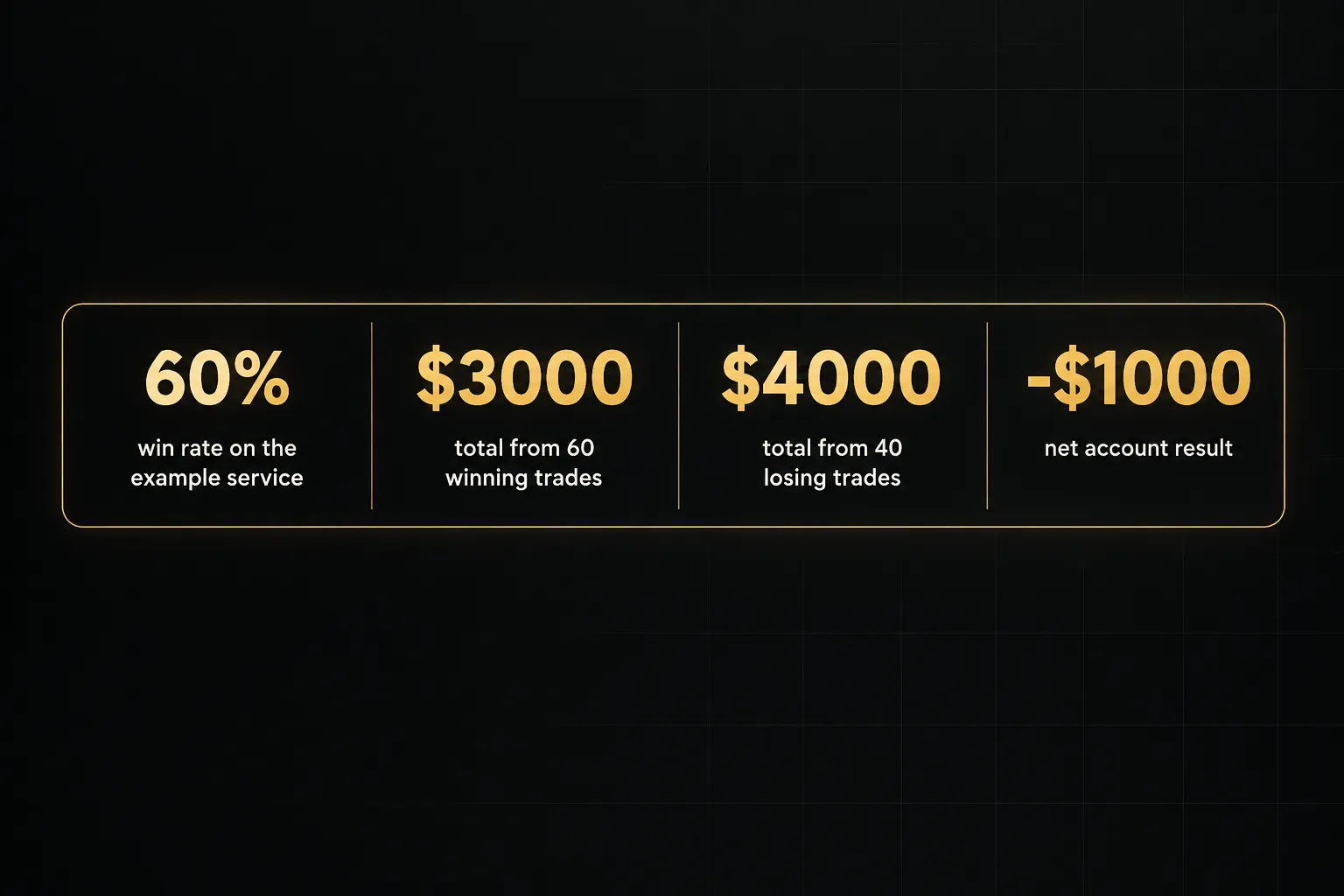
Run the numbers on a service advertising a 60% win rate.
Over 100 trades, you take 60 winners and 40 losers.
Sounds comfortable.
Now set the average win at $50 and the average loss at $100, which is exactly what happens when a provider takes profits quickly but lets losers run to a wide stop.
Winners bring in $3,000.
Losers cost $4,000.
Net result: down $1,000 on a “60% accurate” service.
Expectancy is the metric that settles the argument.
Multiply win rate by average win, subtract loss rate multiplied by average loss.
In the example above: (0.6 × $50) − (0.4 × $100) = −$10 per trade.
Negative expectancy means volume just accelerates the damage.
Flip it.
A 40% win rate with an average win of $150 and average loss of $50 gives you (0.4 × $150) − (0.6 × $50) = +$30 per trade.
Fewer wins, far better business.
Calculating Position Size and Confirming Entries
Position sizing is the one variable entirely under your control, and it’s where a free signal becomes usable or dangerous.
Start with account equity.
Say $10,000.
Apply a fixed risk percentage, conventionally 1% to 2% per trade, so 1% gives you $100 of risk.
Measure the stop-loss distance from the signal: entry 1.0850, stop 1.0825, so 25 pips.
Now apply pip value.
On a standard lot of EUR/USD, one pip is roughly $10, so a 25-pip stop risks $250 per standard lot.
Divide your $100 risk budget by $250 and you get 0.4 lots.
That’s the position.
Not the lot size the Telegram channel suggested, because they have no idea what your balance is.
Change any input and the answer changes.
A 50-pip stop on the same account halves your size to 0.2 lots.
This single calculation, done before every trade, is what separates a survivable losing streak from a margin call.
Confirmation is the other half.
Rather than copying a signal blind, run it against an independent, rules-based check.
Systems like PipTrend use a multi-timeframe confirmation table, where the same pair is assessed across several timeframes before a setup is considered valid, and keep entry logic separate from signal logic so the trigger isn’t a repainting artefact.
What makes that approach useful as a reference point is the transparency: a published results page that includes losing trades and break-evens alongside winners.
Whether you use that tool or another, the principle holds.
A second, independent opinion with visible rules beats a single anonymous alert every time.
Testing Free Signals the Right Way
Three profitable signals prove nothing.
Neither do three losers.
Random noise produces both, which is why testing needs structure and a sample size large enough to mean something.
- Set acceptance criteria before you start. Write down, in advance, the minimum win rate, average risk-to-reward ratio, and maximum drawdown you’d accept before committing live capital. Deciding afterwards is how traders talk themselves into bad services.
- Open a demo account with your intended broker. Use the same broker, same account type, and same leverage you plan to trade live. Spreads and execution differ meaningfully between brokers, and testing on a different platform invalidates the results.
- Commit to a minimum of 30 to 50 signals. Below 30, the numbers are dominated by luck. Fifty is better. If the provider posts two signals a week, that’s roughly six months of forward testing, and yes, that’s the point.
- Log every signal in a journal. Record entry time received, advertised entry price, your actual execution price, slippage in pips, stop loss, take profit, outcome, risk taken as a percentage, and a short note on market conditions. The slippage column alone will teach you more than any review.
- Include the signals you skipped. If you didn’t take a call because you were asleep or unsure, log it anyway with its hypothetical outcome. Otherwise you’re grading a test you partly wrote.
- Calculate expectancy and profit factor at the end. Not win rate alone. Divide gross profit by gross loss for profit factor, and run the expectancy formula per trade. Compare both against the criteria you set in step one.
- Start live at a quarter size. If the service passes, trade it with 0.25% risk per trade rather than 1% for the first month. Live execution introduces emotional friction that demo accounts cannot replicate.
A Demo Testing Protocol
Consistency is what makes the journal worth keeping.
Take every signal that meets the provider’s stated criteria, at the same risk percentage, with no discretionary filtering.
The moment you start picking favourites, you’re testing your judgement, not theirs.
Review weekly, but don’t act on weekly data.
Conclusions come at the end of the sample.
Why Market Conditions Matter
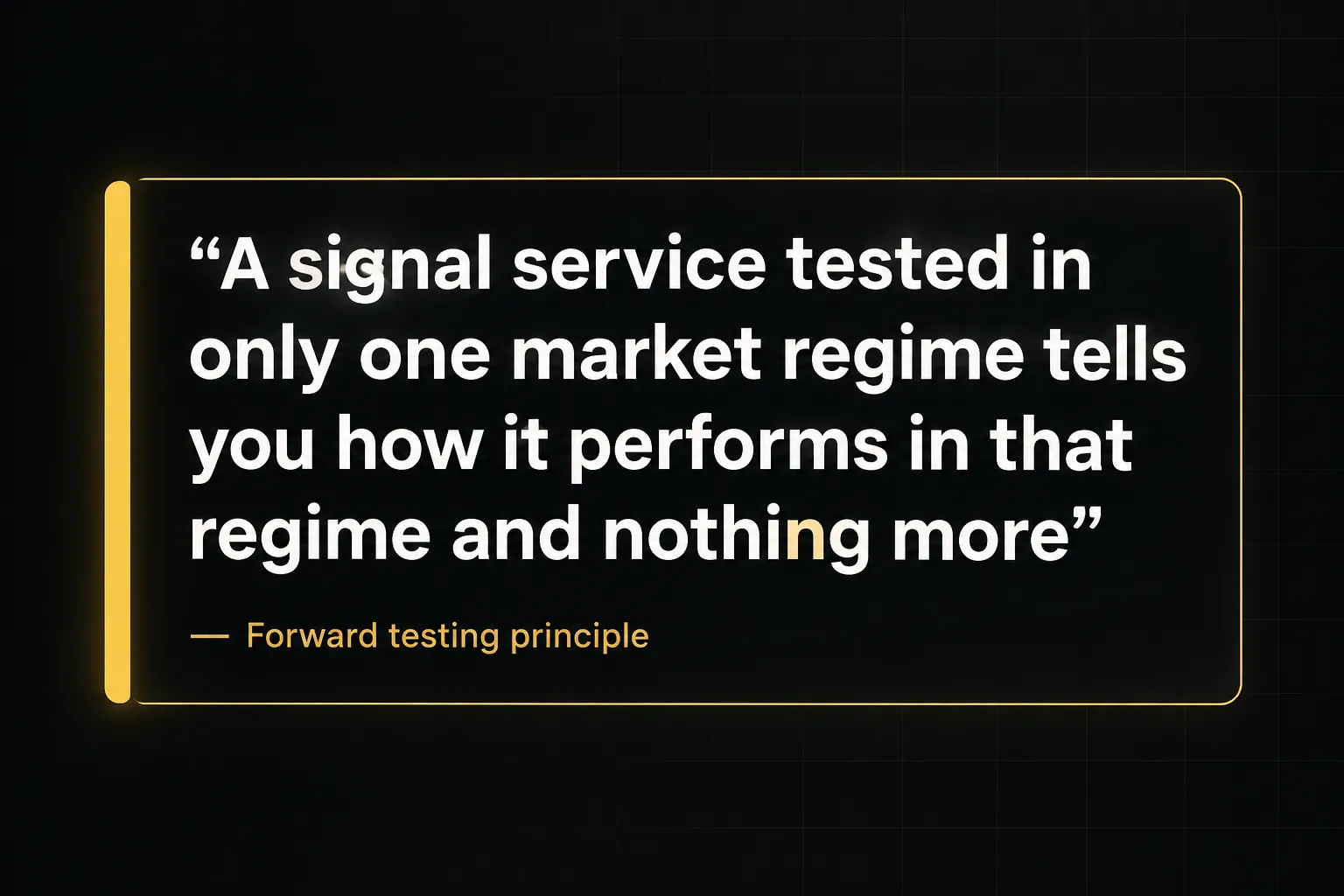
A trend-following signal service tested entirely during a strong dollar trend will look brilliant. Put the same service into a three-month range and watch it get chopped apart by false breakouts and repeated stop-outs.
Spread your test across different regimes: trending and ranging, high and low volatility, quiet summer liquidity and active autumn sessions. Note how the provider handles high-impact news, whether they pause signals around NFP and central bank decisions, or trade straight through the spread blowout.
The Behavioral Trap of Signal Dependence
Here’s the risk nobody warns beginners about.
Signals feel like they remove responsibility, and that feeling changes behaviour.
Four patterns show up repeatedly.
Overtrading, because ten alerts a day feel like ten opportunities rather than ten chances to pay the spread.
Revenge trading, where a loss prompts you to take the next call at triple size.
Abandoning mid-drawdown, quitting a statistically sound system exactly when it was due to recover.
And freelancing, entering trades that resemble the signal but ignore its actual parameters.
Each one converts a neutral or positive-expectancy system into a losing one.
The system didn’t fail.
The execution did.
Frequently Asked Questions
Are free forex signals worth it?
Free forex signals are worth it only as a learning aid and a source of trade ideas to verify independently, not as a standalone strategy.
Their value depends almost entirely on whether the provider publishes a complete, timestamped record including losses and maximum drawdown.
If you cannot audit the results, the signals have no measurable value, whatever the price.
What is the best free forex signal?
There is no single best free forex signal provider, because “best” depends on transparency and verifiable track record rather than popularity or member count.
A service with 5,000 members and a fully published results page including break-evens is more credible than one with 100,000 members and deleted losing calls.
Judge every provider against the same criteria: identifiable ownership, disclosed conflicts of interest, complete history, and forward-verifiable timestamps.
How do I get free forex signals?
Free forex signals are most commonly distributed through Telegram channels, broker platforms, trading apps, and indicator dashboards.
Broker-provided signals are often the most accountable, since the firm is regulated and its identity is public.
Whatever the channel, apply the same checks before acting: does the source publish entry price, stop loss, take profit, and timestamps, and can you track its calls forward in real time?
Can you make money with forex signals?
Yes, but only when the signals carry positive expectancy and you apply disciplined position sizing on top of them.
Profitability comes from the combination of risk-to-reward ratio, win rate, and consistent risk per trade, not from the alerts alone.
A trader risking 1% per position on a modest-edge service will outlast one risking 10% on an excellent one.
What is the success rate of forex signals?
Published win rates for forex signal services typically range from 40% to 70%, but that figure is close to meaningless in isolation.
A 45% win rate with a 1:3 risk-to-reward ratio is highly profitable, while a 70% win rate with a 1:0.3 ratio loses money steadily.
Always ask for profit factor, expectancy per trade, and maximum drawdown alongside any accuracy claim.
Are forex signals legal and safe?
Forex signals are legal in most jurisdictions, though rules vary by country and by your broker’s terms of service.
Some regulators treat personalised trade recommendations as regulated investment advice, requiring the provider to hold a licence.
Safety comes down to the provider’s identity and disclosures: a service that requests your broker login, asks you to transfer funds, or wants remote access to your trading platform should be refused without exception.
Making Signals Work for You
One decision rule cuts through almost every marketing claim you’ll encounter.
If a signal source cannot produce a complete, timestamped record that includes its losses, treat it as entertainment.
Not a trading tool.
That standard alone will filter out the large majority of free channels.
For the minority that pass, the next step isn’t a live account.
It’s 30 to 50 forward-tested signals on demo, with acceptance criteria written down in advance and every execution logged, slippage included.
Then you calculate expectancy and profit factor, compare them to your criteria, and decide with numbers instead of enthusiasm.
Position sizing stays yours throughout.
No provider knows your equity, your stop-loss distance in pips, or how much drawdown you can absorb without abandoning the plan.
And here’s the shift worth making.
The goal was never to find a perfect free signal, because it doesn’t exist.
The goal is a repeatable evaluation process, one you can apply to the next indicator, the next Telegram channel, the next expert advisor that promises something extraordinary.
Build that process and you stop needing anyone else’s certainty.
That’s the actual skill.
Risk Disclaimer: Trading involves risk. Past performance doesn't guarantee future results. Only trade with money you can afford to lose. PipTrend is a tool to assist your trading decisions, not financial advice.