
Curious why so many are diving into currency trading for beginners in 2025? The global forex market is booming, with daily trading volumes hitting an impressive $7.5 trillion. This surge has opened the door for newcomers from every background to step into the world of currency trading with confidence.
This essential guide will break down the basics, making even complex forex concepts accessible for those just starting out. You will learn how the market operates, discover key terms, and explore practical steps to set up your first account.
We will also cover risk management, beginner-friendly strategies, and the common mistakes to avoid. Whether you dream of turning a profit or simply want to understand the fundamentals, this guide offers a clear roadmap for your journey.
Ready to start your path in currency trading for beginners? Let’s unlock the potential together.
Understanding the Forex Market
The world of currency trading for beginners can seem vast and complex, but understanding the basics is the first step toward success. The forex market is where global currencies are exchanged, making it the largest and most liquid financial market. In 2025, interest in currency trading for beginners continues to grow as the market expands and becomes more accessible.

What is Forex and How Does it Work?
Forex, also known as foreign exchange, is the market where currencies are bought and sold. It plays a vital role in international trade, finance, and investment. Every day, trillions of dollars are exchanged as individuals, companies, and governments convert one currency into another.
The scale of the forex market is immense. In 2025, the daily trading volume has exceeded $9.6 trillion, according to Global FX trading volume surpasses $9.6 trillion daily. This massive liquidity is one reason currency trading for beginners is so attractive, offering countless opportunities to trade.
Forex is a decentralized, over-the-counter (OTC) market, meaning trades occur directly between parties without a central exchange. The most traded currency pairs include EUR/USD, USD/JPY, and GBP/USD. These pairs represent the exchange rates between the world's most powerful economies.
There are several ways to trade forex:
- The spot market, where currencies are exchanged instantly at current prices.
- The forward market, where contracts are set for future delivery.
- The futures market, which involves standardized contracts traded on exchanges.
Forex operates 24 hours a day, five days a week, following the sun across major financial centers. The main trading sessions are Asian, London, and New York, each offering unique opportunities.
Key participants in forex include:
| Participant | Role |
|---|---|
| Central Banks | Influence rates and monetary policy |
| Commercial Banks | Facilitate client and proprietary trades |
| Hedge Funds | Speculate for profit |
| Retail Traders | Individuals trading for themselves |
A real-world example: Imagine you travel from the US to Europe. You exchange US dollars for euros at an airport kiosk. This simple transaction is a tiny piece of the global forex market that currency trading for beginners seeks to understand.
Key Forex Terminology Every Beginner Must Know
Success in currency trading for beginners starts with mastering essential terminology. Not knowing these terms can lead to costly mistakes.
Key Terms:
- Pip: The smallest price movement in a currency pair, usually 0.0001.
- Lot: The standard trading size, often 100,000 units of the base currency.
- Leverage: Borrowed funds that allow you to control a larger position.
- Margin: The deposit required to open a leveraged trade.
- Spread: The difference between the bid and ask price.
- Bid/Ask Price: The prices at which you can sell or buy a currency.
- Base/Quote Currency: In EUR/USD, EUR is the base and USD is the quote.
- Long/Short Position: Buying (long) or selling (short) a currency pair.
Example: Calculating Pip Value
# Assume 1 lot (100,000 units) of EUR/USD, pip = 0.0001
pip_value = 100000 * 0.0001
print(pip_value) # Output: 10 USD per pip
Understanding these concepts helps currency trading for beginners to navigate the market confidently. For instance, knowing the pip value allows you to calculate potential profit or loss before placing a trade.
Terminology is the foundation. As you continue your journey in currency trading for beginners, clear knowledge of these terms will help you avoid confusion and make informed decisions.
Setting Up for Success: Platforms, Tools, and Accounts
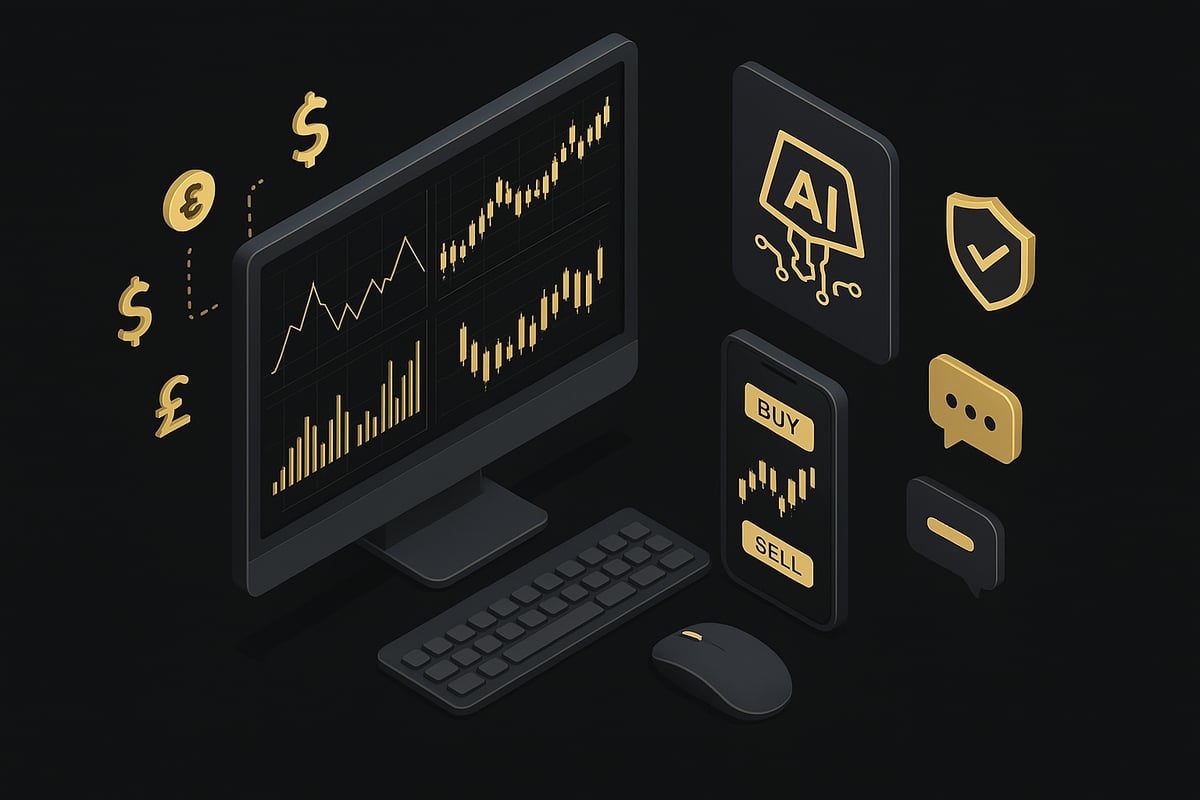
Getting started in currency trading for beginners means laying the right foundation. The right broker, platforms, and tools can make the difference between a smooth start and costly mistakes. Let us break down the essentials you need to launch your trading journey with confidence.
Choosing a Reliable Forex Broker
Selecting a trustworthy broker is the first major decision in currency trading for beginners. Always check if your broker is regulated by authorities such as the FCA, ASIC, CFTC, or CySEC. Regulation means your funds are kept in secure accounts and you have recourse if issues arise.
Brokers offer various account types:
- Demo accounts: Practice with no risk.
- Live accounts: Trade real money.
- Standard or ECN accounts: Choose based on your trading needs and fees.
Carefully review fee structures. Some brokers charge spreads, others take commissions, and overnight swaps may apply. Compare a few options in the table below:
| Broker Type | Spread | Commission | Regulation | Account Types |
|---|---|---|---|---|
| Standard | Medium | Low | FCA/ASIC | Demo/Live |
| ECN | Low | Medium | CySEC | Demo/Live |
Watch for red flags:
- Lack of regulation
- Unclear fee structures
- Poor customer support
For more foundational advice, see these Forex trading beginner tips.
Essential Trading Platforms and Tools
Your trading platform is your command center. MetaTrader 4/5, cTrader, and TradingView are popular choices for currency trading for beginners. Look for platforms offering intuitive interfaces, robust charting tools, and mobile apps for trading on the go.
Key features to prioritize:
- Charting tools: Analyze price trends and patterns.
- Order types: Market, limit, stop orders for flexible trading.
- Demo accounts: Practice in real-time conditions before risking real money.
A good platform also provides responsive support and a library of educational resources. Test several with demo accounts to find what matches your style.
The Role of AI and Trading Indicators
Artificial intelligence is changing the game in currency trading for beginners. AI-driven tools can provide automated signals, detect emerging trends, and send real-time alerts, allowing you to act quickly.
Benefits of AI-powered trading:
- Automated signals: Get buy/sell alerts without manual analysis.
- Trend detection: Spot market shifts early.
- Reduce analysis paralysis: Make decisions with confidence.
For example, an AI indicator might alert you when a major currency pair hits a key support level, helping you avoid emotional trades and stick to your plan.
How AI Tools Like PipTrend Simplify Currency Trading
Platforms like PipTrend are designed to make currency trading for beginners more accessible. PipTrend offers real-time, AI-powered buy and sell signals directly on TradingView, so you are never left guessing.
With instant alerts and multi-timeframe analysis, PipTrend helps you spot high-probability trades. Its clear interface and supportive community guide new traders, helping you avoid common mistakes. Imagine receiving a notification when EUR/USD is about to reverse, giving you the confidence to act at the right moment.
By leveraging the right broker, tools, and AI-driven platforms, currency trading for beginners becomes less daunting and more strategic. Start with a demo account, explore your options, and build your skills step by step.
Core Concepts: Price Action, Technical & Fundamental Analysis
Navigating the world of currency trading for beginners starts with understanding what actually moves the market. Price action, technical analysis, and fundamental analysis form the backbone of every successful trading approach. Mastering these concepts will empower you to interpret market signals, make informed decisions, and manage risk effectively.

Understanding Price Movements in Currency Trading
Price movements in currency trading for beginners are primarily driven by the balance between supply and demand. When demand for a currency rises, its value climbs against others. Conversely, oversupply or reduced demand causes prices to fall.
Macroeconomic factors play a crucial role too. Central bank interest rate changes, inflation data, and GDP growth reports often trigger significant shifts. For example, when the US Federal Reserve announces an interest rate hike, the USD typically strengthens against other currencies.
Market sentiment is another key driver. Traders’ collective emotions and expectations can fuel trends or reversals. Major news releases—such as nonfarm payrolls (NFP) or consumer price index (CPI) data—often spark rapid price changes. Imagine the EUR/USD pair suddenly surging after a positive eurozone economic report. Understanding these forces is vital for currency trading for beginners, as it sets the stage for effective analysis and strategy development.
Technical Analysis Basics for Beginners
Technical analysis is the study of historical price movements to forecast future trends. For those new to currency trading for beginners, it starts with reading candlestick charts, which visualize price action over specific periods. Each candlestick shows the open, high, low, and close prices, revealing patterns and market psychology.
Key chart patterns, such as head and shoulders, double tops and bottoms, and triangles, help traders spot potential reversals or continuations. Support and resistance levels indicate where prices may pause or reverse. Beginners should also familiarize themselves with essential indicators like moving averages, RSI, and MACD. For a comprehensive overview, Key trading indicators overview provides clear explanations of these tools and how to use them.
For example, spotting a bullish reversal might involve identifying a double bottom pattern near a strong support zone, confirmed by a rising RSI. Integrating these elements gives currency trading for beginners a practical edge.
Fundamental Analysis in Forex
Fundamental analysis focuses on the economic and political factors influencing currency values. For currency trading for beginners, monitoring economic calendars is a must. Key indicators include GDP growth, unemployment rates, inflation figures, and central bank decisions.
Traders analyze how these data points might impact specific currency pairs. For instance, if US unemployment falls sharply, the USD may rise against the JPY. News events like central bank speeches or unexpected policy changes can create volatility, offering both risk and opportunity.
Understanding how to interpret these events helps beginners identify potential trade setups. Imagine trading USD/JPY around a Federal Reserve meeting, where an interest rate hike could strengthen the dollar. Staying informed and reacting appropriately is crucial in currency trading for beginners.
Combining Technical and Fundamental Analysis
The most successful strategies in currency trading for beginners blend both technical and fundamental analysis. While technical tools reveal entry and exit points, fundamental analysis provides context for broader market moves.
Building a trading plan that incorporates both approaches ensures a balanced perspective. For example, a trader might wait for a bullish technical pattern on GBP/USD, then confirm the setup with positive UK economic data. This dual approach filters out low-probability trades and enhances decision-making.
By combining technical signals with economic insights, currency trading for beginners becomes more structured and less reliant on guesswork. The synergy of these methods lays a solid foundation for consistent progress in the forex market.
Step-by-Step: How to Start Currency Trading in 2025
Starting your journey in currency trading for beginners can feel overwhelming, but breaking it into clear steps makes it manageable. This roadmap will walk you through each necessary phase, from defining your goals to executing your first live trade and reviewing your progress. By following this structure, you'll build confidence and reduce costly mistakes as you enter the world of currency trading for beginners.

Step 1: Define Your Trading Goals and Style
Every successful journey in currency trading for beginners starts with clear, realistic goals. Ask yourself: Are you looking for short-term gains, long-term growth, or a mix of both? Your trading style should align with your personality and time commitment.
For example, day trading suits those who thrive in fast-paced environments and can monitor markets closely. Swing trading is ideal if you prefer holding positions for several days, while position trading works best for those with a long-term outlook.
| Trading Style | Typical Holding Period | Suitable For |
|---|---|---|
| Day Trading | Minutes to hours | Active, detail-oriented |
| Swing Trading | Days to weeks | Patient, analytical |
| Position Trading | Weeks to months | Strategic, long-term |
Set realistic profit expectations. Avoid the trap of expecting overnight wealth. Instead, focus on consistent improvement and gradual growth, which is the cornerstone of currency trading for beginners.
Step 2: Open and Fund a Trading Account
Once you have set your goals, the next step in currency trading for beginners is opening a trading account. Choose a reputable broker that matches your needs. Prepare the required documents, such as identification and proof of address, for the Know Your Customer (KYC) process.
Funding options typically include bank transfers, credit cards, and e-wallets. Start with an amount you can afford to lose, as this reduces emotional pressure. Before risking real money, open a demo account to familiarize yourself with the trading platform and execute practice trades.
Step 3: Build a Trading Plan
A solid trading plan is vital for currency trading for beginners. This blueprint should outline your entry and exit rules, position sizing, risk limits, and criteria for trade selection. A trading journal is equally important, as it helps you track progress and learn from each trade.
Consider including price action strategies in your plan, as these are proven to help beginners understand market movements. You can find more about Understanding price action trading to enhance your approach.
Here is a simple sample trading plan:
- Trade only EUR/USD and GBP/USD
- Risk no more than 1% of account per trade
- Enter trades on clear support/resistance levels
- Use a 2:1 reward/risk ratio
- Journal every trade with screenshots and notes
Step 4: Practice with Demo Trading
Practicing in a demo environment is essential in currency trading for beginners. Demo accounts allow you to simulate live market conditions without risking real funds. Use this time to refine your trading plan, test different strategies, and get comfortable with the platform’s features.
Track your performance over several weeks and adjust your approach as needed. Most experts recommend demo trading until you can achieve consistent results and fully understand how to manage risk.
Step 5: Execute Your First Live Trade
Transitioning from a demo to a live account is a major milestone in currency trading for beginners. When you are ready, place your first real trade using market or pending orders, following the rules you practiced.
Monitor your open positions carefully, and avoid making impulsive decisions based on emotions. Stick to your trading plan, and remember that discipline is more important than chasing quick profits.
Step 6: Review and Optimize
Continuous improvement is the secret to long-term success in currency trading for beginners. After each trade or trading session, review your results. Analyze both winning and losing trades to identify patterns and areas for improvement.
Adjust your strategies based on performance data. Over time, this iterative approach will help you develop a process that works for your goals and risk tolerance. Celebrate small wins and use setbacks as learning opportunities.
Risk Management and Psychology for Beginners
Starting your journey in currency trading for beginners means understanding that risk is an ever-present companion in the forex market. Every successful trader prioritizes managing risk before chasing profits. By mastering both risk management and trading psychology, you set a strong foundation for sustainable growth and long-term success.
The Importance of Risk Management in Forex
Risk management is the single most important skill for anyone pursuing currency trading for beginners. According to US Forex Trading Statistics 2025, over 70% of retail traders lose money, largely because they ignore proper risk controls. This reality underscores why learning how to protect your capital matters far more than winning any individual trade.
A key tool in risk management is the stop-loss order, which automatically closes your trade if the market moves against you. Pair this with take-profit orders to lock in gains. Always plan your risk/reward ratio before entering a trade. For example:
| Trade Size | Stop-Loss | Take-Profit | Risk/Reward Ratio |
|---|---|---|---|
| $1000 | $20 | $60 | 1:3 |
| $1000 | $50 | $50 | 1:1 |
Never risk more than 1-2% of your trading account on a single trade. This approach helps prevent emotional decisions and protects you from account blow-up.
Mastering Trading Psychology
Trading psychology is a crucial pillar in currency trading for beginners. Emotional reactions like fear, greed, and revenge trading can undermine even the best strategies. When a trade goes against you, it is tempting to double down or chase losses, but this mindset often leads to bigger setbacks.
Discipline and patience are your greatest allies. Develop routines to manage stress, such as taking breaks or stepping away after a tough session. Techniques like deep breathing and journaling can help you stay objective.
Remember, losses are part of the process. The best traders learn from setbacks and avoid letting emotions dictate their next move. If you find yourself overwhelmed, pause and review your plan before trading again.
Avoiding the Most Common Beginner Mistakes
Many pitfalls await in currency trading for beginners, but awareness is your best defense. Some of the most frequent mistakes include:
- Overleveraging your account, which magnifies both gains and losses.
- Chasing losses after a losing trade, leading to impulsive decisions.
- Ignoring your trading plan and trading based on gut feeling.
- Entering trades without a clear exit strategy.
Real-world stories abound of traders who blew up their accounts by ignoring these basics. For instance, one beginner turned a small loss into a major setback by refusing to use stop-loss orders and increasing trade size to recover quickly.
To avoid these traps, always keep your risk per trade small, stick to your plan, and review every trade for lessons learned.
Developing a Growth Mindset
Adopting a growth mindset is essential for anyone interested in currency trading for beginners. The forex market constantly evolves, and so should your skills. Treat every mistake as a learning opportunity instead of a failure.
Here are some proven steps to foster growth:
- Commit to continuous learning through courses, books, and reputable trading communities.
- Set realistic milestones and celebrate small wins.
- Use a trading journal to track progress and identify patterns.
- Seek mentorship or peer support to stay accountable.
By focusing on improvement rather than perfection, you will build resilience and adaptability. Remember, success in currency trading for beginners is a journey, not a destination.
Proven Beginner Strategies and Tips for 2025
Starting your journey with currency trading for beginners can seem overwhelming. However, with clear strategies and the right mindset, you can navigate the forex market confidently. Below, we break down proven approaches, compare trading styles, and provide essential resources to help you thrive in 2025.
Simple Forex Trading Strategies That Work
For anyone starting with currency trading for beginners, simplicity is key. Proven strategies help you build confidence and avoid costly mistakes. The most accessible methods include trend-following, breakout trading, and using moving averages.
- Trend-following: Identify the prevailing market direction and trade with the trend.
- Breakout trading: Enter positions when price breaks key support or resistance.
- Moving average crossovers: Use two averages to spot buy/sell signals.
A classic example is the 50/200 EMA crossover:
# Example: Simple EMA Crossover Strategy
if EMA50 crosses above EMA200:
 signal = "Buy"
elif EMA50 crosses below EMA200:
 signal = "Sell"
This approach allows currency trading for beginners to catch major moves while reducing noise. By sticking to these foundational strategies, you lay the groundwork for consistent progress.
Scalping vs. Swing Trading: Pros and Cons
Choosing the right trading style is crucial for currency trading for beginners. The two most popular approaches are scalping and swing trading. Each has distinct characteristics:
| Feature | Scalping | Swing Trading |
|---|---|---|
| Trade Volume | High | Moderate |
| Time Frame | Seconds–Minutes | Hours–Days |
| Risk Level | Higher per trade | Lower per trade |
| Stress Level | Intense | Moderate |
Scalping involves many quick trades for small profits, ideal for those who thrive in fast-paced environments. Swing trading focuses on holding trades longer, capturing larger moves and suiting those with more patience. In 2024, many beginners found swing trading easier to manage alongside daily responsibilities, making it a strong option for currency trading for beginners.
Tools and Resources for Continuous Improvement
Success in currency trading for beginners depends on ongoing education and self-assessment. Leverage the following resources:
- Top websites: BabyPips, Investopedia, ForexFactory
- Online courses: Udemy, Coursera, official broker academies
- YouTube channels: No Nonsense Forex, Trading 212
- Trading journals: Use Excel, Notion, or specialized apps to track trades
- Communities: Join forums and Discord groups for support
Maintaining a detailed trading journal helps you identify patterns and refine your strategy. Staying active in trading communities provides accountability and valuable feedback for currency trading for beginners.
Staying Ahead: Adapting to Market Changes in 2025
The forex market is evolving rapidly, and currency trading for beginners must keep pace. AI, automation, and tighter regulations are reshaping how trades are executed and analyzed. Automated tools now offer instant trade signals and advanced analytics, making decision-making easier.
For example, AI tools in forex trading can help you spot trends, manage risk, and adapt strategies to changing conditions. In 2024, traders who embraced these innovations were able to respond quickly to volatility and capitalize on new opportunities. Staying adaptable ensures you remain competitive in the ever-changing forex landscape.
Final Tips for Beginner Currency Traders
To excel at currency trading for beginners, focus on a few essential principles:
- Start with small positions and scale up as your confidence grows
- Prioritize process and discipline over chasing profits
- Keep learning through courses, books, and market analysis
- Always stick to your trading plan and review your results
Patience and consistency are your greatest allies. By applying these strategies and tips, you set the stage for lasting success in currency trading for beginners.
Now that you have a clear understanding of how the forex market works, the essential terminology, and practical steps to get started, taking that first confident step is easier than ever. With advanced tools like PipTrend, you no longer have to second guess your trades or feel overwhelmed by market analysis. PipTrend’s real-time AI signals and user-friendly interface are designed specifically to help beginners like you make smarter decisions and avoid common pitfalls. If you’re ready to put your new knowledge into action and start trading with more clarity and confidence, Start Catching Winning Trades, Right Now!