
Intraday trading in 2026 demands more than just quick reactions. With markets moving at lightning speed, precision and timing can mean the difference between profit and loss.
This article unveils the best indicator for intraday strategies, offering proven tools to help traders boost profits and control risk in today’s fast-paced financial environment.
You will discover seven essential indicators, each chosen for their adaptability and effectiveness. Whether you are new to trading or a seasoned professional, these insights will help you stay ahead of evolving market challenges.
Curious how top traders navigate volatility and uncertainty? Explore the strategies and indicators shaping successful intraday trading in 2026.
Understanding Intraday Trading in 2026
Intraday trading has become a dominant force in global financial markets, attracting traders of all backgrounds. This approach involves buying and selling financial instruments within the same trading day, aiming to capitalize on short-term price movements. Its popularity has surged in recent years, driven by technological advancements, tighter spreads, and the pursuit of rapid returns.
As we approach 2026, the landscape of intraday trading faces unprecedented challenges. Volatility has intensified due to global economic shifts and geopolitical events. Algorithmic trading now accounts for over 80% of intraday order flow, making markets more efficient but also less predictable. Tighter spreads and faster price movements demand that traders react quickly, often within seconds.
To succeed, traders must rely on the best indicator for intraday strategies that can manage risk and pinpoint high-probability trade setups. Technical indicators serve as essential tools, helping filter market noise and identify actionable signals. The integration of artificial intelligence has further revolutionized this space, as highlighted in the AI Trading Indicators Guide, enabling traders to process vast data in real time and adapt to evolving conditions.
Trader behavior is also evolving rapidly. Automation and machine learning have streamlined decision-making, while new regulations are reshaping market access and transparency. Many traders now combine discretionary insight with automated systems, using the best indicator for intraday to stay competitive and compliant. This shift has led to more disciplined trading plans and improved risk control.
Let’s consider real-world examples. Successful intraday traders often use a blend of indicators to confirm trends, time entries, and manage exits. For instance, a trader might use a momentum oscillator to spot potential reversals, then validate the signal with a volume-based indicator before executing a trade. On average, intraday holding times have shrunk to mere minutes, and the ability to react to headline news within seconds is crucial. Studies show that traders leveraging AI-powered indicators achieve a 15% higher consistency rate in trade outcomes compared to those using traditional methods.
The current trading environment demands adaptive, data-driven strategies. With the best indicator for intraday, both new and experienced traders can navigate market complexities, minimize risk, and seize profitable opportunities. Staying informed and embracing innovation is now essential for ongoing success in intraday trading.
How to Choose the Best Intraday Indicators
Selecting the best indicator for intraday trading is a critical step for anyone aiming to navigate fast-moving markets with confidence. With so many tools available, it is vital to focus on those that combine accuracy and speed. The right indicators can make the difference between a profitable session and costly mistakes.
What Makes the Best Indicator for Intraday Trading?
When evaluating the best indicator for intraday strategies, focus on key criteria:
- Reliability: Choose indicators with a proven track record in live markets.
- Responsiveness: Select tools that react quickly to price changes for timely signals.
- Ease of Use: Opt for user-friendly interfaces and clear visual cues.
- Compatibility: Ensure the indicator works across stocks, forex, crypto, and indices.
Combining these factors helps ensure you pick the best indicator for intraday use, tailored to your trading style and asset preferences.
Combining Indicators for Stronger Signals
Relying on a single tool often leads to missed opportunities or false signals. The best indicator for intraday trading is usually part of a toolkit, blending leading indicators (which predict moves) with lagging indicators (which confirm trends).
For example, pairing a momentum tool like RSI with a volume-based measure such as VWAP can improve decision-making. Multi-timeframe analysis further increases your edge by aligning signals across different chart intervals.
Testing and Adapting Your Tools
Proper testing is essential before committing to any best indicator for intraday use. Backtesting on historical data reveals how an indicator would have performed under various conditions. Forward testing in real time helps confirm its effectiveness.
Multi-timeframe analysis is key for higher probability trades. By cross-checking signals on the 5-minute, 15-minute, and hourly charts, you reduce noise and spot genuine opportunities.
Avoiding Common Mistakes
Traders often fall into these traps when searching for the best indicator for intraday strategies:
- Using too many indicators, leading to confusion and analysis paralysis.
- Ignoring the unique characteristics of each asset class.
- Overlooking the importance of adapting settings to current volatility.
- Failing to backtest or forward test before trading live.
To explore a wider range of tools and ensure you are not missing out on valuable options, consider reviewing this Comprehensive Trading Indicators List.
Choosing the best indicator for intraday trading is not about finding a single magic solution. It is about building a balanced toolkit, rigorously testing your choices, and staying adaptable as markets evolve.
7 Best Indicators for Intraday Strategies to Use in 2026
Navigating the fast-paced world of intraday trading in 2026 requires more than just intuition. Traders need tools that deliver clarity, speed, and adaptability. The best indicator for intraday strategies is not just about popularity, but about providing actionable insights in real time.
This section explores the seven best indicator for intraday trading success in 2026. Each one has been selected for its reliability, ease of use, and proven results across a variety of markets. Whether you are a beginner or a seasoned trader, leveraging the right indicators can make all the difference in maximizing profits and minimizing risks.
Below, you will find a detailed breakdown of each indicator, including their unique features, ideal use cases, and practical pros and cons. Use this guide to discover which best indicator for intraday approach aligns with your trading style and goals.
1. PipTrend AI Trading Indicator
The PipTrend AI Trading Indicator represents a new era of precision in the best indicator for intraday strategies. Built on advanced AI technology, it delivers real-time buy and sell signals across forex, stocks, crypto, and indices. Its intelligent algorithms adapt to changing market conditions, allowing traders to stay ahead of sudden price swings.
A standout feature is the multi-timeframe trend analysis table. This makes it easier to pinpoint high-probability entries, ensuring that your best indicator for intraday decisions are always data-driven. With instant alerts and customizable notifications, traders can act quickly and never miss an opportunity.
The platform is designed for simplicity. Even those new to intraday trading can easily set up the indicator and interpret its visual cues. Lifetime updates, an active trading community, and 24/7 support further enhance the experience.
Pricing Table:
| Plan | Price | Features |
|---|---|---|
| Monthly | $59.99 | All markets, AI signals |
| Quarterly | $134.99 | Free trial, refund policy |
| Yearly | $479.99 | Lifetime updates, support |
Ideal for: Retail traders, day and swing traders, busy professionals, and anyone using TradingView.
Pros:
- Eliminates guesswork with AI logic
- Universal compatibility with major markets
- Risk-free trial available
Cons:
- Requires TradingView account
- Subscription-based pricing
With its seamless blend of automation and user control, the PipTrend AI Trading Indicator stands out as a best indicator for intraday trading in 2026.
2. Relative Strength Index (RSI)
The Relative Strength Index is a cornerstone among the best indicator for intraday traders. This momentum oscillator measures the speed and change of price movements, identifying overbought and oversold conditions for rapid decision-making. RSI works across stocks, forex, and crypto, making it versatile for any intraday setup.
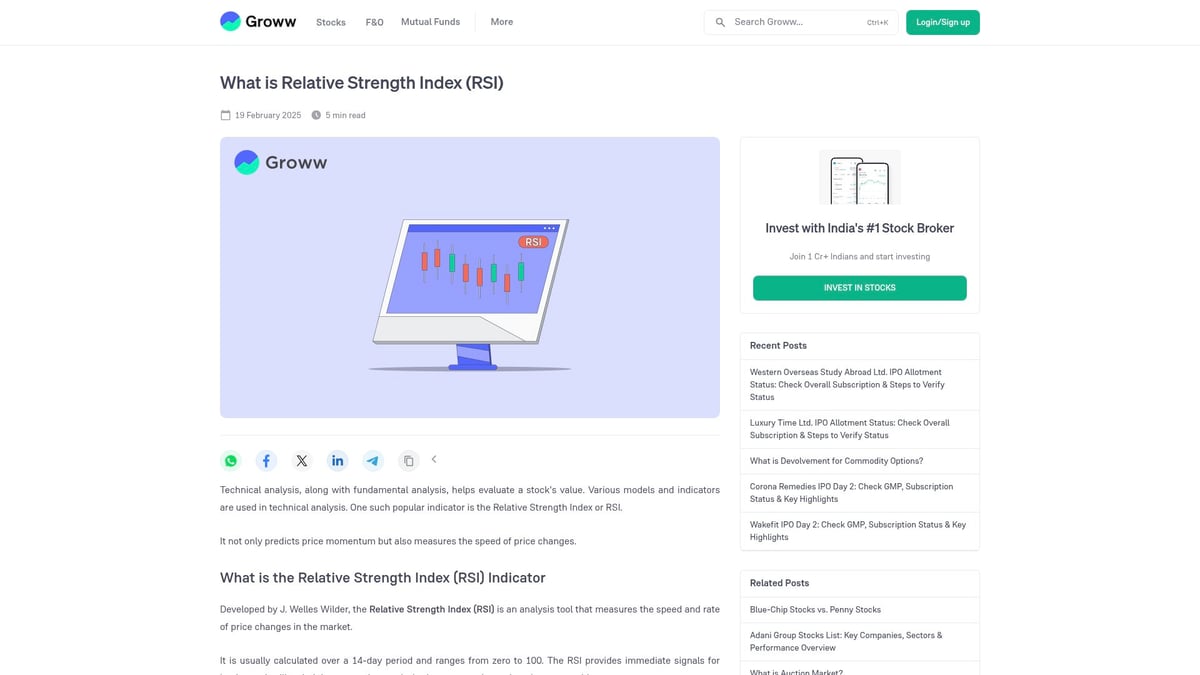
Standard RSI thresholds are 70 (overbought) and 30 (oversold). When the indicator crosses these levels, traders can anticipate potential reversals or momentum shifts. Its straightforward interpretation makes it a favorite for both beginners and experts.
RSI is particularly effective in volatile markets. However, it can sometimes generate false signals during strong trends, so pairing it with other tools is recommended for the best indicator for intraday results.
Ideal for: Traders seeking quick momentum shifts and reversal signals.
Pros:
- Simple to use and widely supported
- Reliable in fast-moving markets
Cons:
- False signals possible in trending markets
- Works best with confirmation from other indicators
For readers seeking a deeper dive into practical applications, the RSI Indicator for Intraday guide provides actionable strategies and tips for maximizing RSI’s effectiveness.
3. Bollinger Bands
Bollinger Bands offer a visual approach to understanding price volatility, making them a top contender for the best indicator for intraday strategies. These bands expand and contract based on market volatility, helping traders identify breakout and breakdown opportunities.
When price touches the upper or lower band, it often signals overextension, hinting at potential reversals or volatility spikes. This makes Bollinger Bands ideal for mean reversion and breakout strategies, especially in rapidly moving intraday markets.
The indicator adapts to different assets, from stocks to forex and crypto, providing clear visual cues for entry and exit points. However, during periods of rapid price movement, Bollinger Bands may lag, so confirmation from other indicators is essential for the best indicator for intraday precision.
Ideal for: Traders exploiting volatility spikes and range-bound conditions.
Pros:
- Adapts to evolving market conditions
- Supports multiple asset classes
Cons:
- May lag in fast markets
- Requires additional confirmation
By integrating Bollinger Bands with other tools, traders can create robust, adaptable intraday strategies.
4. Moving Average Convergence Divergence (MACD)
MACD is a trend-following momentum indicator that ranks high as a best indicator for intraday trading. It uses two moving averages—the fast and slow EMA—to spot changes in trend direction and momentum. MACD crossovers and histogram divergence provide clear signals for entering and exiting trades.
 Moving Average Convergence Divergence (MACD)" />
This indicator excels in both trending and consolidating markets. When the MACD line crosses above the signal line, it signals a potential bullish move. Conversely, a downward crossover may indicate a bearish trend. Traders use MACD to confirm the strength of a move and avoid entering at the wrong time.
Ideal for: Trend-followers and those seeking confirmation of other signals.
Pros:
- Versatile in different market conditions
- Effective for spotting trend shifts
Cons:
- Can lag in choppy or sideways markets
- Requires parameter tuning for each asset
For the best indicator for intraday strategies, many traders combine MACD with other momentum or volume-based indicators to improve accuracy and reduce false signals.
5. Volume Weighted Average Price (VWAP)
VWAP is a favorite among professionals looking for the best indicator for intraday guidance. By blending price and volume data, VWAP reveals the average price at which an asset has traded throughout the day. This helps traders gauge whether current prices are above or below fair value.
Institutional traders often use VWAP as a benchmark, making it highly respected on trading floors. For intraday traders, VWAP acts as a dynamic support or resistance level, guiding entries and exits with precision.
VWAP is particularly effective during regular market hours and for liquid assets. However, its usefulness diminishes in illiquid markets or outside main trading sessions.
Ideal for: Scalpers and day traders seeking high-probability setups.
Pros:
- Anchored to real trading volume
- Reduces noise and false signals
Cons:
- Less effective for illiquid assets
- Limited utility outside market hours
Incorporating VWAP into an intraday trading plan can greatly enhance decision-making and align your trades with institutional flows, making it a leading best indicator for intraday use.
6. Intraday Momentum Index (IMI)
The Intraday Momentum Index (IMI) fuses the strengths of RSI and candlestick analysis into a single, responsive tool. It is tailored for the best indicator for intraday traders who need fast, actionable signals during a single trading session. IMI excels at pinpointing overbought or oversold conditions within intraday timeframes.
By analyzing both price momentum and intraday candlestick patterns, IMI helps traders spot rapid momentum shifts and capitalize on short-duration opportunities. This makes it especially useful for high-frequency and short-term trades.
IMI is easy to interpret, but its effectiveness can diminish in low-volatility periods. For optimal results, pair it with trend filters or volume indicators to confirm signals and avoid whipsaws.
Ideal for: Intraday traders seeking precision entries in volatile markets.
Pros:
- Highly responsive to price action
- Captures rapid momentum changes
Cons:
- Less effective in quiet markets
- Best used with additional filters
With its blend of speed and clarity, IMI is a valuable addition to any best indicator for intraday toolkit.
7. Supertrend Indicator
The Supertrend Indicator is a straightforward, trend-following tool that generates clear buy and sell signals. It adjusts dynamically to volatility and price movement, making it a strong candidate for the best indicator for intraday strategies.
Supertrend’s visual cues are simple: green for bullish trends and red for bearish. This instant feedback helps traders make quick decisions without second-guessing. The indicator works across all timeframes and asset classes, providing consistent guidance.
While Supertrend is easy to implement, it can produce whipsaws in sideways or range-bound markets. Fine-tuning its parameters is key to avoiding false signals and enhancing its reliability.
Ideal for: Traders looking to ride strong intraday trends with minimal lag.
Pros:
- Reduces subjectivity in decision-making
- Effective across various markets
Cons:
- Prone to whipsaws in choppy conditions
- Requires parameter adjustment
By integrating Supertrend with other indicators, traders can create a well-rounded best indicator for intraday strategy that adapts to shifting market dynamics.
Integrating Multiple Indicators for Intraday Success
Combining more than one indicator is a game changer for those seeking the best indicator for intraday results. Relying on a single tool often leaves gaps in your trading plan, but integrating multiple indicators helps fill those gaps and increases your probability of success. Each indicator reveals a different market aspect, so blending them provides a fuller, more reliable picture of price action.
Why Combine Multiple Indicators?
No single tool can truly be the best indicator for intraday trading because markets are multi-dimensional. Trend indicators show direction, momentum tools gauge speed, and volume-based indicators capture participation. By blending these, you filter out noise and avoid chasing false signals. For example, pairing a trend indicator with a momentum oscillator helps confirm if a breakout is genuine or just a temporary spike.
Traders often face conflicting signals, especially during fast market moves. Integrating indicators reduces this risk by requiring agreement before taking action. This approach helps prevent impulsive trades and supports more disciplined decision-making.
Proven Multi-Indicator Strategies
Some of the most effective intraday setups rely on combining complementary indicators. A classic example is using RSI to spot potential reversals and confirming trades with the Using VWAP for Day Trading indicator to align with institutional price levels. Another popular method is blending MACD with the Supertrend indicator, which allows traders to capture trend shifts while filtering out minor whipsaws.
Below is a quick comparison of popular multi-indicator pairings:
| Strategy | Purpose | Example Pairing |
|---|---|---|
| Momentum + Volume | Confirm strength of moves | RSI + VWAP |
| Trend + Volatility | Filter trends and avoid choppy periods | MACD + Bollinger Bands |
| Trend + Trailing Stop | Ride trends, protect profits | Supertrend + Parabolic SAR |
For a deeper dive into how these tools work together, see Best Technical Indicators for Intraday Trading, which reviews their practical applications.
Workflow: From Signal to Execution
A disciplined workflow is essential when using more than one tool, even if you believe you have the best indicator for intraday trades. Start by identifying the market context with a trend or volume indicator. Wait for confirmation from a momentum or volatility tool before entering the trade. Use a third indicator to refine your exit or set stop-loss levels, ensuring each step is supported by clear, actionable signals.
For example, a trader might notice VWAP acting as intraday support, confirm momentum with RSI, and then use Supertrend for the exit signal. This layered approach increases consistency and helps avoid common mistakes like signal chasing or overtrading.
Automation and Optimization
With the rise of AI and algorithmic platforms, integrating multiple indicators is more accessible than ever. Automated systems can scan for confluence across several tools, alerting you when the best indicator for intraday setups aligns. Backtesting different combinations on historical data reveals which setups deliver consistent results for your strategy and asset class.
Always keep your system simple enough to avoid overfitting. Regularly review performance and tweak parameters as market conditions change. This adaptive, data-driven mindset is crucial for long-term success in modern intraday trading.
Common Mistakes to Avoid with Intraday Indicators
Precision is essential when using the best indicator for intraday trading. Yet, even experienced traders can fall into common traps that reduce effectiveness and increase risk. Understanding these pitfalls—and how to avoid them—will help you unlock the full potential of your chosen tools.
Common Pitfalls with Intraday Indicators
One of the most frequent errors is relying solely on a single tool, assuming it is the best indicator for intraday decisions. No indicator is flawless in every market condition. Without confirmation from other sources, you risk acting on false signals.
Ignoring the broader market context—such as breaking news, sudden volume spikes, or macroeconomic events—can also lead to costly mistakes. Even the best indicator for intraday strategies can be undermined by unexpected events. For a deeper understanding of how risk management and regulation impact intraday trading, explore this guide on Technical Analysis for U.S. Stock Markets 2026.
Ignoring Market Context and Adaptability
Failing to adjust indicator settings to match current volatility or the specific asset class can make signals unreliable. Markets in 2026 are more dynamic, with rapid shifts that demand flexible approaches. Always review and recalibrate your indicators regularly.
Chasing signals during periods of low liquidity or around major economic releases is another common pitfall. Liquidity dries up, spreads widen, and even the best indicator for intraday analysis can give erratic signals. Patience and discipline are key. Avoid trading when conditions are abnormal or unpredictable.
Risk management is often overlooked. Neglecting stop-loss placement or trading without a clear exit strategy exposes your capital to unnecessary losses. Always define your risk parameters before entering any trade.
Avoiding Analysis Paralysis and Achieving Clarity
Using too many indicators at once can create conflicting signals, leading to analysis paralysis. Instead, focus on a concise set of tools that complement each other. Look for indicators that provide clear, actionable signals rather than redundant information.
To avoid these pitfalls:
- Always confirm signals with more than one indicator.
- Stay informed about market events and news.
- Adjust your tools to fit current conditions.
- Implement strict risk management and stop-losses.
- Limit your dashboard to essential indicators.
By steering clear of these mistakes, you can maximize the value of the best indicator for intraday strategies and trade with greater confidence.
After exploring the most effective intraday indicators for 2026, it’s clear that success comes down to having the right tools for precision, speed, and confidence in your trades. If you’re ready to simplify your decision-making, reduce guesswork, and take advantage of real-time AI-powered signals, now is the perfect time to elevate your strategy. You deserve an edge that adapts to today’s fast-paced markets—so why not experience what smarter, data-driven trading can do for you?
Try Risk Free